Van's Air Force

The definitive Van's Aircraft support community! Buying, building or flying an RV? Join our exclusive family of mentors and enthusiasts!

WIX filter alert

scsmith

Well Known Member
Sponsor
Advertiser
Back when DanH did the oil filter testing, and at about the same time, the cost of Champion and Tempest filters went through the roof, I went looking for what I thought would be the closest equivalent WIX filter, and I found the 51624 filter, which is actually intended as a hydraulic transmission filter, but has very similar specs to the aircraft filters.

So I removed my Tempest 48108 filter and replaced it with a WIX 51624.
That was 30 flight hrs ago.

Today I changed my oil, and cut open the filter. I should have taken a picture. The WIX filter collapsed. The collapse bent and twisted the metal end plates on the filter element, so I imagine it has been just bypassing oil all this time. (glad it was only 30 hrs).
Oh, by the way in case someone asks, the oil is Phillips Victory 20-50.

So...I put a Tempest 48108 filter back on. The price of that particular WIX filter has increased to match the price of the Tempest filter anyway.

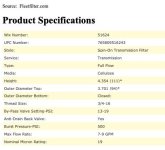
Here is the spec sheet on the WIX 51624 filter:
WIX 51624 specs.jpg
So it looks like the burst pressure and the bypass valve pressure setting are very similar to the Tempest 48108. I'm wondering if it was defective and the bypass valve didn't function correctly?
I suppose it could be some other failure, such as the Vernatherm stuck closed. But it's too coincidental that it happened to the WIX filter. So I'm not going to look any further unless the next filter fails too.
 
Thanks for the report. Funny that people have been running the Wix 51515, 51068 and similar “lower rated” burst pressure automotive filters for decades with no reports of issues. I have recently done some “specification shopping” myself and switched away from the 51068 to the higher burst pressure 51647 with no issues so far. That said, the 51647 is an “oil” filter - specified for heavy duty truck Diesel motor oil - so perhaps the filter element in your lower viscosity hydraulic filter was more prone to collapse. Maybe canister burst pressure is not the only thing to worry about?

Are you willing/able to do a forensic assessment of the failed media and perforated inner tube compared to the Tempest? Would be nice to see if there is a difference in the physical properties between a filter rated for motor oil vs. hydraulic oil.
 
Last edited:
- so perhaps the filter element in your lower viscosity hydraulic filter was more prone to collapse.
This was my thinking when I saw the post. ATF is typically 20 weight; Some of the modern LV stuff even thinner. Your aviation oil is 50 weight or 20W50. A pretty substantial difference. Very possible they use a more restrictive element for trans filters than seen in engine oil applications. That could account for the collapsing, especially if that filter was specified for a trans using LV ATF. I believe the stated flow rating would be based upon the fluid it was designed for.
 
Last edited:
I have used WIX 51085XP multiple times, no issues have been observed. When opening the filter to examine it, the filter media was in perfect and normal shape. The burst pressure of this is listed as 340 PSI vs 275 for the 51068
 
Last edited:
IO-540-K1B5 Engine, no problems up to now.
 

Attachments

  • Screenshot 2025-12-25 at 10.06.06 AM.png
    Screenshot 2025-12-25 at 10.06.06 AM.png
    2.6 MB · Views: 64
I gather the screen shot attached is referring to one is "FAA/PMA Approved" and the other one is not? or what is the reason for showing both choices?
 
This was my thinking when I saw the post. ATF is typically 20 weight; Some of the modern LV stuff even thinner. Your aviation oil is 50 weight or 20W50. A pretty substantial difference. Very possible they use a more restrictive element for trans filters than seen in engine oil applications. That could account for the collapsing, especially if that filter was specified for a trans using LV ATF. I believe the stated flow rating would be based upon the fluid it was designed for.

I agree with you Larry. I have tractors, skit steers, excavators, and other farm equiptment. I have observed that the media varies between the use and viscosity of the oil. Hydraulic filter can get expensive! Between filters and replacemnt fluid, it can easily top $500/ machine.
 
This was my thinking when I saw the post. ATF is typically 20 weight; Some of the modern LV stuff even thinner. Your aviation oil is 50 weight or 20W50. A pretty substantial difference. Very possible they use a more restrictive element for trans filters than seen in engine oil applications. That could account for the collapsing, especially if that filter was specified for a trans using LV ATF. I believe the stated flow rating would be based upon the fluid it was designed for.
This may be true, and may well be the cause of the issue. BUT...be careful. Not all "weight" ratings of oils are the same. SAE 90-weight gear oil is the same viscosity as SAE 50-weight motor oil. The scales are different for different classes of products. I don't know about hydraulic fluids. Since both filters listed a spec of 19 microns, I assumed that the porosity of the medium would be similar. But that appears not to be a good assumption.
 
That seems to be a strange failure mode, if I understand correctly. Sounds like a quality issue. What do you feel could have caused this? Did you have a very cold start?
 
Wow! Risking a 60k engine to save a few bucks on an oil filter?
This sentiment always makes me wonder, what makes someone think that the Champion/Tempest is good and the Wix 51515 is bad (a higher risk) even though there has been a fair amount of testing by DanH and his test results show the Champion/Tempest filter stops filtering after just a few hours (I seem to recall 10 hrs)? If we only use older technology with poorer performance and think we are taking less risk we'd still be flying a Wright Flyer or Sopwith Camel. In this particular case, the Wix 51515 has been used extensively for a long time by a lot of us with excellent results. The filter in question wasn't even for motor oil but transmission oil and it's failure doesn't mean the tested Wix 51515 is also a problem. And, I agree we shouldn't use the Wix 51624 filter based on this one anecdotal event without serious proof this was a fluke event.

I'm not trying to say we should make changes without thought and testing but not moving forward doesn't mean less risk. Just the risk you already take.
 
This sentiment always makes me wonder, what makes someone think that the Champion/Tempest is good and the Wix 51515 is bad (a higher risk) even though there has been a fair amount of testing by DanH and his test results show the Champion/Tempest filter stops filtering after just a few hours (I seem to recall 10 hrs)? If we only use older technology with poorer performance and think we are taking less risk we'd still be flying a Wright Flyer or Sopwith Camel. In this particular case, the Wix 51515 has been used extensively for a long time by a lot of us with excellent results. The filter in question wasn't even for motor oil but transmission oil and it's failure doesn't mean the tested Wix 51515 is also a problem. And, I agree we shouldn't use the Wix 51624 filter based on this one anecdotal event without serious proof this was a fluke event.

I'm not trying to say we should make changes without thought and testing but not moving forward doesn't mean less risk. Just the risk you already take.

Use whatever filter you wish, it’s your engine/airplane.
However there isn’t a big difference between the Tempest, Champion, and Wix filters tested.
 

Attachments

  • IMG_1469.png
    IMG_1469.png
    1.2 MB · Views: 108
Use whatever filter you wish, it’s your engine/airplane.
However there isn’t a big difference between the Tempest, Champion, and Wix filters tested.

My comments are more general than this specific instance. But, I do think there is a significant difference from 68% to 97% and 45% to 90% in the smaller particle size. It is rare we get to have better performance for less money and I don't min that cost to benefit relationship.
 
Even if the filter medium was less able to withstand the motor oil viscosity, ultimately the bypass valve pressure should protect it. The fact that they selected that pressure setting for the bypass valve suggests that the filter medium would be able to withstand that pressure differential - the same pressure differential that is selected for the aviation filters.
 
Even if the filter medium was less able to withstand the motor oil viscosity, ultimately the bypass valve pressure should protect it.

This is what’s bugging me. Pretending for a moment that they selected some unique filter media for this “transmission oil” application and it reacted poorly to “motor oil”, why didn’t the bypass come open and relieve the delta P? How does a normally functioning filter plug up and crush without relieving?
 
I have used WIX 51085XP multiple times, no issues have been observed. When opening the filter to examine it, the filter media was in perfect and normal shape. The burst pressure of this is listed as 340 PSI vs 275 for the 51068
I have also used the wix 51085 without issues when the aviation filter 48110 was unavailable
 
Wix filters are considered premium by heavy equipment professionals. The US made XP series are actually superior to champion (by specs). synthetic filtering media instead of paper (XP) and the non metal parts are of absolute highest quality. Maybe the thin ATF designed filter couldn't handle the 50wt oil although you would expect the bypass valve to open preventing failure. Maybe a defective filter? NAPA "gold" series filters are made by WIX
 
This is what’s bugging me. Pretending for a moment that they selected some unique filter media for this “transmission oil” application and it reacted poorly to “motor oil”, why didn’t the bypass come open and relieve the delta P? How does a normally functioning filter plug up and crush without relieving?
Yes, exactly! AND -- to Walt's comment, the existence and pressure rating of a bypass valve in this filter was my primary reason for trying it. (along with the demonstrated mediocre filter performance, recent quadrupling of price, and six-month back order for a 48018.)

When I cut it open, my impression was that the filter medium didn't strike me as anything different than what we are accustomed to. I can do a crude manual/visual comparison of the filter medium side by side when I find another filter to open. I can measure the thickness of the paper with a mic. Beyond that I don't really have any kind of forensic testing available.
 
Steve, I'd love to see the collapsed internals, if possible.

When you cut your 51624, do you find this drainback valve (the black rubber disk), and this bypass module (the top hat thing)?

Bypass and Drainback Assembly.jpg

You mentioned a stuck vernatherm. Nope. Vernatherm port open or closed has no effect on the downstream filter.
 
Steve, I'd love to see the collapsed internals, if possible.

When you cut your 51624, do you find this drainback valve (the black rubber disk), and this bypass module (the top hat thing)?

View attachment 105520

You mentioned a stuck vernatherm. Nope. Vernatherm port open or closed has no effect on the downstream filter.
I'll go fish the collapsed filter out of the trash tomorrow and take some pictures and measure the paper thickness.
thanks for the reminder on the Vernatherm. Since it lives in the filter adapter, and the oil cooler lines go into the accessory case, it is easy to forget that the oil goes through the filter regardless. Who ever thought up that convoluted plumbing arrangement?
 
This may be true, and may well be the cause of the issue. BUT...be careful. Not all "weight" ratings of oils are the same. SAE 90-weight gear oil is the same viscosity as SAE 50-weight motor oil. The scales are different for different classes of products. I don't know about hydraulic fluids. Since both filters listed a spec of 19 microns, I assumed that the porosity of the medium would be similar. But that appears not to be a good assumption.
Good points here. I am not a scientist by any means and don’t understand the standards and scales used here. But i have worked with a lot of engine oil and atf in my years and notice a significant difference in the way atf pours relative to 40 weight oil. It is pretty significant, especially when cold. I could see a case where the designer chose a tighter weave to provide better filtration, as he knew the viscosity of the oil would allow it. I can also see a case where the micron rating changes with viscosity for a given medium. But that may be more about molecule size than viscosity. Again, way above my knowledge level.

I am not suggesting by any means that this was the source of your problem. It was just a possibility to consider as you search for a root cause.
 
This is what’s bugging me. Pretending for a moment that they selected some unique filter media for this “transmission oil” application and it reacted poorly to “motor oil”, why didn’t the bypass come open and relieve the delta P? How does a normally functioning filter plug up and crush without relieving?
Can’t tell you how, but can assure you that it happens. Just last week, my tundra start throwing codes for vvt timing. Ultimately traced it to low oil pressure. In this case, they don’t use a traditional canister filter. The housing is permanent and you replace the paper element. Someone had left out the center support piece that goes in the center of the paper element and the filter collapsed inward into that void. The filter twists up pushing all the pleats together and substantially reduces surface area and therefore flow rate. I am sure this assembly had a bypass, as every engine does, but it was inadequate to fully provide the volume of flow necessary to create the pressure necessary to activate my hydraulic cam phasers. Have to wonder if these bypasses are designed for partial blockage only. Clearly in the Toyota v8 case, it was NOT adequate.
 
Yes, exactly! AND -- to Walt's comment, the existence and pressure rating of a bypass valve in this filter was my primary reason for trying it. (along with the demonstrated mediocre filter performance, recent quadrupling of price, and six-month back order for a 48018.)

When I cut it open, my impression was that the filter medium didn't strike me as anything different than what we are accustomed to. I can do a crude manual/visual comparison of the filter medium side by side when I find another filter to open. I can measure the thickness of the paper with a mic. Beyond that I don't really have any kind of forensic testing available.
I would expect elements are set coarse to fine not based upon paper thickness, but instead on fiber size. Thicker fibers provide more open space than thinner fibers.
 
Just an FYI, but (based on the small sample I've cut open) Wix seems to use a standard insert which comes in two types, bypass valve and no valve.

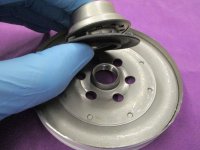
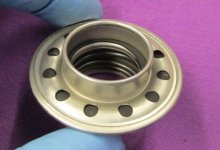
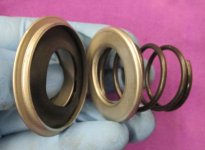
This is the entry side of the bypass valve. Unfiltered oil enters through the small holes at the perimeter when the element loads to the rated deltaP.

51601 Bypass Valve 600w.jpg

I lathed off the other end so the guts would pop out. DeltaP pushes up the rubber flap, backing ring, and spring, which allows oil flow directly to the center and out to the engine.

Bypass Cut Open.jpg

This is the insert which fills the same space in filters without an internal bypass. Same anti-drainback flap valve.

Insert.jpg
 
I've got a subject Wix 51624 in my plane now, 20 hours on it and just starting condition inspection.

I run 20w50 and it hasnt started colder than 60 degree oil temps.

I removed it, stuck a borescope in it and see no distortion in the perforated filter media backing tube or bottom.

Cut it open, the bypass spring at the bottom was in place and the cup assembly like DanH's post 29. I took 3 side views. There may be some extruding of the black material inside the cup.

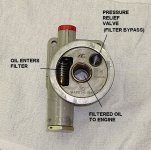
My AC Oil Filter Adapter on the accessory case, horizontal, is the type with it's own pressure relief bypass valve like the attached.

Ran oil pressure same as 51068.

OP, please post some pics to compare!
 

Attachments

  • Lyc Oil Filter Adapter 2 (2).jpg
    Lyc Oil Filter Adapter 2 (2).jpg
    86 KB · Views: 57
  • 17667856414260.jpg
    17667856414260.jpg
    188.7 KB · Views: 55
  • 17667865548811.jpg
    17667865548811.jpg
    329.1 KB · Views: 47
  • 17667865546830.jpg
    17667865546830.jpg
    313.6 KB · Views: 41
  • 17667865549852.jpg
    17667865549852.jpg
    313.9 KB · Views: 53
Last edited:
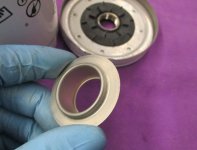
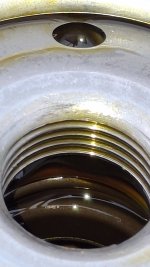
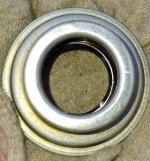
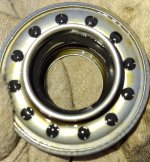
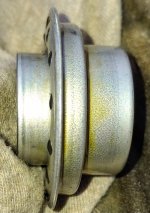
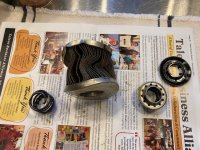
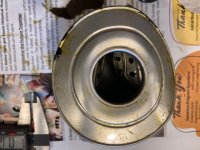
OK, here are a couple of pictures of the collapsed filter. In the first one, you can see the assembly of the anti-drainback diaphragm, the bypass valve, and the filter element. Note how the collapsing of the paper element pulls the end plates in. In the second picture looking inside, you can see how the perforated support tube is also crushed.

I measured the thickness of the paper element and it is 0.019" . It does feel a bit thinner than I recall for typical lube oil filters, but I don't have one to compare. Perhaps someone could measure one and post for comparison. I have a Casper Labs 90-degree filter adapter. I don't know if it has its own pressure relief valve -- I don't think so.

WIX 51624 collapsed.jpginterior collapsed filter.jpg
 
Thank you, Steve!

Here's mine. The different adapter, knowing mine has its own bypass relief, may make this apples and oranges, but 51085XP it will next be for me.

Doing the filter media inspection, at least a normal amount of dirt/carbon, very fine feeling media, maybe too fine for us? No magnetic particles, so a good day!
 

Attachments

  • 17667917802981.jpg
    17667917802981.jpg
    271.7 KB · Views: 67
  • 17667917700570.jpg
    17667917700570.jpg
    293.8 KB · Views: 64
  • 17667915660790.jpg
    17667915660790.jpg
    331.6 KB · Views: 64
Last edited:
Impressive collapse !!
Would be interesting to know if a relief valve in the adapter could prevent what Steve's filter experienced.
Unless he also has a relief valve in his adapter. Then, a freak occurrence ??

I'm currently testing a Fram HP3, only about one hour use for now.
It has more or less the same characteristics as the 48108-2 that I used previously.
Will monitor closely the oil pressure.
Don't know if my adapter as a relief valve, will inquire.

Typical cruise oil pressure for me is 84 PSI at 190F.
It's cold here, in the hangar it's 4C, (40F)
Last week's start at -11C (12F) after a few minutes in the cold, I saw 87 PSI at 40F oil temp.
On run-up it showed 99 PSI at 66F.
On takeoff, it showed 96 PSI at 108F.

Will report back when I open it up.
 
When you are talking about a multigrade oil, 20W-50 in this case, it doesn't mean that the oil has the viscosity of 50 weight oil, it means that when it is at operating temperature, it has the same viscosity as 50 weight oil would at that temp. It flows like 20w cold and doesn't lose much viscosity hot. That said, hot hydraulic oil is probably substantially thinner.

Ed
 
OK, here are a couple of pictures of the collapsed filter. In the first one, you can see the assembly of the anti-drainback diaphragm, the bypass valve, and the filter element. Note how the collapsing of the paper element pulls the end plates in. In the second picture looking inside, you can see how the perforated support tube is also crushed.

I measured the thickness of the paper element and it is 0.019" . It does feel a bit thinner than I recall for typical lube oil filters, but I don't have one to compare. Perhaps someone could measure one and post for comparison. I have a Casper Labs 90-degree filter adapter. I don't know if it has its own pressure relief valve -- I don't think so.

View attachment 105591View attachment 105592
Looking at those pics, I am pretty confident that it came from the factory that way. Don’t believe our oil pumps are anywhere near strong enough to bend metal to that extent.

Likely an automated assembly line and a tool crushed the inside part but kept rolling to the next step, outer can. You can see the partial fluting from where the machine went haywire. The top should have looked like the bottom cap.
 
Steve,

Your filter adapter does not have a built-in bypass valve, so any cold viscosity or loaded element bypass function depends on the valve in the filter. It's why you use a 48108 internal bypass aircraft filter.

For the moment let's assume the most obvious theory, failure to bypass, in whole or in part. I have my cut sample in front of me.

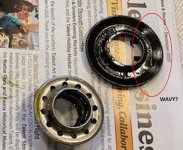
Question; trick of the lighting, or are there waves formed in the perimeter of the drainback valve disk?

Steve's PRV.jpg
 
When you are talking about a multigrade oil, 20W-50 in this case, it doesn't mean that the oil has the viscosity of 50 weight oil, it means that when it is at operating temperature, it has the same viscosity as 50 weight oil would at that temp. It flows like 20w cold and doesn't lose much viscosity hot.

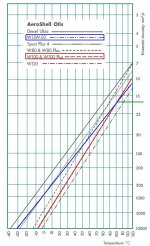
Straight vs multigrade, here's an Aeroshell chart for illustration. I've highlighted 15W-50 and W100. The multigrade is formulated so the viscosity lines cross at 100C (212F). More relevant to this discussion, note the viscosity difference down in the 0 to 30C range where we typically cold crank, often without preheat.

ScreenHunter_3093 Dec. 27 07.47.jpg

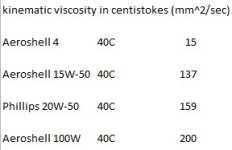
Steve was using Phillips 20W-50. I don't have a viscosity comparison at low temperature, but the data sheets list 40C viscosity, so apples to apples, hot hydraulic oil is indeed substantially thinner.

Viscosity.jpg
 
Dan always brings science to the discussion. Much more illuminating than my vague description. Looks like pre-heat really is a good idea after all. One would expect the filter to bypass with cold thick oil instead of crushing. Still got the problem of cold thick oil not making it to all the bearing surfaces though.

Ed
 
Steve,

Your filter adapter does not have a built-in bypass valve, so any cold viscosity or loaded element bypass function depends on the valve in the filter. It's why you use a 48108 internal bypass aircraft filter.

For the moment let's assume the most obvious theory, failure to bypass, in whole or in part. I have my cut sample in front of me.

Question; trick of the lighting, or are there waves formed in the perimeter of the drainback valve disk?

View attachment 105638
Just a trick of lighting. It is not wavy.
 
Looking at those pics, I am pretty confident that it came from the factory that way. Don’t believe our oil pumps are anywhere near strong enough to bend metal to that extent.

Likely an automated assembly line and a tool crushed the inside part but kept rolling to the next step, outer can. You can see the partial fluting from where the machine went haywire. The top should have looked like the bottom cap.
Well that is an interesting idea I had not considered!
 
I don't have any science or engineering experience to add to this discussion, but as a reference to experimenting with Oil Filters I can relate this story: I purchased my RV7A several years ago thru an intermediary. It was the 3rd build by Dave Cook of Granby, Colorado. (VAF: MTN FLYER) The engine logbook shows a Major Overhaul at 900 Hours since new. Contact with the builder was prohibited so I called the shop that performed the overhaul in Greely, Colorado and was informed that during the "Covid induced shortage of Champion & Tempest filters production the builder (Dave Cook) experimented with an automotive oil filter". It was said the engine lost oil pressure on climb out and he immediately returned to the airport. He was pretty upset about it and pulled the engine and sent it to Greely for inspection. Upon tear down and inspection the shop did not find any damage. When they reported this to the owner he said, "Rebuild it anyway". I was pleased with this explanation and completed the purchase.

As a follow up I finally was able to sleuth his cellphone # and contacted the builder via text a couple months ago. He was happy to hear from me and we chatted about how "RIGHT PROUD" he was of that last build. He said he would love to see that plane again if I was ever near his current location. I sent him recent pictures of the all-new Garmin panel. Recently due to this discussion I texted him to inquire if he remembered why he decided to Overhaul at 900 Hrs. The reply was a Heartbreaker: "This is from Dave's wife; he had a stroke & passed away on November 21, 2025. My guess is that he was a perfectionist & enjoyed working on his airplane more than anything!"

Most of this discussion is second or third hand information but I hope it adds something to this discussion. Ed S.
 
bending 20 gauge steel typically takes many hundreds psi. our oil pumps produce around 100 psi

It’s a positive displacement pump and as such, if “deadhead” it can deliver thousands of PSI. The only real limit is the strength of the drive mechanism. We only see “about 100 PSI” in our engines because of internal bearing leakage and the high pressure relief valve. In Steve’s case, the “deadhead” was upstream of all those relief mechanisms, so the filter was subject to unregulated output.

Would be interesting to somehow force oil through a section of Steve’s failed example and compare it to a known exemplar, like a 51515 or Tempest. Could be a simple as a gravity flow test…. How long does it take a pint of 20/50 Phillips to gravity feed through a section of each filter media. One would think it “should” be similar.
 
Looks like pre-heat really is a good idea after all. One would expect the filter to bypass with cold thick oil instead of crushing. Still got the problem of cold thick oil not making it to all the bearing surfaces though.

Keep in mind the millions of light truck (particularly diesel) applications with 15W-40 and similar, all pumped through a filter. Cold flow in my 6.6 Duramax isn't much different from cold flow in my IO-390 with 15W50, or Steve's 360 with 20W-50.

The 51647 Wix on my 390 is specified for a wide variety of Nissan UD diesels. No internal bypass, as the standard Lycoming filter adapter has one built-in.
 
Last edited:
Just a trick of lighting. It is not wavy.

Thanks. I asked because if installed upside down it would have developed the wave..and blocked the bypass holes.

It does appear your bypass valve cartridge has collapsed in a telescopic manner. That would close it off entirely.
 
If it took thousands of pounds of pressure to bend this, why didn't the outer metal case burst?

The more I read of this thread, the more I believe this was a manufacturing error.
 
Cut it open, the bypass spring at the bottom was in place and the cup assembly like DanH's post 29. I took 3 side views.

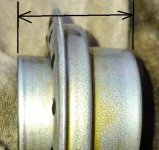
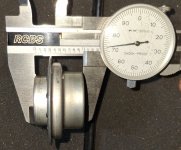
Rich, could you measure the overall height of your bypass cartridge? Let's see if Steve's really is crushed a bit.

17667865549852.jpg
 
Rich, could you measure the overall height of your bypass cartridge? Let's see if Steve's really is crushed a bit.

View attachment 105663
Mine is 0.0895--0.900. Looking inside, the spring is not coil-locked, but the coils are pretty close together. Also the perforated ring appears depressed below the rim crimp, not extending convex outward as shown in Dan's picture.
 
If it took thousands of pounds of pressure to bend this, why didn't the outer metal case burst?

The more I read of this thread, the more I believe this was a manufacturing error.

“If” the media cartridge crushed as a result of a failed bypass or simply overwhelming Delta P, it may have taken far less pressure than the case was capable of containing. Remember, the normal oil pressure the case has to withstand is ~100 PSI, and the filter media lives within that pressure, but the max DELTA pressure it should ever see is 19 PSI (according to the spec sheet). Not sure what pressure it takes to crush media and center tube, but I’d bet it’s far less than case burst pressure.

Ruling out a gross MFG error, WHY did it see such high delta P?
 
Back
Top