Van's Air Force

The definitive Van's Aircraft support community! Buying, building or flying an RV? Join our exclusive family of mentors and enthusiasts!

Nose Gear Lessons Learned

IF you have gotten this far - -

Here is a summary of the thread in a single downloadable document. Feel free to make improvements. I will send you the WORD file to do so. With the new VAF server it is now possible to post as a PDF.

Enjoy the "Nose Gear Lessons Learned" PDF
 

Attachments

Is that the new nose gear or standard old style?
Neither
This is a DIY home built nose gear leg that after introducing it 8 years ago in two youtube videos, there has been no other public info (that I am aware of)

It looks pretty solid whatever one it is.
Not really....
Watch in this video how much fore/aft flex there is in the gear leg. Not a good indicator in my opinion.

 
If you go to the Youtube channel linked in post 54 there are a couple other videos of nosegear design trials at the same airport in Australia on what appears to be the same RV-7A in 2016.
 
Last edited:
Neither
This is a DIY home built nose gear leg that after introducing it 8 years ago in two youtube videos, there has been no other public info (that I am aware of)


Not really....
Watch in this video how much fore/aft flex there is in the gear leg. Not a good indicator in my opinion.

Thanks for the info Scott. It didnt look like the standard gear but I have not seen the new design so I wasnt sure what was going on. The nose gear was my biggest fear before I built my 9A. I did most of my training in my plane and Im getting close to 300 hours in it and I can say I have not had anything scary or crazy happen - even with some not so good landings. If I even have to overhaul the engine I will change to the new mount but things are going better than I feared with the standard gear. I havent done a grass landing yet but my friend who did my phase 1 landed on some Idaho grass strips and it did fine.
 
Thought I'd re-open this thread as it now anppears to affect me. I had posted my "off-camber" nose gear problem in a different thread and I'm posting here rather continuing the hijack of that thread.

The issue was my front wheel and axle being off camber...the axle wasn't parallel to the earth and this made engagement of my Best Tug arms on the axle bolt problematic. Many of the posted theories suggested a bent nose gear leg but in discussing it with both @AlexPeterson and @petehowell I was more inclined to focus on the nose gear leg and its securing bolt, one of the foci in this discussion in this thread, which Alex pointed me to. Alex flew up today to help me out a bit with the diagnostic process. Not being a builder, his input provided me with the defining light-bulb moment.

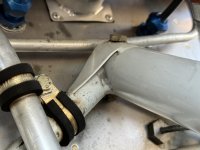
First move was pushing forward on the left wing, applying a little ground yaw. This re-aligned the axle to earth-parallel and the tug engaged the axle for the first time as Mark Patey designed it. Then we unweighted the nose gear did a wiggle test, and sure enough, the nose gear was not secure in the engine mount socket. The gear leg didn't wiggle front/back or side/side...it rotated a bit in the socket along its long axis. This is what was allowing the nose-wheel to sit off-camber and preventing the tug from hitting the axle symmetrically on both ends. Watching the motion clearly while observing the socket/bolt, we could see that the hole in the gear leg is just a bit too big thus creating a bit of rotational slop and that rotation of the gear leg caused the camber of the nosewheel to change. Nose gear leg and engine mount socket appear to be fine. No sign of any wiggle or cracks in the

I'm going to address this, with Alex's guidance, by getting some close-tolerance bolts as described in this thread and seeing if I can re-establish the proper rotational orientation of the nose gear portion of the engine mount.

1758745998309.jpeg

 
Last edited:
Thought I'd re-open this thread as it now anppears to affect me. I had posted my "off-camber" nose gear problem in a different thread and I'm posting here rather continuing the hijack of that thread.

The issue was my front wheel and axle being off camber...the axle wasn't parallel to the earth and this made engagement of my Best Tug arms on the axle bolt problematic. Many of the posted theories suggested a bent nose gear leg but in discussing it with both @AlexPeterson and @petehowell I was more inclined to focus on the nose gear leg and its securing bolt, one of the foci in this discussion in this thread, which Alex pointed me to. Alex flew up today to help me out a bit with the diagnostic process. Not being a builder, his input provided me with the defining light-bulb moment.

First move was pushing forward on the left wing, applying a little ground yaw. This re-aligned the axle to earth-parallel and the tug engaged the axle for the first time as Mark Patey designed it. Then we unweighted the nose gear did a wiggle test, and sure enough, the nose gear was not secure in the engine mount socket. The gear leg didn't wiggle front/back or side/side...it rotated a bit in the socket along its long axis. This is what was allowing the nose-wheel to sit off-camber and preventing the tug from hitting the axle symmetrically on both ends. Watching the motion clearly while observing the socket/bolt, we could see that the hole in the gear leg is just a bit too big thus creating a bit of rotational slop and that rotation of the gear leg caused the camber of the nosewheel to change. Nose gear leg and engine mount socket appear to be fine. No sign of any wiggle or cracks in the

I'm going to address this, with Alex's guidance, by getting some close-tolerance bolts as described in this thread and seeing if I can re-establish the proper rotational orientation of the nose gear portion of the engine mount.

View attachment 98074

For this type of thing, some folks have been installing a slightly longer bolt too (close-tolerance bolt sounds good) with a washer stack-up to insure the shank is getting all the way through the gear socket. In addition, sometimes these bolts get gouged at the socket edges--something to look for. The kit calls for match-drilling the gear socket and leg to a slightly larger hole size, so that might not have been done correctly but less likely. My nose gear has been correct and tight for 21-years now, so the system works if installed correctly!
 
For this type of thing, some folks have been installing a slightly longer bolt too (close-tolerance bolt sounds good) with a washer stack-up to insure the shank is getting all the way through the gear socket. In addition, sometimes these bolts get gouged at the socket edges--something to look for. The kit calls for match-drilling the gear socket and leg to a slightly larger hole size, so that might not have been done correctly but less likely. My nose gear has been correct and tight for 21-years now, so the system works if installed correctly!
Alex tells me that he had this problem on completion of his -6A 24 years ago solved it by replacing with a close-tolerance bolt. He even still has the bolts. May be my solution. I gotta believe that the fact that the issue is in axial rotation and not side-to-side or front-to-back indicates an oversized hole or undersized bolt. I'm out of my depth, but bathed in the warm glow of engineering competence.

1758757289982.jpeg
 
Last edited:
Alex tells me that he had this problem on completion of his -6A fourteen years ago solved it by replacing with a close-tolerance bolt. He even still has the bolts. May be my solution. I gotta believe that the fact that the issue is in axial rotation and not side-to-side or front-to-back indicates an oversized hole or undersized bolt. I'm out of my depth, but bathed in the warm glow of engineering competence.

View attachment 98093
Good luck addressing, but if this has been going on for a bit, I suspect one or two holes has ovalled and may require drilling oversize or welding and redrilling. Get a calipar on the two holes in the socket and that will tell you if an oversized bolt will do it.
 
Good luck addressing, but if this has been going on for a bit, I suspect one or two holes has ovalled and may require drilling oversize or welding and redrilling. Get a calipar on the two holes in the socket and that will tell you if an oversized bolt will do it.
I suspect you’re right. Hand-rotating the gear leg while un-weighted doesn't appear to wiggle the bolt at all…the play appears to be all in the gear leg hole. Alex has a new bolt that sizes at .3120. I’m going to start there and see if that at least helps. It won’t make it worse. If it doesn’t solve the problem, which would be preferable? Match re-drilling or sending it off to Langaire for welding and re-drilling? Or…should I contemplate a new gear leg at $1000 if I can’t find a used one?
 
Last edited:
I suspect you’re right. Hand-rotating the gear leg while un-weighted doesn't appear to wiggle the bolt at all…the play appears to be all in the gear leg hole. Alex has a new bolt that sizes at .3120. I’m going to start there and see if that at least helps. It won’t make it worse. If it doesn’t solve the problem, which would be preferable? Match re-drilling or sending it off to Langaire for welding and re-drilling? Or…should I contemplate a new gear leg at $1000 if I can’t find a used one?

I expect your problem is with the weldment, not the gear leg.
 
I dont think I would go with a used one. I think you will be able to get it straightened out redrilled and new bolt. If not, send it off to Langaire and they should be able to make it work one way or another. Crazy it has been that way for so long and noticed because of your new tug!
 
I suspect you’re right. Hand-rotating the gear leg while un-weighted doesn't appear to wiggle the bolt at all…the play appears to be all in the gear leg hole. Alex has a new bolt that sizes at .3120. I’m going to start there and see if that at least helps. It won’t make it worse. If it doesn’t solve the problem, which would be preferable? Match re-drilling or sending it off to Langaire for welding and re-drilling? Or…should I contemplate a new gear leg at $1000 if I can’t find a used one?
Howard, thanks for the kind words. Actually, he bolt was moving when we rotated the gear leg about its long axis. The slop does appear to be in the mount. It will be simple to try the close tolerance bolt - we'll know in seconds how much it helps. If we need to work on the mount, the problem gets much more complicated...
 
I suspect you’re right. Hand-rotating the gear leg while un-weighted doesn't appear to wiggle the bolt at all…the play appears to be all in the gear leg hole. Alex has a new bolt that sizes at .3120. I’m going to start there and see if that at least helps. It won’t make it worse. If it doesn’t solve the problem, which would be preferable? Match re-drilling or sending it off to Langaire for welding and re-drilling? Or…should I contemplate a new gear leg at $1000 if I can’t find a used one?
the wallowed out hole should be in the socket, so that would be a complete engine removal. The fwd hole may be good and it is the rear hole that is wallowed. The socket is ~1/8" steel and the leg is 1-1/2" steel. The socket material should be the one to wear. Also possible the bolt was wearing. Need to get the leg off and start measuring.

Can't remember how close the bolt hole is to an edge, but drilling a bigger hole is WAY easier than welding, because you can't get to the rear hole for welding without removal. You can drill it yourself and can give some tips when you get to that point. Be sure to measure how far the socket hole is from an edge.
 
What about using a tapered pin, see below
 
I won't know until I get the strut off. If it's the hole in the nose gear socket/weldment that's the problem then I guess that I'll have to match-drill it larger.

If you get to the point where it will need to be match drilled, I might suggest using a taper reamer and replacing the bolt with a taper pin will both resolve the issue and prevent it from reoccuring. I had the same issue and the taper pin fix has held strong for well over 1000 flights hours and 700+ takeoffs and landings.
 
Following this, as I suspect I'm beginning to see the same issue on my nosegear leg at 1900 hours.
 
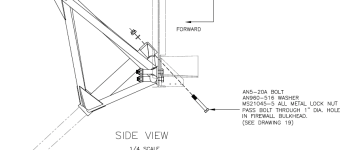
I understand the orientation of the gear leg bolt is important to allow the shank to go completely through the gear leg socket because there's a reinforcement plate that's welded to the top side. It appears that your bolt was installed opposite to Vans assembly instructions. The plans call for a 1-inch access-hole to be drilled into the firewall just behind the bolt-head, then install the bolt and use a hole-plug in the firewall access hole with little Pro Seal. That's how I did mine, too.

1758820067328.png

You Orientation:
1758820466816.png

Proper Orientation:
1758820731308.png
 
Last edited:
My plans (ca 1993) show the bolt from the top. However, I had a bit of slop in the nose gear for a couple hundred hours. When I went to remove the bolt (for replacement with a close tolerance bolt), it was a real challenge. The sharp hole edges in the gear leg had worked up little burs on the bolt. There was a fair amount of cussing involved in getting that bolt out. I broke the edges on the hole so that problem won't recur. BTW, almost 1900 hours and the gear still has no slop.

The design change to inserting the bolt from the bottom is likely so that it can be driven out if necessary. Normal aircraft practice would have the head on top. I'd prefer not to climb into the cockpit to insert that bolt...
 
The design change to inserting the bolt from the bottom is likely so that it can be driven out if necessary. Normal aircraft practice would have the head on top. I'd prefer not to climb into the cockpit to insert that bolt...
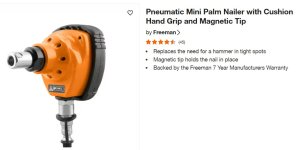
Is there room in there to swing a hammer? You may need to use a palm nailer.
palm.jpg
 
Before you install your new bolt, take a micrometer and measure the shank at the head and at the end of the threads.
There is a small taper just before the threads. This loose fit will allow the leg to move and eventually deform the close fit on the hole at the nut.
The fix is to use the next longer bolt... AN5-21A It will allow the full dimension if the bolt to be in constant shear with both the inlet and outlet hole of the mount. Use washers on each end to provide the proper bolt placement so you don't run the nut into the bolt shoulder.

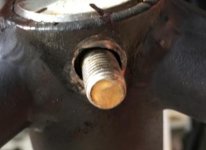
Here is a snip of a bolt that used the threads as a shear fit.... It doesn't work. It's hard to see when you are installing the bolt from the top (like on a 6A) but you must confirm that the bolt extends enough that the proper dimension of the bolt is snug in the hole....
bolt2.jpg
 
Last edited:
I understand the orientation of the gear leg bolt is important to allow the shank to go completely through the gear leg socket because there's a reinforcement plate that's welded to the top side. It appears that your bolt was installed opposite to Vans assembly instructions. The plans call for a 1-inch access-hole to be drilled into the firewall just behind the bolt-head, then install the bolt and use a hole-plug in the firewall access hole with little Pro Seal. That's how I did mine, too.

View attachment 98143

You Orientation:
View attachment 98145

Proper Orientation:
View attachment 98147
Orientation shouldn’t matter, only that the shank of the bolt fully extends past the holes in the socket. You DONT WANT threaded material in contact with the socket hole ID’s. Thread OD is usually .005 smaller than the shank OD and the thread tips greatly increase galling and wearing of the hole id when rotational forces (rotation of items being retained, not bolt rotation) are involved. I believe that orientation is for ease of installation and toque checking down the line.
 
Last edited:
Before you install your new bolt, take a micrometer and measure the shank at the head and at the end of the threads.
There is a small taper just before the threads. This loose fit will allow the leg to move and eventually deform the close fit on the hole at the nut.
The fix is to use the next longer bolt. It will allow the full dimension if the bolt to be in constant shear with both the inlet and outlet hole of the mount. Use washers on each end to provide the proper bolt placement so you don't run the nut into the bolt shoulder.

Here is a snip of a bolt that used the threads as a shear fit.... It doesn't work. It's hard to see when you are installing the bolt from the top (like on a 6A) but you must confirm that the bolt extends enough that the proper dimension of the bolt is snug in the hole....
View attachment 98211
As shown by -9A, -7A and -8A build instructions, if the bolt is inserted from the bottom-up, then the shank of the bolt fits just right into the upper part of the gear leg socket due to the welded reinforcement plate on the top side. Otherwise, the stock AN5-20A bolt is not long enough. Yes--it takes more work to get there, but it prevents this from happening. In saying that, the longer bolt with washers should work fine too using a top-down bolt insertion.

I noticed today that I have a Nyloc nut in there and should be an all metal lock nut, but it hasn't budged in 21-years! Nyloc's can take up to 250 degree F, but I might change it over to an all metal lock nut at the next condition inspection. Or, maybe I will "leave a sleeping giant rest".

1758856227630.png
 
Last edited:
The design change to inserting the bolt from the bottom is likely so that it can be driven out if necessary. Normal aircraft practice would have the head on top. I'd prefer not to climb into the cockpit to insert that bolt...
You are correct.
It was one of many changes I suggested when we were doing the design work on the RV-9 (it didn’t initially have the “A” designation because at that time there was no plan to ever do a tail dragger).
 
Last edited:
You are correct.
It was one of many changes I suggested when we were doing the design work on the RV-9 (it didn’t initially have the “A” designation because at that time there was no plan to ever do a tail dragger).
Given this design change requires a 1-inch hole in the stainless steel firewall with a hole plug and Pro Seal, and then having to insert the bolt from the back side of the firewall while laying on your belly, there must have been more to it than that in Vans engineering department. To drive a top inserted bolt out, a simple slide hammer would easily work. It was clear to me that the recommended AN5-20A bolt is simply not long enough for the shank to fully meet the bottom side of the gear socket due to the welded reinforcement plate on the top side, causing the bolt not to go in far enough. My gear leg has been "rock sold" for 21-years and 1600 hours using Vans stock plans. Whereas, many top inserted bolt airplanes (like MacCool's RV-9A and gasman) have loosened over time.
 
Last edited:
Given this design change requires a 1-inch hole in the stainless steel firewall with a hole plug and Pro Seal, and then having to insert the bolt from the back side of the firewall while laying on your belly, there must have been more to it than that up in Vans engineering department. To drive a top inserted bolt out, a simple slide hammer would easily work. It was clear to me that the recommended AN5-20A bolt is simply not long enough for the shank to fully meet the bottom side of the gear socket due to the welded reinforcement plat on the top side, which causes the bolt not to go in far enough. My gear leg has been "rock sold" for 21-years and 1600 hours using Vans stock plans. Whereas, many top inserted bolt airplanes (like MacCool's RV-9A) have loosened over time.
Since your gear leg "has been rock solid" for 21 years, I am going to assume you have never tried to remove your installed reversed from recommended bolt... There is no space to use a slide hammer on a bolt installed from the top.

Considering the numerous challenging assembly processes that exist building an RV, I am somewhat confused with the comments about changing bolt orientation just because of the difficulty of a one time installation of the bolt.
People that have been saying that must be tone deaf to the comments others have made about how difficult it was to remove a bolt that had been installed from the top. :rolleyes:

There are many different reasons that can cause a loose gear leg bolt connection, but the orientation of the bolt is not one of them (as long as a proper length bolt for the specific installation was used.
 
Since your gear leg "has been rock solid" for 21 years, I am going to assume you have never tried to remove your installed reversed from recommended bolt... There is no space to use a slide hammer on a bolt installed from the top.

Considering the numerous challenging assembly processes that exist building an RV, I am somewhat confused with the comments about changing bolt orientation just because of the difficulty of a one time installation of the bolt.
People that have been saying that must be tone deaf to the comments others have made about how difficult it was to remove a bolt that had been installed from the top. :rolleyes:

There are many different reasons that can cause a loose gear leg bolt connection, but the orientation of the bolt is not one of them (as long as a proper length bolt for the specific installation was used.
I used Vans stock plans, hardware and orientation and have never changed from the RV-9A original gear leg, mount nor fork--no need to if you fly the airplane as Dick VanGrunsven intended it to be flown. And, I also didn't use tire fairings because I like being able to see my brakes and tire condition during every pre-flight. The stock bolt is simply not long enough to insert from the top side on the RV-9A without the threads overlapping the bottom of the gear socket--not enough margin. But, it works nicely using the stock bottom-up bolt orientation,

1758907108841.png
 
Last edited:
As shown by -9A, -7A and -8A build instructions, if the bolt is inserted from the bottom-up, then the shank of the bolt fits just right into the upper part of the gear leg socket due to the welded reinforcement plate on the top side. Otherwise, the stock AN5-20A bolt is not long enough. Yes--it takes more work to get there, but it prevents this from happening. In saying that, the longer bolt with washers should work fine too using a top-down bolt insertion.
...
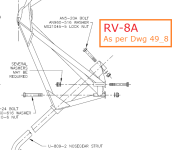
I'm watching this thread with interest as I am not here yet, but took a look ahead about this... My understanding per 49_8 is for the '8A, the bolt is to be inserted "top down", but reading comments here, I am wondering if this bolt can be substituted for a drilled head AN5H-20A (or maybe 21A?) without any adverse effects? (if the bolt ever has to be removed, then perhaps the wire hole can be enlarged prior to extraction somewhat, and a strong wire pulling on it combined with rotation can help get it out? 🤷‍♂️)

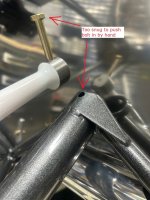
Otherwise, for those that built an 'A and had no hole enlarging issues, any comment on how hard it was to get the bolt in on initial construction? Mine is looking like it will be somewhat of an interference fit and potentially a one-way trip for the bolt when the time comes (Also I want to be darn sure the shank will be long enough)...
 

Attachments

  • RV8ANose.png
    RV8ANose.png
    47.8 KB · Views: 47
  • RV8ANoseBolt.jpg
    RV8ANoseBolt.jpg
    213.5 KB · Views: 48
I'm watching this thread with interest as I am not here yet, but took a look ahead about this... My understanding per 49_8 is for the '8A, the bolt is to be inserted "top down", but reading comments here, I am wondering if this bolt can be substituted for a drilled head AN5H-20A (or maybe 21A?) without any adverse effects? (if the bolt ever has to be removed, then perhaps the wire hole can be enlarged prior to extraction somewhat, and a strong wire pulling on it combined with rotation can help get it out? 🤷‍♂️)

Otherwise, for those that built an 'A and had no hole enlarging issues, any comment on how hard it was to get the bolt in on initial construction? Mine is looking like it will be somewhat of an interference fit and potentially a one-way trip for the bolt when the time comes (Also I want to be darn sure the shank will be long enough)...
Okay and thanks--I stand corrected on the RV-8A. And, in terms of bolt tightness, my RV-9A instructions clearly called for match-drilling up and reaming the gear leg and socket so that the bolt fits properly--some are using close tolerance bolts if it's too loose, but I used the stock AN5-20A bolt and it fit just right. Does the RV-8A instruction set call for this same match-drilling and reaming step? Can always go longer and add washers--I would do this if I built another RV.

1758918593726.png
 
Last edited:
Does the RV-8A instruction set call for this same match-drilling step? ..
I did a search and couldn't find anything about it for the 8A. Doesn't necessarily mean it's not there and I missed it though...lol

Anyway, thanks for sharing your experience with the fitment/length... I'm thinking I'll try get the threads to "just fit through" and hopefully the rest will be "not too snug/not too loose" We'll see...
 
I did a search and couldn't find anything about it for the 8A. Doesn't necessarily mean it's not there and I missed it though...lol

Anyway, thanks for sharing your experience with the fitment/length... I'm thinking I'll try get the threads to "just fit through" and hopefully the rest will be "not too snug/not too loose" We'll see...
I would certainly read over the RV-8A gear leg installation instructions before moving forward--my RV-9A reads as follows. (y):cool:(y)
How to Match-Drill nose gear leg and engine mount.
  1. Alignment: Clamp the nose gear leg and engine mount securely in place, ensuring they are properly aligned to prevent any movement.
  2. Undersized Hole: The engine mount socket already has an upper hole drilled to the final size and a lower, undersized hole drilled first.
  3. Drill Through: A drill bit is inserted into the final-sized hole and used to "bottom out" on the edges of the smaller, undersized hole on the opposite side.
  4. Final Drill: A drill motor is then attached to the inserted drill bit to final-drill the smaller hole, creating a perfectly aligned pair of holes through both the gear leg and the engine mount socket.
  5. Ream and Insert Bolt: The hole is then reamed to the correct final diameter for the chosen bolt, ensuring a tight, zero-play fit.
 
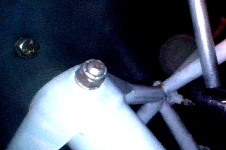
So just to close the loop on my little saga...Alex came up, we weighted the tail and removed the bolt without issue. Slid out with only the gentlest of persuasion. We pulled the nose gear strut out and check that hole and the holes in the engine mount socket against the extra close-tolerance bolt that he had for his own nose gear wobble repair 24 years ago and they slid in just fine...again only gentle nudging, no hammers required. I sprayed the relevant parts with some BraKleen, scrubbed it and greased it up. We took a wooden stake and pounded a dent in the firewall at the appropriate point. The bolt slid in from the top until the threads just showed. We used two washers so as not to tighten the nut down on the shoulder, then the metal lock nut and used it to pull the bolt down to the head. Once tightened down, the end of the bolt protruded enough that it almost touched the firewall. We checked the nose gear, absolutely zero play. After putting the nose gear back on the ground, I attached the Best Tug and the arms now engage perfectly. Problem solved. The whole process took us about 45 minutes max.

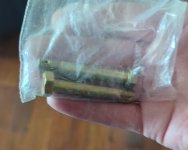
As part of the post-procedure debrief, I looked at the bolt that we took out. It didn't look damaged, BUT measuring it showed it to be 1-13/16" overall length and a grip range of 1-5/16 ". That makes it an AN5-16 bolt. Van's calls for it to be a AN5-20, which would be 2-3/32" overall and 1-9/16" grip. Obviously, somebody put a bolt in this supposed double-shear application that had a length and grip range that is 1/4" too short. The forward/lower engine mount hole was hosting the threads of the bolt, not the shoulder. Anyway...problem solved, at least in the short term. I'll check it again after awhile.

Very grateful to Alex for his assistance. We had collaborated on a previous biomedical engineering/device project...still ongoing...which is how we first met years ago. I did the medical part and he did the Engineering part. I'm always fascinated (and a little intimidated) to watch the Engineering mind at work. Working with him, this time on my airplane instead of a research project, was a gratifying treat.

C7A82ABD-DA0E-46E7-A1FA-E74B3B8DB512_1_105_c.jpeg8D4C700E-92DD-4F2C-8AE7-6DC2AD9C8D4B_1_105_c.jpeg CE88CFCA-6553-4C51-8DE5-560B2388DB39_1_105_c.jpeg

 
Last edited:
This is what I find over and over on this forum (and I go back quite a ways with one of the few peeps with a *glass* airplane that preferred to hang with the metals guys)... Ps. Now I have a metal airplane...(Well technically both, but that's a different story). Anyway, this forum never ceases to amaze me at how helpful it is. Whether in person. Or just online!!!

Glad the issue was resolved!
 
We took a wooden stake and pounded a dent in the firewall at the appropriate point. The bolt slid in from the top until the threads just showed. We used two washers so as not to tighten the nut down on the shoulder, then the metal lock nut and used it to pull the bolt down to the head. Once tightened down, the end of the bolt protruded enough that it almost touched the firewall.
Great to hear you're up and running again with a correct length (-20) close tolerance bolt! Maybe needing to pound a dent into the firewall to get the bolt in from the top-down is why Vans went to the 1-inch firewall access hole and bottom-up gear bolt approach for the RV-9A and probably the 7A but not the 8A, which likely has enough room back there. And, maybe that's why the original builder used a shorter (-16) bolt. :whistle: Thanks for sharing!
 
Last edited:
Great to hear you're up and running again with a correct length (-20) close tolerance bolt! Maybe needing to pound a dent into the firewall to get the bolt in from the top-down is why Vans went to the 1-inch firewall access hole and bottom-up gear bolt approach for the RV-9A and probably the 7A but not the 8A, which likely has enough room back there. And, maybe that's why the original builder used a shorter (-16) bolt. :whistle: Thanks for sharing!
No, it is actually for the reason I already mentioned, but we were aware that if it wasn’t inserted from the bottom that there also would be an interference with the firewall.
 
No, it is actually for the reason I already mentioned, but we were aware that if it wasn’t inserted from the bottom that there also would be an interference with the firewall.
Well--at least we can say that it's critical, in this application, to achieve good bolt shank contact with both the upper and lower gear leg socket and to also match-drill and ream your gear leg and socket as precisely as you can. Otherwise, you're probably going to end-up with a "wobbler". And, following Vans instructions is never a bad idea! (y) :cool: (y)
 
I installed a -21 from the top (for reasons that I mentioned earlier in this thread) with a washer under the head, and two under the nut, and I did not pound out the firewall.

You just add the washer and the nut as you are tapping the bolt through the leg. IOW... you can't just drive the bolt in and expect the washer and nut to go on without interference from the FW.

To remove the existing bolt from the top, I clamped vise grips onto the head and tapped the grips with a hammer.
 
MacCool,
With that much play in the leg to top socket, you may have wear in the lower socket...
An easy test with the nose wheel off of the ground, is to take your fist and thump the gear at the bend.
If it is loose, you will hear it. If it fails the test, I have a simple solution. Contact me with a DM.
socket.jpg
 
Back
Top