Van's Air Force

The definitive Van's Aircraft support community! Buying, building or flying an RV? Join our exclusive family of mentors and enthusiasts!

Air temp exiting cowl

Webb

Well Known Member
Sponsor
I installed 2 thermocouplers on the firewall about 10” above the scoop exit for early fire detection. Air temp on the way out was 145/146 while doing pattern work today with an ambient temp of 88f. Thought it might be of interest to those that want to know what temps things on the firewall are cooking.
 
I installed 2 thermocouplers on the firewall about 10” above the scoop exit for early fire detection. Air temp on the way out was 145/146 while doing pattern work today with an ambient temp of 88f. Thought it might be of interest to those that want to know what temps things on the firewall are cooking.
Slow simmer in my wifes crock pot..............
 
With an efficient cooling system, the delta (OAT vs exit) will be surprisingly high.
Here are some numbers recorded on my plastic plane (Lancair)

MSL 8500
OAT (F) 60
RPM 2400
C FLAPS closed
RAM AIR open
MP-Ram ON .23.0
MP-Ram OFF 21.6
Plenum pressure inHg 13.2
Lower Cowl pressure inHg 8.5
Cowl Exit Temp F 154

EDIT:
I also have an alarm for “fire detection”.
But, your comment got me thinking – if there is a (rapid) fire, what happens to the temperature sensor? Does it melt/fail before you get a warning?

My current sensor is a thermocouple and not resistance, so it “should” give a warning before it fails. Certainly it would give a warning for a developing fire condition like a cracked exhaust starting to fail. Maybe I’ll look at a thermal sleeve for that sending wire sometime…..
 
Last edited:
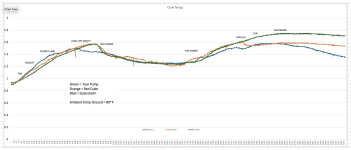
Pete Howell loaned me a set of thermocouples and a wireless data logger that he built. I used it to look at under-cowl temps as I contemplate revising my fuel routing. They're a little high, although not as high as I thought. I placed one on the gascolator, red cube, and engine-driven fuel pump.

1750419336013.png
 
Pete Howell loaned me a set of thermocouples and a wireless data logger that he built. I used it to look at under-cowl temps as I contemplate revising my fuel routing. They're a little high, although not as high as I thought. I placed one on the gascolator, red cube, and engine-driven fuel pump.

View attachment 90564
Would that Pete Howell guy loan his set up to someone like me to check my oil cooler performance?
 
The installation is far from stock, but I've recorded exit air temps well above 180F.
 
What are the temperatures after landing and taxing to the fuel pump? Highest reading after shut down?
I’ll make a note and get back to you next time I fly for specific temps. Mainly because I want to narrow the normal range, and set the alerts more appropriately.
 
I have a probe next to my battery (EarthX) and the average reading is around 130F when the OAT is around 70F. I will move it to the exit air and get more reading and will report back here.
 
Another interesting perspective ...

I also have a fire suppression system (beside the point), and use two channels from my EI 16-channel engine analyzer to measure the real time air temps at the distribution spider location and under the sump adjacent to the servo (where I have the nozzles for the suppression material distribution). What these two temps provide is an indication of the efficiency of the downdraft cooling system. When Dave Anders did the design he always maintained that the "delta" T across the cylinders should be in the neighborhood of 60*F+ for adequate cooling.

In almost all flight regimes/seasons, in my airplane, this has proven to be the case. Of course, at shutdown, stagnated heat remains to "cook" whatever is available under the plenum, and I can tell you that the temp around the servo area gets quite high for a little while.

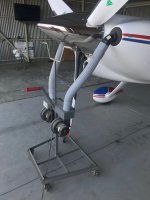
To help solve that problem for me, I live in the Central Valley of California, where the ambient temp in my corrugated tin hangar in the summertime easily reaches 120*F+ on hot afternoons, I built a "huffer", that I plug in after every flight to evacuate the stagnated air. Even though the air temp going in may be 100* or more, that is a significant reduction from trapped air in the plenum that can easily reach temps above 200*F. I run it on an 1 1/2 hour mechanical timer, but in just 10 minutes or less, the evacuation cycle has cooled the area significantly. If you are standing anywhere "south" of the cowling exit you can clearly feel the heat extraction ...

YMMV - but not by much.

HFS
 

Attachments

  • “Huffer”.jpg
    “Huffer”.jpg
    2 MB · Views: 40
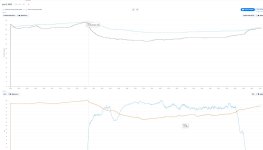
Temp probes mounted port side FWF (Under the WAAS antennas) high reads 125 F when OAT is 98 F. Starboard side lower FWF reads 136 F same OAT. This was after almost 20 min hold. Once airborne temps go down. This leg weas 30 mins after landing and everything was pretty much heat soaked. Idling at 1,300 RPM seems to help.

Screenshot 2025-06-20 200402.jpg
 
I built a "huffer", that I plug in after every flight to evacuate the stagnated air.
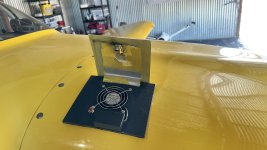
I have a small battery powered fan I carry. Pop the oil door and place the fan over it.
It draws out a surprising amount of hot air. I recharge it in flight.(USB) and it’s ready to go at the next stop or home base. “Auto” shut off if left unattended as a battery runs out after 30+ minutes or so. A cheap $10 option

I had the plastic shear coupling on a B&C pad mounted alternator fail after 200 hours. Likely all that heat before I started carrying the fan and popping the oil door contributed..
 
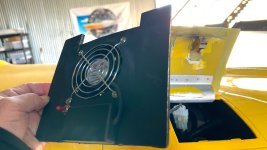
After a flight, my under-cowl temps will hit about 180° F. IMHO the only problem that those post-shutdown temps cause is that the fuel temps can lead to difficult hot restarts on a hot day (an example would be landing to refuel, or 5-7 Young Eagles flights). More important to engine health is the condensation that will form in the crankcase as the engine cools. My routine for managing the hot restart issue is a 12v muffin fan as a vent fan on a timer plugged into my battery-maintainer connector, that I put in the oil door. Not necessary if it's just going back in the hangar. My solution to venting the crankcase condensation is an engine dehydrator blowing through the dipstick tube. Doesn't have to be high volume, just positive pressure.

The vent fan (Amazon) is kind of high-speed noisy and does draw attention from people walking by if parked on the ramp. Only runs for 1 hour. Current draw is minimal.

IMG_0617.jpegIMG_0646.jpeg
 
Last edited:
After a flight, my under-cowl temps will hit about 180° F. IMHO the only problem that those post-shutdown temps cause is that the fuel temps can lead to difficult hot restarts on a hot day (an example would be landing to refuel, or 5-7 Young Eagles flights). More important to engine health is the condensation that will form in the crankcase as the engine cools. My routine for managing the hot restart issue is a 12v muffin fan as a vent fan on a timer plugged into my battery-maintainer connector, that I put in the oil door. Not necessary if it's just going back in the hangar. My solution to venting the crankcase condensation is an engine dehydrator blowing through the dipstick tube. Doesn't have to be high volume, just positive pressure.

The vent fan (Amazon) is kind of high-speed noisy and does draw attention from people walking by if parked on the ramp. Only runs for 1 hour. Current draw is minimal.

View attachment 90644View attachment 90645

I have a plenum, so this system doesn't work for me for the trapped, stagnated air there - hence my "huffer" that blows from the intakes, thru the cylinders and exits at the rear of the cowl.
 
I have a plenum, so this system doesn't work for me for the trapped, stagnated air there - hence my "huffer" that blows from the intakes, thru the cylinders and exits at the rear of the cowl.
I have a plenum too. I don't see the problem with "stagnated air". My little vent fan arrangement works really well with hot-restarts, which is the problem I needed to solve.
 
The aviation branch of the CN Temu offers an amazing array of tooling and parts suitable for... experimenting. Oil filter cutter, holding clamps, oetiker style clamps, rivnuts, ignition wire holders, etc.
I also recently acquired a remote dual probe BBQ temperature thermometer, with which I will hopefully be able to read actual Ts at chosen locations. We shall see...
 
Last edited:
On my RV-10, the air temperature exiting the cowling is about 10°F higher than the oil temperature on average. For example, on a relatively cool summer day with an ambient temperature of 73°F, my oil temperature is around 180°F, while the cowl exit air is about 190°F. My sensor is located about 5 inches above the air exit. I also use this sensor as an early fire alarm, set to trigger at 250°F. With a six cylinder Lyc engine, it gets quite hot under the cowl.
 
Back
Top