Van's Air Force

The definitive Van's Aircraft support community! Buying, building or flying an RV? Join our exclusive family of mentors and enthusiasts!

Thoughts on the Plane Power AL12-EI60

Maybe I’m not as knowledgeable about this subject but I don’t understand why anyone would bother with a Plane Power alternator. One post said “I'm expecting my PP to fail at some point ”. If that’s the case why do you even have one. I put a B&C alternator in my RV-3, RV-4 and now in my RV-8 and never had a lick of trouble with any of them. Seems like the alternator problems addressed on this forum always seem to be related to the Plane Power brand. Neither brands are cheap and maybe I’m missing something but the B&C alternator is $650-850 depending on the model and the PP alternators start at $1200. I respect the dissection and research some are conducting to find the problems but if you just buy a B&C you won’t have to bother and you can just go fly instead.
I believe the issue is that when you buy an engine from Vans, it comes with that alternator. Due to this, a lot of builders/fliers are stuck dealing with the issue. Brian is doing a public service for those in that situation.

Charlie
 
Has anyone approached Vans to delete the alternator from the engine or let the buyer choose the alternator? For such a great airplane I can’t for the life of me understand why Vans would agree to such an inferior product with known problems in the field. Does Vans even read these forums? Lycoming is not going to listen to us little guys one at a time but if Vans addressed the problem directly with the engine supplier maybe some solution could be reached.
 
Last edited:
I haven't found one yet -- the I.D. is 15.00mm if that helps any. Timely article this month in KitPlanes -- ( https://www.kitplanes.com/denso-alternator-homemade-adaptation/ ) The author machined his own pulley and the dimensions are in there. Maybe he can make some for us :)

He did highlight a concern that we've all had/shared about the operating speed of these alternators, I think it would be better for everything if we grew the sheave an Inch -- get the RPM down ~9000 to ~6000.

I just put the alternator in the vise and held the sheave by hand. I'll use red Locktite when I put these back to together.
Brian, most ND alternators have a broached hex shaped hole in the front end of the rotor shaft. This allows you to place a box wrench on the nut and a hex key [aka Allen wrench] on the shaft [with a 12" length of pipe over the handle of the Allen wrench for leverage] to hold it while you either tighten or loosen the nut to remove/replace the pulley. Why are you referring to the pulley as "sheaves"? Is the PP alternator actually supplied with sheaves [2 pieces which form a pulley] or a pulley [solid 1 piece]?
In over 30 years dealing with ND alternators, I rarely need to resort to using a box wrench and Allen wrench to loosen the nut. Every mechanic I know, places a red cloth rag around the pulley and removes the nut with an impact gun [pneumatic or electric] The rag gives you enough grip to hold the pulley still. The box wrench & Allen wrench method is used to tighten the nut for the pulley.
Regardless of what those bearings are rated for, empirical evidence shows that the 2.5" pulley most NDs come with, spins the unit much to fast for optimum bearing and brush life. What is the diameter of the PP pulley/sheaves? Years [decades?] ago, 4" diameter aluminum pulleys were available, on VAF and the other RV Lists, as I bought one. Perhaps someone could make a side business of supplying this???
I agree that 6,000 RPMs is a much more reasonable speed. Bear in mind that cars/trucks spend a great deal of time at idle or low [< 1200 RPM] speeds while running the A/C [20 -30 amps] & lights in summer and in the winter, the lights, heater and heated rear [30 amp draw] windshield. That is part of the reason for the small 2.5" pulley, be it a Vee belt or serpentine belt. No harm in using red LockTite, but it's not really needed on most cars. Engine rotation and alternator rotation match the thread [left or right hand] used on the rotor shaft. This makes the nut on the front self tightening. Are those threads on the PP alternator right hand or left hand thread?
May I request that you weigh your PP alternators of different part numbers? I'd like to see how actual weights compare to manufacturer "claimed" weight are. I'm old enough to remember IPP versus RMS watts ratings for stereo components! :eek:
 
Brian, most ND alternators have a broached hex shaped hole in the front end of the rotor shaft. This allows you to place a box wrench on the nut and a hex key [aka Allen wrench] on the shaft [with a 12" length of pipe over the handle of the Allen wrench for leverage] to hold it while you either tighten or loosen the nut to remove/replace the pulley. Why are you referring to the pulley as "sheaves"? Is the PP alternator actually supplied with sheaves [2 pieces which form a pulley] or a pulley [solid 1 piece]?
In over 30 years dealing with ND alternators, I rarely need to resort to using a box wrench and Allen wrench to loosen the nut. Every mechanic I know, places a red cloth rag around the pulley and removes the nut with an impact gun [pneumatic or electric] The rag gives you enough grip to hold the pulley still. The box wrench & Allen wrench method is used to tighten the nut for the pulley.
Regardless of what those bearings are rated for, empirical evidence shows that the 2.5" pulley most NDs come with, spins the unit much to fast for optimum bearing and brush life. What is the diameter of the PP pulley/sheaves? Years [decades?] ago, 4" diameter aluminum pulleys were available, on VAF and the other RV Lists, as I bought one. Perhaps someone could make a side business of supplying this???
I agree that 6,000 RPMs is a much more reasonable speed. Bear in mind that cars/trucks spend a great deal of time at idle or low [< 1200 RPM] speeds while running the A/C [20 -30 amps] & lights in summer and in the winter, the lights, heater and heated rear [30 amp draw] windshield. That is part of the reason for the small 2.5" pulley, be it a Vee belt or serpentine belt. No harm in using red LockTite, but it's not really needed on most cars. Engine rotation and alternator rotation match the thread [left or right hand] used on the rotor shaft. This makes the nut on the front self tightening. Are those threads on the PP alternator right hand or left hand thread?
May I request that you weigh your PP alternators of different part numbers? I'd like to see how actual weights compare to manufacturer "claimed" weight are. I'm old enough to remember IPP versus RMS watts ratings for stereo components! :eek:

ND rotors (and most of the "clones") do have a male hex embossment (broached) machined into the spindle at the drive end - not a recess hex for an "allen" wrench; which is still a pain in the --- to use, hold and find the custom joggled/welded box wrench to use on the big nut. The plane power rotor - for which I haven't found the exact ND part -- yet -- has the hex end removed -- weight savings.

I call it a sheave because that's what I was taught comprised a pulley system; sheave + bearings + casing = pulley. (https://www.motionsystems.us/difference-between-a-sheave-and-a-pulley/). Tomato - Tomahto, I guess...

The torque impulse from a torque wrench is sufficient to overcome any "spinning" of the mass under the nut, so no need to hold on to the spindle in either case - tightening or loosening...just a red shop rag on the spinning thing ;)

The outside diameter of the Plane Power AL12-EI60 sheave is 2.75" (~70mm). 4" might be too large to clear the bottom cowl, and keep the same length of belt, and keep the alternator housing clear of the propellor governor oil line...good idea though...

The threads on the PP and ND 101211-2130, and the other ~74mm rotors I had were all right handed (ed. some Bosch and Mitsub rotors are left handed.) I expected the CCW rotors (Plane Power, Honda-ND) to be the opposite. Of note, the nut used on the Plane Power is a flange nut locking type -- think of 1/2 of a Nordlock washer. The ND has no locking feature.

When I do the next teardown, I'll include gross weights...
 
Last edited:
snipped
I call it a sheave because that's what I was taught comprised a pulley system; sheave + bearings + casing = pulley. (https://www.motionsystems.us/difference-between-a-sheave-and-a-pulley/). Tomato - Tomahto, I guess...
snipped
I note that the description in the link above is for a system using ropes. Something like the link below.

https://i5.walmartimages.com/seo/Block-Tackle-Pulley-System-Rope-Hoist-Heavy-Duty-Lifting-Objects-Garage-Automotive-Warehouse-Building_662bce3f-dfd8-4c2d-b05c-a8c0b083f981.ec1bdb72d642d6a2aec93d0d477bedf6.jpeg

Further down, the Vee Belt Pulley system, they are referred to as pulleys. You obviously are not a Yankee, because we Yankees grew up with snowmobiles. Snowmobile engines connect to the drive system via Large Vee belts, with a sheave on the engine output shaft and a fixed pulley or another variable sheave on the drive input shaft. The sheave is 2 halves which spread apart at low speeds. This allows the Vee belt to drop down low, effectively creating a small diameter pulley. This system uses centrifugal force to vary the distance between the halves of the sheave. As engine speed increases the 2 halves of the drive sheave move closer together. This forces the Vee belt higher up, effectively creating a larger diameter pulley. A spring loaded tensioner keeps the Vee belt tight. The entire system is referred to as an infinitely variable transmission.
You are correct, but in the automotive/Rec Vehicle/aircraft world, pulley is the preferred terminology. It denotes a solid 1 piece device. Sheaves are considered as a specialized version of a pulley, as I described above or a single diameter pulley made of 2 separate parts, usually out of simple steel stampings.
Using the web link below, enter either of the following into the search box. A344-263 or 4989N [Lester#] & enter your input.

https://alternatorstarter.com/PRIMARY-CATALOG

On the resulting page, hold your cursor over the photo of the alternator. Note that there is no mention of a sheave. This is used on 1988 -1991 Civics and CRXs. Perhaps this is the rotor you are looking for?? Clicking on the alternator photo will yield additional tech info.

Charlie Kuss
 
I believe the issue is that when you buy an engine from Vans, it comes with that alternator. Due to this, a lot of builders/fliers are stuck dealing with the issue. Brian is doing a public service for those in that situation.

Charlie
While I have ZERO knowledge about the business relationships here, I do realize that sometimes when you enter an "ecosystem" you accept some "good with the bad". Van's obviously has relationships with Lycoming and with Hartzell. These two companies now own just about all mechanical items that are firewall forward.

The good thing about this is that, in theory, Hartzell will bring its (previously PlanePower) alternator "up to snuff". And maybe the lightweight starters as well.

And finally, as great as the B&C products are (I use products from both companies), I strongly believe in maintaining as many choices as possible. Competition makes everyone better.

Just some opinions.

"YMMV".
 
Last edited:
ND rotors (and most of the "clones") do have a male hex embossment (broached) at the drive end - not a recess hex for an "allen" wrench; which is still a pain in the --- to use, hold and find the custom joggled/welded box wrench to use on the big nut. The plane power rotor - for which I haven't found the exact ND part -- yet -- has the hex end removed -- weight savings.
snipped
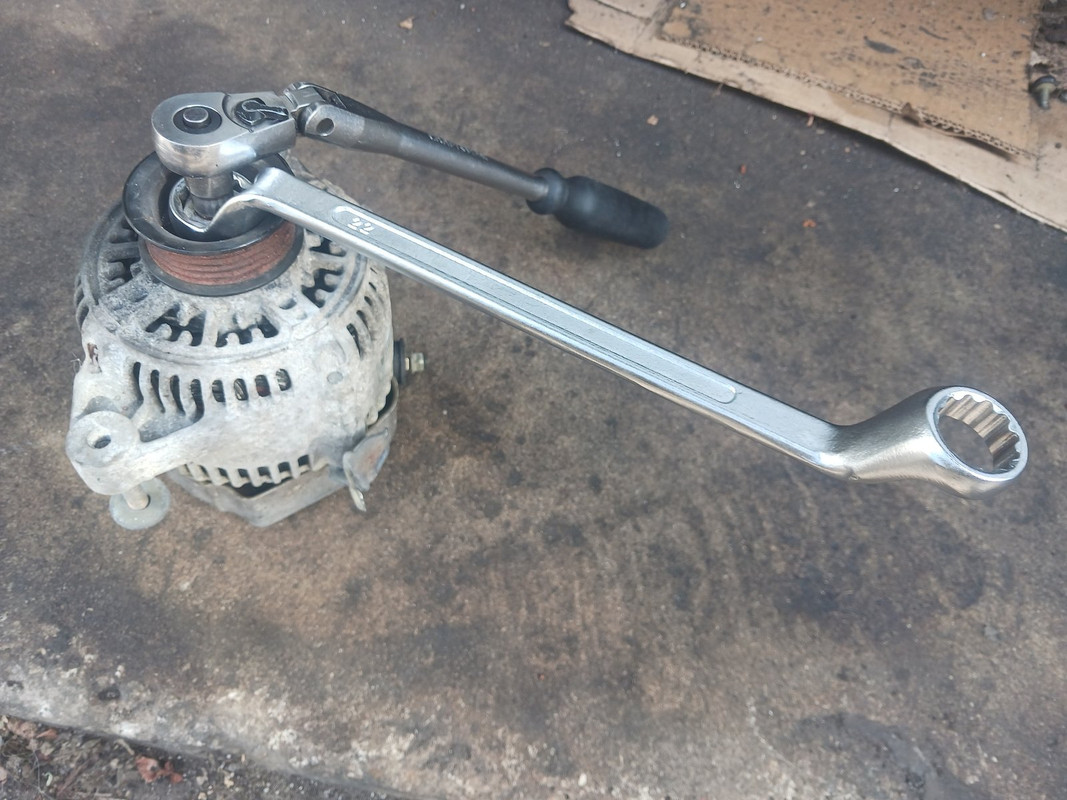
Brian, You are absolutely correct! I was wrong. I was confusing GM Delco alternators, with ND. It's Delco alternators which have the hex opening for an Allen wrench. I had to go lifting hoods to check. Later, I will provide a photo of the wrench set up for tightening the pulley retaining nut. I dug out an old ND off of a 1998 Camry [ND 70 amp big frame] I used a 22mm offset box wrench on the nut and a long 3/8" drive ratchet with a 10mm 6 point socket. Don't use a 12 point socket here, as you may round off the corners of that 10mm hex on the rotor shaft. Wrench sizes may differ on that small frame PP.
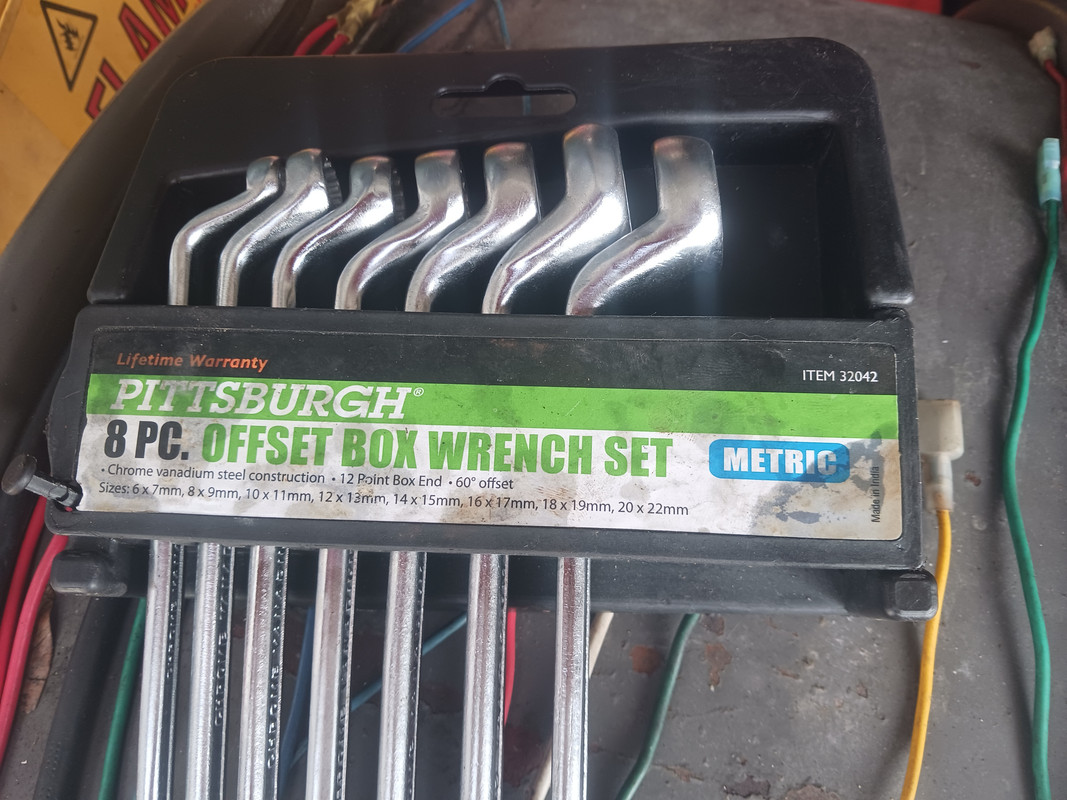
I was given a set of Harbor Freight metric offset box wrenches as a gift many years ago. I've probably used them 4 times in the past 8 years! They still look new. HF P/N for the wrench set is 32042. The offset wrenches are not needed often, but are great when nothing else will fit! Photo to be added later. [cell phone is on the charger]. 4:46 PM EDT phone is off the charger.


Charlie
 
Last edited:
This set of HF offset wrenches are quite affordable. See my previous post for the HF P/N or simply read the label on the wrench set. I just verified that the part number is still valid.


PS If you feel that an SAE set of offset box wrenches would be of more use, the SAE set is HF P/N32041. This may still work, as 22mm = 7/8", 17mm = 11/16", 16mm = 5/8", 11mm = 7/16" & 8mm = 5/16". FYI, they might be "off" by .002" - .005", which is not enough to matter for removing and installing nuts and bolts.
 
Last edited:
snipped
The threads on the PP and ND 101211-2130, and the other ~74mm rotors I had were all right handed (ed. some Bosch and Mitsub rotors are left handed.) I expected the CCW rotors (Plane Power, Honda-ND) to be the opposite. Of note, the nut used on the Plane Power is a flange nut locking type -- think of 1/2 of a Nordlock washer. The ND has no locking feature.

When I do the next tear-down, I'll include gross weights...
Brian, great reporting on this. Can you post a photo of the PP pulley retaining nut?? With a CCW rotating alternator, it will be self tightening if the rotor and nut have a normal right hand thread. Imagine the rotor shaft is a bolt going into the nut. CCW facing the alternator is CW when viewed from the rear. [The head of the bolt would be in the rear.]
When you say "gross weight" what are you including in that weight? Have you had any time to research the Lester # 4989N I mentioned in post #55? I believe that uses the same smaller frame. It will have the correct fan orientation and 15mm rotor front shaft diameter. Hopefully it can be used on or more of the PP models.
Charlie
 
Last edited:
ND rotors (and most of the "clones") do have a male hex embossment (broached) machined into the spindle at the drive end - not a recess hex for an "Allen" wrench; which is still a pain in the --- to use, hold and find the custom joggled/welded box wrench to use on the big nut. The plane power rotor - for which I haven't found the exact ND part -- yet -- has the hex end removed -- weight savings. snipped
Perhaps it could be suggested to PP to broach a hex into the front end of the rotor shaft, ala GM? It would ease removal/installation of the pulley retaining nut and save a few more grams of weight. For the princely sum they charge, they could at least give the owners that minor concession.
 
snipped The outside diameter of the Plane Power AL12-EI60 sheave is 2.75" (~70mm). 4" might be too large to clear the bottom cowl, and keep the same length of belt, and keep the alternator housing clear of the propeller governor oil line...good idea though...snipped
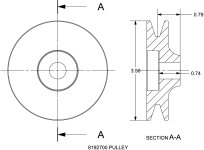
I understand you want to make fixing PP alternator problems as painless as possible for folks. If you feel 4" diameter is to large, perhaps scale up hgerhardt's drawings in post 37 to say 3.25" or 3.50". I can definitely see that a larger diameter pulley could be an issue on something as tightly cowled as an RV-3 or RV-4. I'm sure no one who has a flying RV would want to add a cowl blister and face repainting their cowl.
For those still building, shortening the adjustment bracket or using a slightly shorter or longer belt may be considered a worthwhile sacrifice. In the end, each builder must make their own decisions. You might not be a machinist, but you might know one. [pro or amateur] who could be bribed into making one for you. ;) Kitplanes recently had a nice article on a DIY larger [3.75" diameter] pulley. See

Denso Alternator Homemade Adaption article from Kitplanes

FYI, an investment into a Kitplanes subscription is money well spent!
Charlie
 
Our PP EI60 recently failed after 10-years and 500hrs. Just ordered a B&C SF601 and look forward to installing after all I'm hearing about PP failures. The cost for a new PP is unbelievable!
 
? Years [decades?] ago, 4" diameter aluminum pulleys were available, on VAF and the other RV Lists, as I bought one. Perhaps someone could make a side business of supplying this???
Let me know if there is a market for this. I would be willing to make some. Always looking for projects that create gas money.
 
Let me know if there is a market for this. I would be willing to make some. Always looking for projects that create gas money.
Larry,
My suggestion would be to post a notice in the "group buy" forum. Offer to make a batch if there is enough interest. You could state what you feel is a "minimum number" before you would commit. That way you would have an idea of how much material you need to buy. You could also get a feel for what diameter(s) people want. Perhaps set a price for the most popular diameter and then add a surcharge for the less popular diameters, as that would involve a bit more work for you?

Group Buy forum
 
snipped The outside diameter of the Plane Power AL12-EI60 sheave is 2.75" (~70mm). 4" might be too large to clear the bottom cowl, and keep the same length of belt, and keep the alternator housing clear of the propeller governor oil line...good idea though... snipped
I had 6 vendors who used to sell 3.75" -4.00" diameter pulleys with a 15mm bore. None of my bookmarks are valid now. I have found a vendor on eBay, who offers a 79mm [3.1"] diameter V pulley with a 15mm bore. The majority of ND serpentine belt alternators have a 76mm [2.76"] diameter pulley. That would definitely fit, but would only reduce the alternator's RPM about 720 RPM @ 2,700 engine RPM, so probably not worth the time or money. A 3.5" diameter pulley would reduce the same situation to 7,500 RPM.

Charlie Kuss
 
I had 6 vendors who used to sell 3.75" -4.00" diameter pulleys with a 15mm bore. None of my bookmarks are valid now. I have found a vendor on eBay, who offers a 79mm [3.1"] diameter V pulley with a 15mm bore. The majority of ND serpentine belt alternators have a 76mm [2.76"] diameter pulley. That would definitely fit, but would only reduce the alternator's RPM about 720 RPM @ 2,700 engine RPM, so probably not worth the time or money. A 3.5" diameter pulley would reduce the same situation to 7,500 RPM.

Charlie Kuss

Charlie,

Don't forget about the space needed between the bearing and the inside face of the pulley. I think it needs about 11mm to clear the D.E. nose casting.
 
I had 6 vendors who used to sell 3.75" -4.00" diameter pulleys with a 15mm bore. None of my bookmarks are valid now. I have found a vendor on eBay, who offers a 79mm [3.1"] diameter V pulley with a 15mm bore. The majority of ND serpentine belt alternators have a 76mm [2.76"] diameter pulley. That would definitely fit, but would only reduce the alternator's RPM about 720 RPM @ 2,700 engine RPM, so probably not worth the time or money. A 3.5" diameter pulley would reduce the same situation to 7,500 RPM.

Charlie Kuss
Charlie, what didn't you like about the 3.5" pulley I showed on post 37? To make it fit the Denso you just need to remove 0.19" from the end via lathe. It's available from https://store.alternatorparts.com/8...-lucas-c40t-series-tach-drive-generators.aspx.

1748738276534.jpeg
 
It’s interesting to note that the PMA’d/ Certified versions of the Plane Power units do not appear to have the issues of the ‘Experimental’ version - It been said “you get what you paid for” , a fact of life nowadays in many areas.
 
I worked with the US reps for the bearing and finally with them and the NTN bearing factory in Taiwan for the bearing with expansion rings. I finally got a quote for 10000 pieces under $3. I took the SRE and machined a groove in the housing and inserted a Delrin ring in the ID of the housing. The push in force was about the same as the factory bearing. The housing was baked in the oven at 250F then allowed to cool back to room temperature 10 times then the push out force was 41 lbs at 70F. It was much tighter in the bore when hot.

I believe that if the rear bearing issue was solved, it would last half way to overhaul w/o trouble. The rotor has to be balanced though. In general, alternator rotors, stators and bearings should last 2000 hrs, they should not be primary causes of failures.

And -at $1200 we are not getting what we pay for.
 
Last edited:
Charlie,

Don't forget about the space needed between the bearing and the inside face of the pulley. I think it needs about 11mm to clear the D.E. nose casting.

Looks like this would need a 2.5mm shim behind it.
eBay item number:135901086906
 
Charlie, what didn't you like about the 3.5" pulley I showed on post 37? To make it fit the Denso you just need to remove 0.19" from the end via lathe. It's available from https://store.alternatorparts.com/8...-lucas-c40t-series-tach-drive-generators.aspx.

View attachment 89025
Charlie, what didn't you like about the 3.5" pulley I showed on post 37? To make it fit the Denso you just need to remove 0.19" from the end via lathe. It's available from https://store.alternatorparts.com/8...-lucas-c40t-series-tach-drive-generators.aspx.

View attachment 89025
Very nice. Or move the alternator rearward 0.19".
 
I worked with the US reps for the bearing and finally with them and the NTN bearing factory in Taiwan for the bearing with expansion rings. I finally got a quote for 10000 pieces under $3. I took the SRE and machined a groove in the housing and inserted a Delrin ring in the ID of the housing. The push in force was about the same as the factory bearing. The housing was baked in the oven at 250F then allowed to cool back to room temperature 10 times then the push out force was 41 lbs at 70F. It was much tighter in the bore when hot.

I believe that if the rear bearing issue was solved, it would last half way to overhaul w/o trouble. The rotor has to be balanced though. In general, alternator rotors, stators and bearings should last 2000 hrs, they should not be primary causes of failures.

And -at $1200 we are not getting what we pay for.

Bill,

Who was the beneficiary of your efforts? PP, B&C? It looks like HET/PP moved away from the EC SRE bearing sometime before the H-Snnnnnn serial number range.

The other thing I've noticed that's different between the ND & Clones and the PP is the size of the SRE bearing; In all the 100mm OD stator/106mm OD case units, the DE (front) bearing measures 35x11x15mm, the SRE (rear) measures 32x11x15mm, except the PP which measures 32x9x15 (until recently -- see pic in the OP).

BOM cost for a Unipoint ALT5020 is about $95US. Retail at $135..

So, we are NOT getting what we pay for...not even close...
 
Don't forget about the space needed between the bearing and the inside face of the pulley. I think it needs about 11mm to clear the D.E. nose casting.
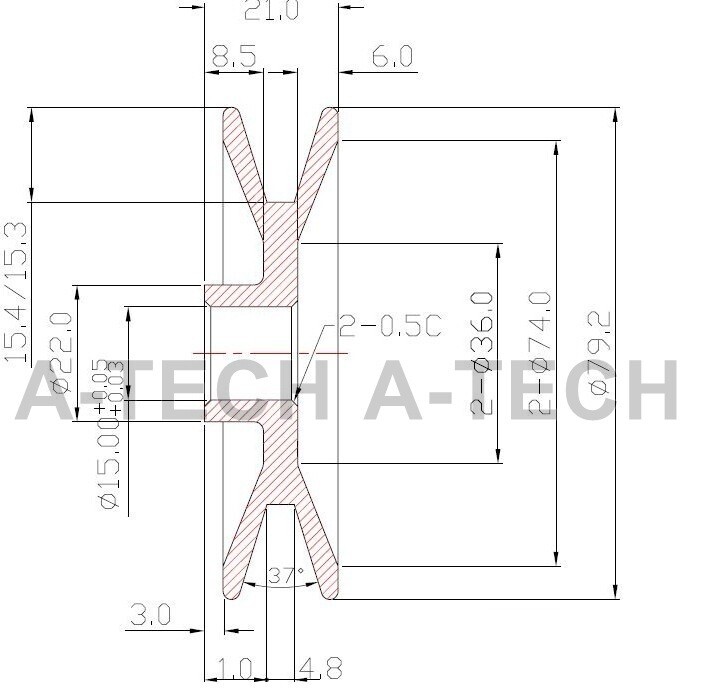
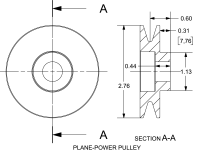
Below is the actual PP pulley which I reverse-engineered previously, but with more dimensions added. You need less than 8mm to clear the casting.

1748790957658.png
 
Below is the actual PP pulley which I reverse-engineered previously, but with more dimensions added. You need less than 8mm to clear the casting.

View attachment 89058
That's what I thought, until I mic'd all three -- no two DE castings are exactly same. The ND -2130 casting is quite deep, compared with the PP; can't swap pulleys between them :(
 
This has been fascinating reading! To add a data point, I have a PlanePower alternator on my plane that first flew in July 2010. It now has just under 1000 hours on it. I have had zero issues with it. It has never once hiccuped. I do have a blast tube fed to the backside of the alternator. I also do not have the crossover exhaust running underneath the alternator. I have four straight pipes running back and down from each cylinder exiting out the bottom and back of the lower cowl. I am sure this is helping keep things cooler in the area surrounding the alternator. Outside of these potential heat differences I wonder if there are internal component differences between my earlier generation alternator and these newer ones. It would be interesting to know why my alternator has lasted 15 years and 1000 hours when newer ones are failing.
 
This has been fascinating reading! To add a data point, I have a PlanePower alternator on my plane that first flew in July 2010. It now has just under 1000 hours on it. I have had zero issues with it. It has never once hiccuped. I do have a blast tube fed to the backside of the alternator. I also do not have the crossover exhaust running underneath the alternator. I have four straight pipes running back and down from each cylinder exiting out the bottom and back of the lower cowl. I am sure this is helping keep things cooler in the area surrounding the alternator. Outside of these potential heat differences I wonder if there are internal component differences between my earlier generation alternator and these newer ones. It would be interesting to know why my alternator has lasted 15 years and 1000 hours when newer ones are failing.
Maybe clean living? ;)

From my experience, THE problem with Plane Power has been way too much anecdote being confused with actual analysis and data. It's human nature, unfortunately.

For the record -- There is 0 evidence that HET/Plane Power does *anything* untoward to save weight by changing parts, or further machining the castings, or using "cheap xxxxxxx parts...", and on and on and on.

Stepping back, and looking at real failures, understanding root cause, and I think you'll find that most of the earlier issues (and ongoing) with PP alternators can be root caused to heat, and vibration. Heat can be easily addressed -- we know how. Solving vibration requires a bit more effort -- which is what B&C does to their rotors. Maybe HET (Tim G. are you out there?) could take that back to the dev. folks.

...and for what it's worth, I am not now, nor have I ever been, in the employ of HET, or any of its subsidiaries. I'm just a retired engineer with more time than money on his hands...with a wife who wants me to stop using our office as a lab...
 
This has been fascinating reading! To add a data point, I have a PlanePower alternator on my plane that first flew in July 2010. It now has just under 1000 hours on it. I have had zero issues with it. It has never once hiccuped. I do have a blast tube fed to the backside of the alternator. I also do not have the crossover exhaust running underneath the alternator. I have four straight pipes running back and down from each cylinder exiting out the bottom and back of the lower cowl. I am sure this is helping keep things cooler in the area surrounding the alternator. Outside of these potential heat differences I wonder if there are internal component differences between my earlier generation alternator and these newer ones. It would be interesting to know why my alternator has lasted 15 years and 1000 hours when newer ones are failing.
I'm having similar luck. My PP first flew in 2009, has 800 hrs on it. It has a blast tube to the back where the electronics are, and a radiation shield on the exhaust pipe that runs nearby. Keeping them cool does seem like a formula for success. Oh, I also replaced the oval plug in the back with an automotive one that has the proper strain relief 'doughnuts' around the pins.
 
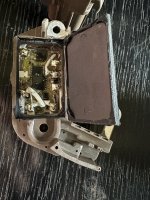
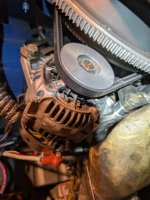
There are three regulators that I'd like to try out with my Plane Power alternator, The INR240, '257, and '259. I ordered a couple of regulators from ebay; that were listed as ND 126000-2400 (WAI INR240) compatible...

IMG_7459.jpg

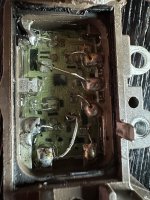
That's a whole lot of sleeve in there, and a 22 pin uController -- who knows what for; maybe a Zero-day alternator attack. Think Stephen King's "Maximum Overdrive." :)

IMG_7460.jpg

...and then there is the "Naked Version" -- Seriously, whomever built this one used de/uncapped components...

So another key learning -- don't buy things off ebay unless you can verify the supply chain.
 
I'll post this question in here as I strongly believe the problem I'm about to describe is related to my Plane Power 60A.

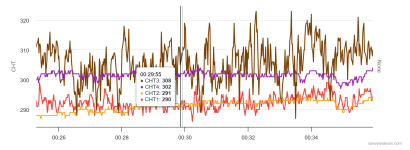
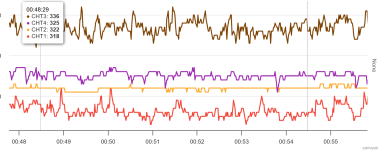
I've owned my RV-8 for about 3 years now (purchased from the 3rd owner). About 2 years ago, I started to get a lot more noise in my CHT #3 and EGT #1 indications. I assumed this noise was related to the probes going bad but now strongly suspect it is related to the alternator. My engine monitor is an AFS 4500s which uses ungrounded probes. Here's an example:
1752464457424.png

This airplane had a reputation with the previous owners for eating alternators; I think the one installed was its 3rd Plane Power, and as a result, the guy I bought it from had procured a spare to fly around with. When I bought it, we found a spot where the starter cable was arcing against the engine case, so I'm sure that wasn't helping. Anyway, a few weeks ago, I started having intermittent system voltage drops. They were odd...my alternator warning lamp didn't come on but I was showing a slight discharge on the ammeter and the system voltage came down to approximately battery level (around 12.0V). If I pulled the field CB, the warning lamp came on and the discharge increased to 8-10A, about what I'd expect my in-flight load to be. I was about to go on a big cross country trip so when it happened the third time I gave in and installed my spare alternator. I think the old one may have been going bad due to the brushes on account of all the black schmutz coming out of it. On the other hand, the lack of voltage regulation it was displaying would seem to indicate it was a voltage regulator issue.

1752465041816.jpeg

After replacing the alternator, my CHT #3 and EGT #1 noise reduced dramatically...for about 15 hours.
1752465209642.png

During my most recent 3 flights, the previous large amount of signal noise has returned.

Questions for the crowd:
1. How would the PP alternator cause this noise? The oscillations are on the scale of seconds long, so I would have thought any noise from rectification would be too fast for my engine monitor to see. It also seems to not affect, or have much less effect, on EGT #3 and CHT #1, despite all those probes being near the alternator and wire. All the probe wires also run together in the same conduit through the firewall with the alternator wire.
2. Could this be an indication that the regulator in my new alternator is already going bad?

Thanks!
 
I'll post this question in here as I strongly believe the problem I'm about to describe is related to my Plane Power 60A.

I've owned my RV-8 for about 3 years now (purchased from the 3rd owner). About 2 years ago, I started to get a lot more noise in my CHT #3 and EGT #1 indications. I assumed this noise was related to the probes going bad but now strongly suspect it is related to the alternator. My engine monitor is an AFS 4500s which uses ungrounded probes. Here's an example:
View attachment 92473

This airplane had a reputation with the previous owners for eating alternators; I think the one installed was its 3rd Plane Power, and as a result, the guy I bought it from had procured a spare to fly around with. When I bought it, we found a spot where the starter cable was arcing against the engine case, so I'm sure that wasn't helping. Anyway, a few weeks ago, I started having intermittent system voltage drops. They were odd...my alternator warning lamp didn't come on but I was showing a slight discharge on the ammeter and the system voltage came down to approximately battery level (around 12.0V). If I pulled the field CB, the warning lamp came on and the discharge increased to 8-10A, about what I'd expect my in-flight load to be. I was about to go on a big cross country trip so when it happened the third time I gave in and installed my spare alternator. I think the old one may have been going bad due to the brushes on account of all the black schmutz coming out of it. On the other hand, the lack of voltage regulation it was displaying would seem to indicate it was a voltage regulator issue.

View attachment 92474

After replacing the alternator, my CHT #3 and EGT #1 noise reduced dramatically...for about 15 hours.
View attachment 92475

During my most recent 3 flights, the previous large amount of signal noise has returned.

Questions for the crowd:
1. How would the PP alternator cause this noise? The oscillations are on the scale of seconds long, so I would have thought any noise from rectification would be too fast for my engine monitor to see. It also seems to not affect, or have much less effect, on EGT #3 and CHT #1, despite all those probes being near the alternator and wire. All the probe wires also run together in the same conduit through the firewall with the alternator wire.
2. Could this be an indication that the regulator in my new alternator is already going bad?

Thanks!
Wow 3 alternator failures. How many hours on the plane? What a Terrible track record. Sure hope you chose a different brand for the fifth. Too bad they don’t put this in the marketing materials. “With PP you can make it to tbo with only 8 alternator replacements. An incredible value!!”

I apologize for taking gabs at pp and not helping you, but don’t have a good answer. Can only say that thermocouple operate on very low voltage (few millivolts) and therefore susceptible to noise. Even the magnetic energy surrounding high current wires.
 
Last edited:
I'll bet you a nickel the problem with your CHT readings is related to the probes and is just a loose connection somewhere, most likely a crimp on a spade connector. I've also seen cases where the insulating sleeve on the probe wire starts fraying and exposes the naked wire, and it touches something else. As Larry @lr172 said, it does not take much to disturb the readings of these probes.
 
I've seen a few posts/replies where it's stated that the engine "comes with" a PP alternator, yet it's listed in the firewall forward kit...are the factory new engines coming with the PP alternator? I surely plan to delete that from the FWF kit if not.

Answering my own question, Vans states that: "Alternators, exhaust systems, vacuum pumps, governors, etc. vary according to aircraft type and are not supplied."
 
Last edited:
Wow 3 alternator failures. How many hours on the plane? What a Terrible track record. Sure hope you chose a different brand for the fifth. Too bad they don’t put this in the marketing materials. “With PP you can make it to tbo with only 8 alternator replacements. An incredible value!!”

I apologize for taking gabs at pp and not helping you, but don’t have a good answer. Can only say that thermocouple operate on very low voltage (few millivolts) and therefore susceptible to noise. Even the magnetic energy surrounding high current wires.
I'm sure the starter cable shorting to the engine case wasn't helping. I'm not sure how long that was going on before I bought it.

It has 1200 hours on it now; I bought it with 800 hours in 2022 (2012 build). This alternator made it at least 400 hours, and part of that time getting to experience some pretty wild transients during start (the field is controlled only via CB).

I am looking at swapping to an ND or B&C at my next annual. 90% of my flying is for travel so I'm also looking at a Monkworkz so I don't get stuck somewhere for alternator issues again.
 
I'll bet you a nickel the problem with your CHT readings is related to the probes and is just a loose connection somewhere, most likely a crimp on a spade connector. I've also seen cases where the insulating sleeve on the probe wire starts fraying and exposes the naked wire, and it touches something else. As Larry @lr172 said, it does not take much to disturb the readings of these probes.

I thought the same. A bit prior to the total failure of the old alternator, I replaced both CHT #3 and EGT #1 and inspected the blade connectors and crimps for both ends and all were very secure. I couldn't find any place in the engine case that any of the wires could be grounding either. I saw the exact same noise out of the new probes.

I wouldn't have tied the probe problem together with the alternator except that when I replaced the alternator, the noise in both probes went away immediately...for about 15 hours. When the noise finally returned, it was on climbout of Gallup, NM, on a summer afternoon, on my 3rd leg of the day. I was thinking maybe I had burned out a diode in the rectifier which would cause more AC in the alternator output. My CHT's were in the 380's which is pretty warm for my engine.
 
I've seen a few posts/replies where it's stated that the engine "comes with" a PP alternator, yet it's listed in the firewall forward kit...are the factory new engines coming with the PP alternator? I surely plan to delete that from the FWF kit if not.

Answering my own question, Vans states that: "Alternators, exhaust systems, vacuum pumps, governors, etc. vary according to aircraft type and are not supplied."
Lycoming does not supply an alternator or at least for my 2 purchased did not. (2016 and 2020) They do include a starter which I requested a SkyTech NL vs the lightweight one SkyTech makes which has also known issues. (Amp hog) I did request Vans to delete the PP alternator that comes with the FWF kit. Highly recommended and went with B&C.
 
@Crash'nF16 -- I suspect that there is an electrical connection issue (e.g. loose ground, loose B+ lead, failing/failed breaker, failing/failed ANL). The B&C, ND will suffer the same fate as the PP unless you get to the root of the problem and resolve it.

PM me if you'd like me to autopsy the old alternator -- maybe revive it, or at least give you some additional insight as to where to look for issues.

B
 
Wow 3 alternator failures. How many hours on the plane? What a Terrible track record. Sure hope you chose a different brand for the fifth. Too bad they don’t put this in the marketing materials. “With PP you can make it to tbo with only 8 alternator replacements. An incredible value!!”
I think we should help our fellow traveller ascertain the root cause of the failure -- you know, get some facts/data, before he throws more $$$ at the problem.
 
I'll bet you a nickel the problem with your CHT readings is related to the probes and is just a loose connection somewhere, most likely a crimp on a spade connector. I've also seen cases where the insulating sleeve on the probe wire starts fraying and exposes the naked wire, and it touches something else. As Larry @lr172 said, it does not take much to disturb the readings of these probes.
Adding to this, I know from personal experience that thermocouple wires, if bound together near spark plug wires, can create all sorts of wild swings on the CHT and EGT readings; Not always, but sporadic and inconsistent. So if you have that case, I would absolutely separate them, but it does raise the question of whether or not a failing alternator, or some other electrical issue, could be creating spiky waveforms on some high current lines that are impacting them.
 
I think we should help our fellow traveller ascertain the root cause of the failure -- you know, get some facts/data, before he throws more $$$ at the problem.
Yes, I should have held my tongue. However, I wasn't recommending buying a new alternator to address this issue.
 
I'll post this question in here as I strongly believe the problem I'm about to describe is related to my Plane Power 60A.

I've owned my RV-8 for about 3 years now (purchased from the 3rd owner). About 2 years ago, I started to get a lot more noise in my CHT #3 and EGT #1 indications. I assumed this noise was related to the probes going bad but now strongly suspect it is related to the alternator. My engine monitor is an AFS 4500s which uses ungrounded probes. Here's an example:
View attachment 92473

This airplane had a reputation with the previous owners for eating alternators; I think the one installed was its 3rd Plane Power, and as a result, the guy I bought it from had procured a spare to fly around with. When I bought it, we found a spot where the starter cable was arcing against the engine case, so I'm sure that wasn't helping. Anyway, a few weeks ago, I started having intermittent system voltage drops. They were odd...my alternator warning lamp didn't come on but I was showing a slight discharge on the ammeter and the system voltage came down to approximately battery level (around 12.0V). If I pulled the field CB, the warning lamp came on and the discharge increased to 8-10A, about what I'd expect my in-flight load to be. I was about to go on a big cross country trip so when it happened the third time I gave in and installed my spare alternator. I think the old one may have been going bad due to the brushes on account of all the black schmutz coming out of it. On the other hand, the lack of voltage regulation it was displaying would seem to indicate it was a voltage regulator issue.

View attachment 92474

After replacing the alternator, my CHT #3 and EGT #1 noise reduced dramatically...for about 15 hours.
View attachment 92475

During my most recent 3 flights, the previous large amount of signal noise has returned.

Questions for the crowd:
1. How would the PP alternator cause this noise? The oscillations are on the scale of seconds long, so I would have thought any noise from rectification would be too fast for my engine monitor to see. It also seems to not affect, or have much less effect, on EGT #3 and CHT #1, despite all those probes being near the alternator and wire. All the probe wires also run together in the same conduit through the firewall with the alternator wire.
2. Could this be an indication that the regulator in my new alternator is already going bad?

Thanks!
Some thoughts/questions.

1. What does the data look like for other thermocouples in the system? What about RTD devices? What does the Volts and AMPS signature look like?
2. Yes, arcing from the starter wire is not a good thing, especially if it's energized all the time. Some builders choose to leave out the starter relay on the firewall, keep the B.F.W. hot all the time, and use the solenoid/starter as the relay. (really stupid IMHO...)
3. My suspicion is an electrical connection issue -- either grounding of or supply to/from alternator. It could also be the connections on the 3 pin plug, but the correct behavior of the Lamp signal points away from that.
 
Some thoughts/questions.

1. What does the data look like for other thermocouples in the system? What about RTD devices? What does the Volts and AMPS signature look like?
2. Yes, arcing from the starter wire is not a good thing, especially if it's energized all the time. Some builders choose to leave out the starter relay on the firewall, keep the B.F.W. hot all the time, and use the solenoid/starter as the relay. (really stupid IMHO...)
3. My suspicion is an electrical connection issue -- either grounding of or supply to/from alternator. It could also be the connections on the 3 pin plug, but the correct behavior of the Lamp signal points away from that.

1. EGT's that aren't #1 and CHT's that aren't #3 are generally within 10 and 5 degrees of fluctuation, respectively. My OAT is very stable, though I don't think it runs near the alternator wire at any point.

I'll provide the whole history. Here's a flight from Feb of 2024, which was typical before I started having these noise issues. CHT #3 is the noisiest but still readable. System voltage is 14.4 +/- 0.1V and shunt amps are steady at about 1-2 the whole flight.

Over time, I started to see more noise in CHT #3 and EGT #1.

This flight is the first when my system voltage dropped to ~12.0V. It looks like it occurred a little after takeoff. I didn't notice it for about 15-20 minutes since my voltage wasn't set to alarm until below 11. I've fixed that now. The alternator lamp did not come on, but after noticing the issue I tried cycling the field with the CB. That did cause the light to come on (when the field was de-energized), but didn't restore the system voltage to 14. Notice that the noise in CHT #3 has increased substantially, even from the high amount before.

On my next flight, the alternator restored itself to 14.4V and maintained that for 3 more flights before I had the 12V issue again. At that point I swapped in the spare alternator that came with the plane. I am missing some engine logs from forgetting to download them, but here's a couple flights after that. As soon as I cranked with the new alternator, my noise had returned to its original low level.

I went on a long cross country and put about 15-20 hours on the new alternator. You can see towards the end of this flight where I started to get the noise again. I've had the noise on all 3 subsequent flights as well.

I feel pretty confident the noise is related to the alternator because if I pull the field CB, the CHT noise goes away nearly completely. Since this noise issue seemed to have precipitated my previous failure, I'm worried my new alternator isn't going to make it very far.

2. This airplane has a starter relay on the firewall. So it was theoretically only arcing when the starter was energized, but it really did a number on the starter cable as you might imagine.

3. I was thinking about a connection issue as well since the problem was intermittent, but when I swapped the alternator out everything felt secure both before and after. It wouldn't be the first time I missed something like that though.

 
1. EGT's that aren't #1 and CHT's that aren't #3 are generally within 10 and 5 degrees of fluctuation, respectively. My OAT is very stable, though I don't think it runs near the alternator wire at any point.

I'll provide the whole history. Here's a flight from Feb of 2024, which was typical before I started having these noise issues. CHT #3 is the noisiest but still readable. System voltage is 14.4 +/- 0.1V and shunt amps are steady at about 1-2 the whole flight.

Over time, I started to see more noise in CHT #3 and EGT #1.

This flight is the first when my system voltage dropped to ~12.0V. It looks like it occurred a little after takeoff. I didn't notice it for about 15-20 minutes since my voltage wasn't set to alarm until below 11. I've fixed that now. The alternator lamp did not come on, but after noticing the issue I tried cycling the field with the CB. That did cause the light to come on (when the field was de-energized), but didn't restore the system voltage to 14. Notice that the noise in CHT #3 has increased substantially, even from the high amount before.

On my next flight, the alternator restored itself to 14.4V and maintained that for 3 more flights before I had the 12V issue again. At that point I swapped in the spare alternator that came with the plane. I am missing some engine logs from forgetting to download them, but here's a couple flights after that. As soon as I cranked with the new alternator, my noise had returned to its original low level.

I went on a long cross country and put about 15-20 hours on the new alternator. You can see towards the end of this flight where I started to get the noise again. I've had the noise on all 3 subsequent flights as well.

I feel pretty confident the noise is related to the alternator because if I pull the field CB, the CHT noise goes away nearly completely. Since this noise issue seemed to have precipitated my previous failure, I'm worried my new alternator isn't going to make it very far.

2. This airplane has a starter relay on the firewall. So it was theoretically only arcing when the starter was energized, but it really did a number on the starter cable as you might imagine.

3. I was thinking about a connection issue as well since the problem was intermittent, but when I swapped the alternator out everything felt secure both before and after. It wouldn't be the first time I missed something like that though.

It's definitely worse, isn't it.

I see little excursions on some of the other parameters -- I suspect that the AF is a more sensitive to AC or DC noise on the rails when it comes to reading the CHT/EGT -- Rob Hickman can comment on how he has the thermocouples wired internally (opamps, LMxxx, open collector/drain, how isolated from buss power/grounds, etc.)

That said, I'd be happy to look at some/all of your alternators and at least give you a feeling of what - if anything - is going on with them. PM/DM me and we can figure it out.

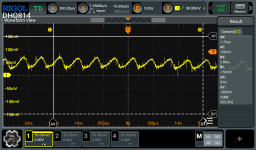
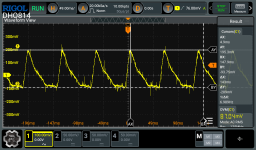
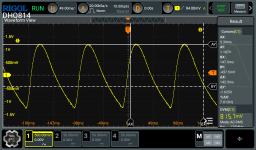
FWIW - This has been a bit of a project (fascination, obsession) for me over the past year. I've measured the "noise" coming from the PP 99-1012 alternators, and it's not terrible - but...it's there.... (attached screen grabs.)

RIpple_capture.png

^^ This capture shows a ~2600Hz signal with a 50mV swing --- this is "ripple" and is caused by the rectification of 3-phase AC. The frequency tracks the engine rpm -> alternator rpm -> number of poles -> number of phases, etc. Engine was running at 1250RPM at the time this was taken.

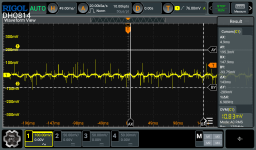
Battery_On_Slow Noise.png

^^ The other signature - shows a ~ 3.5Hz signal with a ~290mV swing -- I believe this is from the field in the alternator being switched on/off by the regulator -- it tracks engine RPM & Current/Load changes.

Battery_OFF.png

^^ This is what happens when you pull the battery off the buss (Master Off, Alternator On) -- the field switching noise changes in amplitude; to the point of tripping the overvoltage protection in the alternator...

Ignition Noise.png

^^ This last one comes from the Dual Lightspeed Plasma III's that I have in my airplane.

So - it would be REALLY interesting if you were to hook up an O-scope and see what's really going on with the alternator...
 
I'm sure the starter cable shorting to the engine case wasn't helping. I'm not sure how long that was going on before I bought it.

It has 1200 hours on it now; I bought it with 800 hours in 2022 (2012 build). This alternator made it at least 400 hours, and part of that time getting to experience some pretty wild transients during start (the field is controlled only via CB).

I am looking at swapping to an ND or B&C at my next annual. 90% of my flying is for travel so I'm also looking at a Monkworkz so I don't get stuck somewhere for alternator issues again.

1. EGT's that aren't #1 and CHT's that aren't #3 are generally within 10 and 5 degrees of fluctuation, respectively. My OAT is very stable, though I don't think it runs near the alternator wire at any point.

I'll provide the whole history. Here's a flight from Feb of 2024, which was typical before I started having these noise issues. CHT #3 is the noisiest but still readable. System voltage is 14.4 +/- 0.1V and shunt amps are steady at about 1-2 the whole flight.

Over time, I started to see more noise in CHT #3 and EGT #1.

This flight is the first when my system voltage dropped to ~12.0V. It looks like it occurred a little after takeoff. I didn't notice it for about 15-20 minutes since my voltage wasn't set to alarm until below 11. I've fixed that now. The alternator lamp did not come on, but after noticing the issue I tried cycling the field with the CB. That did cause the light to come on (when the field was de-energized), but didn't restore the system voltage to 14. Notice that the noise in CHT #3 has increased substantially, even from the high amount before.

On my next flight, the alternator restored itself to 14.4V and maintained that for 3 more flights before I had the 12V issue again. At that point I swapped in the spare alternator that came with the plane. I am missing some engine logs from forgetting to download them, but here's a couple flights after that. As soon as I cranked with the new alternator, my noise had returned to its original low level.

I went on a long cross country and put about 15-20 hours on the new alternator. You can see towards the end of this flight where I started to get the noise again. I've had the noise on all 3 subsequent flights as well.

I feel pretty confident the noise is related to the alternator because if I pull the field CB, the CHT noise goes away nearly completely. Since this noise issue seemed to have precipitated my previous failure, I'm worried my new alternator isn't going to make it very far.

2. This airplane has a starter relay on the firewall. So it was theoretically only arcing when the starter was energized, but it really did a number on the starter cable as you might imagine.

3. I was thinking about a connection issue as well since the problem was intermittent, but when I swapped the alternator out everything felt secure both before and after. It wouldn't be the first time I missed something like that though.

I installed an sds system for a guys 7. He asked me to do the test flights and tuning. I was struggling with egt fluctuations of around 10* while trying to get reliable performance data for tuning. I started turning things off and sure enough they stabilized. Sorry, but can’t remember what the offending appliance was; it may have been the strobes, but was not the alternator. The electrical system was something of a mess and found several errors while wiring the sds, so assumed something was wired wrong and throwing junk on the bus or the ground. Say all this to let you know this doesn’t have to be the alternator or just the alternator.
 
Last edited:
It's definitely worse, isn't it.

I see little excursions on some of the other parameters -- I suspect that the AF is a more sensitive to AC or DC noise on the rails when it comes to reading the CHT/EGT -- Rob Hickman can comment on how he has the thermocouples wired internally (opamps, LMxxx, open collector/drain, how isolated from buss power/grounds, etc.)

That said, I'd be happy to look at some/all of your alternators and at least give you a feeling of what - if anything - is going on with them. PM/DM me and we can figure it out.

FWIW - This has been a bit of a project (fascination, obsession) for me over the past year. I've measured the "noise" coming from the PP 99-1012 alternators, and it's not terrible - but...it's there.... (attached screen grabs.)

View attachment 92545

^^ This capture shows a ~2600Hz signal with a 50mV swing --- this is "ripple" and is caused by the rectification of 3-phase AC. The frequency tracks the engine rpm -> alternator rpm -> number of poles -> number of phases, etc. Engine was running at 1250RPM at the time this was taken.

View attachment 92546

^^ The other signature - shows a ~ 3.5Hz signal with a ~290mV swing -- I believe this is from the field in the alternator being switched on/off by the regulator -- it tracks engine RPM & Current/Load changes.

View attachment 92547

^^ This is what happens when you pull the battery off the buss (Master Off, Alternator On) -- the field switching noise changes in amplitude; to the point of tripping the overvoltage protection in the alternator...

View attachment 92548

^^ This last one comes from the Dual Lightspeed Plasma III's that I have in my airplane.

So - it would be REALLY interesting if you were to hook up an O-scope and see what's really going on with the alternator...
Sent you a DM. I'd really like to know as well. The things I can't make sense of:

1. Why CHT #3 and EGT #1 are affected so much more than the others. I took a look at all my engine probe connections on the right side of the engine and there wasn't anything unique about those two. If there was, I would have expected there to be some change after swapping both of those probes out, but the new ones behaved identically. With its proximity to the alternator and regulator, CHT #1 should be seeing the worst effect but it is pretty stable in comparison.

2. The noise you observed in the oscilloscope at 2600Hz and 3.5 Hz are both happening much faster than the CHT noise swings which seem to be on the order of several seconds. I suppose the sampling the EFIS is probably doing could cause it to look like a longer cycle.

My working theory is that I cooked a rectifier diode and that caused the AC noise to increase. I can't think of anything else that would do it while still permitting the alternator to function. But I have air going into the rear area / rectifier so I'm not sure what else to do besides go to external rectification if that ends up being the case.
 
I installed an sds system for a guys 7. He asked me to do the test flights and tuning. I was struggling with egt fluctuations of around 10* while trying to get reliable performance data for tuning. I started turning things off and sure enough they stabilized. Sorry, but can’t remember what the offending appliance was; it may have been the strobes, but was not the alternator. The electrical system was something of a mess and found several errors while wiring the sds, so assumed something was wired wrong and throwing junk on the bus or the ground. Say all this to let you know this doesn’t have to be the alternator or just the alternator.
That's similar to how I found out it was probably the alternator. I figured I must have something causing that EMI and thought it would be the strobes. When they had no effect, I stepped through every circuit on my airplane until I had every switch off except the master (this was on the ground). Finally I pulled the field CB and the noise settled out instantly. Pushing the CB back in caused the noise to return.
 
That's similar to how I found out it was probably the alternator. I figured I must have something causing that EMI and thought it would be the strobes. When they had no effect, I stepped through every circuit on my airplane until I had every switch off except the master (this was on the ground). Finally I pulled the field CB and the noise settled out instantly. Pushing the CB back in caused the noise to return.
Any chance your thermocouple wires are wrapped in a bundle with the B lead wire?
 
That's similar to how I found out it was probably the alternator. I figured I must have something causing that EMI and thought it would be the strobes. When they had no effect, I stepped through every circuit on my airplane until I had every switch off except the master (this was on the ground). Finally I pulled the field CB and the noise settled out instantly. Pushing the CB back in caused the noise to return.
That sure seems to point to the alternator. Sadly, you wouldn’t be the first that had their pp start failing after 15 hours. May be worth $50 to throw in a cheap auto alternator to see if the problem disappears, as it did last time.
 
Any chance your thermocouple wires are wrapped in a bundle with the B lead wire?
Yeah they all go through the firewall at the same spot. #1 and #3 spend more time with the B lead wire since the pass through is on the bottom left of the firewall (from the pilot's perspective). But it's still odd that #1 CHT and #3 EGT don't have the noise since they have the same distance on the run with the B lead.
 
Back
Top