Van's Air Force

The definitive Van's Aircraft support community! Buying, building or flying an RV? Join our exclusive family of mentors and enthusiasts!

PMAG ON-OFF-TEST switch

Bavafa

Well Known Member
Patron
For those folks with a On-Off-Test switch which typically installed when you don't have a key switch and push to start switch installed, how do you put the PMAG in the setup mode to set the timing?
A PMAG is in a setup mode when it is powered up and P-Lead grounded which then the timing can be set on it. I can imagine this can be a pain particularly if you don't have easy access to the back of the switch to some how ground the P-lead temporarily for the setup/config mode.
 
I setup both of mine to have the serial connection to a db-9 behind the instrument panel. So I can configure with a laptop, or with the EngineBridge wifi-enabled controller.

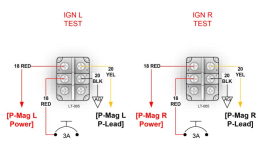
But if the switch is "off", power is applied to the PMAG and the P-lead is grounded. "on" enables the PMAG by ungrounding the P-lead; power is always applied with the master on. "test" removes ship power from the PMAG to test it is self-powering at sunup.
 
I setup both of mine to have the serial connection to a db-9 behind the instrument panel. So I can configure with a laptop, or with the EngineBridge wifi-enabled controller.

But if the switch is "off", power is applied to the PMAG and the P-lead is grounded. "on" enables the PMAG by ungrounding the P-lead; power is always applied with the master on. "test" removes ship power from the PMAG to test it is self-powering at sunup.
From Stein...
 
I setup both of mine to have the serial connection to a db-9 behind the instrument panel. So I can configure with a laptop, or with the EngineBridge wifi-enabled controller.

But if the switch is "off", power is applied to the PMAG and the P-lead is grounded. "on" enables the PMAG by ungrounding the P-lead; power is always applied with the master on. "test" removes ship power from the PMAG to test it is self-powering at sunup.
Great info, thank you.
 
Mine is almost exactly as Bruce. I also routed two cables inside to female d-subs. Male d-subs have to jumper for the "A" curve. Breakers in the panel. I added a spring hinged cover over the start switch. Both are powered by individual fused circuits from a buss off the Master. When Master is on, the p-mags are grounded with power. Set up mode. They go active as soon as they detect rpm.
 
Mine is almost exactly as Bruce. I also routed two cables inside to female d-subs. Male d-subs have to jumper for the "A" curve. Breakers in the panel. I added a spring hinged cover over the start switch. Both are powered by individual fused circuits from a buss off the Master. When Master is on, the p-mags are grounded with power. Set up mode. They go active as soon as they detect rpm.
Since with this setup, the PMAGS are powered just by the Master switch, a point of caution, not to use any trickle charger when master is ON. Emag advises against using trickle charger with the PMAG powered.
 
Personally I find the ‘mag’ check with the 3 pos switch non-intuitive/non-standard, more complex, and more expensive then just pulling the breakers and doing a ‘normal’ mag check.
 
Personally I find the ‘mag’ check with the 3 pos switch non-intuitive/non-standard, more complex, and more expensive then just pulling the breakers and doing a ‘normal’ mag check.
Agreed with Walt.. That's how mine is, it's simple and less failure points!!
 
just pulling the breakers and doing a ‘normal’ mag check.
Definitely not a fan of CB in place of a ON-OFF switch, each have their place and their function. I have ON-OFF switch and the circuit is protected by a CB. I also have a LED above my switch which will light up if the switches are in the OFF position. If they were accidentally left Off, I will know about it.
 
Klixon data spec:

Endurance

2,500 cycles: 120 VAC, 400 Hz inductive
5,000 cycles: 120 VAC, 400 Hz resistive
2,500 cycles: 30 VDC inductive
5,000 cycles: 30 VDC resistive
10,000 cycles: Mechanical, no load
 
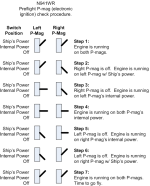
I did it like this, copied shamelessly from Bill Repucci:

View attachment 88588

The above is Precisely why I prefer to use a more traditional way to test the system, certainly not intuitive or standardized.
I’ve been working on RV’s for a long time, on occasion I’ve been unable to decipher a simple start procedure and had to call the owner to figure it out.
 
well.. you *can* make it simple by not testing the internal generator.. just make it on-off and be done? having said that, I prefer my sequence over the one posted above (which does look more complicated than it really is)
 
well.. you *can* make it simple by not testing the internal generator.. just make it on-off and be done? having said that, I prefer my sequence over the one posted above (which does look more complicated than it really is)
Mine is on my checklist.
Basically, turn one off. Test the opposite. Turn it back on. Reverse the procedure.
 
The above is Precisely why I prefer to use a more traditional way to test the system, certainly not intuitive or standardized.
I’ve been working on RV’s for a long time, on occasion I’ve been unable to decipher a simple start procedure and had to call the owner to figure it out.
I agree that the full pmag test procedure looks complex and difficult, but when you've done it once or twice it only takes a few seconds. And if you don't want to do the full test, for whatever reason, just treat it as Larry said - a simple "on/off" procedure. I feel the important part is the switchology - down is off, up is fly, middle is a test state. I like to have all my switches up when in a normal state. If someone wants to fly my aircraft, it's simple. Put all the switches up, push the start button, fly. I even labeled all my switches. 😄
 
Definitely not a fan of CB in place of a ON-OFF switch, each have their place and their function. I have ON-OFF switch and the circuit is protected by a CB. I also have a LED above my switch which will light up if the switches are in the OFF position. If they were accidentally left Off, I will know about it.
You are not using the CB to test them on every flight!!
 
Stein has a lot of good ideas and sells many really good things, but I don't really get the benefits of this set up. I use 2 regular mag switches (could be a keyed switch if that is your preference) and 2 switched breakers. I know the switched breakers have a life but I don't test the generator every flight, just a usual mag check. I've been running at least 1 p-mag for the last 20 years and have not seen a generator failure. There is no need to test every flight. Switched breakers will last a long time and make for a simple system.
 
Been following this thread and am a little confused -
I have the exact setup as post #5(dual Emags). I have been doing mag checks by bringing up RPM’s to 1700 and one at a time switching each mag to off (switch down) watching for corresponding RPM drop. So far all good. Isn’t the mag running on internal power at 1700 RPM ?? What exactly am I testing by moving the switch up to the “test” position. Thought I had an understanding of these guys until I read this thread…
 
Been following this thread and am a little confused -
I have the exact setup as post #5(dual Emags). I have been doing mag checks by bringing up RPM’s to 1700 and one at a time switching each mag to off (switch down) watching for corresponding RPM drop. So far all good. Isn’t the mag running on internal power at 1700 RPM ?? What exactly am I testing by moving the switch up to the “test” position. Thought I had an understanding of these guys until I read this thread…
Turning the off the switch for each P-Mag is actually shutting it down, like a P-Lead on a magneto that grounds the spark. The other test is done to ensure the P-Mag is generating power on its own by removing ship power to the unit. I do this with circuit breakers and test about once a month.
 
I do this with circuit breakers and test about once a month.
This explains your earlier post #18, I and everyone else that I know of does this every single time at the run up. One could ask why not test the MAG ( P-lead) itself once a month?
 
This explains your earlier post #18, I and everyone else that I know of does this every single time at the run up. One could ask why not test the MAG ( P-lead) itself once a month?
The 'P' lead gets tested when you do a standard mag check to verify the unit is actually working.
Let me ask you this, would you cancel a flight away from home if the internal gen wasn't working?
 
Let me ask you this, would you cancel a flight away from home if the internal gen wasn't working?
Probably yes. I say probably based on how far away home is, what kind of terrain I am flying over, night or day. Also, one other difference between knowing a weakness in the system vs not knowing is that one can take his/her route a bit more carefully and be more on his toes just in case.
But I do check my PMAG generator every single time as I don't see any reason not to do. The cost of a couple of switches is not worth it and I prefer build it in such way that gives me the option. If there was any draw back to this design/logic, I would consider it but I see NONE.
 
Turning the off the switch for each P-Mag is actually shutting it down, like a P-Lead on a magneto that grounds the spark. The other test is done to ensure the P-Mag is generating power on its own by removing ship power to the unit. I do this with circuit breakers and test about once a month.
So essentially what you are saying is that the Pmag will function normally even if its own generator fails (reverts to ships power to provide spark). The test mode gets rid of ships power to assure the internal generator is working. Do I have that right ?
 
This explains your earlier post #18, I and everyone else that I know of does this every single time at the run up. One could ask why not test the MAG ( P-lead) itself once a month?
Then you have an unusual group of friends. What risk are you mitigating by testing the generator every flight? I suggest it is a waste of time. Test each mag using the normal "p-lead” switch (I do that at 1900rpm) and go. Test the generators every now and then. If the internal generator fails nothing happens, the aircraft generator supplies power. If the aircraft generator fails nothing happens as the battery supplies power, probably for longer than there is gas in the tanks. Clearly it's your choice how you operate your airplane but from my perspective you are being very cautious.
 
Last edited:
So essentially what you are saying is that the Pmag will function normally even if its own generator fails (reverts to ships power to provide spark). The test mode gets rid of ships power to assure the internal generator is working. Do I have that right ?
Correct.
 
Then you have an unusual group of friends. What risk are you mitigating by testing the generator every flight? I suggest it is a waste of time. Test each mag using the normal "p-lead” switch (I do that at 1900rpm) and go. Test the generators every now and then. If the internal generator fails nothing happens, the aircraft generator supplies power. If the aircraft generator fails nothing happens as the battery supplies power, probably for longer than there is gas in the tanks. Clearly it's your choice how you operate your airplane but from my perspective you are being very cautious.
You are correct, I have unusual group of friends and I am very cautious.
 
I'm running two PMAGS on my -10.

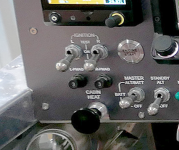
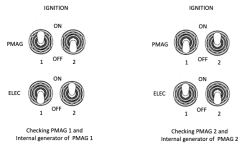
On the panel I have two rows of switches. One row controls the PMAG on/off function (similar to P-lead). The other row controls ship's power to the units.

My ignition check during run up involves turning two switches off at a time in an opposite corner style. NW-SE, and SW-NE. This checks both the PMAG on/off function and the internal generator function. Once you do this a couple of times it becomes second nature during run-ups. This set-up takes me 4 seconds during the runup to complete. See pic.

By the way, I do have a spark advance Off/On switch as well. I find that I can keep cylinder head temps a bit lower by operating with the spark advance OFF. This has come in useful during summer climbs here in Texas. I also think it would be very beneficial to someone breaking-in an engine using PMAGs.

David

P.S. As someone else asked, have you flown home after discovering that the internal generator had failed in one of your PMAGS? My answer...yes. The folks at EMAG repaired it in one day.

1748558346772.png
 
Last edited:
Back
Top