Van's Air Force

The definitive Van's Aircraft support community! Buying, building or flying an RV? Join our exclusive family of mentors and enthusiasts!

Least expensive avionics for IFR flight?

Duncannon

Well Known Member
I’m currently not instrument rated and don’t really have a desire to obtain the rating, but I’ve been contemplating getting it as I would plan to recreationally travel and fly X/C’s if I owned an RV. If I were going to build a Vans (7-9) or bought one with a VFR panel and wished to update, which avionics would be the least expensive while still qualifying for flight in IMC? I don’t plan to do hardcore IFR flight, I’m simply considering the rating to avoid being stranded at a distant airport or worse, stranded in the air due to sudden IMC conditions popping up. So I don’t need a super fancy glass cockpit with dual screens, etc.

I’m painfully aware that the words “inexpensive” and “avionics” do not mix, and even the least expensive panel will probably chew a minimum of a $20k hole in my wallet. I just don’t want to spend $100k on an instrument panel. I’m also aware that if I buy used, it’s far easier/more affordable to go ahead and buy an RV that is already equipped with IFR. I’m asking primarily in case I build. And I may choose not to obtain the rating, but am exploring options just in case.
 
I’m currently not instrument rated and don’t really have a desire to obtain the rating, but I’ve been contemplating getting it as I would plan to recreationally travel and fly X/C’s if I owned an RV. If I were going to build a Vans (7-9) or bought one with a VFR panel and wished to update, which avionics would be the least expensive while still qualifying for flight in IMC? I don’t plan to do hardcore IFR flight, I’m simply considering the rating to avoid being stranded at a distant airport or worse, stranded in the air due to sudden IMC conditions popping up. So I don’t need a super fancy glass cockpit with dual screens, etc.

I’m painfully aware that the words “inexpensive” and “avionics” do not mix, and even the least expensive panel will probably chew a minimum of a $20k hole in my wallet. I just don’t want to spend $100k on an instrument panel. I’m also aware that if I buy used, it’s far easier/more affordable to go ahead and buy an RV that is already equipped with IFR. I’m asking primarily in case I build. And I may choose not to obtain the rating, but am exploring options just in case.
You'll probably get a ton of opinions here, but here's mine.

Absolute minimum equipment and cheapest cost would be a used NAV radio. In reality, VORs are either being decommissioned or NOTAM'd because they are broken.

Another realistic alternative would be the GNX375. This is a GPS/Transponder combo from Garmin. It's likely you'll need ADS-B, so this equipment will meet that regulation, plus it allows for GPS approaches. Most every airport has a GPS approach nowadays. You'll be vulnerable to GPS outages etc, but for minimum equipment this is a good option. You'll probably want to add more equipment, but with a comm radio and the GNX375 you can file and fly IFR no problem, all in 1 box.

I'd also recommend a G5 instead the vacuum or electric driven attitude indicators and directional gyros.

Good luck with your decision.
 
There is no inexpensive way that I know of. An EXPERIMENTAL airplane MUST meet the requirements of instruments called out in 91.205. (Typically 91.205 only applies to "STANDARD" category airplanes but our OpLims state we much for NIGHT and / or IFR operations.)

The most expensive part will be the radios necessary to conduct the IFR flight..
 
You'll probably get a ton of opinions here, but here's mine.

Absolute minimum equipment and cheapest cost would be a used NAV radio. In reality, VORs are either being decommissioned or NOTAM'd because they are broken.

Another realistic alternative would be the GNX375. This is a GPS/Transponder combo from Garmin. It's likely you'll need ADS-B, so this equipment will meet that regulation, plus it allows for GPS approaches. Most every airport has a GPS approach nowadays. You'll be vulnerable to GPS outages etc, but for minimum equipment this is a good option. You'll probably want to add more equipment, but with a comm radio and the GNX375 you can file and fly IFR no problem, all in 1 box.

I'd also recommend a G5 instead the vacuum or electric driven attitude indicators and directional gyros.

Good luck with your decision.

I failed to mention that I still want GPS and ADSB compliance, so I’d still have some modernization.
 
Putting the actual glass panel in is probably not going to be the big expense.

The IFR approved GPS navigator will probably set you back 7-15k dependent on the one you purchase. There’s only a couple of manufacturers in the GA space, Garmin and Avidyne.

You could probably go used as well and find a Garmin 430W somewhere for less. I guess you could also install a VOR/ILS but I don’t think I would go that route.

You need to have an approved navigator to legally file IFR whether no matter the weather.
 
You'll probably get a ton of opinions here, but here's mine.

Absolute minimum equipment and cheapest cost would be a used NAV radio. In reality, VORs are either being decommissioned or NOTAM'd because they are broken.

Another realistic alternative would be the GNX375. This is a GPS/Transponder combo from Garmin. It's likely you'll need ADS-B, so this equipment will meet that regulation, plus it allows for GPS approaches. Most every airport has a GPS approach nowadays. You'll be vulnerable to GPS outages etc, but for minimum equipment this is a good option. You'll probably want to add more equipment, but with a comm radio and the GNX375 you can file and fly IFR no problem, all in 1 box.

I'd also recommend a G5 instead the vacuum or electric driven attitude indicators and directional gyros.

Good luck with your decision.
Read Paul Dye's article in the most recent Kitplanes issue for some thoughts. Bottome line, you'll need an IFR-legal navigator of some sort, be it an IFR GPS or a VOR. As VORs are decommissioned, the latter is inadequate in more and more situations.

There can also be quite a difference between "legal" and safe. While I used to do it all the time 30-40 years ago (steam gauges, of course), I will no longer fly single-pilot IFR without a working autopilot. There are also questions to be asked about what's already there in the VFR panel, what level of redundancy you're comfortable with (might differ if you're going to punch through a 1,000' marine layer to VMC v a scenario where a significant percentage of the flight would be in IMC). Don't forget competency/proficiency. Lots of accident reports with someone who has (had) a rating, but didn't stay proficient. Instrument skills are some of the first to degrade from lack of use. Not trying to be a scare-monger, but it's not as simple as one might wish.
 
You are asking on a Vans (experimental) forum, so you should know that the EAB rules are slightly relaxed, compared to normally certified aircraft, e.g., there are no redundant power rules (although imho they are a very good idea). A big question for you is risk. Are you willing to fly in IMC where a single failure (like an EFIS box) would likely lead to your death? This is allowed under EAB, but not standard certified aircraft. So:
1. Cheapest way to get your rating: ‘mini’ EFIS (Garmin G5, GRT ‘mini-EFIS’, or similar from Dynon), used nav-com (get an SL-30 if you can find one), transponder. Depending on the airspace where you fly, add ADSB, in and out. You may need to travel some distance to find VORs and ILSs to practice on, and take the test. I am a cfii and I would not fly with you in actual IMC due to the single source of attitude, you’d have to do everything vfr under the hood (which I personally do not recommend, but is legal).
2. cheapest practical set up: you need a TSO’d gps. (FARs say ‘approved’ but so far the faa has not approved anything not TSO’d). Unfortunately these are expensive. Lowest cost one is a Garmin GPS-175, about $5.4K (if you do the installation). And another attitude source (at this point many owners go to a ‘full up efis’ (Garmin G3X, GRT 10.1 or similar EFIS, similar from Dynon), as well as a Li battery powered back up mini-efis. Skip the nav-com, but always have a ‘plan B’ in case of gps failure. With this setup I’d be happy to fly mostly in VMC, but do departures and approaches thru layers, with vmc on top.
3. Add an autopilot for multi-hour trips in IMC. Yes, it is possible to hand fly but it’s very tiring. A stand-alone AP (I like the Trio Pro) adds to the redundancy (it will keep the top side up, even shoot a gps approach, if both efis units fail, for about $3K).. You can save $1K by going with an efis-based AP but of course it doesn’t work if that efis fails.
General advice: consider the panel as a whole. E.g., if you go with a Garmin efis you’ll want an adsb-in device that can display on a Garmin panel, etc for the other brands. Lots to think about.
Edit. I forgot with option 2 you’ll need a com radio, too.
 
General advice: consider the panel as a whole.
This is the best advice.

A couple of thoughts:
- There is no such thing as "light IFR".
- A used legacy Skyview will do everything you need. Add a TSO GPS navigator like the GPS-175, the pitch and roll SkyView AP servos and the integrated SkyView ADS-b receiver and you have the bases for a reliable IFR system.

Carl
 
Last edited:
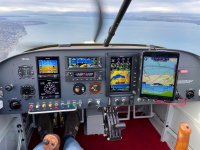
this is the solution I came with (overflying lake Geneva, on the Swiss/French border that is), using what I think reflects most accurately the stuff I was using when flying the Bus... Garmin non-standard dual G5s, GNX 375, G3X as MFD primarily engine display, AV-20S as a different brand last chance BU ADI.
You sure could arrange a similar config with cheaper brands such as GRT...

Ah yeah, an AP is for p...... and fully optional ;)
 

Attachments

  • Copy of IMG_9911.jpg
    Copy of IMG_9911.jpg
    835.8 KB · Views: 208
I do not fly IFR without a dual axis autopilot.

Carl
Same. Given the (relatively…) low cost of dual axis autopilots in EAB world, and the safety and convenience they bring to the table, it’s pretty silly to fly IFR without one IMHO.
 
I have an IFR panel and its functionality and features were basic at the time (non touch G3X/650/ GxPilot AP). The Stein build panel was less/equal than/to my Vans I0360M1B engine. It meets regs, and my personal wants for backups. Some redundancy, but everything. My life depends on it in IMC and cheap or expensive are not words. Stein and Aerotronics both build cost effective panels that can utilize the full functions offered by the manufacturers at a cost effective level.

Personally, I feel a lot better about the flying options with IFR panel, training and currency. Use of the airspace system in VMC or IMC both offer the safest operation for me. Added features and functionality beyond the avionics for flight can cost more, but that is a personal value judgement. Doing more work yourself (knowledge & research) greatly improves the panel regardless of who actually builds it. Mine included and AP and it frees up the hands and brains for timely decision making and cross checks.

My VFR flights are a lot lower stress levels with IFR standing by. There can be a lot of weather in the range of an RV.
 
Go to your local flight school or flying club & ask to sit in an IFR equipped plane. Copy down all the instruments & avionics in that plane. Also take that opportunity to talk to one of their instructors and get their take on so-called ‘light IFR’ flying.
Finally go on one of the big avionics website like Pacific Coast Avionics & price out all those items you listed from your sample plane.
That will get you a realistic idea of a probably later legacy IFR set up. Now times it by 2 if you install it. Times it by 3 or more if you went with a prebuilt/wired package.
 
You will need an IFR navigator, as others have said, and the least expensive of these is a VHF receiver. It gives you acceptable VOR/ILS/LOC-BC reception, as well as enroute navigation capabilities. Of course that will require some sort of course guidance indication in the cockpit - either a CDI, or your compatible EFIS screen if you have one that shows course info. If you have an onboard, but not certified GPS, either built in or handheld, you can use that for enroute IFR navigation as long as you’re in an ATC radar environment, which is most of our country. However, you can’t conduct an instrument approach using this non-certified GPS guidance. You’ll need to use raw data - VOR/ILS/LOC if you don’t have an approach certified GPS navigator, but you should be able to overlay this on your EFIS/GPS screen, as long as you are using the VHF raw data for course guidance.

I’ve done this several times in the past, but you need to realize that you can’t legally conduct a dedicated LNAV/VNAV/LPV approach using nothing but non-certified GPS data. You can do a precision ILS approach, a LOC approach, or a VOR approach, and you can do LNAV/VNAV approach as long as it’s an overlay of a VHF approach, but you’ll need to be able to monitor VHF raw data on that approach to ensure accuracy. I’ve found that not to be a limitation for the airports I’ve visited. It’s a lower cost option for the extremely expensive modern IFR navigators that use GPS for primary approach operations.
 
Used ones.

Dave
People are upgrading to the latest and greatest equipment versions constantly and IFR flying has been around for quite awhile and done successfully with equipment that many here would consider outdated, antique and antiquated (and they’re correct) . With that said much of this old equipment is settling around and otherwise collecting dust on shelves and under benches in hangars everywhere, lots of online places offer these relatively cheap . Where today’s glass panels offer incredible situational awareness almost effortlessly and pictorially represented so well that you’d almost be able to understand what it’s telling you about what’s going on with almost no interpretation on the part of the pilot it’s literally like technically has caught up with science fiction which makes flying IFR incredibly easier than ever before. BUT the “ old fashioned “ stuff still works mostly ( NDB & ADF’s as well as LORAN are gone and good riddance) VOR’s are being decommissioned but there’s still enough to find your way if you’re high enough to get the signal.
So can an IFR panel be put together on the cheap? Yep if you’re able or can find someone willing to hook up all the components. It will tell you all the information that you need to fly in the “ soup and murky “ but you’ll be busier than a one armed paper hanger.
Regarding “lite IFR “ really like being a little “pregnant “ you ether are or your not.

To OP take a flight with an CFII or a truly current and competent instrument rated pilot in REAL instrument conditions and then decide how much information you need to fly successfully in adverse weather conditions.
 
One of the avionics suppliers has put together an IFR “lite” panel. It’s still $30k, and I would add a G5 back up as well.
Not sure you can do IFR cheaply.
 

Attachments

  • image.jpg
    image.jpg
    1.6 MB · Views: 145
This is an interesting question and will get a lot of answers. I am in a similar situation. Finishing a 4 that is mostly a sport plane and just fun to fly, I want to be able to travel some. Having IFR capable is a must. Heres what I'm doing.

Used G430W. $4,500
AV30/Tail Beacon X / AV Mag / AVHSI. New $5000.
Dynon AP controlled by a D10A with an AP74 AP $500

Staying current $$$Priceless

Along with this I have the appropriate round gages. Came with the project.

I can not say enough about staying proficient flying IFR. I live on the east coast and if I travel I file. Its the best way to go, keeps you safe and out of airspace that you don't want to wonder into.

CC
 
Not sure you can do IFR cheaply.
Perhaps not, but you can definitely do it for less than $30K plus another G5.

Two G5s (or equivalent Dynon etc.), a used 430W, an iPad with ForeFlight or equivalent, and the appropriate autopilot would give you a very capable setup with great redundancy. Should be able to do that for under $15K if I’m doing the spitball math right.
 
One of the avionics suppliers has put together an IFR “lite” panel. It’s still $30k, and I would add a G5 back up as well.
Not sure you can do IFR cheaply.
This is pretty close to my setup, capability-wise, except instead of the GTN650 I have a GNX375 plus a backup G5. It was about $30K.

When I consider "lite-IFR" it's more about being in a single-engine airplane that whatever capability I have on the panel. We spend a lot of time in primary flight instruction in forced landing scenarios. As a CFI, I generally teach this maneuver starting about 3,000' AGL, and once a pilot gets the hang of it, I expect them to be able to get to an acceptable solution at almost any point in the flight. But even at 3,000 ft, I often have to steer the flight to somewhere that offers sufficient choices of emergency landing fields.

Now, let's consider the 'lite-IFR" scenario. When we think about IMC ceilings, 1,000 ft overcast is generous to make an instrument approach. But what if you have an engine failure at 8,000 ft cruising altitude and you descend IMC at Vy, pop out of the clouds at 1,000 ft, and now you have to find a field and land on it. To successfully complete this maneuver from 1,000 where you first have visual contact with the ground, you must first be lucky, as your gliding range at 1,000' is pretty small. Secondly, you must be very proficient at emergency landings to have a successful outcome.

How low of a ceiling are you willing to fly in a SE airplane in lite-IFR? Whatever your answer is, go out and fly at that altitude, and simulate and engine failure and see what your options are and how well you could land from there. Be honest with yourself and see how much of the time there are acceptable fields within gliding distance and how often there aren't. Then reconsider what you mean by "lite-IFR."

When I was young and dumb, I flew a Grumman Yankee in IFR on round dials, VOR, ILS, and NDB. I didn't have an autopilot and due to the fuel being inside the wing spar, I could rarely take my hand off the yoke because there wasn't roll trim, and it was almost always out of balance in roll. I never considered a forced landing while IMC and it was only by dumb luck and the grace of God that I survived my own poor decision making.

I’m currently not instrument rated and don’t really have a desire to obtain the rating, but I’ve been contemplating getting it as I would plan to recreationally travel and fly X/C’s if I owned an RV. If I were going to build a Vans (7-9) or bought one with a VFR panel and wished to update, which avionics would be the least expensive while still qualifying for flight in IMC? I don’t plan to do hardcore IFR flight, I’m simply considering the rating to avoid being stranded at a distant airport or worse, stranded in the air due to sudden IMC conditions popping up. So I don’t need a super fancy glass cockpit with dual screens, etc.

I’m painfully aware that the words “inexpensive” and “avionics” do not mix, and even the least expensive panel will probably chew a minimum of a $20k hole in my wallet. I just don’t want to spend $100k on an instrument panel. I’m also aware that if I buy used, it’s far easier/more affordable to go ahead and buy an RV that is already equipped with IFR. I’m asking primarily in case I build. And I may choose not to obtain the rating, but am exploring options just in case.

I'd caution you to honestly evaluate how much risk you are considering with this approach. IFR capability is only as good as your own proficiency. Continued VFR flight into IMC is one of the leading causes of aviation accidents and fatalities. You either have to commit to being an IFR pilot, and constantly train to it, or limit yourself to VMC flying. Do one or the other, because having an IFR rated airplane and a VFR proficient pilot is a bad combination. Accident reports are filled with dead pilots and dead loved ones of pilots who didn't hone their craft and had to get somewhere right then. As they say, when you crash on a bad weather day, it will be a sunny day when you are buried.

 
Used G430W. $4,500
Yup, the used 430W is the king of the “budget” IFR world. GPS plus a navcom and Garmin says they’ll support it for “decades.” Buy a second beater so you have a backup screen if needed and you’re still ahead. 🤣 Unbeatable price/performance compared to new units.
 
As someone said, you will get a ton of different answers. To answer your original question, you can fly IFR with a Garmin GPS 175 and a G5 (referring to the Navigation requirement only - obviously, you need at least 1 com). You can do it for under $10K, it's just that those who have flown IFR know that there is no such thing as not flying hardcore IFR. You are bound to get caught up in the soup and fly in it and THAT is when Murphy shows up... Murphy's law always shows up when you're not ready. Flying in the soup with a single IFR navigator , no VOR, 1 G5, no other attitude indicator . . . yeah, 1 failure away from a really bad day.
 
Whenever this question gets asked, people always jump in with their (usually very good) opinions about IMC flying, rather than what the minimum cover charge to get in to the nightclub is, which is what I think the asker is asking. There is a huge difference between "what's the bare minimum I can legally do IFR training in on a nice sunny day" and "what I would personally require to fly solo in IMC for my own safety and peace of mind."
 
You are asking on a Vans (experimental) forum, so you should know that the EAB rules are slightly relaxed, compared to normally certified aircraft, e.g., there are no redundant power rules (although imho they are a very good idea). A big question for you is risk. Are you willing to fly in IMC where a single failure (like an EFIS box) would likely lead to your death? This is allowed under EAB, but not standard certified aircraft. So:
1. Cheapest way to get your rating: ‘mini’ EFIS (Garmin G5, GRT ‘mini-EFIS’, or similar from Dynon), used nav-com (get an SL-30 if you can find one), transponder. Depending on the airspace where you fly, add ADSB, in and out. You may need to travel some distance to find VORs and ILSs to practice on, and take the test. I am a cfii and I would not fly with you in actual IMC due to the single source of attitude, you’d have to do everything vfr under the hood (which I personally do not recommend, but is legal).
2. cheapest practical set up: you need a TSO’d gps. (FARs say ‘approved’ but so far the faa has not approved anything not TSO’d). Unfortunately these are expensive. Lowest cost one is a Garmin GPS-175, about $5.4K (if you do the installation). And another attitude source (at this point many owners go to a ‘full up efis’ (Garmin G3X, GRT 10.1 or similar EFIS, similar from Dynon), as well as a Li battery powered back up mini-efis. Skip the nav-com, but always have a ‘plan B’ in case of gps failure. With this setup I’d be happy to fly mostly in VMC, but do departures and approaches thru layers, with vmc on top.
3. Add an autopilot for multi-hour trips in IMC. Yes, it is possible to hand fly but it’s very tiring. A stand-alone AP (I like the Trio Pro) adds to the redundancy (it will keep the top side up, even shoot a gps approach, if both efis units fail, for about $3K).. You can save $1K by going with an efis-based AP but of course it doesn’t work if that efis fails.
General advice: consider the panel as a whole. E.g., if you go with a Garmin efis you’ll want an adsb-in device that can display on a Garmin panel, etc for the other brands. Lots to think about.
Edit. I forgot with option 2 you’ll need a com radio, too.
+1 and one additional comment.

If in the above scenario, a GRT EFIS was used and there was a GRT MINI, for the price of a switch, you could have the MINI run their servos in the case of a main EFIS failure.

Now, although the MINI has an internal battery backup, you would NOT have autopilot if you lost main power UNLESS you had redundant power to the servos.

I run such a setup and failed to supply redundant power to the servos and it always bugs me. At some point, I must fix that!
🙂
 
I'll throw in my 2 cents. We had the same decision about our RV. We went all Garmin. 10 inch display, GNX375 (ads-b, transponder and IFR navigator), dual radio, GMC507, and a G5 backup. We also added a 6ah battery backup system. I won't bore you here with every but and bob I bought, but if you're interested I'll give you my complete buy list including install kits. I can total it up, but I bet we were under $25k in 2022 dollars. All new equipment.
 
I’ve written a couple of blog posts on my IFR panel upgrade. I’m still working on getting the rating, but feeling pretty confident about the capabilities in what I have selected.
 
Whenever this question gets asked, people always jump in with their (usually very good) opinions about IMC flying, rather than what the minimum cover charge to get in to the nightclub is, which is what I think the asker is asking. There is a huge difference between "what's the bare minimum I can legally do IFR training in on a nice sunny day" and "what I would personally require to fly solo in IMC for my own safety and peace of mind."
You’re right if you go by the title of this thread, but in this case the chosen title doesn’t match the text of the post. While the title says “least expensive”, the text makes it clear that the OP’s intent would be to use it in IMC, if the circumstances arose. Title is “apples”, actual question asked is “oranges”. Thus, to me at least, what seems on the surface to be thread drift v. the title, really isn’t.
 
Inexpensive and easy for a recently rated pilot to use are not the same. One reason for expensive avionics is that instrument flying can, occasionally, be challenging and expensive avionics helps out. Seriously consider a 2nd attitude source, even a TC, to save your neck. A minimum panel might be a G5, AV-30 as backup (both with internal batteries) plus a GPS 175 (or 355 or 375) plus an SL-30 if one is available. Installing a 430 today is false economy as it may well break tomorrow and be useless. Autopilot (hooked up to G5) is almost essential for anything more than a very brief cloud break.
 
Seriously consider a 2nd attitude source, even a TC, to save your neck.
Agree completely.

Installing a 430 today is false economy as it may well break tomorrow and be useless.
😂 The market apparently disagrees. They still have significant value used.

And for good reason! The only unobtainium part for the 430W is the video screen (not the plastic cover). I’ve been using 430s for 20+ years and have never had a screen break. But like basically anything else, it could happen. If the OP is really worried, he could always get a second “parts” unit as a backup and still be well ahead of the equivalent new unit $ wise.

Sure, the new stuff is better. But if we’re actually talking about budget IFR panels, the 430W is the clear winner, and it’s not even remotely close. New certified IFR GPS/navcomms are five figure$ uninstalled!

I really don’t get the 430W hate around here. 😆

Autopilot (hooked up to G5) is almost essential for anything more than a very brief cloud break.
Agree completely, although the equivalent Dynon etc. systems certainly deserve a look. Garmin QC on the GSA28 has been a bit uneven.
 
An AVMap package would work and can be retained as backup instrumentation if you upgrade later. As others have said, proper planning for any flight is the critical element. A 2 axis autopilot (Dynon) is a real stress reliever in IFR; however it works best when coupled to a compatible Nav instrument i.e. Dynon D100 or later. Just my $.02.
 
You will want to define your IFR missions to get a good idea of what gets you the basic IFR legal equipment and the additional IFR back up equipment you are comfortable with if you don't have an "unlimited budget". You then stick to your risk tolerances on weather to correspond to your proficiency and equipment.

In my case I already had the Skyview system with autopilot so I added the MGL Nav16 radio and Razer head (the interface to the remote radio) and built a wingtip antenna and had it tuned by the local HAM radio club guys. It integrates into the Skyview HSI so you have redundant ILS, LOC and VOR approach displays, and it give you VOR navigation in addition to GPS navigation from the Skyview. If the airports you frequent have ground based radio navigation and approaches you don't really need the expensive Garmin gps navigators. You then add the desired back up instruments on a stand alone basis and reduce the risk of everything tying back to a "single equipment box".

If your airports you frequent only have GPS approaches, then your IFR equipment budget just grew by 2X to 4Xs.
 
I’m currently not instrument rated and don’t really have a desire to obtain the rating, but I’ve been contemplating getting it as I would plan to recreationally travel and fly X/C’s if I owned an RV. If I were going to build a Vans (7-9) or bought one with a VFR panel and wished to update, which avionics would be the least expensive while still qualifying for flight in IMC? I don’t plan to do hardcore IFR flight, I’m simply considering the rating to avoid being stranded at a distant airport or worse, stranded in the air due to sudden IMC conditions popping up. So I don’t need a super fancy glass cockpit with dual screens, etc.

I’m painfully aware that the words “inexpensive” and “avionics” do not mix, and even the least expensive panel will probably chew a minimum of a $20k hole in my wallet. I just don’t want to spend $100k on an instrument panel. I’m also aware that if I buy used, it’s far easier/more affordable to go ahead and buy an RV that is already equipped with IFR. I’m asking primarily in case I build. And I may choose not to obtain the rating, but am exploring options just in case.
Your what if scenario is after you spend 2 years building a plane. The industry will change in that timeframe.

I started buying the pieces to upgrade my daily driver to IFR. Then I figured out how much I was spending and decided to buy a previously flying project RV7 and put the avionics in that.

20k in avionics in a 15k airplane doesn’t make it worth 35k. However by buying a project that needed more than a little work, I think there is more than enough room to bring it up to market value and make it worth my time.
 
My panel cost about $10k and would qualify for minimal IFR:
GRT Sport EX EFIS with 2axis auto pilot
GRT Mini EFIS with battery backup
Trig TR22 Xponder with ADSB
MGL V16 comm
MGL N16 Nav (VOR, ILS GS)
MGL Razor control head
Piper heated pitot
GRT EIS engine monitor

There is room on the panel for the GPS-175 which would boost the cost to $16K.
 
My panel cost about $10k and would qualify for minimal IFR:
GRT Sport EX EFIS with 2axis auto pilot
GRT Mini EFIS with battery backup
Trig TR22 Xponder with ADSB
MGL V16 comm
MGL N16 Nav (VOR, ILS GS)
MGL Razor control head
Piper heated pitot
GRT EIS engine monitor

There is room on the panel for the GPS-175 which would boost the cost to $16K.
Well that was 2021 prices. I priced the list currently and it is about $13,200 without the GPS-175.
 
When thinking about avionics platforms please include in your deliberations what technical documentation, customer support and training videos that vendor offers for its customers. IFR flying is a perilous task and requires pilots to maintain currency in not just flying the aircraft in IMC conditions but also knowledgeable operation of the equipment in their aircraft. Not all your recurring training is accomplished in flight.

Frankly there is very little standardization between avionics manufacturers. Buttonology varies not only across manufacturers but also among manufacturers equipment. Those manufacturers who have developed easy to use documentation and offer a library of useful training videos should (IMHO) be given more weight in deciding what equipment you’re going to use for IMC flight. Also, since your IFR aircraft is going to need a bi-annual IFR certification you should consider what avionics manufacturers are considered “industry standard” by your local avionics shop and what equipment they’re willing to work on. It can suck having to fly 200-300 miles to find an avionics shop to accomplish your bi-annual.

For EFIS systems I believe Garmin and Dynon have the best documentation and customer support. GRT, while good equipment, is not well supported with good documentation or instructional videos. You’ll spent a lot of time trying to learn this equipment and stay current. Garmin is far more popular than Avidyne as an IFR navigator. Battery backup, more than one EFIS, and an autopilot is (again IMHO) absolutely necessary.

Good luck.
 
Also, since your IFR aircraft is going to need a bi-annual IFR certification you should consider what avionics manufacturers are considered “industry standard” by your local avionics shop and what equipment they’re willing to work on.
The biannual static/XPDR check is required. Not sure what you mean by biannual IFR certification.

I pay the local avionics shop to do the check (SkyView), but I always do a careful leak check before hand and I sit in the plane during the check. The last check the shop owner said “you have a big leak on the pitot”. I asked if the pitot drain holes got taped. Nope - his junior helper forgot. The system was tight way up into the flight levels.

I never let any avionic shop touch my panel. I built it, so I am the only person that is going to work on it.

Carl
 
I like to have a capable and reliable radio, at least 10W. With a large display, not a small round control head, and made by a trustworthy company. For me that is Trig or Garmin, used to be King. I find it a small amount of insurance.
 
When thinking about avionics platforms please include in your deliberations what technical documentation, customer support and training videos that vendor offers for its customers. IFR flying is a perilous task and requires pilots to maintain currency in not just flying the aircraft in IMC conditions but also knowledgeable operation of the equipment in their aircraft. Not all your recurring training is accomplished in flight.

Frankly there is very little standardization between avionics manufacturers. Buttonology varies not only across manufacturers but also among manufacturers equipment. Those manufacturers who have developed easy to use documentation and offer a library of useful training videos should (IMHO) be given more weight in deciding what equipment you’re going to use for IMC flight. Also, since your IFR aircraft is going to need a bi-annual IFR certification you should consider what avionics manufacturers are considered “industry standard” by your local avionics shop and what equipment they’re willing to work on. It can suck having to fly 200-300 miles to find an avionics shop to accomplish your bi-annual.

For EFIS systems I believe Garmin and Dynon have the best documentation and customer support. GRT, while good equipment, is not well supported with good documentation or instructional videos. You’ll spent a lot of time trying to learn this equipment and stay current. Garmin is far more popular than Avidyne as an IFR navigator. Battery backup, more than one EFIS, and an autopilot is (again IMHO) absolutely necessary.

Good luck.
Piling onto Jim's comment - I completely agree. I love my GRT but learning to use it is hard mainly due to no simulation on the ground. If you are going to fly IFR, it can help a lot to have something that can run on your pc simulator in order to practice. Or spend a lot of money / time flying with a safety pilot. This is hard with a tandem RV.
 
The biannual static/XPDR check is required. Not sure what you mean by biannual IFR certification?

Carl
Carl,
I’m sure you understood what I meant but for clarification I’m referencing FAR
“§ 91.411 Altimeter system and altitude reporting equipment tests and
inspections” and FAR “§ 91.413 ATC transponder tests and inspections” that are required every 24 months.

My experience over the last ten years demonstrated more and more avionics shops refusing to accomplish the bi-annual certification on GRT equipped panels. This growing unwillingness to support these inspections was explained to me by several shops being due to poor GRT documentation and unresponsive telephone support. It just wasn’t worth their time and effort ( and I was even willing to bring them the needed GRT instructions).

For the record, the RV7A I previously owned had dual GRT EX Horizon EFIS, GRT EIS, GRT ARINC, and their Discovery ADSB-In. It was solid equipment! Played well with the other components of my panel BUT frankly required a significant learning curve that was (IMHO) unnecessarily difficult because of a lack of easy to understand documentation with needed information spread over several various equipment manuals, no company videos, and a CFI /tech counselor community unfamiliar with their equipment. If I had a question that needed GRT help, the only way to get that help was via email with often several emails back and forth before both parties understood the question and answer. Email is okay but can take a lot of time before true communication occurs.

If the OP wants to save a few dollars then by all means look at GRT. However just be prepared to “invest” a significant amount of time in “teaching oneself” how to wire it up, program it, and then operate their systems. The OP will effectively be learning on his own. For my two cents: decide where you want to spend your time and then determine what equipment you want in your IFR panel.
 
Last edited:
For EFIS systems I believe Garmin and Dynon have the best documentation and customer support. GRT, while good equipment, is not well supported with good documentation or instructional videos. You’ll spent a lot of time trying to learn this equipment and stay current. Garmin is far more popular than Avidyne as an IFR navigator. Battery backup, more than one EFIS, and an autopilot is (again IMHO) absolutely necessary.
Agree on all, except I've had much better customer support from GRT than from Garmin.
 
Carl,
I’m sure you understood what I meant but for clarification I’m referencing FAR
“§ 91.411 Altimeter system and altitude reporting equipment tests and
inspections” and FAR “§ 91.413 ATC transponder tests and inspections” that are required every 24 months.

My experience over the last ten years demonstrated more and more avionics shops refusing to accomplish the bi-annual certification on GRT equipped panels. This growing unwillingness to support these inspections was explained to me by several shops being due to poor GRT documentation and unresponsive telephone support. It just wasn’t worth their time and effort ( and I was even willing to bring them the needed GRT instructions).

For the record, the RV7A I previously owned had dual GRT EX Horizon EFIS, GRT EIS, GRT ARINC, and their Discovery ADSB-In. It was solid equipment! Played well with the other components of my panel BUT frankly required a significant learning curve that was (IMHO) unnecessarily difficult because of a lack of easy to understand documentation with needed information spread over several various equipment manuals, no company videos, and a CFI /tech counselor community unfamiliar with their equipment. If I had a question that needed GRT help, the only way to get that help was via email with often several emails back and forth before both parties understood the question and answer. Email is okay but can take a lot of time before true communication occurs.

If the OP wants to save a few dollars then by all means look at GRT. However just be prepared to “invest” a significant amount of time in “teaching oneself” how to wire it up, program it, and then operate their systems. The OP will effectively be learning on his own. For my two cents: decide where you want to spend your time and then determine what equipment you want in your IFR panel.
I have a legacy GRT EFIS in my -10. Fully agree with your comments about the documentation, and because of that, the learning curve needed to make it hum. For example, it took me multiple hours to figure out how to get my autopilot (TruTrak) to couple and fly approaches. The actual procedure are VERY different from what’s described in the manual. I’m not the builder, so I escaped that needed to accomplish the installation.

I’m surprised however by the comments you received from Avionics shops regarding the 91.411 and 91.413 certs, unless perhaps they were regarding the transponder (mine is a Garmin 330ES, not GRT equipment). I guess I’m struggling to understand what sort of tech support they would need. I always remain present while the work is performed, but none of the shops have needed any support. It’s basically been a matter of connecting their equipment, turning it and the avionics on and allowing them to initialize, and letting the tests run. All intuitive stuff on the airplane side. The only issues any of the shops I’ve used have had were 1) a leak in the static system that required a new coupler; and 2) one shop had some minor difficulty getting a good seal around the Gretz pitot tube, which has a somewhat rough surface finish. Of course neither of those were related to the EFIS manufacturer or its documentation. What were the shops needing?
 
Hey guys, the word is “biennial” (every 2 years), not “biannual” (2 times per year). This language confusion is the sole reason the FAA changed the every 2 year flight check from ‘BFR’ to ‘Flight Review’, dropping the biennial because no one could spell it correctly!
And yes, the inspections required by FAR 91.411 and 91.413 are often called ‘pitot static/transponder tests’, and that’s what you need to fly under IFR.
Now, wrt GRT: I personally installed my GRT avionics, one wire at a time. On first power up, everything worked, no smoke. The system has passed 8 pitot-static/transponder tests consecutively over 14+ years, all done by the same local testing shop, no problems. It just works. But, it is true, I have something of an electronics background. I had no trouble with the documentation, but do understand that it is written by engineers, for engineers, and some folks just have trouble with that. Modern avionics systems require hours of study to fully comprehend. This is true of all the brands, but GRT may require a bit more study. (Local flying club, where I used to do cfi work, installed a Garmin EFIS system and autopilot in their 182. When giving check rides, very few of their pilots could explain (or even knew about) the ‘envelope protection function’, nor how to turn it off. My point is, you have to take the time to read thru 100+ page manuals, and many pilots don’t.
 
Back
Top