Van's Air Force

The definitive Van's Aircraft support community! Buying, building or flying an RV? Join our exclusive family of mentors and enthusiasts!

Red cube failure mode

Dorfie

Well Known Member
Friend
Yesterday my FF suddenly went high to about 10gph more than it should be. It changed appropriately with leaning and power changes just stayed about 10 gph too high. No change in engine behavior or seen in any other engine parameters. It has done it once in previous flight for brief time and settled back into normal range. Have not been into PDF settings for long time. Has about 650 hours on it.
Engine is IO-540.
Is this a failure mode of the red cube or should I look somewhere else?
Thank you.
Johan
 
Yesterday my FF suddenly went high to about 10gph more than it should be. It changed appropriately with leaning and power changes just stayed about 10 gph too high. No change in engine behavior or seen in any other engine parameters. It has done it once in previous flight for brief time and settled back into normal range. Have not been into PDF settings for long time. Has about 650 hours on it.
Engine is IO-540.
Is this a failure mode of the red cube or should I look somewhere else?
Thank you.
Johan
Sure sounds like a failure to me. Mine lasted about 700 hrs before it failed. My second one has around 700hrs on it, but still going strong. I keep a spare in the hangar.
 
Sounds interesting — I would reach out to EI and give them the opportunity to assess & diagnose.
 
I was coming back from Massachusetts couple of years ago burning 8 gallons an hour. Fuel flow alarmed. It jumped up to 29 gph! Like you no changes in anything else and engine continued to run fine. First thing I did as a differential diagnosis was to turn boost pump on. If there was a fuel leak distal to the red cube the fuel flow would have increased which it thankfully did not. Started feeling a little better. I Landed at airport just off the nose to troubleshoot. Confirmed No leaks. While checking the red cube and wires, the red power wire fell fell out of where I had connected it to my wiring. I guess with the wiring giving way until there was only a single strand of wire it was at some point just before breaking reaching a point that resistance was changing causing the hight readings. Anyway that was the problem. Took off and back to my usual 7.5-8 gph.
 
Last edited:
Yesterday my FF suddenly went high to about 10gph more than it should be. It changed appropriately with leaning and power changes just stayed about 10 gph too high. No change in engine behavior or seen in any other engine parameters. It has done it once in previous flight for brief time and settled back into normal range. Have not been into PDF settings for long time. Has about 650 hours on it.
Engine is IO-540.
Is this a failure mode of the red cube or should I look somewhere else?
Thank you.
Johan
When my red cube failed (at about 350 hours), the indicated fuel flows would fluctuate between correct, or zero. I'm skeptical that a rotating-vane device would fail with high flow readings. I suppose it could fail electronically, but I don't know what the symptoms would be.

EI says that the life expectancy of an FT-60 should be 10,000 hours. IMHO, that is wildly optimistic.
 
I have only flown my airplane for close to 100 hours. In the last month, I noticed the RedCube was showing 4 to 5 gals / hours at the initial start up of the day where it should be only 2 - 2.5 gal/hour. After about 30 secs, the fuel flow dropped to the normal idle level. This is the only anomaly I detected on the cube so far. I don't think my cube is failing but I am continuing to monitor its behavior with more flight time.
 
It would be interesting to see if there is a correlation between failure times and mounting. My cube is suspended between flex lines after the fuel pumps. Just under 800 hrs so far with no issues. I also wrapped the cube in thin self adhesive heat reflector material.
 
Hard mounted or suspended from the fuel line? Red cubes have been known to read high if subjected to engine vibration (personal knowledge on this).

Carl
Suspended on fuel lines. About 3" fire sleeved line from red cube outflow to fuel divider, about 4" from adel clamp mounted to intercylinder baffle retainer and red cube inflow, also fire sleeved. Fairly sturdy but not hard mounted to engine. I checked with EI and they said it is OK to mount to engine.
Johan
 
I was coming back from Massachusetts couple of years ago burning 8 gallons an hour. Fuel flow alarmed. It jumped up to 29 gph! Like you no changes in anything else and engine continued to run fine. First thing I did as a differential diagnosis was to turn boost pump on. If there was a fuel leak distal to the red cube the fuel flow would have increased which it thankfully did not. Started feeling a little better. I Landed at airport just off the nose to troubleshoot. Confirmed No leaks. While checking the red cube and wires, the red power wire fell fell out of where I had connected it to my wiring. I guess with the wiring giving way until there was only a single strand of wire it was at some point just before breaking reaching a point that resistance was changing causing the hight readings. Anyway that was the problem. Took off and back to my usual 7.5-8 gph.
This sounds so similar to the way mine behaved. I have call in to EI to get their opinion, waiting on them to call back. I cannot think why the rotor pulses will suddenly and consistently increase with the same fuel flow and appropriately varies with mixture and throttle changes. Will remove the top cowl as soon as I can to check the wiring. I've always thought those connection to be a little skimpy!
Thanks.
Johan
 
I've come to believe that electrical connections and/or grounding issues are the culprits in many cases of abbarent instrument readings. Of course when in the air we must always be suspicious of the worst case scenarios and act accordingly. When the power wire literally fell from my crimped connection into my hand which was doing the "jiggling" it was nice in this case the smoking gun was so obvious. Red cube life of 10K... hmmm... I don't know. I have close to 700 hours on mine and with the exception of the issue I had, (which was my own fault in the form of a bad crimped connection), it has worked flawlessly.
Let me add this thought. Over the course of flying my plane there have been a couple times I've had weird readings in other areas... some at times only happening occasionally. Upon checking for the obvious stuff and finding nothing, I decided to just cut out what appeared to be a perfectly good connection and recrimp and even sometimes adding a drop of solder in a few places. Whatever the reasons... coincidence, luck or the new connection It always appeared to have worked.
 
Last edited:
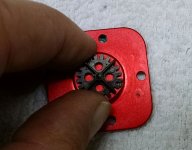
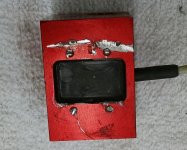
The rotor is the only moving part. It's just a shutter, i.e. not physically connected to anything. The electronics are potted solid. I'd look at wiring.

Trigger.jpg
Potted Electronics.jpg
 
Failing wiring and/connectors; can cause all manner of "bad readings" at the EFIS/EIS.

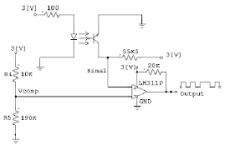
Probably not too different than the attached -- imagine the different failure signatures...

Electronic-circuit-used-with-each-optical-sensor.png
 
Red Cube. Don't get me started.
I have been fighting my red cube since the end of phase 1.
My issue has been a wandering calibration.
I have it between the mech pump and the fuel control unit.
for the first 50 to 100 hours, my counts was set at 77000 and every fill up was less than 1% off.
the next 100 hours, the calibration went to 86000.
the last 50 hours, it seems it wants to be at 80000.
Granted all cals are way off the recommended 65000.

My only thought is to move it to between the fuel control unit and the spider; this might prevent double counting when the electric fuel pump is on.

althou last flight I had a big bubble of air go thru the system as notice by a momentary loss of power during cruise. Perhaps a bubble was in the red cube???
 
The rotor is the only moving part. It's just a shutter, i.e. not physically connected to anything. The electronics are potted solid. I'd look at wiring.

View attachment 71436
View attachment 71437
Dan, I agree.
I believe the cause of the ‘failures’ is/was a design fault. I was also sceptical of the many reports until mine has issues too. Bought a new unit & noticed a very slight difference from my old one , ie the wiring coming out of the cube is now potted in place with resin ? making it more secure however I think the real cause of ‘failures’ of the cube is the stiffness of the white covering on the wiring.
Many of us just bend that to whatever direction is needed the suit the install. That action, in effect, stresses the internal connection causing a break (& sometimes intermittently) into the sensor.
There are 2 ways of preventing that from happening 1. Use a heat gun on the insulation before bending the wiring or 2. Carefully remove the white covering to within say 1/2” to 3/4” from where it exits the cube. Just saying.
 
I'm on my third red cube (RV-14A with IO-390, installed per Vans recommendation). The first one failed at about 180 hours, with the typical failure symptoms - erratic readings, then no fuel flow indication, and would intermittently recover. The second red cube failed hard - no output when measured at the red cube. This one was replaced by EI under warranty.
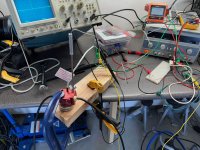
I was interested in the first, "typical" failure, and set up a bench test to try and replicate the problem. I used a constant flow of room temp water through the cube, and set up a measurement system to replicate the aircraft (G3X) installation. The tests were run with a flow rate of about 12 gal/hour.
At room temperature, the failed unit indicated about double the actual flow rate, and was somewhat erratic. As the cube was warmed up, the output stabilized at the correct flow rate, and then became erratic and doubled again as the cube cooled down.
I also tested a new red cube, and found it was correct and consistent at all temps.
The test results seem to indicate that the problem is the red cube electronics, possibly in the sensor comparator circuit. As others have stated, the circuit is potted, and I was unable to remove the potting without damaging the circuit, so no further troubleshooting was possible.

Some observations from testing: the red cube cools very quickly with liquid flow. That, plus the fact that this cube fails only at temps near room temp on the bench but was failing in the aircraft, indicates to me that it is probably relatively cool in flight. If it's thermally damaged, then probably after shutdown. The new red cube I installed has multiple thermal stickers on it to get an idea of the max surface temp it sees in operation.

Link to a short video of the scope on the output as the red cube cools: https://vimeo.com/1015438236?share=copy

Test setup pic:

IMG_2002.jpg
 
Is this the only fuel flow device on the market? I'm not quite to the FWF yet, but it seems like the forums are pretty ripe with "red cube" failures. Are there just no other choices?
 
Dan Gerdes, the picture of your cube shows exactly what I wrote about - also it appears the wiring exit does not have any resin potting done where the wiring exits the cube as more recent manufactured ones. I noticed that the wiring exit is not perpendicular to the cube and also looks like it can move around at that exit & possibly cause stress internally - those internal connections are very delicate.
 
Is this the only fuel flow device on the market? I'm not quite to the FWF yet, but it seems like the forums are pretty ripe with "red cube" failures. Are there just no other choices?
No, you could use the Flowscan 201 units too. This situation reminds me of the saga with CHT/EGT probes, people were replacing the probes when the real cause was the connectors, go figure🙄😉
Btw, I’m continuing using the EI Fuel Flow units, YMMV.
 
I was interested in the first, "typical" failure, and set up a bench test to try and replicate the problem
At room temperature, the failed unit indicated about double the actual flow rate, and was somewhat erratic. As the cube was warmed up, the output stabilized at the correct flow rate, and then became erratic and doubled again as the cube cooled down.

My compliments sir. One measurement is worth 1000 opinions!
 
My compliments sir. One measurement is worth 1000 opinions!
I'm on my third red cube (RV-14A with IO-390, installed per Vans recommendation). The first one failed at about 180 hours, with the typical failure symptoms - erratic readings, then no fuel flow indication, and would intermittently recover. The second red cube failed hard - no output when measured at the red cube. This one was replaced by EI under warranty.
I was interested in the first, "typical" failure, and set up a bench test to try and replicate the problem. I used a constant flow of room temp water through the cube, and set up a measurement system to replicate the aircraft (G3X) installation. The tests were run with a flow rate of about 12 gal/hour.
At room temperature, the failed unit indicated about double the actual flow rate, and was somewhat erratic. As the cube was warmed up, the output stabilized at the correct flow rate, and then became erratic and doubled again as the cube cooled down.
I also tested a new red cube, and found it was correct and consistent at all temps.
The test results seem to indicate that the problem is the red cube electronics, possibly in the sensor comparator circuit. As others have stated, the circuit is potted, and I was unable to remove the potting without damaging the circuit, so no further troubleshooting was possible.

Some observations from testing: the red cube cools very quickly with liquid flow. That, plus the fact that this cube fails only at temps near room temp on the bench but was failing in the aircraft, indicates to me that it is probably relatively cool in flight. If it's thermally damaged, then probably after shutdown. The new red cube I installed has multiple thermal stickers on it to get an idea of the max surface temp it sees in operation.

Link to a short video of the scope on the output as the red cube cools: https://vimeo.com/1015438236?share=copy

Test setup pic:

View attachment 71452

Dan's testing somewhat proves our theory of the transducer inflight. The failures that we have seen and heard of all seem to be electrical in nature, and not a location issue--although some locations do seem to have more 'electrical" induced failures than others. Attention to powers and grounds, especially the grounds seem to solve alot of the problems. As our friend Dan Horton's autopsy of the transducer has shown, the only moving part is the shutter wheel, and it free spins. The failures dont have to do with debris stopping the shutter wheel, but either the circuitry or the input wiring or connections. Reminds me of the General Motors HEI ignition failures in the mid 70's with the stator wires breaking from movement.
 
Dan's testing somewhat proves our theory of the transducer inflight. The failures that we have seen and heard of all seem to be electrical in nature, and not a location issue--although some locations do seem to have more 'electrical" induced failures than others. Attention to powers and grounds, especially the grounds seem to solve alot of the problems. As our friend Dan Horton's autopsy of the transducer has shown, the only moving part is the shutter wheel, and it free spins. The failures dont have to do with debris stopping the shutter wheel, but either the circuitry or the input wiring or connections. Reminds me of the General Motors HEI ignition failures in the mid 70's with the stator wires breaking from movement.
if the red cube is mounted in line, should one use a ground wire from the case to the airplane?
Maybe that is my problem since flowing fuel can upset electronics with static noise. I think I will do this anyways,
 
if the red cube is mounted in line, should one use a ground wire from the case to the airplane?
Maybe that is my problem since flowing fuel can upset electronics with static noise. I think I will do this anyways,
Run the ground wire back to the EIS box.
 
Run the ground wire back to the EIS box.
I am thinking that the build up of static in the hoses is all concentrating at the red cube since it has nowhere else to go. And the red cube has a tiny ground wire, meant for signal return, to bleed this static. So i think any ground wire NOT going back to EIS, like to structure will clean up my signal to EIS. The anodization doesn't help, but may explain why it was good for the first 100 hours or so; like until the anodization wore off in some certain spot. I'll report back in a month or two my success. (I am not pulling cowl just for this.)
 
Dan's testing somewhat proves our theory of the transducer inflight. The failures that we have seen and heard of all seem to be electrical in nature, and not a location issue--although some locations do seem to have more 'electrical" induced failures than others. Attention to powers and grounds, especially the grounds seem to solve alot of the problems. As our friend Dan Horton's autopsy of the transducer has shown, the only moving part is the shutter wheel, and it free spins. The failures dont have to do with debris stopping the shutter wheel, but either the circuitry or the input wiring or connections. Reminds me of the General Motors HEI ignition failures in the mid 70's with the stator wires breaking from movement.
“the input wiring or connections. Reminds me of the General Motors HEI ignition failures in the mid 70's with the stator wires breaking from movement.
 
Tom, that’s my point - I believe it’s the wiring connection AT the cube. I’d suggest as the wire is so stiff (caused by the white sleeving) most failures are induced by installers bending ( I now use a heat gun) that wiring causing a strain on the internal connections which results in a complete or intermittent failure of the fuel flow. Then temperature can affect the readings too.
Dan - with respect I understand and appreciate the scientific approach however sometimes the ‘in field troubleshooting’ has its place - after all aren’t we in this together to help fellow aviators? 😉
 
Thank you for all the replies and help. Some feedback on my erroneous red cube readings.

I have checked all the wiring from the red cube, and all the connections are good.

I called Electronics International, the manufacturer of the red cube. Not much definitive help. They said it could be dirt (unlikely since it over reads), air bubble but not sure what the effect will be other than erratic behavior or electrical issue. Failure of the rotor is rare. No specific answer to the scenario of over reading the fuel flow yet act appropriately to changes in mixture and throttle. They suggested I contact Garmin since I am not using their monitor, which I did. I was wondering if the K-factor somehow could change itself and account for the over read. Garmin thinks it to be highly unlikely and have never before heard about this happening. The default K-factor for the FT60 red cube is 68,000. I checked mine and it is 66,591, most likely due to a correction I have done long time ago. The difference (2%) does not account for the big difference in the FF I have seen.

I have a new one on order. I know there is no fuel leak after the red cube. We are planning a flight to NC on Sunday to deliver much needed supplies. I am going to do the flight with the current setup and see the behavior. Maybe it is an air bubble!! I know pretty well the fuel consumption and performance at different power settings and altitude, especially at LOP. If problem remains the same, I will put the new red cube in next week.

Will report back.

Thanks to all.

Johan
 
I’ve had a Flowscan fuel transducer in our 182 since 1998 and north of 3000 hours with no failures.

Why is there such an overriding use of the EI “Red Cube” in the RV world? I have a Red Cube that I plan to install in my 14 but I don’t know why I shouldn’t just get a FlowScan.
 
I am thinking that the build up of static in the hoses is all concentrating at the red cube since it has nowhere else to go. And the red cube has a tiny ground wire, meant for signal return, to bleed this static. So i think any ground wire NOT going back to EIS, like to structure will clean up my signal to EIS. The anodization doesn't help, but may explain why it was good for the first 100 hours or so; like until the anodization wore off in some certain spot. I'll report back in a month or two my success. (I am not pulling cowl just for this.)
John, any teflon fuel hose SHOULD be conductive. So, in theory any static would not stop at the cube, but flow through the OTHER conductive hose to the engine fittings to ground. Now---If the engine has a ground issue, then thats something else. Here is our thoughts on location---some builders have issues while others with the same plane, and the same location dont. So my personal theory is it has something to do with the electrical install.
 
I’ve had a Flowscan fuel transducer in our 182 since 1998 and north of 3000 hours with no failures.

Why is there such an overriding use of the EI “Red Cube” in the RV world? I have a Red Cube that I plan to install in my 14 but I don’t know why I shouldn’t just get a FlowScan.
I have wondered this too. I'm simply not a big fan of a company that accepts massive amounts of failures and never addresses the problem. Over time I have definitely noticed a trend with the red cube.... I think we all have.

I am not familiar enough with Flowscan but I would sure like to start considering them. Idk if they have the same failure rate though and maybe you just got lucky? Would love to hear from others on this one.
 
I’ve had a Flowscan fuel transducer in our 182 since 1998 and north of 3000 hours with no failures.

Why is there such an overriding use of the EI “Red Cube” in the RV world? I have a Red Cube that I plan to install in my 14 but I don’t know why I shouldn’t just get a FlowScan.
Most likely because Van's sells/provides Red Cubes as part of the kits and the dominance of Dynon electronics which support the FT-60 and display FF. For RV-12s, Van's has some interesting advice in a SL that addressees erroneous Red Cube FF readings at various altitudes. Basically, they recommend not using it if you have FF errors.


BTW, my FT-60 recently failed at 450 hours on the hobbs. I am sure the powered-on hours are far higher because I regularly run the electronics on the GPU.

John Salak
RV-12 N896HS
 
Most likely because Van's sells/provides Red Cubes as part of the kits and the dominance of Dynon electronics which support the FT-60 and display FF. For RV-12s, Van's has some interesting advice in a SL that addressees erroneous Red Cube FF readings at various altitudes. Basically, they recommend not using it if you have FF errors.


BTW, my FT-60 recently failed at 450 hours on the hobbs. I am sure the powered-on hours are far higher because I regularly run the electronics on the GPU.

John Salak
RV-12 N896HS

Do you still have the failed unit? Care to do an autopsy, post the pictures?
 
Do you still have the failed unit? Care to do an autopsy, post the pictures?
I am not going to remove it until the CI in February, it is installed in the tunnel and is a real pain to get to. My ECU display shows an estimated FF based on injector open timing and rpm and was pretty close to the FT-60 number, so most likely I will take Van's SL advice and not replace it. I will probably hook it up to my scope, like DanG did, to verify a mechanical or electrical failure mode.

I am disappointed that EI does not address whatever the problem(s) is, especially with the 10,000 hour MTBF rating. I hate to think EI's business model is to sell you a new one after 500-700 hours of operation, as opposed to finding the root cause and upgrading the design.

John Salak
RV-12 N896HS
 
John, any teflon fuel hose SHOULD be conductive. So, in theory any static would not stop at the cube, but flow through the OTHER conductive hose to the engine fittings to ground. Now---If the engine has a ground issue, then thats something else. Here is our thoughts on location---some builders have issues while others with the same plane, and the same location dont. So my personal theory is it has something to do with the electrical install.
Then the only thing I can do is relocate it to between the fuel control and spider. I will be calling you for new hoses next time I pull the cowl. Thanks.
 
The red cube has an anodized housing so it is considered non-conductive from a static dissipation standpoint. If you thread an anodized NPT fitting into it, you might get lucky and get some metal-metal contact enough to dissipate charge through it but it certainly isn't guaranteed over the life of the installation. That might explain why they get flaky over time. In fuel systems, if you need a guaranteed path to bleed off charge, then you would normally use a boss port (instead of NPT) with a spot face chem-filmed per MIL-DTL-5541 Class 3 to get an electrical bond of 1 ohm or less or 2.5 milliohms depending on the requirement. For static charge, you just need 1 ohm or less. Then you modify the AN fittings to remove the anodization from the hex face and the flare and also apply chem film to those surfaces. When assembled, you get a conductive path all the way through an LRU from the hoses or tubes on either side. On my uninstalled red cube, I measure continuity between the black power lead and one of the case screws so the case is effectively grounded through the power lead. All the fittings in these airplanes are anodized and things aren't blowing up so static must not be a problem with 100LL (it definitely is a concern with Jet A). I suppose it's possible intermittent electrical contact through the fittings which worsens over time could be upsetting the electronics in the red cube, generating a noisy output. One way to test that would be to sand off the anodization around one of the 1/4 inch mounting holes for a bolt and a lug and run a short wire to the nearest ground point. Be sure to observe the proper washer stackup per AC 43.13-1B Section 11-189 for corrosion protection. Having an extra ground there shouldn't cause a problem and it may help. For anybody who is seeing high readings, if you can get hold of a portable oscilloscope (or laptop with USB DAQ card), look at the output pin going into the GEA or whatever is reading it. I did this in my truck one time to diagnose a broken tooth on the differential ring gear for my ABS system. If you see an irregular or noisy signal, then some sort of filtering between the red cube and avionics might fix it.

-Bob
 
Last edited:
Bob, everything you said is good advice. I hate to dig out my scope on the weekend; it is suppose to be my fun time. So I’ll probably just add the ground wire and see if it helps. If not, I will relocate red cube between fuel control and spider so it wont get hit with double pulses when electric fuel pump is on. Relocation also brings it out of the hot air from the oil cooler ( another correction to a bad idea)
 
Well, Sunday we flew supplies to NC.
At start up and taxi the FF was reading high between 5 and 6GPH. At TO it was back to normal readings. Leaned to 11.7gph, and when I looked again it was reading 23.4gph, pretty close to double, as if it was double counting. Stayed like that all the way. On flight back to home base the FF read correctly all the way. Plane behaved normally.
Yesterday I installed the new red cube. The 3 wires from the red cube and the connections were all good by pulling on them, but on closer inspection there might be some surface corrosion of the wire strands. I am saying this because the strands were not as shiny as new.
The old one will go to DanGerdes for his analysis. Thank you DanGerdes.
Best.
Johan
 
Ya know, I just installed one on my EAB build. The instructions from EI said not to connect the ground if the unit is hard mounted to the fuselage. I guess they did not want two grounds. So, I wonder if two grounds causes this error.
 
I have the red cube, installed 2017 on the engine mount between the fuel pump and the fuel servo and there was erratic readings.
Vibrating environment and about 150F close to the red cube could be the problem.
I moved the red cube behind the firewall firmly bolted to avoid vibration.
It is placed between the electric fuel pump and the mechanical fuel pump.
The fuel line consist of aluminium piping 3/8" and a rubber hose before the fuel servo.
I have seen no problem after the relocation of the red cube.
IO-360, 180 hp max fuel flow 17-18 g.

Good luck
 
I moved the red cube behind the firewall firmly bolted to avoid vibration.
It is placed between the electric fuel pump and the mechanical fuel pump.
I have seen no problem after the relocation of the red cube.
No increase in indicated fuel flow when you switch the electric pump on and off?
 
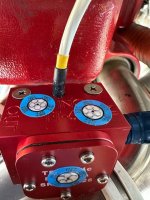
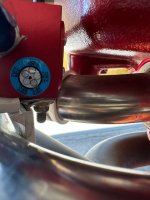
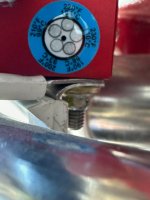
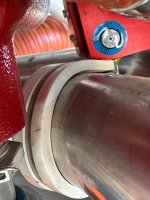
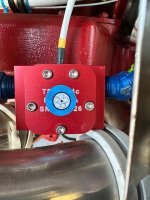
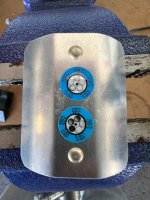
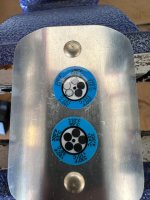
More red cube data. I installed a replacement red cube about 25 hours ago, and placed temp indicator stickers (McMaster) on 4 sides of the sensor, trying to determine if the sensor was exposed to excessive temps.
Pics of the indicators below. There was no indication that the red cube reached even 188 F.

This is the recommended RV14A installation, with heat shields only, no other insulation.
Operating conditions for the last 25 hours were typical San Diego area: warm to hot, but nothing excessive.

Also a couple of pics of a bench test of the stick on sensors, just to confirm they actually work.

IMG_2264.jpegIMG_2269.jpegIMG_2270.jpegIMG_2271.jpegIMG_2263.jpegIMG_2298.jpegIMG_2299.jpeg
 
Yesterday my FF suddenly went high to about 10gph more than it should be. It changed appropriately with leaning and power changes just stayed about 10 gph too high. No change in engine behavior or seen in any other engine parameters. It has done it once in previous flight for brief time and settled back into normal range. Have not been into PDF settings for long time. Has about 650 hours on it.
Engine is IO-540.
Is this a failure mode of the red cube or should I look somewhere else?
Thank you.
Johan
 
More red cube data. I installed a replacement red cube about 25 hours ago, and placed temp indicator stickers (McMaster) on 4 sides of the sensor, trying to determine if the sensor was exposed to excessive temps.
Pics of the indicators below. There was no indication that the red cube reached even 188 F.

This is the recommended RV14A installation, with heat shields only, no other insulation.
Operating conditions for the last 25 hours were typical San Diego area: warm to hot, but nothing excessive.

Also a couple of pics of a bench test of the stick on sensors, just to confirm they actually work.

View attachment 72819View attachment 72820View attachment 72821View attachment 72822View attachment 72818View attachment 72824View attachment 72825
Hey Dan---this is excellent data---especially in your installed location. Somewhat confirms what we already theorized.
 
More red cube data. I installed a replacement red cube about 25 hours ago, and placed temp indicator stickers (McMaster) on 4 sides of the sensor, trying to determine if the sensor was exposed to excessive temps.
Pics of the indicators below. There was no indication that the red cube reached even 188 F.

This is the recommended RV14A installation, with heat shields only, no other insulation.
Operating conditions for the last 25 hours were typical San Diego area: warm to hot, but nothing excessive.

Also a couple of pics of a bench test of the stick on sensors, just to confirm they actually work.

View attachment 72819View attachment 72820View attachment 72821View attachment 72822View attachment 72818View attachment 72824View attachment 72825
If we had an indication of fuel temperature at the inlet to the red cube, we could dispense with another OWT/failure mode...
 
Back
Top