One point to ponder is that when comparing AOA indications (even with the same system) from airplane to airplane (even airplanes of the same type) is like comparing indicated airspeed values--both will vary as a result of calibration. This is one of the primary short-comings of a field calibration: it is difficult to replicate results consistently. This, however,
doesn't lessen the value of AOA for stall avoidance but it may limit the utility for deriving any performance cues (say approach condition, etc.) from displayed data or tone. When calibrated, a differential pressure system should reliably detect stall even in edge cases (ground effect, high sideslip, etc.) since the coefficient of pressure (the difference between the pressures adjusted mathematically) will
always peak at stall. This is what the system is engineered to do: provide progressive stall warning. This doesn't mean the derived AOA solution is accurate in the sense that it's measuring 100% fractional lift (in the case of the Dynon) or actual AOA or body angle in degrees. But again, to emphasize, if calibrated, the system is doing what it's designed to do: warn the pilot of impending loss of lift.
First, let's consider an edge case. I demonstrate this by putting the airplane in a condition that maximizes side slip and allows a sustainable oscillating stall condition to occur. That's a fancy way of saying I stall the airplane at very short intervals (less than 2 seconds) in a sideslip. The takeaway from this demonstration and plot is to note that even when we challenge the sensor, the physics of using differential pressure to detect stall works. In the video note that reliable stall warning occurs prior to stall (loss of stability). This is NOT the Dynon AOA solution driving the tone, but it is a Dynon sensor. All coefficient of pressure AOA systems share this characteristic. In other words, if you calibrate you can have confidence in your system:
Again, the takeaway from the demonstration is that the system accurately detects stall. What's interesting is that the condition is so dynamic, I couldn't tell you what the actual AOA accuracy is; but it doesn't matter. The system detects stall and provides warning. Here is a plot of AOA and sideslip data during the demo:
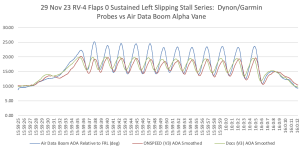
This first plot shows three different AOA solutions, the red line is the solution using the Dynon probe, the green line is the solution using the Garmin probe. Again,
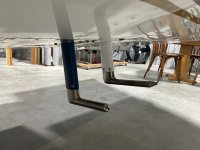
not the Dynon or Garmin AOA system--just the probes, both mounted in the same flow field under the left wing at about 25% chord:
The big takeaway from the first plot is that all three sensors reliably detect stall. There is variability in magnitude (stall angle) and some variability in frequency due to the difference in shape of the sensors and the length of tubing from the pitot/AOA to the pressure sensors. Since measured stall angle is approximately 20 degrees, it appears from this plot that the pressure-derived systems are doing a better job than the boom mounted vane, which is likely subject to inertial effects mounted on the left wing tip. This is also the case in ground effect, where actual critical AOA changes due to upwash effect. That is one of two conditions where that is the case. The other is at extreme pitch rate change, which may be the effect occurring at the alpha vane on the boom. Any time the airplane rotates rapidly, the CL/alpha curve extends momentarily, and you can actually exceed critical AOA without stalling; but there is no free lunch, and the air molecules catch up quickly

.
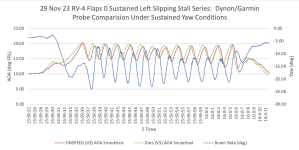
This next plot simply compares the pressure-derived AOA solution to sideslip angle (engineers call that "beta", just like they call AOA "alpha"). Note that the stall is occurring with about 20 degrees of sideslip:
OK, now that we understand that a pressure-derived AOA system will reliably detect a stall if it's calibrated, let's look more specifically at the actual Dynon system. One of our early experiments was asking 10 folks to calibrate their Dynon AOA systems using the same system in similar airplanes and the manufacturer's instructions. The punch line is that all ten calibrations varied, which is exactly what's happening to folks in this thread. The takeaway is that all ten calibrations accurately captured stall, but if you were to compare visual or audio indications, they varied from airplane to airplane.
The first thing to understand, is that the Dynon AOA is a fractional lift measurement, it isn't computing AOA (or body angle) in degrees. When a wing is producing no lift, the fractional (or percent) lift is zero. The wing produces 100% lift just prior to stall. Thus, we can express the "CL/alpha" curve as either a fraction from zero to 1, or simply as a percent. This is just as effective as deriving AOA in degrees. As a matter of fact, a couple of key performance parameters are easily expressed as a % lift: maneuvering speed, stall warning, on speed and L/Dmax ASSUMING the system is accurate enough and has sufficient amplitude of usable AOA signal to do so. The Dynon % lift signal may, or may not meet this requirement depending on the airplane (see the example of the SeaRay above); and, as I said, it's not engineered to do so. It's engineered to provide progressive stall warning.
Let's drill down into this a bit. First, let's consider variation in calibration. All Dynon systems have data recording, and it's practical to download data post flight and export it to a spreadsheet (e.g., Excell, etc.) or MATLAB for some arm-chair analysis for your airplane. The data in these charts were downloaded directly from a Dynon EFIS.
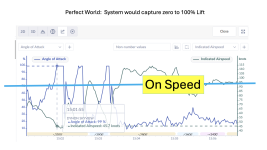
This plot shows what is arguably a perfect single-curve fractional lift calibration with a SkyView system. The "single curve" part is important, at the time of testing, Dynon did not support multiple calibrations to accommodate each flap setting. Any time this is the case, we recommend you calibrate in your normal landing configuration, but again, just looking at the chart, you can see that the system accurately captures stall in each configuration; but visual indications and audio will be different for each because the value of the peak AOA varies. The blue line is % lift, and the red line is IAS. FWIW, this calibration was achieved by an experimental test pilot. The reason I bring it up is that he was unable to duplicate results in subsequent tests.
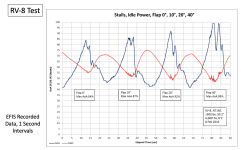
Let's see what the calibration plot shows us. Notice that each stall has a peak and a valley. Notice that other than Flaps 40, the actual peak is not 100% even though we know the wing is working at 100% capacity at the stall. Also notice the valley isn't "zero lift," it's simply some "low AOA cruise condition." The difference between the valley and the peak is the "amplitude" of the AOA solution, or effectively "the range of AOA measurement." Any visual display or tone dependent on signal will vary.
But to foot stomp: The system is accurately capturing stall in each configuration.
Now let's look at a typical field calibration from a different pilot and airplane:
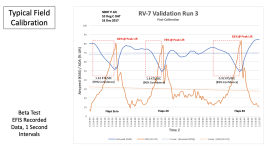
Notice in this case, the pilot consistently achieved "peak lift" at about 80% and the minimum lift at about 15%. The point is, even if you use the same display and tone settings, both of these airplanes would provide slightly different cues other than stall warning; so you can't say "well, I use two yellow bars" or "the start of the chirp tone" on approach in my RV-7 and expect that it will translate to your RV-7 any more than you can compare IAS in two airplanes with a different pitot/static calibration.
So, to summarize: when calibrated, the AOA system provides reliable stall warning, but displays and tones may/will vary with differences in calibration. Calibration is highly dependent on pilot technique, the sensor used and where it is located on the airplane. Without factory or some form of standardized automatic field calibration logic, AOA will simply vary from airplane to airplane, just as IAS does without factory standardization.
In no way does this lessen the value of AOA in the airplane. AOA still provides the best "how hard the wing is working right now" indication of any flight instrumentation system.
Fly safe,
Vac





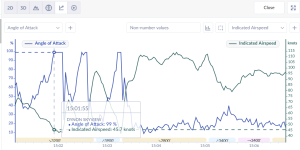
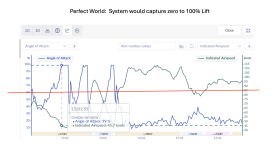
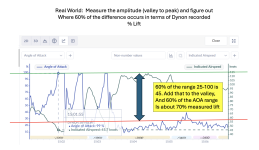
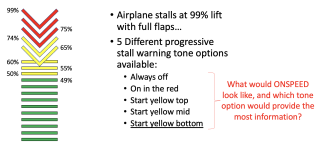
 ), so interpreting the audio would be important to ameliorate some of those effects. Of course, under those conditions, the airspeed would be jumping around as well, there is no free lunch. And there aren't "gust additives" when you fly AOA, but the technique we use is slightly fast until transition to landing. The only way you can land an airplane is when the wing stops working, so it's important to manage kinetics (velocity) and lift (stall margin). Most of the time, as folks transition from a speed cue to an AOA cue for approach, they perceive a "slow" condition, but the reality is they were generally carrying too much speed. The tactical advantage of AOA is it provides stall margin feedback real-time, which is something that you can't do with an airspeed indicator (unless you build yourself a maneuvering buffer for a combination of known g and weight parameters, which then screws up the energy equation). AOA just makes maneuvering and landing easier. It's the "how hard the wing is working" and "power required" gauge.



 ).
).