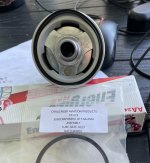
That's what I use on my 7. Still tight but doable with the Tempest filter. A little more room with the K&N 1002 filters I use now. Be about the same when I start using my reusable.:O I didn't even know that existed. That's an awesome idea.


That's what I use on my 7. Still tight but doable with the Tempest filter. A little more room with the K&N 1002 filters I use now. Be about the same when I start using my reusable.:O I didn't even know that existed. That's an awesome idea.

Ha! I knew that! That is what I have! How do you torque it on now? My mind is always trying to figure out something, sometimes pretty bizarre! This is what I came up with today. Went out to the hangar to see if there was a 3/8" square anything that would adapt. Nope. I remember somewhere in my distant mechanical past using a breaker bar (the only thing that would fit) and using a fish scale (Yes, this would be the problem for me. I bought the automotive equivalent to the K&N, which doesn't come with the 1" nut machined into the housing.
On the -6, you'd need something to go into the 3/8" square hole on the cup, and give you a 3/8" socket (or whatever matches your torque wrench) offset about 2-3" to one side to clear the body of the filter. No math is required if you align the axis of the crows foot at 90 degrees to the axis of the torque wrench. That removes the effect of the offset.
 ) to measure the pounds of pull. I have a more sophisticated scale I use to weigh my racing bicycles that measures pounds in 0.1 accuracy. Put at the one foot distance from the center of the breaker bar would give you foot/pounds.....and make everyone around you laugh.....

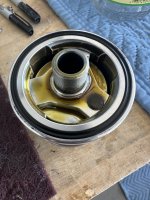
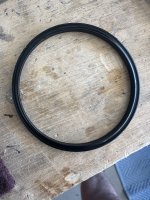
Is this what you mean by "too big"? I've been holding off installing mine until the results from Dans experiment was published. Just inspected mine. I removed the O-ring that came with the filter and tried O-rings from two separate batches, and both fit as the one in the picture. When I went to put the original O-ring back in same issue. To me it appears would be very easy not to notice if the O-ring popped out of the groove upon installation especially if it had excessive pre-lube applied. These O-rings come with a minimal amount of some sort of lubricant. What helps is after install to "message" the ring around the filter redistributing the slight excess material.yep, this ain't good...
Along my S15 I ordered 10 spare o-rings... used the first o-ring for about 300 hours, and then, upon trying to install one of them spares, noticed that all had too big a diameter, though the height of the H seal was correct.
Luckily I was saved by rv8ch who provided some o-rings of the right size (thanks again Mickey).
Some engine stuff is critical. This o-ring, same as the Andair gascolator o-ring, is critical. Requires the right size, some lubrication, a proper torque, and safety wiring.

My unit came with a similar unit specific to the filter.Any chance one of these auto filter wrenches could be used with a 3/8"drive torque wrench? There many sizes and styles to fit auto filters. Just a thought.
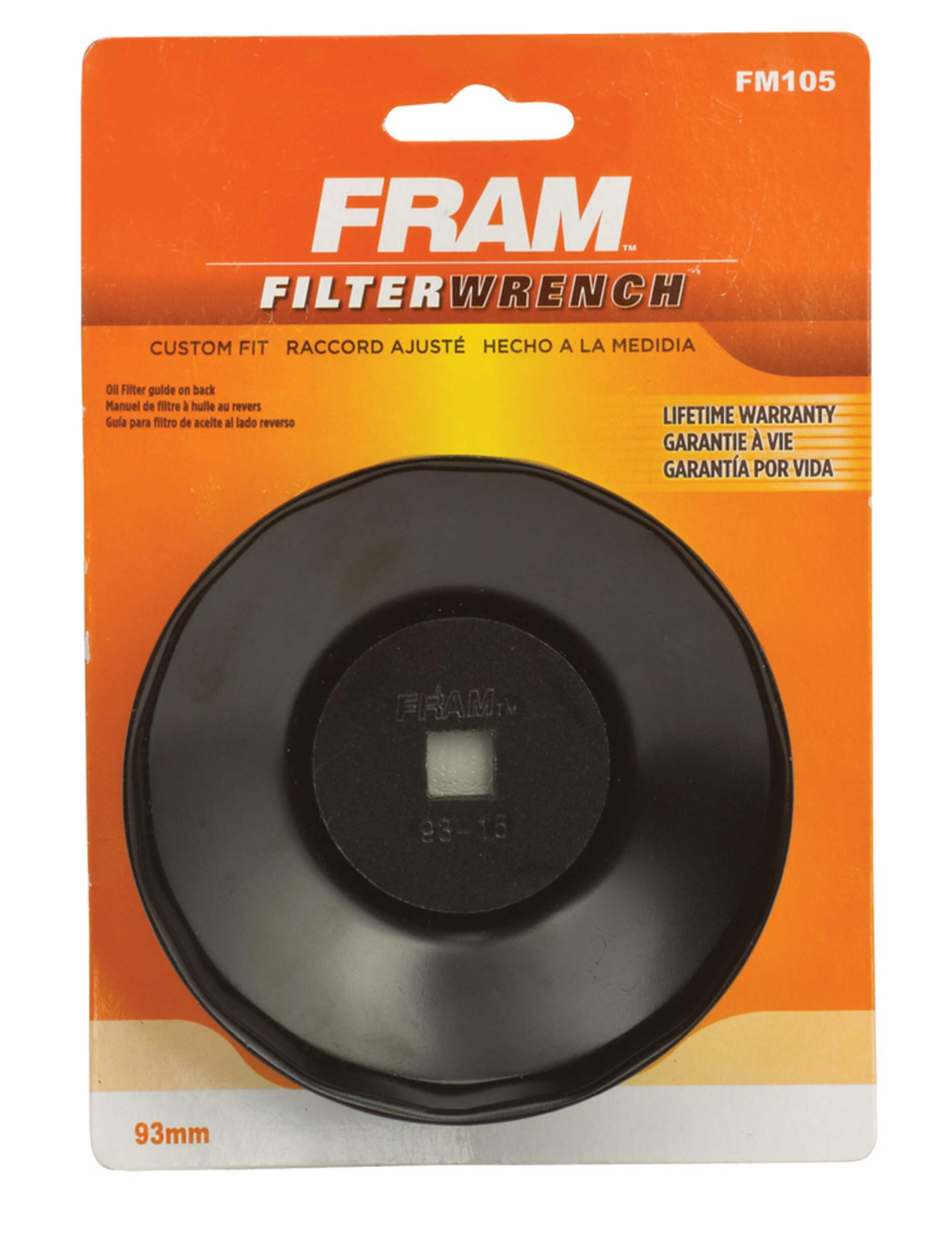


The cost is 3 or 4 times what I paid for mine when it first came out.Maybe room if you used one of these.

I wiped the inside of the S15 with the scotch bright pad and made sure there was lots of purple dust left inside the housingJust an observation - bottom pic shows some FOD stuck to the O-ring. Hopefully you wiped it off well before reinstalling, after letting it get that close to the maroon ScotchBrite on the workbench.
Thanks !!Hi dmattmull, it's been a couple of months now... but I still recall them seals being large enough to not safely fit inside the filter's groove and stay put, e.g. somewhat larger than what your pic shows. I assumed (in aviation never assume, so was I told by my first training captain a couple (of dozens...) of years ago) that there were different sizes available and I just got the wrong ones.

Same here. This makes it hard to use the low profile Tempest wrench however.My unit came with a similar unit specific to the filter.

The automotive version comes with one, but the clearance to the firewall (RV-6, O-320, stock firewall) makes it unusable with a conventional torque wrench.Any chance one of these auto filter wrenches could be used with a 3/8"drive torque wrench? There many sizes and styles to fit auto filters. Just a thought.
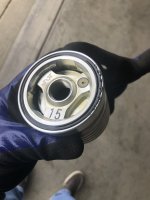

This is what I found on my first oil change with the S15.

I agree - I wonder if this was one of those X-rings that was slightly to large and got caught under the outer lip of the housing? We’re definitely still learning!Looks like one lobe of the X got pinched between the housing and the face of the engine's filter adapter.
Another K&P S15 with O-ring damage...
This is what I found on my first oil change with the S15. Installed per instructions with light coat of oil before torquing. No leaks or pressure issues, but it doesn't give me warm and fuzzy feelings about this filter--definitely would not reuse the o-ring. Also thinking about going back to Tempest until this gets figured out.
View attachment 60247e
Have you or anyone contacted KP engineering? Its only a matter of time before someone gets seriously hurt or worse.

1. How much torque was applied?Another K&P S15 with O-ring damage...
This is what I found on my first oil change with the S15. Installed per instructions with light coat of oil before torquing. No leaks or pressure issues, but it doesn't give me warm and fuzzy feelings about this filter--definitely would not reuse the o-ring. Also thinking about going back to Tempest until this gets figured out.
View attachment 60247
Not so sure of that, look at the ELTs they have signed off on.Can anyone confirm that the certified Challenger version of the S15 uses a similar or different o-ring style? It seems like it is the x profile of the ring that creates the potential issue. I may be a bit ham-fisted, but my experience makes me surprised that the FAA would sign off on such a fragile o-ring system.
OK: this thread freaked me out enough (and I don't freak out easily) that I needed to go check my S15 which has been oil-pressurized but the engine has not yet run. (SOON!) I torqued it to 18ft/lb by torque wrench at the time of installation. Pulling the filter: the "O" ring was well-seated and undamaged. It took a little bit of fingernail action to get it out. The inside of the groove and the bottom of the ring were dry. I decided just to replace it (I might keep the old ring around....) and tried several things. This is a new ring, fresh out of the package from the factory. No lube: it slipped in the groove with a VERY slight bulge. I then lubricated both sides with fresh oil. Put it in the filter and the slight bulge was still there but more difficult to get it to stay reduced (medical term): it rose up a bit more easily. Took it out and there was a small amount of oil in the groove. That likely was pressing on the ring causing it to rise up and the ring was lubricated on the sides as well. Cleaned up the groove of oil and the ring and slipped it back into place. There was still a slight raised section that would 'massage' down enough it might have been raised less than a mm. I SLOWLY put the filter on watching all areas (including what I could see with a mirror) and the ring matched up with the engine perfectly as I torqued it down hand-tight. Torque to 17ft/lb (between the recommended 15-18) and it turned less than one inch past 90 degrees marked with hand-tightening. Safety wire.Follows are pictures of the S15 and O-ring; 50 Hours since new, 2 installations - 16ft/lb torque. 15w-50 oil applied to top surface of seal only. No evidence of wear or deformation.

......Pythagoras turns over in his grave. Yes, the correction is very small, within the noise and variance of the torque wrench, but C^2 = A^2 + B^2.No math is required if you align the axis of the crows foot at 90 degrees to the axis of the torque wrench. That removes the effect of the offset.

Going to Challenge Mr. Smith's assumptions/perspective. I've done stupider things.......Pythagoras turns over in his grave. Yes, the correction is very small, within the noise and variance of the torque wrench, but C^2 = A^2 + B^2.
(I confess to being pedantic here -- for a 24" torque wrench with a 3" extension turned 90°, the effective length is 24 3/16". )
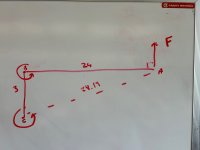
Going to Challenge Mr. Smith's assumptions/perspective. I've done stupider things.
I believe you're making/missing an assumption; that being that the applied force (F @ A) deviates relative to the torque wrench. It shouldn't. If looking at it another way, sum of moments @ B & C, net delta = 0.
View attachment 60381
Edit = Original image from phone didn't attach. Mr Smith is well respected and I'm not. Boy am I gonna hear it if I'm seeing this wrong.
Sorry, It's 24.19 is smudgy white board marker.Your math is off a bit -- CA = 24.186"
One more thing to consider, changing your grip location (F) will also increase/decrease the torque that's applied.
You're right...I failed my thought experiment...Sorry, It's 24.19 is smudgy white board marker.
In general, no Sir. The Torque wrench is reacting to torque at the head; hence, the moment sum reference. Even if a beam torque wrench is used, a properly designed one has the annoying pivoting handle. This is to help ensure a fixed beam length for measuring material deflection (versus actual torque) but the result(ant torque) at the head is the same.
Scott is correct if you are careful to pull on the torque wrench perpendicular to the handle of the wrench. It is difficult to resist the tendency to pull perpendicular to the effective line of action though - line A-C. When you do that, not only is the lever slightly longer, but the force is also slightly larger at the moment the torque wrench 'clicks'. (both by less than 1%, so we really are splitting hairs).Going to Challenge Mr. Smith's assumptions/perspective. I've done stupider things.
I believe you're making/missing an assumption; that being that the applied force (F @ A) deviates relative to the torque wrench. It shouldn't. If looking at it another way, sum of moments @ B & C, net delta = 0.
View attachment 60381
Edit = Original image from phone didn't attach. Mr Smith is well respected and I'm not. Boy am I gonna hear it if I'm seeing this wrong.

Am I the only one that feels slightly dumber after reading the last three posts??? Sheesh...
Not often I get to correct a fellow aeronautical engineer, but Pythagoras can sleep easy. The effective length is still 24" if you are pulling perpendicular to the handle of the wrench.......Pythagoras turns over in his grave. Yes, the correction is very small, within the noise and variance of the torque wrench, but C^2 = A^2 + B^2.
(I confess to being pedantic here -- for a 24" torque wrench with a 3" extension turned 90°, the effective length is 24 3/16". )
Attached is a foto to show the comparison and it was difficult to get a good one but gives us an idea as the S15 O-ring doesn’t have much to compress before you bottom out. I realize that there is only so much meat on the body of the housing and that there are limitations to what they can cut for an O-ring. (I bet reducing the cannister size to cut costs)

Wow! An amazing treatise on Quad rings! Now I can see why those were chosen over flat or round rings....!Tech manual for Quad rings here https://o-ring.info/en/o-ring/technical handbook/21 - eriks nv - o-ring technical handbook - quad-ring x-ring.pdf

How do you guys safety wire the S15 filter?
Or you don't?
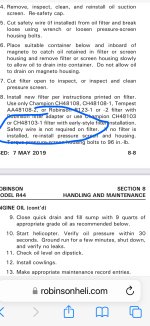 If Robinson helicopter doesn’t require saftey wire on a shaking, vibrating helicopter, I think I’ll be ok.. I’ve never seen a filter come loose.. they are always tighter than when they were put on..
Lots of other places where I wouldn’t mind seeing saftey wire, but aren’t.. Oil hoses, fuel lines.. ect.. but the oil filter? Naaa not neededView attachment 60442If Robinson helicopter doesn’t require saftey wire on a shaking, vibrating helicopter, I think I’ll be ok.. I’ve never seen a filter come loose.. they are always tighter than when they were put on..
Neither have I, the more so the standard filter square seal combination.I’ve never seen a filter come loose..

That's for sure - very interesting reading!Wow! An amazing treatise on Quad rings! Now I can see why those were chosen over flat or round rings....!
Yeah, but why NOT? Added safety: is that ever a bad thing? The top cooling ring on mine was easily drilled in multiple, evenly spaced places and is now safetied (is that a word?) the same way I did the 'standard' oil filters. Now I KNOW it ain't agonna come off!Neither have I, the more so the standard filter square seal combination.
Still, the standard filters have the tabs for the safety wire, why not use it? And yes, I drilled and safety wire my S15 everytime.
I bet there are many parts on an engine, or an RV as a matter of fact, which are safety wired, and which none of us has ever seen come loose...

You are correct if in fact you pull perpendicular to the wrench. My observation is that people often don't. They tend to pull perpendicular to the 'line of action'. See post #286. Its a minor point either way.Not often I get to correct a fellow aeronautical engineer, but Pythagoras can sleep easy. The effective length is still 24" if you are pulling perpendicular to the handle of the wrench.
All good information. It just does not apply to our filters.That's for sure - very interesting reading!
Some interesting points from the document:
- The Gow-Joule effect. The Quad-Ring®/X-Ring should not be installed in a stretched position around the shaft. The inner diameter of the Quad-Ring® /X-Ring needs to be 2-5% larger than the diameter of the shaft.
- The surface finish of the groove always has to be rougher than the surface finish of the shaft to avoid spinning.
- Lubrication of the Quad-Ring®/X-Ring reduces the frictional force, keeps the seal cool, and reduces the tendency of the seal to harden.
I'm not an expert in the field by any measure. Having said that, let me give you an example: when I installed the Tempest I got more or less a full 360 turn from initial contact of the seal with engine block till the filter was properly torqued. Not sure if Champion is any different in that aspect?"How far each O-ring sticks out" is not a measure of how effective the seal will be.