Van's Air Force

The definitive Van's Aircraft support community! Buying, building or flying an RV? Join our exclusive family of mentors and enthusiasts!

Simplified Approach

dual fed engine bus

Dual fed engine bus.

If you use a Bussmann 15600 fuse panel you can feed it from opposite ends to eliminate an FMEA SPOF, loose nut on stud. The fuse panel is easily modified for the 2nd stud; snap the cap off, remove the bus strip, find the 2nd hex hole in the base for the stud head, notch the cap for the 2nd stud you add, reassemble.

Photos here.
.
 
Is there any concern about a bus short or fault in this arrangement? (A bunch of water lands on the fuse block etc)

Typically, fresh water would not be a problem with a 12V bus.
 
Last edited:
Typically, fresh water would not be a problem with q 12V bus.

Just don't let there be any way at all that any water could be "contained"! Symmetry of redundant systems is your enemy. It could have you returning to the foreign country you just left over the ocean :). Don't ask me how I know.
 
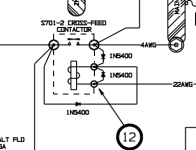
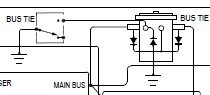
Cross Tie (Bus Tie) which wiring diagram is correct

I have been getting different inputs on how to correctly wire a bus tie. I basically look at the Z-14 drawing and can figure that out and looks correct. I received another drawing what is also proposed to be correct. The diode connected to the ground is my concern. Maybe a better mouse trap but as a non-EE I don't know. This question is not about adding SPOF or added complexity I don't need just are these an acceptable way of wiring a cross feed contactor. Thanks, and as always appreciate the input.
 

Attachments

  • Z-14.png
    Z-14.png
    21.2 KB · Views: 126
  • panel 2.jpg
    panel 2.jpg
    7.6 KB · Views: 383
Last edited:
Use Bob's

Top one is the most airplane standard. The idea is the pair of diodes ensure there is power to the coil regardless which bus has power, and the diode between the coil terminals is a flyback to avoid an arc at the switch when you open it.

Depending on what you use for the diodes to ground you could make the bottom one work, but I don't see any advantage. Letting the energy from the collapsing field when you open circuit dissipate in the contactor coil is a long proven technique.

Derek
 
Thanks

Top one is the most airplane standard. The idea is the pair of diodes ensure there is power to the coil regardless which bus has power, and the diode between the coil terminals is a flyback to avoid an arc at the switch when you open it.

Depending on what you use for the diodes to ground you could make the bottom one work, but I don't see any advantage. Letting the energy from the collapsing field when you open circuit dissipate in the contactor coil is a long proven technique.

Derek

Derek, agreed and thanks. Z-14 has been working for quite some time and no need to reinvent the wheel.
 
I have been getting different inputs on how to correctly wire a bus tie. I basically look at the Z-14 drawing and can figure that out and looks correct. I received another drawing what is also proposed to be correct. The diode connected to the ground is my concern. Maybe a better mouse trap but as a non-EE I don't know. This question is not about adding SPOF or added complexity I don't need just are these an acceptable way of wiring a cross feed contactor. Thanks, and as always appreciate the input.

Seems to me the diode to ground in the 2nd image will not capture the flyback pulse because the flyback is positive.
.
 
Gentlemen, there are no cross feed contactors in the system presented here.
 
Hi Dan - I'm currently mapping out the electrical system for our RV-10 and I ran across this thread.

When I download the JPG of your schematic and zoom in, the image becomes blurry and I can't read the labels (not enough resolution). Would it be possible to post a PDF of the schematic?

Also, you have a tie point where the yellow and white lines meet in the upper right of the schematic. I've seen these "fat wire tie points" in other schematics (maybe Z-101).

How are these tie points physically made? Is this a threaded post? Is this a bus bar with multiple screw terminals?

I know that's a basic question. Just haven't found the answer yet.

Thanks,

Charles
 
... "fat wire tie points"... how are these tie points physically made?

I haven't used one but a FAT wire tie point I have found online is Bussmann Stud Type Junction Block C1933-1, 5/16 studs is same as contactors, only available in black.
 
Hi Dan - I'm currently mapping out the electrical system for our RV-10 and I ran across this thread.

When I download the JPG of your schematic and zoom in, the image becomes blurry and I can't read the labels (not enough resolution). Would it be possible to post a PDF of the schematic?
I would appreciate that too! (If possible)
 
9/13/2023 - Updated drawing at post #149. EFI/EI on single bus with dual feed. EFI/EI bus and avionics busses supplied via MIDI fuses.

I'm going to post recent work, and risk being branded a heretic.

Opinion...the current approach to power supply wiring has become far too complicated, both physically and operationally. Both aspects can be simplified, if we throw out some fixed thinking.

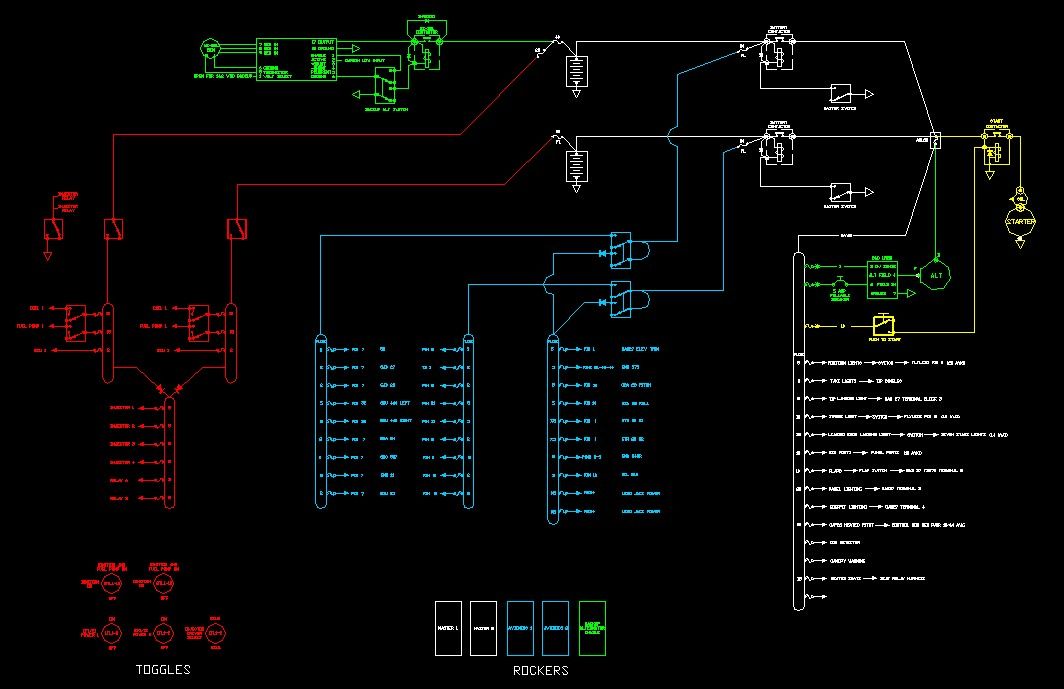
The attached is a dual bus, dual battery, dual generation system, supporting an SDS EFI /EI, and a three screen G3X/G5. Batteries are ETX900's. Primary alternator is a B&C L60 w/ an LR3D. Backup generator is an MZ-30L. The G5 has its own battery.

Yellow: cranking system.
Green: power generation.
Red: EFI/EI.
Blue: avionics.
White: typical main bus functions.

System is effectively modular.

Diagram.jpg


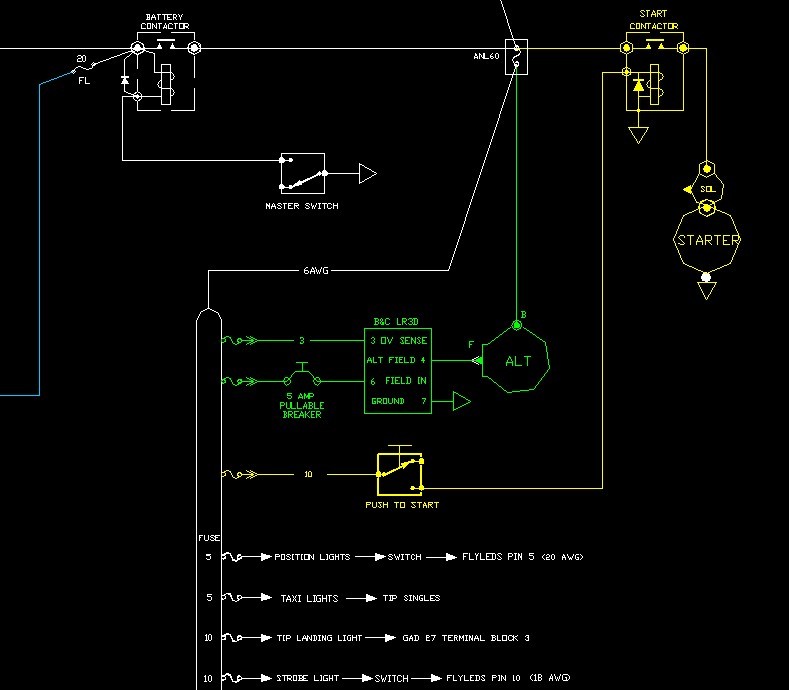
Nothing exotic at the main bus. No field switch, just a pull breaker, which is mostly relegated to being a test function. The LR3C handles overvoltage.

Main%20Bus.jpg


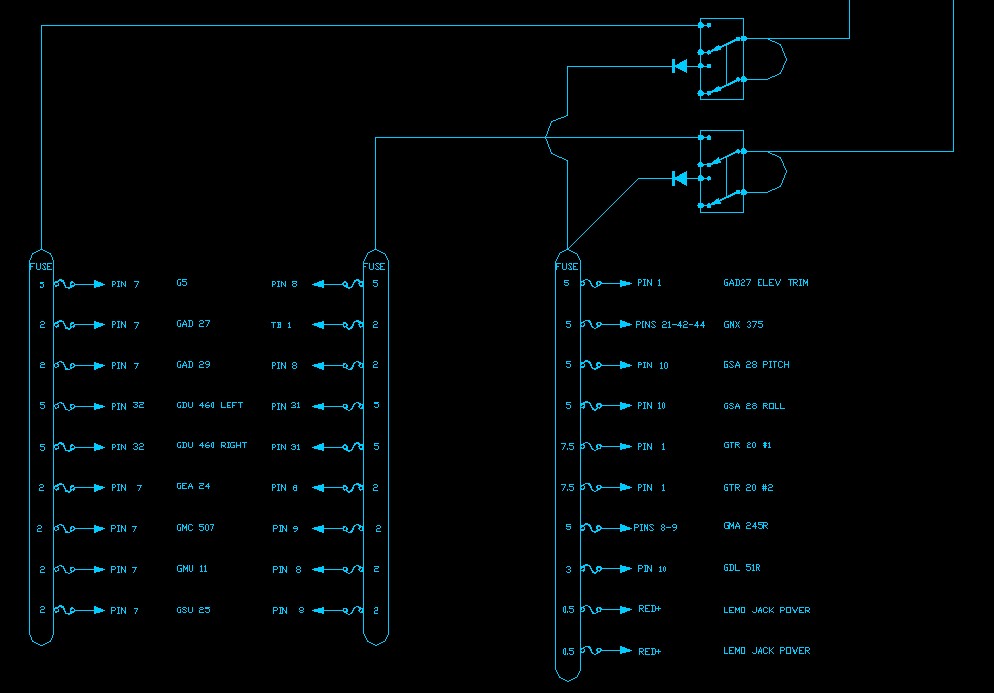
The leftmost avionics busses dovetail with the dual power inputs on many Garmin products. Single input avionics go on a bus with dual feeds. Avionics may be fed from either battery, or one.

Avionics.jpg


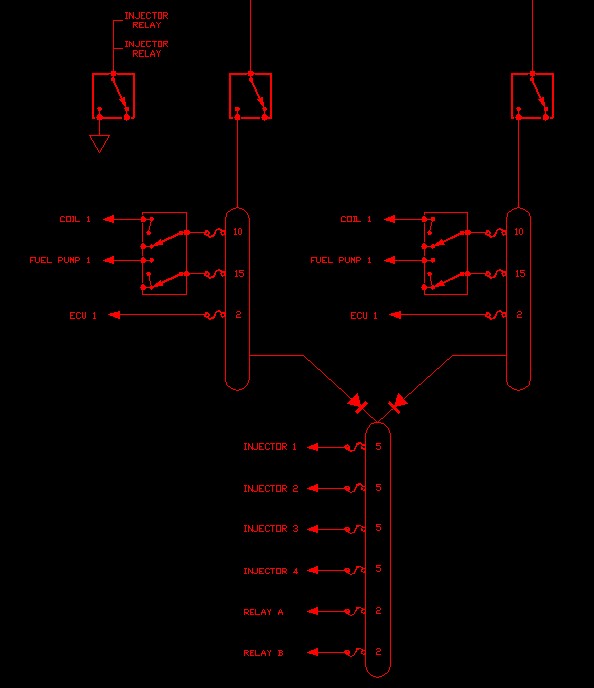
The SDS power supply is critical. Again, feed is from either battery, or one. Each coil/fuel pump switch is a three position Honeywell 2TL1-10 wired as OFF/COIL ON/COIL & FUEL PUMP ON.

EFI%20EI.jpg


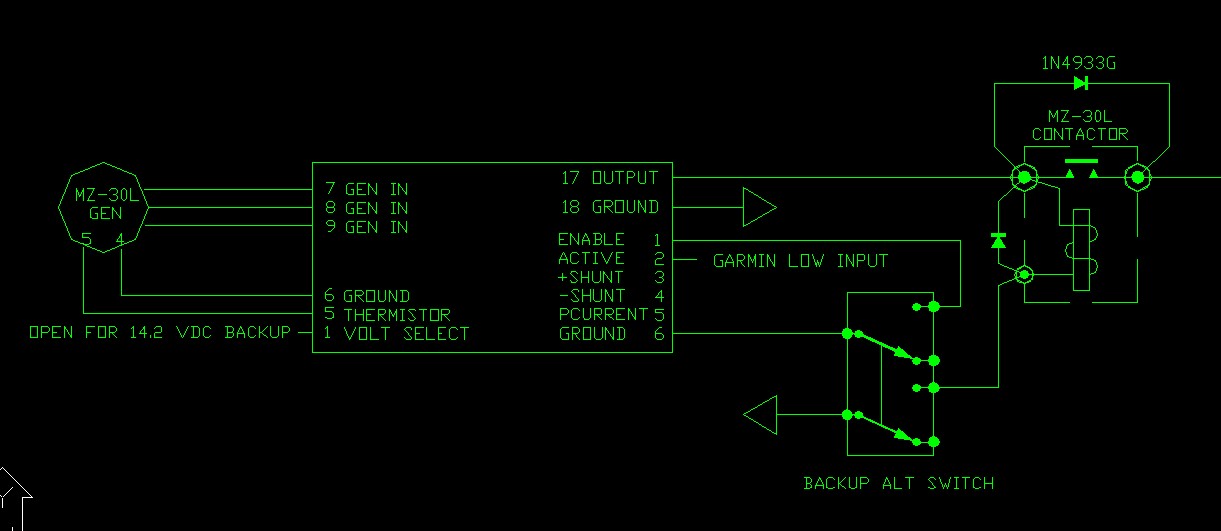
The MZ-30L has several interesting features, foremost being self-start and electronic current limiting. Here the primary purpose is powering the SDS system no matter what. As a secondary mission, it will also support limited avionics and main bus function. It's wired with a relay or contactor because it's connected to battery #1, and the regulator does have a small parasitic draw. With the ENABLE switch closed, it is in standby, and comes online if bus power drops to battery voltage or less.

Note a typical Monkworkz application ties the regulator output to the switched side of the main contactor. In that case, if set as an auto backup (regulator pin 1 open), it would not need a relay. Again, here the goal was to feed an SDS bus with the masters open.

MZ-30L%20Auto.jpg


Operational simplicity should be a major design goal. When the spit hits the fan, pilot IQ tends to go out the window, at least for a little while. So, let's make the switching intuitive, and more important, arrange it so it requires little or no pilot action given power failure.

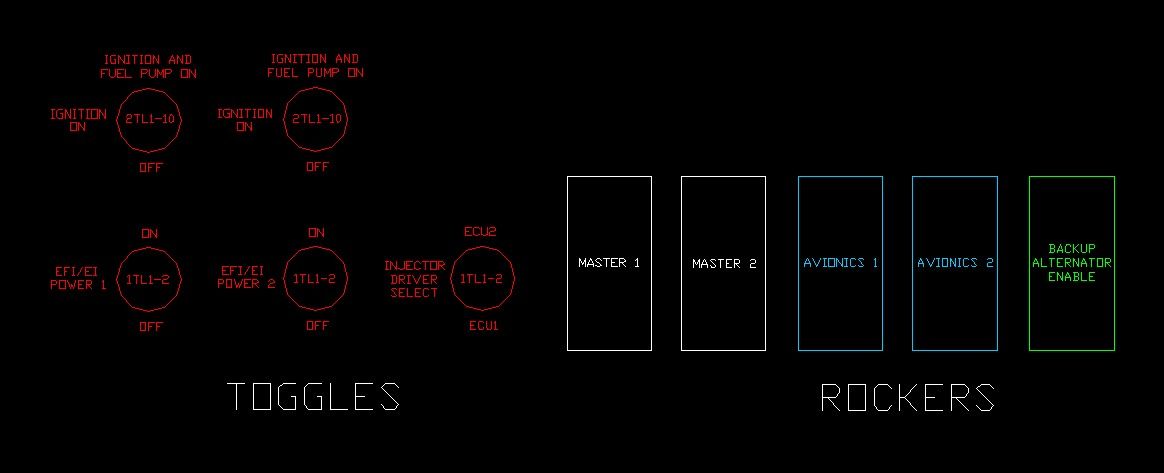
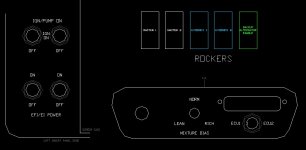
This is going in an Aerosport panel, so all the toggles to the left of the pilot's display are for the SDS EFI/EI. The critical rockers (DPST Carlings) are below the display. Note the conceptual similarities to traditional systems. It's basically mags and masters.

For a critical flight regime (like departure), the switch settings are dead simple...they're all UP, with one exception, INJECTOR DRIVER SELECT. Given power loss at 300 feet over the trees, the entire pilot response is flip that one switch, and change tanks. Again, pretty familiar.

Switching.jpg


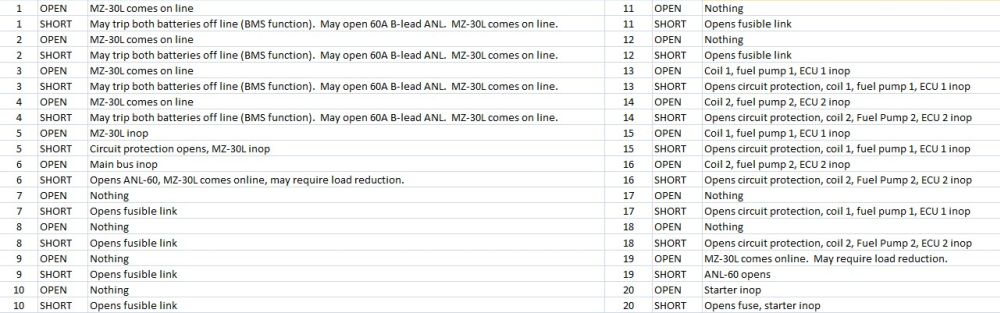
First pass, a basic "open or short" review doesn't turn up any critical issues, but if I missed something, hey, I'm all ears.

Open-Short%20Review.jpg


On a bad day, both main contactors can be opened, which immediately dumps the large loads and brings the MZ-30L on line. Avionics load is about 10A, maybe 13 running autopilot servos, and can be less. The pilot has access to both batteries and the MZ-30L, in any combination.

On a really, really bad day, the MZ-30L carries the SDS, and the G5 is on internal battery.

 
Sorry, I have not been following this thread. One track mind...

The old CAD program I use does not output in PDF format, so the best I can do is post blown up sections of the drawing. Jeff has already done it above (thank you sir).

The tie point at the upper right is an ordinary ANL fuse holder. Terminals are 5/16" IIRC. See below.

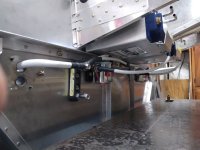
The design was for a RV-7 rebuild. The physical layout placed two sealed and vented EarthX batteries aft of the firewall, with contactors below and power distribution mini-ANL's above.

Contactors and ANL.jpg

Forward Fuselage 11-23.jpg
 
Dan - I suggest a piece of fire sleeve or such around that big fat wire as it goes through the firewall penetrator. Vibration against that SS passthrough will make short work of that wire’s insulation.

Carl
 
Dan - I suggest a piece of fire sleeve or such around that big fat wire as it goes through the firewall penetrator. Vibration against that SS passthrough will make short work of that wire’s insulation.

Carl

Is it ok if I fly with clecos and green tape?

Seriously, (1) it's a fabrication photo, not an installation, and (2) when it's time to install, I pump tubular firewall fittings full of FireBarrier, which both seals the penetration and entirely fixates the wire...no chafing.
 
Last edited:
Hopefully no one minds me resurrecting this old thread. I still reread it regularly to decide if/how I want to put this electrical architecture into my RV-10 and came up with a scenario I'd like to run by people to help me understand if it is a realistic concern or not.

See post 149 for Dan's updated diagram.

Given that EarthX batteries are being used and that the BMS will disconnect the batteries if it detects a short circuit, I'm wondering what will actually happen if a short circuit happens anywhere between the batteries and the starter. I know it has been said that the airframe is likely to burn away and remove the short circuit but I don't know if we can assume that will always happen, especially if the BMS disconnects the batteries before it burns away. If it doesn't burn away quickly enough then both of the alternators will still be connected to the short so there won't be anything left to keep the engine running until the contactors are opened.

I know there's a lot of what if's and assumptions in this scenario so maybe it isn't likely enough to worry about or even possible, but what do others think?
 
Hopefully no one minds me resurrecting this old thread. I still reread it regularly to decide if/how I want to put this electrical architecture into my RV-10 and came up with a scenario I'd like to run by people to help me understand if it is a realistic concern or not.

See post 149 for Dan's updated diagram.

Given that EarthX batteries are being used and that the BMS will disconnect the batteries if it detects a short circuit, I'm wondering what will actually happen if a short circuit happens anywhere between the batteries and the starter. I know it has been said that the airframe is likely to burn away and remove the short circuit but I don't know if we can assume that will always happen, especially if the BMS disconnects the batteries before it burns away. If it doesn't burn away quickly enough then both of the alternators will still be connected to the short so there won't be anything left to keep the engine running until the contactors are opened.

I know there's a lot of what if's and assumptions in this scenario so maybe it isn't likely enough to worry about or even possible, but what do others think?

Hi Tim,

Yes, a short to the airframe between the batteries and the start contactor might make an EarthX BMS open. It's largely true for all installations, not just this one. A short beyond the start contactor would only be a starting problem.

Take a look at the photos in #164. Minimal length from each battery positive to its master contactor, then again minimal length from contactors to a junction bolt on the ANL. One more short lead to the start contactor. Even that could be moved to a spot next to the ANL. The key is short lengths, and a physical arrangement to make an airframe short unlikely.

Same applies to a more conventional layout. For example, assume the batteries are on the firewall. We can physically package both master contactors, the ANL, and the start contactor together in a very small space nested alongside the batteries. The chance of an airframe contact is minimal.

A battery in the rear of the fuselage usually means a long run from master contactor to start contactor. Risk is mitigated with careful routing and fixation. Some builders like high quality welding cable for that run because it has thick, tough rubber. Some simply use an AGM battery.

How much length is acceptable for a completely unprotected power cable? The "Nuckolls rule" would be less than 6" when possible, but it really depends on the physical arrangement.
 
Last edited:
Thanks for the response Dan. The short runs in your photos do look ideal for minimizing the risk of a short. The longer runs in an RV10 have me a little more concerned, but in the years I've been following these forums I don't remember seeing many (if any) post about a short on the main cable so I'm probably overestimating the risk of that happening as long as the cable is routed and secured carefully.

One other detail I've been wondering about is whether the MIDI fuses would actually blow before the BMS disconnected the battery due to a short on the avionics or engine feeds. I've emailed EarthX to ask them about how quickly the short circuit protection kicks in and they said it activates in a few milliseconds and is triggered around 1400 amps. The Time-Current chart from the Littelfuse documentation shows a 30 amp MIDI fuse (the orange line) will open in .01 seconds starting at just under 1000 amps. I know that a short would result in a lot more amps flowing than that but I don't know how much it takes for the fuse to be faster than the BMS.

TimeCurrentMidi.JPG
 
I am doing my panel and wiring now... Simple is not what I'd call this. I have simple, one battery, one alternator. The P-mags back up theirselves. The G5 backups it self.

I may add the TCW backup or a small AGM or Earth=X backup to avionics buss, adding two diodes to isolate the batteries.
 
Thanks for the response Dan. The short runs in your photos do look ideal for minimizing the risk of a short. The longer runs in an RV10 have me a little more concerned, but in the years I've been following these forums I don't remember seeing many (if any) post about a short on the main cable so I'm probably overestimating the risk of that happening as long as the cable is routed and secured carefully.

One other detail I've been wondering about is whether the MIDI fuses would actually blow before the BMS disconnected the battery due to a short on the avionics or engine feeds. I've emailed EarthX to ask them about how quickly the short circuit protection kicks in and they said it activates in a few milliseconds and is triggered around 1400 amps. The Time-Current chart from the Littelfuse documentation shows a 30 amp MIDI fuse (the orange line) will open in .01 seconds starting at just under 1000 amps. I know that a short would result in a lot more amps flowing than that but I don't know how much it takes for the fuse to be faster than the BMS.

View attachment 77804
This is the exact question I’m dealing with at the moment - would a short of a bus feed in a parallel battery system like @dan’s simple design result in both batteries coming off line?

I keep oscillating between a parallel system like this, and a dual bus split system with a diode fed engine bus.

The downside of the split bus system is that in an alternator failure a cross tie is needed so the battery on that side can remain charged in the event of alternator failure. But a cross-tie means in a short scenerio bad thinks can happen if the pilot closes that tie and doesn’t understand the system.

Can’t decide which way to go to be honest!
 
@DanH , thanks for sharing this. I’m putting together a RV10/SDS/Advanced panel setup and have been trying to figure out how to make the system a bit redundant but try to keep it simple. What I came up with in my head was similar, but was trying to do a single engine bus, but wanted two power sources, also didn’t think about the monkworks on that side as well, I like that. I am not entirely sure how I am going to get b/u power to the AFS ACM, and need to consult with them. I do have a couple of questions. I will try to draw out what I am planning and post for critiquing once I get it done.

With the diode feeding the engine bus (V2) does that end as a single point of failure? Will the Monkworkz as wired in normal operation charge both batteries with all switches on if the main alternator has quit?
 
With the diode feeding the engine bus (V2) does that end as a single point of failure? Will the Monkworkz as wired in normal operation charge both batteries with all switches on if the main alternator has quit?

The engine bus is driven through parallel diodes, as are the avionics components which don't have built-in dual power inputs.

Yes, the generator would charge both batteries with both masters ON.

Drive the ACM with a parallel diode feed to the primary power input terminal, as above. A TCM backup to the dedicated dsub would still be an available option, if desired.
 
@DanH , thanks for sharing this. I’m putting together a RV10/SDS/Advanced panel setup and have been trying to figure out how to make the system a bit redundant but try to keep it simple. What I came up with in my head was similar, but was trying to do a single engine bus, but wanted two power sources, also didn’t think about the monkworks on that side as well, I like that. I am not entirely sure how I am going to get b/u power to the AFS ACM, and need to consult with them. I do have a couple of questions. I will try to draw out what I am planning and post for critiquing once I get it done.

With the diode feeding the engine bus (V2) does that end as a single point of failure? Will the Monkworkz as wired in normal operation charge both batteries with all switches on if the main alternator has quit?
From my neighbor with an SDS equipped RV-10 -

Assuming have two independent busses already, why not feed each of the SDS components (ECU, coil pack, fuel injector power) from an individual hot battery bus (essentially Nuckolls Z-14)? No diodes to fail and either bus will run the engine as long as you have fuel and electrons. Can the Monkworks generator not be loaded continuously? Also, I would not power any of the SDS components through the ACM (or a VPX) but that’s just me.
 
The engine bus is driven through parallel diodes, as are the avionics components which don't have built-in dual power inputs.

Yes, the generator would charge both batteries with both masters ON.

Drive the ACM with a parallel diode feed to the primary power input terminal, as above. A TCM backup to the dedicated dsub would still be an available option, if desired.
Thanks, getting something drawn up. I have a TCM b/u. I am thinking AFS after contacter, and have a separate switched feed from the batt 1 side. Panel won't go dark with the TCM, just loose some things. If the monkworks is still working, and I need more switch on to connect it. I don't see this as immediate action, and it gives me time to assess. Are the batts working fine and the bu gen, if so apply power. I started drawing it, I'll post it once done. Definitely will be really similar to yours, thanks for sharing this.
 
From my neighbor with an SDS equipped RV-10 -

Assuming have two independent busses already, why not feed each of the SDS components (ECU, coil pack, fuel injector power) from an individual hot battery bus (essentially Nuckolls Z-14)? No diodes to fail and either bus will run the engine as long as you have fuel and electrons. Can the Monkworks generator not be loaded continuously? Also, I would not power any of the SDS components through the ACM (or a VPX) but that’s just me.
AFS will be downstream, it won't see anything SDS.

I was going to do two busses, my concern was the injector relay. With split busses I'll have half injectors in each bus, loose one bus and loose 3 injectors. As long as the injector relay gets power from the good bus I can switch the injectors over to the good bus. I figured one bus with two power sources would be better. Loose one power source still have everything. That is what is seems Dan's v2 is doing. I have been going back and forth on this. I could still do his v1 and split the busses and tie in the injectors with diodes for two power sources.
 
Keep in mind...a key here was to design for human factors. Simplify and add lightness. It's real easy to add this and that in anticipation of some 0.001% event, and wind up with a system nobody really understands.
 
Keep in mind...a key here was to design for human factors. Simplify and add lightness. It's real easy to add this and that in anticipation of some 0.001% event, and wind up with a system nobody really understands.
That was what I was trying to do. With the SDS I wanted something that didn't require thought to keep the engine running. I am ok with a some switch throws for emergencies as long as they are something that doesn't need an immediate response. I've flown enough airplanes with pages of immediate action items. I plan on keeping the airplane forever, as does everyone but I know things happen and want it simple for the next person too.

I looked at the SDS again, I think his dual bus architecture does allow the injector relay to switch the injectors to the other bus (input into the relay from both busses). I still am leaning towards one essential bus with two power sources.
 
AFS will be downstream, it won't see anything SDS.

I was going to do two busses, my concern was the injector relay. With split busses I'll have half injectors in each bus, loose one bus and loose 3 injectors. As long as the injector relay gets power from the good bus I can switch the injectors over to the good bus. I figured one bus with two power sources would be better. Loose one power source still have everything. That is what is seems Dan's v2 is doing. I have been going back and forth on this. I could still do his v1 and split the busses and tie in the injectors with diodes for two power sources.
Again from my neighbor with the SDS equipped RV-10 -

I’m sure you know this, but if you lose one ECU, you will lose the three injectors triggered by that ECU. You will have to throw the PRI/NOR/BAK switch to either PRI or BAK, depending on which ECU has failed. I don’t know of any way to avoid an immediate action item in event of an ECU failure. Which failure is more likely, ECU or bus? I have no idea. It is a limitation of the SDS architecture. Maybe EM-7 will overcome this, but that would require a big change in the design.

With the modified injector relay now available from SDS, the relay(s) can be switched to whichever bus has power. The relays are unpowered in the NOR position and the triggers and power sources are simply passed through.
 
I had an email from Ross just this last week - for a 4 cylinder, he can supply modified relays which switch both the ground and the power allowing split busses.

I decided to stay with one engine bus however, as splitting the busses like this only guards against a bus short for the non-injector items. The injectors would still need to be on one bus with diode feeds. If you split the injectors then you lose 2 of your 4 cylinders in a bus short on one of your split busses. Instead I will build my engine bus to be very unlikely to get a short.

@DanH what do you think about the packages like this which have 2 diodes in one physical package? I had two of these in my system, but wondering if one package (with 2 diodes) would suffice? Is one package of 2 diodes likely to have a failure mode which takes out both diodes?
 
I had an email from Ross just this last week - for a 4 cylinder, he can supply modified relays which switch both the ground and the power allowing split busses.

I decided to stay with one engine bus however, as splitting the busses like this only guards against a bus short for the non-injector items. The injectors would still need to be on one bus with diode feeds. If you split the injectors then you lose 2 of your 4 cylinders in a bus short on one of your split busses. Instead I will build my engine bus to be very unlikely to get a short.

@DanH what do you think about the packages like this which have 2 diodes in one physical package? I had two of these in my system, but wondering if one package (with 2 diodes) would suffice? Is one package of 2 diodes likely to have a failure mode which takes out both diodes?
Once again from my neighbor -

I’m really glad to hear that SDS has developed a full dual bus capability for the 4 cylinder system.

If I understand the architecture of the 4 cylinder systems - all injectors are triggered by the selected ECU (either PRI or BAK) - so loss of the buss that powers said ECU (or failure of the ECU itself) requires an immediate action item of switching the PRI/BAK switch. Assuming Barry has designed the new relay box(es) to provide the same functionality as the 6 cylinder version - in my opinion you would have better redundancy with a fully split bus system powering each of the SDS components from an individual hot battery bus. You have to throw the switch with either failure.

I doubt if the injector power is split 1&2, 3&4 with the new relay boxes. It is more likely all on buss 1 or all on buss 2. Hence, my suggestion that you fully separate the busses and components.

If I am wrong on this, I hope Ross will come along shortly to correct me.
 
@DanH what do you think about the packages like this which have 2 diodes in one physical package? I had two of these in my system, but wondering if one package (with 2 diodes) would suffice? Is one package of 2 diodes likely to have a failure mode which takes out both diodes?

I used that particular package. I do not think one diode failure can kill both. Locate it on an aluminum panel which can serve as a heat sink.

A caveat; hardcore electronics reliability analysis is the province of specialists, and that ain't me...
 
I used that particular package. I do not think one diode failure can kill both. Locate it on an aluminum panel which can serve as a heat sink.

A caveat; hardcore electronics reliability analysis is the province of specialists, and that ain't me...
Understand. Just after an opinion. I also don’t really know what happens to diodes - I wouldn’t imagine any more than 30amps through these. They should be hardly working. I was going to use 2 of these packages but the second diode is just sitting wasted. One will mount nicely on a 401k heat sink and bridge the gap across the vertical wiring channel in the -14.
 
That was what I was trying to do. With the SDS I wanted something that didn't require thought to keep the engine running. I am ok with a some switch throws for emergencies as long as they are something that doesn't need an immediate response. I've flown enough airplanes with pages of immediate action items. I plan on keeping the airplane forever, as does everyone but I know things happen and want it simple for the next person too.

Amen brother.

Spin the wayback machine a few decades. I built an essential bus system (then a new concept) and battery-direct EI power into an RV flown by three pilots. The other two were classic GA guys, Bonanza and Saratoga specifically. They didn't understand it, and thus hated it, no matter how much explanation. (i gotta turn something off before I turn something on? Are you kidding me?"). Familiarity = comfort.

So, human factors design...make operation simple and intuitive for a typical GA pilot. You've seen the wiring diagram. Here's the human side.

This particular work was for an Aerosport panel in a fixed pitch RV-7, so toggles on the far left, rockers across the bottom, and a throttle subpanel on the right:

ScreenHunter_2828 Jun. 17 07.24.jpg

Fire up your Piper/Cessna brain and take a mental flight.

For takeoff, all the EFI/EI switches are UP. All the pilot side rockers are UP. Mixture knob is centered.

The ignition switches are cycled for a run up check, just like mags. Doing so checks both an ignition and a fuel pump.

The familiar response to power failure on takeoff is typically mixture rich, throw one switch, and change tanks. Here mixture rich translates to "confirm mixture knob centered". It has a stripe on it, so it requires only a glance. The required switch throw is traditionally an aux fuel pump (assuming it was not already running), but here it's the ECU Select. Note the ECU switch is located in throttle/mixture subpanel...no hunting for it among other switches lined up in a row, no confusion, no moving the wrong switch. Even if the ECU switch was moved inadvertently, everything still runs, and power loss response is the same (just move it the other way). The fuel selector is directly below the throttle, mixture, ECU panel....same hand, easy flow.

Soapbox off.
 
OK, I'm going to say something really heretical here...
I've read much of this thread, and noted the MANY different approaches to electrically dependent airplanes.
I've also encountered multiple Vans aircraft purchased by 2nd / 3rd owners that have NO POH AT ALL
I also frequently read concerns about the liability of selling you amateur built plane...

Which leads me to these thoughts...
1) there is no standardization in electrically dependent designs
2) what to do in an emergency then varies (widely)
3) instruction / documentation for future owners varies widely
4) most first time 2nd hand buyers have zero experience with electrically dependent aircraft

All of which greatly increases the liability risk.
I'm sure Dan's will have excellent documentation, but will that be the exception or the rule ?
 
OK, I'm going to say something really heretical here...
I've read much of this thread, and noted the MANY different approaches to electrically dependent airplanes.
I've also encountered multiple Vans aircraft purchased by 2nd / 3rd owners that have NO POH AT ALL
I also frequently read concerns about the liability of selling you amateur built plane...

Which leads me to these thoughts...
1) there is no standardization in electrically dependent designs
2) what to do in an emergency then varies (widely)
3) instruction / documentation for future owners varies widely
4) most first time 2nd hand buyers have zero experience with electrically dependent aircraft

All of which greatly increases the liability risk.
I'm sure Dan's will have excellent documentation, but will that be the exception or the rule ?
Nope, no standard at all. Looking at all of the discussion on electrically dependent aircraft, I’d be surprised to find two that are the same.

POH is not required, and I would guess most people don’t want to spend the time creating one. As there is no standard for the build, each POH would be a unique document. I would also speculate the many people who do create a POH, do not include detailed descriptions or diagrams of the systems they included in the aircraft.

Abnormal and emergency procedures would be as unique as the POH.
 
Nope, no standard at all. Looking at all of the discussion on electrically dependent aircraft, I’d be surprised to find two that are the same.

POH is not required, and I would guess most people don’t want to spend the time creating one. As there is no standard for the build, each POH would be a unique document. I would also speculate the many people who do create a POH, do not include detailed descriptions or diagrams of the systems they included in the aircraft.

Abnormal and emergency procedures would be as unique as the POH.
So on sale, you just get verbal info on V speed (save the little that's required in the aicraft log), systems, and procedures

We can do better.
 
So on sale, you just get verbal info on V speed (save the little that's required in the aicraft log), systems, and procedures

We can do better.
No doubt but people don’t want to put the time in to create a good poh…they’d rather be flying!

To be honest, I have been working on my poh for five years; it isn’t high on my priority list. It is about 70% done. When my son gets the airplane, the poh will have all the pertinent systems descriptions and diagrams in it, as well as checklists and procedures.
 
Again from my neighbor with the SDS equipped RV-10 -

I’m sure you know this, but if you lose one ECU, you will lose the three injectors triggered by that ECU. You will have to throw the PRI/NOR/BAK switch to either PRI or BAK, depending on which ECU has failed. I don’t know of any way to avoid an immediate action item in event of an ECU failure. Which failure is more likely, ECU or bus? I have no idea. It is a limitation of the SDS architecture. Maybe EM-7 will overcome this, but that would require a big change in the design.

With the modified injector relay now available from SDS, the relay(s) can be switched to whichever bus has power. The relays are unpowered in the NOR position and the triggers and power sources are simply passed through.
Correct, one switch throw will be required in that case.
 
Back
Top