Van's Air Force

The definitive Van's Aircraft support community! Buying, building or flying an RV? Join our exclusive family of mentors and enthusiasts!

Things you do because you you've done it that way before.

claycookiemonster

Well Known Member
I remember very early in my time here, as a very newbie builder, I was an absolute sponge for any hints from the experienced builders. There was a thread about the right color of sharpie for marking things, believe it or not! Anyway, the consensus was that Blue was the best marker color. I ran out and bought a couple boxes of Blue Sharpies, and I'm still using them!

I was just wondering what other shop habits, or good luck operations you may have carried on over the course of your build, just because you've done it that way before.

And, YES, my RV will actually be painted blue. I'm sure there's no connection.
 
  • Like
Reactions: pjc
Building
I don’t cut on the line. I cut just short of the line and hand file to the line. I know it takes a lot of extra time but I still do it because I always have.
Drilled holes at #40 then drilled up for those that were 1/8” rivets to #30. Nobody does that anymore I am sure as nobody is drilling holes.
Put tools away at end of every work session. Spent hours looking for a wrench the next day once so now always put everything away even if in the middle of a task.
Flying
Pull the prop through full revolution during preflight. Seems to be help starting when I was having starting issues years ago so always still do it.

FYI. I use black sharpie for cutting and red sharpie for other markings that are not cuts like hole spacing and folds and bends.
 
Last edited:
The best/most important hint I can give is do not use black electrical tape when you install your windscreen. It disappears in the black-dyed epoxy you use for the first couple of fiberglas layers. :eek: Use yellow, blue, red . . . any color but black. Ask me how I found out.
 
There was a thread about the right color of sharpie for marking things, believe it or not!

I do believe it...It's in section 5 of Vans build manual that blue lasts longer on aluminum than any other color, but nobody knows why :)

As far as my own habits, I'm sure I've got bunch that I don't even notice, but the only one that comes to mind at the moment is that my dad taught me that there's a right way to use a crescent wrench and if you put it on backward you put undue stress on the movable jaw.

'I have no idea if thats even remotely true, but I always do it like he showed me, about 45 years ago.
 
I always disconnect an air tool from its hose when I put the tool down on a bench - I’ve broken enough drill bits when the weight of the hose (or someone tripping on it) pulled the drill motor off the table. I disconnect them so automatically I don’t even think about it anymore….
 
Habits

I also do most of the habits posted.
Cut outside the line
Drill the first hole #41
Disconnect air from tools

I always test the countersink cage on scrap. I have three and no matter how many perfect countersinks, they still get tested before final hole.

I drill holes in fiberglass one size smaller. Clekos fit better and can always be upsized later if needed.
 
As well as the above, a few more items:

- Always disconnect tools from power source before changing bits/blades/etc.
- Always put chuck key back before using tool (flying key really hurts)
- Always back up the hole being drilled with a small wood block (helps prevent drilled fingers)
 
Inspect each rivet that was just installed.
Then admire or curse and replace.

Cut cable tie ends off as close as possible so I don’t get cut later.
 
Last edited:
Habits

Years ago as a Xerox Tech Rep, I was advised never to put tools in my pockets. I also take a break after 2 hours or so and quit for the day if I find myself getting stressed over a problem.
Still never do. Double ditto on all previous habits. Especially putting tool away after use. Great thread BTW:D
 
Last edited:
"Measure twice, cut once" is on a sign above my workbench......
Stewart Willoughby, 6 final assembly
 
At least once in every build session, put the cleco pliers down in a place they won't be found without serious work stoppage. Also, for some reason, the cleco pliers with blue rubber on the handles are used for #30's while the ones with no rubber on the handles are used on #40's.
 
- Always disconnect tools from power source before changing bits/blades/etc.
- Always put chuck key back before using tool (flying key really hurts)

For electrical drills, I tape the chuck key to the plug side of the power cord which forces me to unplug the tool in order to use the chuck.

Another carpenter's trick: When using an extension cord, first tie the tool's cord to the extension cord and then plug it into the extension cord. This prevents you from accidentally pulling the tool's cord out of the extension cord.
 
Until the blade is stopped and it is unplugged, any power saw is not your friend. Always assume it is plugged in.

After the second yawn, you're done for the night.

Walking away from a problem and coming back tomorrow will cost you nothing. Pushing a bad day could cost you thousands. Or a finger. Or an eye.
 
Last edited:
After the second yawn, you're done for the night.

Walking away from a problem and coming back tomorrow will cost you nothing. Pushing a bad day could cost you thousands. Or a finger. Or an eye.

Total agree and one reason building a metal airplane is so much better than working with composites/fiberglass (and anything else that cures like proseal).

And your chance for mistakes significantly increases after a yawn.
 
Warm up

I do a "warm up" when going down to the shop - work on something easy or non-consequential before getting to the most serious stuff.

I also tried to have several things going at once - some fiberglass, some electrical, some metal. Some days you just feel like doing wiring, some days you feel like riveting or cutting aluminum. And even some days you feel like fiberglass, but that's a bit more rare. When you feel like it, you want to be able to jump in and get productive.

Not sure if anyone mentioned it, but the first thing I did was put on eye protection - no matter what I was working on. It just became a habit. I can fly without a finger or with a scar on my face, but not without eyes. Lots of stuff in the shop can take out an eye.
 
Last edited:
Years ago as a Xerox Tech Rep, I was advised never to put tools in my pockets.
Still never do. Double ditto on all previous habits. Especially putting tool away after use. Great thread BTW:D

in a similar but opposite way, when I was a kid I read a tip in Field and Stream magazine to never lay a pocket knife down. Open it, use it, and then put it back in your pocket. You'll never loose it that way.
Lay it on the tree stump or on the ground while you do something else with whatever it is you're working on will often lead to you leaving it there and walking away.

I've lost a few tools over the years when I didn't follow that suggestion.
 
Boost pump

Maybe more a hard lesson learned, but on my next plane I will locate the boost pump switch just above the throttle, within thumb reach in the blind, rather than in a line of switches on the left panel. 🙈
 
Don't try to move too fast.

I have been thinking about this thread and rediscovered a shop rule. My plane was built in my basement and it was tight in 3D. Hanging, leaning and sitting.

I discovered the rule: "don't move fast in any direction without looking and deliberation" Otherwise something gets damaged, me-it or both.

Edit: Yes, MEL, especially moving vertically, I (gently) bumped my head (the rediscovery) on a hanging mirror after rising from my knees looking at some books with a flashlight.
 
Last edited:
I have been thinking about this thread and rediscovered a shop rule. My plane was built in my basement and it was tight in 3D. Hanging, leaning and sitting.
I discovered the rule: "don't move fast in any direction without looking and deliberation" Otherwise something gets damaged, me-it or both.

Important follow-op to this rule; After bending over, DO NOT straighten up quickly! The back of your head is softer than most airplane parts.
 
I got into the habit of doing a total shop cleaning after each stage of the build was done. All tools and supplies were replaced to the correct locations and the shop was blitzed. This helped me to mentally shift gears into a new phase of the project. I enjoyed working in a clean shop, and it saved time when I was not having to search for tools.
The other thing- install more lighting...there is never enough light.
 
The most-used power tool in my shop is the shop vac. I vacuum up ships and dust as soon as I can. Could probably get away with less but that's what I do.

Dave

Me too, until I moved the older RoboRock S5 from the house to the shop. Now it vacuums the shop three times a week at 2AM. I love it. Gets under everything and saves me a bunch of time sweeping up drill shavings and lost rivets. It occasionally finds a cleco or two...

I just sweep the bench top off onto the floor, and 'ol Rocky will get it later.

Seriously, get one. (highly recommend the Roborock brand. Great mapping, nav, and software.)

If I ever get the hangar doors replaced and electricity (Ian), I may get one for the hangar.
 
Before you end your build session, leave a note of what you are going to do in the next build session. When ordering from Spruce, look for USPS prices. Air tools only need three drops of air oil for the day. Scotch matt finish removable tape will hold rivets in place.
 
I don't like to keep changing drill bits so I have seven identical compact cordless drills with keyless chucks. Bought them on eBay. Somebody is going to score big time when I am done building.
 
I got into the habit of doing a total shop cleaning after each stage of the build was done. All tools and supplies were replaced to the correct locations and the shop was blitzed. This helped me to mentally shift gears into a new phase of the project. I enjoyed working in a clean shop, and it saved time when I was not having to search for tools.
The other thing- install more lighting...there is never enough light.
About once a week, I halt all progress and clean the shop/replace all the tools. Not building a plane, but always involved in 'projects' of some sort. A clean shop is a productive shop!


Bill
 
I've gotten in the habit of writing the size of the drill bits that I'm using on a pieces of painters tape. I stick it on the drill motor that I'm using because I will forget which one is in there when I return to the shop. Also I have more that one drill so that I don't need to re-tool constantly. This is a big time saver.
 
Building
I don’t cut on the line. I cut just short of the line and hand file to the line. I know it takes a lot of extra time but I still do it because I always have.
Drilled holes at #40 then drilled up for those that were 1/8” rivets to #30. Nobody does that anymore I am sure as nobody is drilling holes.
Put tools away at end of every work session. Spent hours looking for a wrench the next day once so now always put everything away even if in the middle of a task.
Flying
Pull the prop through full revolution during preflight. Seems to be help starting when I was having starting issues years ago so always still do it.

FYI. I use black sharpie for cutting and red sharpie for other markings that are not cuts like hole spacing and folds and bends.
only one revolution? i do 9 revolutions. oh, disreguard that, that's only on the AT-6 i don't do it on the RV-4......
 
My #30 and #40 have spring stops on them. The #30 is a copper colored spring, the #40 is silver and they live in an Altoids tin when not in use. Other than those 2, every bit gets sized with a wire gauge and put back in the index at least at the end of the day, if not sooner.

Ive also gotten into the habit of wearing Croakies on my glasses to keep them from sliding down my nose, a cap of some kind to protect my bald head, and one of those LED strip type head lamps so that my old eyes aren't straining to see what I'm working on. Definitely not gonna make the cover of GQ, but its quite functional.
 
I've gotten in the habit of writing the size of the drill bits that I'm using on a pieces of painters tape. I stick it on the drill motor that I'm using because I will forget which one is in there when I return to the shop. Also I have more that one drill so that I don't need to re-tool constantly. This is a big time saver.
Everything #30 - bit, reamer, CS, dimple die is colored blue with permanent marker. Ditto #40 but red.
Color them on purchase before they are stored in the workshop.

Any other bit? Only one out at a time!
 
kind of what paul said........i always take the bit out of a hand held drill so that when it gets knocked on the floor it doesn't hurt the bit.
Yup. Me too. I bent a #40 reamer on a handheld drill once. Never again. When I'm done, the bit/reamer comes out. I also use Testors model paint to mark my drill bits. i.e. yellow 3/32, red #40, Green 1/8' , etc. (but then I still glass them when it's a critical items being drilled - don't trust my evil twin)
 
Any time I cut free a piece of safety wire, I put it directly into the trash. I never put it on the floor. Not even for a minute. If I am undoing something with a lot of safety wire pieces to cut, it means a lot of getting up and down and walking to the trash - I regard that as a good thing -- less time efficient, but better for exercise and stretching. But the main point is that I will never again kneel down on a piece of safety wire.
 
Any time I cut free a piece of safety wire, I put it directly into the trash. I never put it on the floor. Not even for a minute. If I am undoing something with a lot of safety wire pieces to cut, it means a lot of getting up and down and walking to the trash - I regard that as a good thing -- less time efficient, but better for exercise and stretching. But the main point is that I will never again kneel down on a piece of safety wire.
Similar protocol, but it goes in the bottom of my roll-around tool cart, along with clipped wire ties, damaged screws, and any other trash - all gets emptied when it gets to be a mess. Saves me from getting up and going to the trash can…
 
I have three drills, yes, really.
A Milwaukee 12 volt that NEVER gets anything except #40 sized implements chucked into it.
A Milwaukee 20 volt that NEVER gets anything except #30 sized implements chucked into it.
A Dewalt 20 volt that handles everything else.
 
Any time I cut free a piece of safety wire, I put it directly into the trash.
I put the largest piece of removed safety wire in the can with the rest of the fasteners I just removed. That way it reminds me that when putting that stuff back together I need to safety wire something.
If during removal of fasteners I have one I want to replace for some reason, I immediately go to my fastener bins and get the new one to put in the can with the other ones and throw out the one I am replacing. I always know when putting thing back together that the fasteners in the can equals what I need to install.
 
I remember very early in my time here, as a very newbie builder, I was an absolute sponge for any hints from the experienced builders. There was a thread about the right color of sharpie for marking things, believe it or not! Anyway, the consensus was that Blue was the best marker color. I ran out and bought a couple boxes of Blue Sharpies, and I'm still using them!

I was just wondering what other shop habits, or good luck operations you may have carried on over the course of your build, just because you've done it that way before.

And, YES, my RV will actually be painted blue. I'm sure there's no connection.
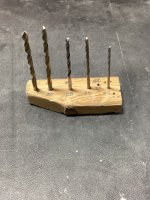
I got this idea from Jay Pratt many years ago.
Very handy!
 

Attachments

  • IMG_0153.jpeg
    IMG_0153.jpeg
    1.4 MB · Views: 64
I use a wood block holder too (8” chunk of 2x4) to hold my bits, all of them including shortys, 6”, 12” & threaded bits sorted & labeled by size. That wood chunk is 20 years old & has never tipped over & obviously never misplaced.
 
My habit:
Wear a cap when working inside fuselage, some angles are sharp and painfull..
Stop working when tired or back is painfull, or some bad actions are coming...
Clean and sort workshop at the end of the day, put a red mark on this f...g pin tool that helps you to center rivet holes before inserting them ( very usefull), never begin composite work at the end of the day,

My father used to say: " three time cut, three times too short"
 
My habit:
Wear a cap when working inside fuselage, some angles are sharp and painfull..
Stop working when tired or back is painfull, or some bad actions are coming...
Clean and sort workshop at the end of the day, put a red mark on this f...g pin tool that helps you to center rivet holes before inserting them ( very usefull), never begin composite work at the end of the day,

My father used to say: " three time cut, three times too short"
Kudos, following these simple tenets have allowed me to keep all my fingers and toes after 17 years working for Xerox in the field, cabinet-making, building 2 houses, and 2 airplanes. I try to rake a break every 2 hours, quit for the day when focus begins to wane, and so far at age 84, it WORKS!
 
"Parts on a plate"

I keep a stack of paper plates in the shop. When I'm ready to work on the plane, I place one paper plate on the tool bench and place one on my tool cart near the plane. Sometimes I place a paper plate in the plane. If I need to temporarily walk away from the job, any part/tool that I have in my hand gets placed on a paper plate. If the plates get dirty, they get tossed and replaced with a clean one.

Why? Early in my build when I found the need to walk over to the bench for a tool or something, I would put down the part/tool I had in my hand in a "convenient" location before heading over to the bench. Sometimes the part came with me to the bench, sometimes it didn't. You probably all know where this is headed. You get distracted, a visitor stops by,....... More than a few times when I was ready to go back to work it took me forever to find the part/tool that I placed in that "convenient" location. Problem solved with paper plates.
 
That works.
I used paper bowls often. Also wrote the rivet size on the inside sometimes when several were in use.
Now I use a clean plastic oil drain pan for a work tray. Everything goes in. End of the work session, I carry the pan to the tool box and put everything away.
 
I like Vic’s suggestion on his recent EAA video about always putting some blue masking tape where you half finished a job. To remind yourself the jam nut hasn’t been tightened, or the nuts holding the Vstab on haven’t been torqued and cross checked painted yet. Interruptions can cause mistakes. AMHIK 😳
 
I like Vic’s suggestion on his recent EAA video about always putting some blue masking tape where you half finished a job. To remind yourself the jam nut hasn’t been tightened, or the nuts holding the Vstab on haven’t been torqued and cross checked painted yet. Interruptions can cause mistakes. AMHIK 😳
Another method of noting lock nuts that have not been torqued is to use castle nuts temporarily. When it comes to final check, I know that it either needs a cotter pin or a locknut.
 
Kudos, following these simple tenets have allowed me to keep all my fingers and toes after 17 years working for Xerox in the field, cabinet-making, building 2 houses, and 2 airplanes. I try to rake a break every 2 hours, quit for the day when focus begins to wane, and so far at age 84, it WORKS!
Good to hear. I'll probably be 82 before I finish this project the rate I'm going.
 
I like Vic’s suggestion on his recent EAA video about always putting some blue masking tape where you half finished a job. To remind yourself the jam nut hasn’t been tightened, or the nuts holding the Vstab on haven’t been torqued and cross checked painted yet. Interruptions can cause mistakes. AMHIK 😳
And sharpy notes all over the parts in process - wipes off with a paper towel and acetone. The entire airplane is a notepad for me for "in-process" stuff. Remove the notes as the work is done, the whole piece is not complete until it's clean.
 
And sharpy notes all over the parts in process - wipes off with a paper towel and acetone. The entire airplane is a notepad for me for "in-process" stuff. Remove the notes as the work is done, the whole piece is not complete until it's clean.
I've gotten into this habit as well, and it really does help with my wandering brain. Most of my remaining notes at this point are just ridiculing me though - I circle any area on the skin that I've dinged during riveting and needs makeup before paint. My wings were sitting without bottom skins for a year, and I finally finished them up this week. They are beautiful, minus the areas around the flap and aileron hinges. :rolleyes: No rivet set I owned (or made) worked without leaving dings. Sharpie circles galore for future filler.

 
Back
Top