

Van's Air Force
You are using an out of date browser. It may not display this or other websites correctly.
You should upgrade or use an alternative browser.
You should upgrade or use an alternative browser.
...
- Thread starter RV8JD
- Start date


"Aircraft pitch is approximately 30° nose-down, wings almost level. The
IAS is recorded at 244kts"
ZK DVS....it appears commonality among some accidents is overspeed. slippery aircraft flying close to VNE pointing downwards not a good mix. I flew a lancair many years ago and came to the conclusion it was awesome to roll and a lawn dart pointing downhill...its ok...but not if you screw it up. I went over VNE pulling out and eased off...luckily the surfaces did not flutter. Id like to see the rudder have a 50% margin on the speed before breakup...maybe 300 knots but perhaps thats unrealistic.
I do wonder if the "8" rudder is better in this respect being a folded trailing edge? seeing these rudders fold in the wind is a little worrying.
In this case rudder flutter caused the vertical stab to separate and one wonders if the surface was balanced well....
quote..."Van’s Aircraft has conducted stick raps and rudder pedal kicks testing to 220kts, 8 with no indication of flutter up to this airspeed. Flight at any airspeed over Vne, however, exposes the aircraft to the possibility of flutter"
I tend to think that there is somewhat of a variance in what might be experienced between different aircraft and balance of the flight controls should be of paramount importance especially after painting. You simply cannot take flutter with a grain of salt...it destroys aircraft.
So in that case..no doubt vans has done extensive testing and in the normal envelope with balanced controls we have nothing to worry about...but overspeed or overload and add flutter.....mmmm.....poor buggers.
Its a timely reminder to do two things...
1. balance your controls
2. don't fly outside the manoeuvring speeds or g loading. if you do...carefully recover....
IAS is recorded at 244kts"
ZK DVS....it appears commonality among some accidents is overspeed. slippery aircraft flying close to VNE pointing downwards not a good mix. I flew a lancair many years ago and came to the conclusion it was awesome to roll and a lawn dart pointing downhill...its ok...but not if you screw it up. I went over VNE pulling out and eased off...luckily the surfaces did not flutter. Id like to see the rudder have a 50% margin on the speed before breakup...maybe 300 knots but perhaps thats unrealistic.
I do wonder if the "8" rudder is better in this respect being a folded trailing edge? seeing these rudders fold in the wind is a little worrying.
In this case rudder flutter caused the vertical stab to separate and one wonders if the surface was balanced well....
quote..."Van’s Aircraft has conducted stick raps and rudder pedal kicks testing to 220kts, 8 with no indication of flutter up to this airspeed. Flight at any airspeed over Vne, however, exposes the aircraft to the possibility of flutter"
I tend to think that there is somewhat of a variance in what might be experienced between different aircraft and balance of the flight controls should be of paramount importance especially after painting. You simply cannot take flutter with a grain of salt...it destroys aircraft.
So in that case..no doubt vans has done extensive testing and in the normal envelope with balanced controls we have nothing to worry about...but overspeed or overload and add flutter.....mmmm.....poor buggers.
Its a timely reminder to do two things...
1. balance your controls
2. don't fly outside the manoeuvring speeds or g loading. if you do...carefully recover....
I wonder how much difference builder to builder variations in the training edge make?
It would be interesting to compare differences in the stiffness of rudders on different aircraft. It might not require much shear movement in the trailing edge before balancing becomes ineffective because the top and bottom flutter independently.
A folded trailing edge seems like it would be much stiffer.
It would be interesting to compare differences in the stiffness of rudders on different aircraft. It might not require much shear movement in the trailing edge before balancing becomes ineffective because the top and bottom flutter independently.
A folded trailing edge seems like it would be much stiffer.

A folded trailing edge seems like it would be much stiffer.
Remember that folded rudders also tend to have a dab of RTV or proseal at the end of each stiffener to help prevent skin cracking. That will tie skin and stiffeners all together making a much more robust trailing edge.

I have the full report on C-GNDY from the TSB. In addition to the overspeed in flight (also over 240 kt if I recall) the conclusion was that the rudder was severely unbalanced. It had been inspected in an unpainted condition, and afterwards it was painted and that included some significant (up to 1/8" thick) filler used smooth the rudder and elevator surfaces. There was no evidence that the surfaces were re-balanced after the paint job.
So in addition to keeping speeds under Vne, keep your control surfaces balanced.
So in addition to keeping speeds under Vne, keep your control surfaces balanced.
You can't blame structural failures on the airframe when it's taken over Vne and/or people are making massive control inputs at way over Va.
Step outside any of the limits and you're on your own as several pilots have sadly discovered here. Flutter and overstress are not things you can ignore and remain part of this world for long.
Step outside any of the limits and you're on your own as several pilots have sadly discovered here. Flutter and overstress are not things you can ignore and remain part of this world for long.
Last edited:

Bob Martin
Well Known Member
Are builders actually balancing the counterbalanced rudders?
Thought Vans said installed the kit provided lead and that was enough on the rudder...........
Wondering now..
My original -6 rudder wasn't balanced at all.
Thought Vans said installed the kit provided lead and that was enough on the rudder...........
Wondering now..
My original -6 rudder wasn't balanced at all.

Balance rudder
Manual doesn't mention balancing the rudder. Unless I haven't gotten that far. If memory serves, it's fairly aft heavy even with the weight. I would think it would take a bit of lead to get it balanced.
Are builders actually balancing the counterbalanced rudders?
Thought Vans said installed the kit provided lead and that was enough on the rudder...........
Wondering now..
My original -6 rudder wasn't balanced at all.
Manual doesn't mention balancing the rudder. Unless I haven't gotten that far. If memory serves, it's fairly aft heavy even with the weight. I would think it would take a bit of lead to get it balanced.
A Must Read
For anyone with limited aerobatic experience planning aerobatics in an RV, Van's An Aerobatic Epistle is a must read. That also took me to a lengthy article by Van and others that was submitted for publication in Sport Aviation. I don't know if it was ever published. "Aviation Courtesy"
The difference between the aerobatic RV's when compared to many other aerobatic aircraft is the wider range between stall and Vne, Epistle details how easy it is to impose a load of 20 G's on an RV by yanking on the stick at or near Vne.
For anyone with limited aerobatic experience planning aerobatics in an RV, Van's An Aerobatic Epistle is a must read. That also took me to a lengthy article by Van and others that was submitted for publication in Sport Aviation. I don't know if it was ever published. "Aviation Courtesy"
The difference between the aerobatic RV's when compared to many other aerobatic aircraft is the wider range between stall and Vne, Epistle details how easy it is to impose a load of 20 G's on an RV by yanking on the stick at or near Vne.

For anyone with limited aerobatic experience planning aerobatics in an RV, Van's An Aerobatic Epistle is a must read. That also took me to a lengthy article by Van and others that was submitted for publication in Sport Aviation. I don't know if it was ever published. "Aviation Courtesy"
The difference between the aerobatic RV's when compared to many other aerobatic aircraft is the wider range between stall and Vne, Epistle details how easy it is to impose a load of 20 G's on an RV by yanking on the stick at or near Vne.
I tool the liberty of stealing the excellent "Aviation Courtesy" article and reposting it on my website:
http://www.rv8.ch/aviation-courtesy/

There was a post a while ago, possibly referring to a Kitplanes article, about the most common cause of RV-4 wings parting company with the airplane. As I remember, it was pilots newly acquiring an RV-4, not builders, that would execute a fast low pass with a zooming pull-up. Easy to overstress any airplane. The RV series is very responsive without being twitchy but even SMALL stick inputs can results in LARGE changes in attitude. Pull the stick back half an inch at cruise and see how fast you are suddenly at another altitude.
Ya'll be careful out there now.....
Ya'll be careful out there now.....
I'd submit that 7s are not failing at all if built properly and flown within the prescribed limits.
Other RV types have had stab failures from coarse elevator input and wing failures too as I recall doing high speed stuff.
From a similar 2012 thread - "my suggestion would be to fly the plane within it's design limits- thousands of hours of "field testing" would suggest that the designs are pretty safe if you do that.
Terry, CFI
RV9A N323TP"
Other RV types have had stab failures from coarse elevator input and wing failures too as I recall doing high speed stuff.
From a similar 2012 thread - "my suggestion would be to fly the plane within it's design limits- thousands of hours of "field testing" would suggest that the designs are pretty safe if you do that.
Terry, CFI
RV9A N323TP"
Last edited:

It does seem that more and more folks are putting -8 rudders on their -7s, and that’s a good thing, IMO.
If I had a -7, that’s what I would do.. especially because that -9 rudder feels just too big and stiff. Those folded trailing edges feel sweeter. Isn’t the vertical different too? Like the -7 crowd would need to change the stab and the rudder together? I thought the -8 balance tab was smaller and doesn’t fit the -7 stab..
Part of the problem (but I don't believe it's the whole problem) may be that Van's has never issued a Service Bulletin or Service Letter for the older RV models (including the -7s) stating that Van's changed the definition of Vne from IAS to TAS. They did put out an SL for the RV-14, and they put out a POH revision for the RV-12s, but nothing for the older RVs. It's disappointing that Van's has not issued an SB or SL addressing their change of that critical safety-of-flight information. Many RV pilots are unaware that Vne is now in terms of TAS…
+1. Since this is so different from the way normal (part 23) aircraft limitations are expressed, I too am disappointed in the way this information has (or has not) been disseminated. IMHO it’s a black mark for an otherwise excellent company.

Clarification
The original 7 release came with the same-as-the-8 rudder also the same as counterweighted 6 rudder with .020 skin. Let's call it the 7Short. The vertical on the 7 does not change with the rudder. I have both, the 6-8-7short hanging in my basement, 7tall/9 on the plane.
Vans shipped free tall (aka -9) rudders for early 7 serial numbers after they did spin testing and a test pilot did not like the recovery response.
A number of the inflight failures, broke the rudder, broke the forward VS spar, and folded down the HS spar - -maybe in that order the first pieces to hit the ground were the upper section of rudder w/counterweight.
These are all facts listed in reports.
What I would like to know: How much flutter margin (if that is the real issue) changes with the rudder change on a 7? I get vertigo just reading about flutter.
If I had a -7, that’s what I would do.. especially because that -9 rudder feels just too big and stiff. Those folded trailing edges feel sweeter. Isn’t the vertical different too? Like the -7 crowd would need to change the stab and the rudder together? I thought the -8 balance tab was smaller and doesn’t fit the -7 stab..
The original 7 release came with the same-as-the-8 rudder also the same as counterweighted 6 rudder with .020 skin. Let's call it the 7Short. The vertical on the 7 does not change with the rudder. I have both, the 6-8-7short hanging in my basement, 7tall/9 on the plane.
Vans shipped free tall (aka -9) rudders for early 7 serial numbers after they did spin testing and a test pilot did not like the recovery response.
A number of the inflight failures, broke the rudder, broke the forward VS spar, and folded down the HS spar - -maybe in that order the first pieces to hit the ground were the upper section of rudder w/counterweight.
These are all facts listed in reports.
What I would like to know: How much flutter margin (if that is the real issue) changes with the rudder change on a 7? I get vertigo just reading about flutter.
Last edited:

Margins for the zipper rudder
Every design if operated within the design margin is safe. HOWEVER, some designs have narrower margins. The unzipped rudder seems to have a rather unpleasant consequence if the design is exceeded.
I removed the -7 /-9 zipper rudder from my -9 and installed a balanced -8 rudder. It was easy peasey. Probably an overkill for a non-aerobatic -9.
Every design if operated within the design margin is safe. HOWEVER, some designs have narrower margins. The unzipped rudder seems to have a rather unpleasant consequence if the design is exceeded.
I removed the -7 /-9 zipper rudder from my -9 and installed a balanced -8 rudder. It was easy peasey. Probably an overkill for a non-aerobatic -9.

Aftermarket RV7 Folded Rudder?
What if some people with the equipment can build the folded rudder like the RV8 but with the larger size for the RV7 and sell them? I am sure some of the RV7 owners are willing purchase a stronger design that is less prone to zipping.
What if some people with the equipment can build the folded rudder like the RV8 but with the larger size for the RV7 and sell them? I am sure some of the RV7 owners are willing purchase a stronger design that is less prone to zipping.
What if some people with the equipment can build the folded rudder like the RV8 but with the larger size for the RV7 and sell them? I am sure some of the RV7 owners are willing purchase a stronger design that is less prone to zipping.
I bet some would if it was lighter (like the 8), carbon fiber, stronger/stiffer in torsion and bending. Then counterweight factor could be better. Reno/racers might want it.
Can this be done in carbon?
Edit: Why lighter and stiffer? Nice discussion of flutter.
Last edited:
Fly within the design limits of the airplane...
......about the most common cause of RV-4 wings parting company with the airplane. As I remember, it was pilots newly acquiring an RV-4, not builders, that would execute a fast low pass with a zooming pull-up.
My post was referencing exceeding the design limits of any airplane, but sited the cause of some -4 incidents. I did not infer that the -7 had a wing failure, just that it was a common cause of RV-4 wing failures as this discussion was referring to exceeding design limits during flight, a possible cause. At this juncture, we do not know the cause of the most recent referred to incident.
......about the most common cause of RV-4 wings parting company with the airplane. As I remember, it was pilots newly acquiring an RV-4, not builders, that would execute a fast low pass with a zooming pull-up.
The RV-7/7As are not coming apart in-flight because of wing failures.
My post was referencing exceeding the design limits of any airplane, but sited the cause of some -4 incidents. I did not infer that the -7 had a wing failure, just that it was a common cause of RV-4 wing failures as this discussion was referring to exceeding design limits during flight, a possible cause. At this juncture, we do not know the cause of the most recent referred to incident.

Untainted123
Well Known Member
Every design if operated within the design margin is safe. HOWEVER, some designs have narrower margins. The unzipped rudder seems to have a rather unpleasant consequence if the design is exceeded.
It seems like once you go past the margins and unzip the rudder, the rest of airplane or at least the tail is not far behind it.
Does any one know if it would be possible to land or fly an RV with only the rudder unzipped/departed, and the rest of the tail intact? Otherwise I would think having a “stronger” -8 rudder just moves the failure to somewhere else on the tail, and the (tragic) results are the same once you go past the point of no return.
Stewbronco
Well Known Member
RV4 structural failure
I would be VERY interested in that article if you can .....in all my investigations,I could only find one structural failure of an RV4 ( in Australia) and after reading the report and looking at pictures of the wreckage ,it couldn't be blamed on the design ( operating outside the design limits ) and the failure was not the wing
There was a post a while ago, possibly referring to a Kitplanes article, about the most common cause of RV-4 wings parting company with the airplane. As I remember, it was pilots newly acquiring an RV-4, not builders, that would execute a fast low pass with a zooming pull-up. Easy to overstress any airplane. The RV series is very responsive without being twitchy but even SMALL stick inputs can results in LARGE changes in attitude. Pull the stick back half an inch at cruise and see how fast you are suddenly at another altitude.
Ya'll be careful out there now.....
I would be VERY interested in that article if you can .....in all my investigations,I could only find one structural failure of an RV4 ( in Australia) and after reading the report and looking at pictures of the wreckage ,it couldn't be blamed on the design ( operating outside the design limits ) and the failure was not the wing
What if some people with the equipment can build the folded rudder like the RV8 but with the larger size for the RV7 and sell them? I am sure some of the RV7 owners are willing purchase a stronger design that is less prone to zipping.
I bet some would if it was lighter (like the 8), carbon fiber, stronger/stiffer in torsion and bending. Then counterweight factor could be better. Reno/racers might want it.
Can this be done in carbon?
I don’t think adding a new untested rudders into the mix without it going through Vans engineering would satisfy my worries if I had a -7. Changing stiffness and mass will change the aeroelastic axis and with out proper engineering may actually reduce flutter margin.
Last edited:
Education Please
Could you help the flutter-ignorant engineers with some understanding please. I thought that decreasing mass, moment, and increasing stiffness of a flight control would always extend the flutter speed. Given fixed design otherwise.
I do understand the aft fuse, HS, VS structures are all involved the dynamics, and one time at low altitude I hit a burble at 130kts (straight and level) and the tail seemed to shake like a wet dog. Nothing like this has happened in 250 hrs since. It would make me happy if there was a full ground vibration test performed, but that is out of my control.
Edit: Here is a reference for the combination of lower mass, stiffer torsionally, and stiffer in bending.
I don’t think adding a new untested rudders into the mix without it going through Vans engineering would satisfy my worries if I had a -7. Changing stiffness and mass will change the aeroelastic axis and with out proper engineering may actually reduce flutter margin.
Could you help the flutter-ignorant engineers with some understanding please. I thought that decreasing mass, moment, and increasing stiffness of a flight control would always extend the flutter speed. Given fixed design otherwise.
I do understand the aft fuse, HS, VS structures are all involved the dynamics, and one time at low altitude I hit a burble at 130kts (straight and level) and the tail seemed to shake like a wet dog. Nothing like this has happened in 250 hrs since. It would make me happy if there was a full ground vibration test performed, but that is out of my control.
Edit: Here is a reference for the combination of lower mass, stiffer torsionally, and stiffer in bending.
Last edited:

Thank you
What a great thread for a safety discussion regarding aerobatics in RV's.
I'm glad that VAF has not found reason (so far) to close or delete the thread for any presumption of speculative comments relating to a specific incident. Reader/Contributors - Please refrain from making that sort of comment on this thread.
I have been considering, with some apprehension, getting some instruction/introduction to some gentlemanly aerobatics in my recently completed 14A. This thread and some of the embedded links make good reading and provide much appreciated guideance.
EDIT > One question I have about aerobatics, and instruction in aerobatics is "Are parachutes required?". You can't or it isn't a recommended procedure to eject the canopy in-flight in an RV-14A, so what does a parachute do for you if they are required?
What a great thread for a safety discussion regarding aerobatics in RV's.
I'm glad that VAF has not found reason (so far) to close or delete the thread for any presumption of speculative comments relating to a specific incident. Reader/Contributors - Please refrain from making that sort of comment on this thread.
I have been considering, with some apprehension, getting some instruction/introduction to some gentlemanly aerobatics in my recently completed 14A. This thread and some of the embedded links make good reading and provide much appreciated guideance.
EDIT > One question I have about aerobatics, and instruction in aerobatics is "Are parachutes required?". You can't or it isn't a recommended procedure to eject the canopy in-flight in an RV-14A, so what does a parachute do for you if they are required?
Last edited:

Although the RV-10 and -14 rudders still have riveted trailing edges, the internal structure is different from that in the-7/9. Stiffeners are tied to the rudder spar with shear clips, and the stiffeners themselves are much more robust - the horizontal flanges are joined to their mates on the opposite side with a rivet about halfway down the rudder chord. Also, the counterweight skin is integral to the rudder skin and not riveted on as with the -7/9.I have been considering, with some apprehension, getting some instruction/introduction to some gentlemanly aerobatics in my recently completed 14A.
My professional flight test work has only dealt with structures and flutter at a conversational level, but my sense is that these changes make the rudder quite a bit stiffer. Only Van's can say whether those changes were remedies for a weakness in the -7/9 rudder design, or if they were done for another reason.
ds
Last edited:
Posts like this worry me. The point of the counterbalance is to balance the rudder, just like the elevators.Are builders actually balancing the counterbalanced rudders?
Thought Vans said installed the kit provided lead and that was enough on the rudder.
Nor is mine. But it's a different design, with different size and shape and different speed limitations on the airframe. Van did switch to a counterbalanced rudder on the -6 before they stopped selling the kit, as part of the development of the -7. A number of -6's have been upgraded to that tail, or the -8 tail, to get increased rudder authority.My original -6 rudder wasn't balanced at all.
Posts like this worry me. The point of the counterbalance is to balance the rudder, just like the elevators.
You’ve got my attention, now. To balance the rudder as per the elevators would require significantly more lead. Is the rudder’s lead there simply to bring its cg forwards “enough” for safe flight or to balance it as per the elevators? The instructions so far have not suggested that it requires to be balanced like those. Please expand, if you’re confident you know what you’re talking about - I’m keen to learn!

Vibration in flight...
Bill,
I encountered a similar issue in my first -7 with the big rudder (R-901), and 3" x 1/2" wedge attached to T.E. We were heavy, aft CG but within limits, in a descent from 9500 passing 8500 at 175KTAS. Hit a slight bit of turbulence and then I could feel/hear a vibration similar to a wooden ruler held flat on a desk - being thumped and then slid over the desk --- "brrrrrrraaaaaap" (not quite the A-10 brrrrrrrp...but close ). Put my feet on the rudder pedals (I usually fly feet off until maneuvering) , chopped power, and the vibration ceased.
Switched to the RV-8 rudder (R-801PP), flew another 300 hours in that airplane without issue.
YMMV FWIW
B
I hit a burble at 130kts (straight and level) and the tail seemed to shake like a wet dog. Nothing like this has happened in 250 hrs since. It would make me happy if there was a full ground vibration test performed, but that is out of my control.
Bill,
I encountered a similar issue in my first -7 with the big rudder (R-901), and 3" x 1/2" wedge attached to T.E. We were heavy, aft CG but within limits, in a descent from 9500 passing 8500 at 175KTAS. Hit a slight bit of turbulence and then I could feel/hear a vibration similar to a wooden ruler held flat on a desk - being thumped and then slid over the desk --- "brrrrrrraaaaaap" (not quite the A-10 brrrrrrrp...but close
). Put my feet on the rudder pedals (I usually fly feet off until maneuvering) , chopped power, and the vibration ceased.Switched to the RV-8 rudder (R-801PP), flew another 300 hours in that airplane without issue.
YMMV FWIW
B
PilotjohnS
Well Known Member
weight of 7 and 9 rudder
So how much heavier is a 8 rudder as compared to a 7/9 rudder?
So how much heavier is a 8 rudder as compared to a 7/9 rudder?
So how much heavier is a 8 rudder as compared to a 7/9 rudder?
I believe the -8 is lighter, but not by much. While the -8 rudder is smaller in area compared to the -9 rudder, it uses thicker skins (.020" vs .016"). The -8 rudder has fewer parts as well (no R-916 and associated rivets, smaller Rudder bottom, shorter counterbalance skin, smaller rudder tip).
So how much heavier is a 8 rudder as compared to a 7/9 rudder?
The 7 Short (aka 8) rudder is smaller, lighter, and CG closer to the pivot than the 7Tall/9 rudder.
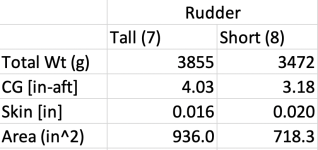
Area and weights not including fiberglass. Area is from spar rivet line aft.
Thanks Brian, I have just been lazy and not installed my 8 (aka 7 Short) rudder, and will have to invest in painting it too. I did all the glass fitting but not the final ready-to-paint details. Di you find any significant changes to landings?
Last edited:

EDIT > One question I have about aerobatics, and instruction in aerobatics is "Are parachutes required?". You can't or it isn't a recommended procedure to eject the canopy in-flight in an RV-14A, so what does a parachute do for you if they are required?
As I understand it, you are not required to have a parachute to perform aerobatics alone. You are free to kill yourself. However, if you have a passenger, you are both required to have parachutes. You aren’t supposed to kill innocent victims or, presumably, let them watch you go down with the ship, so to speak.
Put my feet on the rudder pedals (I usually fly feet off until maneuvering) , chopped power, and the vibration ceased.
More likely to have bad things happen with "stick free" (in this case rudder pedals free) than with "stick fixed". Control cables/tubes provide another constraint when held with control pressure.
...
Thanks Brian, I have just been lazy and not installed my 8 (aka 7 Short) rudder, and will have to invest in painting it too. I did all the glass fitting but not the final ready-to-paint details. Di you find any significant changes to landings?
None whatsoever; crosswind (demonstrated) to 20kts (Airport T82) at heavy weights. I tend to land a bit on the faster side however -- usually over the fence at 75kts, rounding out / flare at 65kts...
More likely to have bad things happen with "stick free" (in this case rudder pedals free) than with "stick fixed". Control cables/tubes provide another constraint when held with control pressure.
No argument -- I now rest the balls of my feet on the outside of the rudder pedals, takes up any slack in the cables.

The 7 Short (aka 8) rudder is smaller, lighter, and CG closer to the pivot than the 7Tall/9 rudder.
View attachment 29671
Area and weights not including fiberglass. Area is from spar rivet line aft.
Thanks Brian, I have just been lazy and not installed my 8 (aka 7 Short) rudder, and will have to invest in painting it too. I did all the glass fitting but not the final ready-to-paint details. Di you find any significant changes to landings?
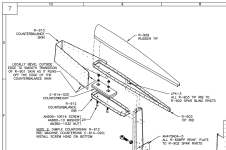
Interesting that the 8 rudder CB weight is 1.85lbs vs the 7 rudder is 1.43lbs
Interesting that the 8 rudder CB weight is 1.85lbs vs the 7 rudder is 1.43lbs
Plans for the -7 big rudder (RV-9) call for the E-612-020 weight. Which according to Van's weighs in at 1.85lbs.
Attachments
Last edited:

I bet some would if it was lighter (like the 8), carbon fiber, stronger/stiffer in torsion and bending. Then counterweight factor could be better. Reno/racers might want it.
Can this be done in carbon?
Would it be as simple as producing a skin that folds at the edge rather than being riveted? How about a piece of .062 or even thinner bent to scab on over the trailing edge?
Plans for the -7 big rudder (RV-9) call for the E-612-020 weight. Which according to Van's weighs in at 1.85lbs.
Ok now I'm confused.
According to the Van's website for the -20 weight:
"Counterweights for optional 0.020 Skins, RV-6/6A, Early RV-7/7A"
Would it be as simple as producing a skin that folds at the edge rather than being riveted? How about a piece of .062 or even thinner bent to scab on over the trailing edge?
From the manufacturing perspective, a folded rudder will cost more material since less number of rudder skin can be cut from a larger sheet of raw stock because of the odd shape. For a zip leading edge, more smaller rudder skins, left and right skins are identical, can be stamped from a larger sheet, thus, more economical use of the raw stock. We all love the low prices of Vans aluminum parts.
edit: confirmed the 7 tall-9 has the E-614-020 (1.85#) called out.
Yes but "I think" that was for the early 7 rudder (which was the 8).
The RV8 plans call for the -20....
Update: Van's tech support (Stirling) just confirmed both rudders (7/8/9) use the same -20 weight.
Last edited:
From the manufacturing perspective, a folded rudder will cost more material since less number of rudder skin can be cut from a larger sheet of raw stock because of the odd shape. For a zip leading edge, more smaller rudder skins, left and right skins are identical, can be stamped from a larger sheet, thus, more economical use of the raw stock. We all love the low prices of Vans aluminum parts.
I understand the reason. Shipping for all the tail kits that go out is big too. Im looking for a way to strengthen the zipper. If I took a 4" piece of .062, bent it to about 160 degrees (not sure if that is the correct bend) and then epoxy or rivet to the trailing edge? That would strengthen it considerably and maybe help with AV type wind damage too.
I flew today and on my walk around, I tried flexing the rudder like it would in the wind. It feels pretty solid, but I can see how a wind gust could weaken it and after several smacks, I could see it weakening. I imagine flutter do the same thing in seconds.
Comments
Things I haven't seen mentioned;
Utah airplane was in an area of possible moderate to severe turbulence.
Utah airplane was "estimated" by NTSB to be 128# over aerobatic gross weight.
The Washington airplane was never recovered from the water except for a few small pieces. Therefore the probable cause is loss of control for undetermined reasons. Although this was an experienced pilot the NTSB does not address aerobatic experience. I believe in this case it is POSSIBLE that the airplane was in a fully developed accelerated spin with full power that exceeded Va and failed the rudder which was fully deflected in excess of Va.
Apples to oranges but Jurgis Kairys in the SU26 and SU31 did accelerated spins that transitioned into snap rolls. Approximately 14 turns, at the halfway point the rotation was considerably faster than one can count. Now consider a RV pilot, relatively inexperienced in spins, inadvertently enters a spin with full power and elevator neutral. Panics and maintains the full power and full redder deflection.
Things I haven't seen mentioned;
Utah airplane was in an area of possible moderate to severe turbulence.
Utah airplane was "estimated" by NTSB to be 128# over aerobatic gross weight.
The Washington airplane was never recovered from the water except for a few small pieces. Therefore the probable cause is loss of control for undetermined reasons. Although this was an experienced pilot the NTSB does not address aerobatic experience. I believe in this case it is POSSIBLE that the airplane was in a fully developed accelerated spin with full power that exceeded Va and failed the rudder which was fully deflected in excess of Va.
Apples to oranges but Jurgis Kairys in the SU26 and SU31 did accelerated spins that transitioned into snap rolls. Approximately 14 turns, at the halfway point the rotation was considerably faster than one can count. Now consider a RV pilot, relatively inexperienced in spins, inadvertently enters a spin with full power and elevator neutral. Panics and maintains the full power and full redder deflection.
Flutter
The Polen Special is derived form the Midget Mustang I which was designed by a Pier Engineer in the 40's. The Polen flew successfully for many years and then developed rudder flutter. The fix was a carbon fiber rudder.
Years ago I met a Harmon Rocket builder/pilot who bragged about flying at 300 indicated. It would seem that if the -7 does have a rudder problem the first thing to consider would be the construction and balance of the rocket rudder.
Again apples to oranges but since the starting point for the Harmon Rocket is RV4 parts, maybe John Harmon and other HR builders know things that would be applicable to the RV7.
The Polen Special is derived form the Midget Mustang I which was designed by a Pier Engineer in the 40's. The Polen flew successfully for many years and then developed rudder flutter. The fix was a carbon fiber rudder.
Years ago I met a Harmon Rocket builder/pilot who bragged about flying at 300 indicated. It would seem that if the -7 does have a rudder problem the first thing to consider would be the construction and balance of the rocket rudder.
Again apples to oranges but since the starting point for the Harmon Rocket is RV4 parts, maybe John Harmon and other HR builders know things that would be applicable to the RV7.
PilotjohnS
Well Known Member
Vans problem
So this is Van's issue, if there is an issue. When it comes to flutter and adding rudder mass, I can see where this gets complicated real fast. I don't want to be a test pilot for someone else's TLAR (That Looks About Right) engineering. JMHO
Although the RV 7/7A/9/9A are as easy to fly as a Cessna 152 or 172, they are not the same; they are one level up from the trainer market and their limits must be respected. For example, I don't think anyone can ever exceed Vne in a 152, even point straight down at Max RPM. But Van's RV's, Piper's, Cirrius, and more advance Cessna's will.
When someone finds an RV accident where the operator did not exceed the recommended operating limitations, then I will get a little excited. YMMV
The Polen Special is derived form the Midget Mustang I which was designed by a Pier Engineer in the 40's. The Polen flew successfully for many years and then developed rudder flutter. The fix was a carbon fiber rudder.
Years ago I met a Harmon Rocket builder/pilot who bragged about flying at 300 indicated. It would seem that if the -7 does have a rudder problem the first thing to consider would be the construction and balance of the rocket rudder.
Again apples to oranges but since the starting point for the Harmon Rocket is RV4 parts, maybe John Harmon and other HR builders know things that would be applicable to the RV7.
So this is Van's issue, if there is an issue. When it comes to flutter and adding rudder mass, I can see where this gets complicated real fast. I don't want to be a test pilot for someone else's TLAR (That Looks About Right) engineering. JMHO
Although the RV 7/7A/9/9A are as easy to fly as a Cessna 152 or 172, they are not the same; they are one level up from the trainer market and their limits must be respected. For example, I don't think anyone can ever exceed Vne in a 152, even point straight down at Max RPM. But Van's RV's, Piper's, Cirrius, and more advance Cessna's will.
When someone finds an RV accident where the operator did not exceed the recommended operating limitations, then I will get a little excited. YMMV
Last edited:

Z-EDD
Well Known Member
Better the devil you know.
Ok, so I'm not a learned engineer, but I have been involved in aviation for several decades and thousands of hours. My understanding is that it is not as simple as this. If it were, it would be easy for designers to avoid flutter, but that does not appear to be the case.
IMHO the structural design has little to do with the problem, other than stiffness having some effect on when flutter occurs. Talk of 'unzipping"rudders is misguiding. Flutter causes destructive loads, if this does not occur on the trailing edge, then it will someplace else.
What we have here with the RV-7 is a mature design with significant service experience that shows that the rudder flutters at a fairly consistent speed significantly above VNE. Owners fitting anything other than the standard rudder built to plans are IMHO going into test pilot territory. You may get an improvement in flutter margin, but you just as easily may make it worse. If there is an improvement, then who is to say that something else will not fail shortly after? Most airplanes see downward failure of the horizontal stab as the first failure above VNE.
Training and superior judgement to avoid the situation in the first place is the answer IMHO.
Could you help the flutter-ignorant engineers with some understanding please. I thought that decreasing mass, moment, and increasing stiffness of a flight control would always extend the flutter speed. Given fixed design otherwise.
I do understand the aft fuse, HS, VS structures are all involved the dynamics, and one time at low altitude I hit a burble at 130kts (straight and level) and the tail seemed to shake like a wet dog. Nothing like this has happened in 250 hrs since. It would make me happy if there was a full ground vibration test performed, but that is out of my control.
Ok, so I'm not a learned engineer, but I have been involved in aviation for several decades and thousands of hours. My understanding is that it is not as simple as this. If it were, it would be easy for designers to avoid flutter, but that does not appear to be the case.
IMHO the structural design has little to do with the problem, other than stiffness having some effect on when flutter occurs. Talk of 'unzipping"rudders is misguiding. Flutter causes destructive loads, if this does not occur on the trailing edge, then it will someplace else.
What we have here with the RV-7 is a mature design with significant service experience that shows that the rudder flutters at a fairly consistent speed significantly above VNE. Owners fitting anything other than the standard rudder built to plans are IMHO going into test pilot territory. You may get an improvement in flutter margin, but you just as easily may make it worse. If there is an improvement, then who is to say that something else will not fail shortly after? Most airplanes see downward failure of the horizontal stab as the first failure above VNE.
Training and superior judgement to avoid the situation in the first place is the answer IMHO.
Z-EDD
Well Known Member
Posts like this worry me. The point of the counterbalance is to balance the rudder, just like the elevators.
Nor is mine. But it's a different design, with different size and shape and different speed limitations on the airframe. Van did switch to a counterbalanced rudder on the -6 before they stopped selling the kit, as part of the development of the -7. A number of -6's have been upgraded to that tail, or the -8 tail, to get increased rudder authority.
Please don't be worried Rob. The -7 rudder has a counterbalance weight, but it is NOT designed to be fully balanced. It would take a significant amount of additional lead to do so. Would adding more lead improve the flutter margins? I don't know, but I'm not going to go into test pilot mode to find out.
