Van's Air Force

The definitive Van's Aircraft support community! Buying, building or flying an RV? Join our exclusive family of mentors and enthusiasts!

Young eagles- personal ri$k management flying others.

…and the other side of the coin…

I have given many YE flights over the years and there is nothing better than the look on those children’s face when you leave the ground.

The people saying that GA is dying ought to take a hard look in the mirror to find the root cause.
 
Yup, for most of us it's relatively easy to be well-insured except with respect to aviation.

From a liability standpoint, probably the most valuable part of a typical $1M aviation policy with $100,000 sublimits is that the insurer has a duty to defend. The actual coverage is just not a ton of cash to throw at a problem like an aviation wrongful death.

Also, we need to be clear-eyed about the nature and extent of the relative risks involved. Everything has risks, but some risks really are bigger than others. For example, no matter how you calculate it, the riskiest part of your GA flight is your GA flight, it's not the drive to the airport: https://www.aviationseminars.com/downloads/big_lie_john_king.pdf

If we're talking liability risk, it seems to me that teaching others how to fly (CFI) has to be much higher on the list than flying Young Eagles.
 
My friend used to give Young Eagles rides in his -6A until one incident that scared the @rap out of him. On rotation, the kid grabbed the stick and pulled back as hard as he could. Had to have the stick forced out of his hand. He quit giving unknown kids rides after that. Heard recently that same kid showed up to another young eagles event. The organizers warned the pilot what happened on his previous flight. The pilot agreed to take him and his mom up in the second seat of a Cherokee 6. The mother threw a fit and sent complaint letters and phone calls to the EAA administration because her kid had to sit in the back seat.

I love the idea of it, but the potential for just one bad out of thousands of good rides stops me from doing it.
A proper preflight explanation and any warnings of what not to do, and what to expect, provided to the youngsters prior to getting into the plane will remediate those concerns👍🙂
 
If we're talking liability risk, it seems to me that teaching others how to fly (CFI) has to be much higher on the list than flying Young Eagles.
IMHO, absolutely true. And do you know where that risk is? It’s when you sign them off for solo. Out on their own, there’s nothing official from the faa-just a cfi sign off in their logbook. So if anything goes wrong, guess who will be sued?* Only true for primary instruction. For instrument instruction, ‘students’ cannot legally fly in IMC, nor under the hood without a safety pilot, so there’s some built in protection from crazy lawsuits.
BTW, I think I have had to physically hit (across the forearms) at least one student who wouldn’t let go of the controls when I asked for them.
*I quit signing solo sign-offs after I read of a CFI in HI who was sued by the grieving parents of a 17 year old who, on his x-country solo, had attempted to fly thru a cloud at Maui - apparently not realizing that there was a mountain on the other side. The parents claimed that the cfi (not them, of course) ‘should have known’ that there son lacked sufficient maturity. The CFI won the legal case - but only after spending $10K on his legal defense. Ask any cfi: they’ll tell you that there are simply some students that make the hair on the back of your neck stand up. You just have a sixth sense that, as soon as you turn them loose for solo, they’re going to ignore everything you tried to reach them, and do something stupid.
 
IMHO, absolutely true. And do you know where that risk is? It’s when you sign them off for solo. Out on their own, there’s nothing official from the faa-just a cfi sign off in their logbook. So if anything goes wrong, guess who will be sued?* Only true for primary instruction. For instrument instruction, ‘students’ cannot legally fly in IMC, nor under the hood without a safety pilot, so there’s some built in protection from crazy lawsuits.
BTW, I think I have had to physically hit (across the forearms) at least one student who wouldn’t let go of the controls when I asked for them.
*I quit signing solo sign-offs after I read of a CFI in HI who was sued by the grieving parents of a 17 year old who, on his x-country solo, had attempted to fly thru a cloud at Maui - apparently not realizing that there was a mountain on the other side. The parents claimed that the cfi (not them, of course) ‘should have known’ that there son lacked sufficient maturity. The CFI won the legal case - but only after spending $10K on his legal defense. Ask any cfi: they’ll tell you that there are simply some students that make the hair on the back of your neck stand up. You just have a sixth sense that, as soon as you turn them loose for solo, they’re going to ignore everything you tried to reach them, and do something stupid.
Yeah, so nobody sign off a student for solo…talk about killing GA.
 
Yeah, so nobody sign off a student for solo…talk about killing GA.
In practice, it’s not much of a problem. They just go find a 20 year old cfi who has essentially no assets, and is therefore ‘judgement proof’. But I have talked with a number of (older) pilots, who were good pilots and said that they thought they would enjoy teaching - but their lawyer told them that this was a very bad idea, for the above reasons.
 
From the sound of it you see already decided that the answer is "no" and I would respect that. For others considering, I find the worry about litigation to be substantially more than the actual threat with regard to Young Eagles. EAA has good liability coverage.

As for undisciplined kids, this should not be a concern. First, a Young Eagles pilot is under no obligation to fly someone who appears undisciplined. In fact, you could restrict your flights to kids of a certain age. We do not have a problem in this area.

It is important, however, for a YE pilot to do a THOROUGH preflight with the YE, including what not touch and what is to happen. This shouldn't be a get-in-and-go thing.

If your heart isn't in it, by all means do not do it. It's not fair to the Young Eagles. For those who are interested, it is a very rewarding thing. You are making a difference in the lives of some kids.

For those looking for more information, I've put together a comprehensive section on my chapter website.

Screenshot_29-4-2026_182758_chapters.eaa.org.jpeg
 
IMHO, absolutely true. And do you know where that risk is? It’s when you sign them off for solo. Out on their own, there’s nothing official from the faa-just a cfi sign off in their logbook. So if anything goes wrong, guess who will be sued?* Only true for primary instruction. For instrument instruction, ‘students’ cannot legally fly in IMC, nor under the hood without a safety pilot, so there’s some built in protection from crazy lawsuits.
BTW, I think I have had to physically hit (across the forearms) at least one student who wouldn’t let go of the controls when I asked for them.
*I quit signing solo sign-offs after I read of a CFI in HI who was sued by the grieving parents of a 17 year old who, on his x-country solo, had attempted to fly thru a cloud at Maui - apparently not realizing that there was a mountain on the other side. The parents claimed that the cfi (not them, of course) ‘should have known’ that their son lacked sufficient maturity. The CFI won the legal case - but only after spending $10K on his legal defense. Ask any cfi: they’ll tell you that there are simply some students that make the hair on the back of your neck stand up. You just have a sixth sense that, as soon as you turn them loose for solo, they’re going to ignore everything you tried to reach them, and do something stupid.
I'd guess that any airplane accident where there is death or injury will result in a lawsuit. Granted, some or many may get settled for liability insurance limits. I'd also guess that there's a high likelihood of a lawsuit for any student pilot mishap with death or injury regardless of where they are in the training. I can readily envision the plaintiff's attorney's argument that the instructor just did a crappy job of teaching that student how to manage the emergency that killed them.
 
I don’t think I’d have a problem taking kids I know up for a flight.

Shortly after I soloed in a 1974 c172M I bought a 1974 c172 M. My instructor stopped teaching me out of some form of liability concern. I think he carried over some bias from something that happened and his friend that owned the rental plane told him not to. He also said his solo endorsement was no longer any good because the new plane had a powerflo exhaust.
 
For those who are afraid of the liability concerns (way overblown IMO) how about finding some other way to give back / pay it forward? We all have someone in our past that took a risk on us and created an opportunity that changed our lives. Do the same for someone less fortunate than yourself.

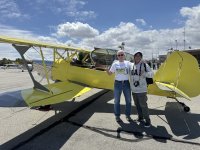
This is me and my new friend Ivan at the Redlands Spring Fling last weekend. He’s 13 years old…the proverbial Kid at the Airport Fence. After seeing him outside the fence line for the second time at my home airport taking pics of airplanes I went over there and asked him what he was doing. He shyly dropped his head and said “I like airplanes”. His mom came over about that time and said “He LOVES airplanes and wants to be a pilot”. I haven’t taken him flying yet - not out of liability concerns but instead circumstances - but am doing what I can to educate him and the family about aviation and creating opportunities to expose him to GA. He’s a hell-of-a photographer and an A student.

Like a good friend of mine told me a long time ago …”if you can help somebody out and it’s not going to cost you a lot, why not do it?”
 

Attachments

  • IMG_4784.jpeg
    IMG_4784.jpeg
    5.3 MB · Views: 72
If we're talking liability risk, it seems to me that teaching others how to fly (CFI) has to be much higher on the list than flying Young Eagles.
You may well be right. I have no idea. Insurance company practices will usually be based on data — what kind of insurance limits are available for CFIs?
 
BTW, I think I have had to physically hit (across the forearms) at least one student who wouldn’t let go of the controls when I asked for them.
I was a glider CFI from 1974 through 2002. When I was prepping for my CFI-G flight test with the FAA Examiner, the experienced CFI I was working with warned me about students freezing on the controls. He told me the quickest way to get them off the controls was to cover their eyes. People will instinctively let go of the controls and use both hands to uncover their eyes to get their sight back. Back then we were using mostly Schweizer 2-22s and 2-33s as trainers, where the CFI in the back seat could easily lean forward and cover a student's or passenger's eyes in the front seat.
 
Last edited:
In practice, it’s not much of a problem. They just go find a 20 year old cfi who has essentially no assets, and is therefore ‘judgement proof’. But I have talked with a number of (older) pilots, who were good pilots and said that they thought they would enjoy teaching - but their lawyer told them that this was a very bad idea, for the above reasons.
Probably shouldn't let anyone ride in your car, golf cart, side by side, boat, or anything else for that matter...you know, might get sued.

You probably ought to thank the guy that risked everything to sign YOU off for solo, though...
 
This thread is, for me at least, one of the most depressing things I've read on VAF. I understand the liability concerns and certainly don't fault pilots for deciding not to give rides to kids. I get it. This is the world we have created.

But it saddens me nonetheless.

I'll give a ride to anyone who wants one. I can't tell you how many people have given me a set of keys to their airplane with instructions to fly it whenever I wanted. I'm sure liability could have been on their mind as well, because every one of them had significant net worth. But they gave a kid a break, and here I am all these years later. I've posted previously about how the kindness of a random person back in the 70's started me on the road to where I am now (and where I am now is in Savannah, GA getting typed on the Gulfstream G700, so it really led to some cool stuff).

Do I have a family? Assets? Sure. But I'll be darned if I'm going to be the one to pull the ladder up behind me. I just cannot do it. If there are risks (and there ARE risks with everything in life), then I will take them.

I once heard Dick Rutan ask an EAA audience where mankind would be if people hadn't been willing to take risks to achieve things of importance. Perhaps flying Young Eagles wasn't what he was talking about.

But maybe it was.

--Ron
 
…and the other side of the coin…

I have given many YE flights over the years and there is nothing better than the look on those children’s face when you leave the ground.

The people saying that GA is dying ought to take a hard look in the mirror to find the root cause.
I don’t think it is fair to say those of us not giving YE rides are killing GA. Liability threat is real, whether you believe it or not. Odds may be low, but that doesn’t eliminate risk. I worked hard for my savings and simply will not accept ending up on welfare because some plantiff took all my money. If you think this risk doesn’t exist, that is great and will keep YE alive.
 
I was a glider CFI from about 1975 through 2002. When I was prepping for my CFI-G flight test with the FAA Examiner, the experienced CFI I was working with warned me about students freezing on the controls. He told me the quickest way to get them off the controls was to cover their eyes. People will instinctively let go of the controls and use both hands to uncover their eyes to get their sight back. Back then we were using Schweizer 2-22s and 2-33s as trainers, where the CFI in the back seat could easily lean forward and cover a student's or passenger's eyes in the front seat.

That is always a risk. And there are plenty of others. I used to solo people in a Pitts S-2B at a very busy airport, on a short runway, right next to a longer runway with 757s and A320s constantly landing on it. The stress would get to some people, especially if they weren't used to that kind of environment. And I always worried about a student freezing up on a brake pedal, maybe without even being aware of it. We'd end up in the weeds and there would be nothing I could do to free up that wheel. By the time I'd start to communicate to the student it would be all over because things happen so fast in that airplane.

I taught an advanced spin course in an Extra 300 and if someone froze on the controls in the middle of some accelerated flat spin, would I be able to overpower them? Flying in the back seat of a Super Decathlon, I had no access to the fuel valve. If they turned that thing off, what could I do? Nothing.

Everything in life has risks. A friend became a quadriplegic after an accident while working out. People die every day from falling in the shower. Choking on food. You name it.

But out of the 2,500,000 kids flown by Young Eagles, how many have died? I think I'd take those odds -- and by that I mean I'd allow my own kids to go flying with a YE pilot. And I probably understand the risks better than your average person. Of course, I also understand the impact a YE flight can have on a kid better than the average person, too...

--Ron
 
A proper preflight explanation and any warnings of what not to do, and what to expect, provided to the youngsters prior to getting into the plane will remediate those concerns👍🙂
Unfortunately the kid was special, and the person interviewing and helping load him in the plane didn’t feel the need to share that information.
 
This thread is, for me at least, one of the most depressing things I've read on VAF. I understand the liability concerns and certainly don't fault pilots for deciding not to give rides to kids. I get it. This is the world we have created.

But it saddens me nonetheless.

I'll give a ride to anyone who wants one. I can't tell you how many people have given me a set of keys to their airplane with instructions to fly it whenever I wanted. I'm sure liability could have been on their mind as well, because every one of them had significant net worth. But they gave a kid a break, and here I am all these years later. I've posted previously about how the kindness of a random person back in the 70's started me on the road to where I am now (and where I am now is in Savannah, GA getting typed on the Gulfstream G700, so it really led to some cool stuff).

Do I have a family? Assets? Sure. But I'll be darned if I'm going to be the one to pull the ladder up behind me. I just cannot do it. If there are risks (and there ARE risks with everything in life), then I will take them.

I once heard Dick Rutan ask an EAA audience where mankind would be if people hadn't been willing to take risks to achieve things of importance. Perhaps flying Young Eagles wasn't what he was talking about.

But maybe it was.

--Ron
excellent post and it is great to hear. I am all for helping out new folks and do so in many different ways. Have always wanted to develop a mentoring program for kids to learn how to build repair planes. I very much want to give back, but I have just seen too much on the legal side, especially the judgement sizes when small children are injured.
 
Probably shouldn't let anyone ride in your car, golf cart, side by side, boat, or anything else for that matter...you know, might get sued.

You probably ought to thank the guy that risked everything to sign YOU off for solo, though...
The guy who signed me off was 20 years old, basically no assets to lose.
And for many years I did fly YEs (still do), signed off students for solo, etc. But reality hit when I saw the news of that cfi lawsuit. The issue is being held responsible when I’m not in the cockpit. How many times has a golfer been sued for a golf cart accident where he wasn’t near the cart? To be clear, if I were single I’d probably still be signing off students. But somehow it seemed unfair to risk my wife’s assets for my hobby. And to answer someone else, it’s usually not about emergencies while solo. It’s about solo pilots taking foolish unnecessary risks, once they’re out of my sight. In two cases, I had solo students directly do what I clearly told them not to do. And somehow I might be sued for this.
Bob, I feel guilty about what I’m going to say, but, really, go get a cfi certificate, sign off a bunch of students. Then you’ll be walking in my shoes with every right to criticize me. But until then….
 
"...Bob, I feel guilty about what I’m going to say, but, really, go get a cfi certificate, sign off a bunch of students. Then you’ll be walking in my shoes with every right to criticize me. But until then…."

Bob, I have had my CFI, CFII, MEI continuously for 40+ years; I have signed off many, many people along the way. I guess you might say that I am qualified to criticize, however, it really isn't an attack. I understand your reluctance and aversion to a risk.
 
Probably shouldn't let anyone ride in your car, golf cart, side by side, boat, or anything else for that matter...you know, might get sued.
Not comparable. In each of those scenarios, it is much, much easier to obtain insurance commensurate with the liability exposure.

I’d agree that, from my perspective (and it’s only that) people typically worry about aviation liability risks more than they should, and indeed humans are bad at calculating risks generally (the reason Las Vegas exists…). For example, if you have assets, operate a car, and don’t carry max liability plus an umbrella policy, flying YEs is likely not your biggest exposure. 🤣

But the aviation liability problem in the US is undeniably real. The aviation liability policies available to most of us offer relatively low limits AND for some reason, people are worth a lot more when they die in airplanes vs. boats, cars, golf carts, etc. Anyone with assets will need to assess how it affects them and how best to grapple with it given their individual circumstances, values, and jurisdiction. Inapposite comparisons and bizarrely wrong legal theories, both of which are rampant on the interwebs, won’t make it go away.

 
Not comparable. In each of those scenarios, it is much, much easier to obtain insurance commensurate with the liability exposure.

I’d agree that, from my perspective (and it’s only that) people typically worry about aviation liability risks more than they should, and indeed humans are bad at calculating risks generally (the reason Las Vegas exists…). For example, if you have assets, operate a car, and don’t carry max liability plus an umbrella policy, flying YEs is likely not your biggest exposure. 🤣

But the aviation liability problem in the US is undeniably real. The aviation liability policies available to most of us offer relatively low limits AND for some reason, people are worth a lot more when they die in airplanes vs. boats, cars, golf carts, etc. Anyone with assets will need to assess how it affects them and how best to grapple with it given their individual circumstances, values, and jurisdiction. Inapposite comparisons and bizarrely wrong legal theories, both of which are rampant on the interwebs, won’t make it go away.

Not comparable. In each of those scenarios, it is much, much easier to obtain insurance commensurate with the liability exposure.

I’d agree that, from my perspective (and it’s only that) people typically worry about aviation liability risks more than they should, and indeed humans are bad at calculating risks generally (the reason Las Vegas exists…). For example, if you have assets, operate a car, and don’t carry max liability plus an umbrella policy, flying YEs is likely not your biggest exposure. 🤣

But the aviation liability problem in the US is undeniably real. The aviation liability policies available to most of us offer relatively low limits AND for some reason, people are worth a lot more when they die in airplanes vs. boats, cars, golf carts, etc. Anyone with assets will need to assess how it affects them and how best to grapple with it given their individual circumstances, values, and jurisdiction. Inapposite comparisons and bizarrely wrong legal theories, both of which are rampant on the interwebs, won’t make it go away.

The comparisons are still valid; in today’s society, you can be sued for anything by anyone. In some places, you can even be sued by “hurting someone’s feelings” but that is a separate discussion that does not belong here…

The liability risk is certainly real but so is the observation that GA will die as people choose not to keep it alive based on that risk.

I also see people complaining about inexperienced instructors, “big box store” training, and lack of stick and rudder skills. How do you mitigate those issues if the experienced instructors refuse to instruct because of liability?…and if the people complaining are actually experienced instructors, then they are part of perpetuating the problems.

One has to look no farther than any of the discussions on this board; everyone has their own level of risk aversion for every possible issue. That aversion runs from “I shouldn’t get out of bed this morning because I might stub my toe” to arguably reckless. Most are somewhere in between. Hopefully, there are enough experienced instructors willing to keep aviation going forward and pass along their experience to the next generation. Time will tell.
 
The comparisons are still valid; in today’s society, you can be sued for anything by anyone. In some places, you can even be sued by “hurting someone’s feelings” but that is a separate discussion that does not belong here…

The liability risk is certainly real but so is the observation that GA will die as people choose not to keep it alive based on that risk.

I also see people complaining about inexperienced instructors, “big box store” training, and lack of stick and rudder skills. How do you mitigate those issues if the experienced instructors refuse to instruct because of liability?…and if the people complaining are actually experienced instructors, then they are part of perpetuating the problems.

One has to look no farther than any of the discussions on this board; everyone has their own level of risk aversion for every possible issue. That aversion runs from “I shouldn’t get out of bed this morning because I might stub my toe” to arguably reckless. Most are somewhere in between. Hopefully, there are enough experienced instructors willing to keep aviation going forward and pass along their experience to the next generation. Time will tell.
It has been mentioned many times, but the risk only exists if you have meaningfull assets that can be taken (primary home and IRA/401k usually excluded). There are plenty of people that are mostly judgement proof (lawyer won't take on the case if the plantiff doesn't have enough assets to cover their costs + profit from their 1/3) to keep GA doing what it has always done, including YE. Most folks in their 20's or 30's rarely have enough assets for these risks to be real.
 
It has been mentioned many times, but the risk only exists if you have meaningfull assets that can be taken (primary home and IRA/401k usually excluded). There are plenty of people that are mostly judgement proof (lawyer won't take on the case if the plantiff doesn't have enough assets to cover their costs + profit from their 1/3) to keep GA doing what it has always done, including YE. Most folks in their 20's or 30's rarely have enough assets for these risks to be real.
To add some color on how bad the liability issue is in GA, I considered getting my A&P so I could do CI's for RVs. The liability insurance was $10k per year for just one guy working part time. That gives you an idea how often folks are getting sued in this field.
 
It has been mentioned many times, but the risk only exists if you have meaningfull assets that can be taken (primary home and IRA/401k usually excluded). There are plenty of people that are mostly judgement proof (lawyer won't take on the case if the plantiff doesn't have enough assets to cover their costs + profit from their 1/3) to keep GA doing what it has always done, including YE. Most folks in their 20's or 30's rarely have enough assets for these risks to be real.

Honestly, I wonder how people even get out of bed any more…
 
Imagine the risk and liability associated with giving people advice on how to build and maintain airplanes on something public like…uh…you know…the internet?! 😉

When I started writing as an aviation journalist in this world, I simply had to stop thinking about all the people that might follow what I write about building, maintaining, and flying airplanes using things that I wrote. Mind-boggling…..
 
From the sound of it you see already decided that the answer is "no" and I would respect that. For others considering, I find the worry about litigation to be substantially more than the actual threat with regard to Young Eagles. EAA has good liability coverage.

As for undisciplined kids, this should not be a concern. First, a Young Eagles pilot is under no obligation to fly someone who appears undisciplined. In fact, you could restrict your flights to kids of a certain age. We do not have a problem in this area.

It is important, however, for a YE pilot to do a THOROUGH preflight with the YE, including what not touch and what is to happen. This shouldn't be a get-in-and-go thing.

If your heart isn't in it, by all means do not do it. It's not fair to the Young Eagles. For those who are interested, it is a very rewarding thing. You are making a difference in the lives of some kids.

For those looking for more information, I've put together a comprehensive section on my chapter website.

View attachment 116377
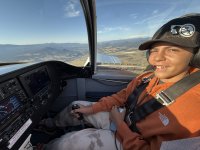
This —^ is why I do it.

I grew up riding a 3-speed bicycle to the airport (without a helmet). No fences. No gates. Just airplanes, airplanes and airplanes. Beech-18’s in massive rows as freight dogs. My first ride was in someone Apache, after some maintenance no less.
I was hooked. Kershner’s Student pilot handbook was read, highlighted and read again.

Now more than 50-years and 5-figure logbook numbers it is my chance to “Pass the Baton”
I can teach them “the 4-pictures” in less than 5-10 minutes, that smile is contagious and addicting.

Oh, and finally - “Safety Third”

- cappy

uuid=C4EB2F46-2A96-443B-8E43-6373EBCC6924&code=001&library=1&type=1&mode=2&loc=true&cap=true.jpeg
 
Imagine the risk and liability associated with giving people advice on how to build and maintain airplanes on something public like…uh…you know…the internet?! 😉

When I started writing as an aviation journalist in this world, I simply had to stop thinking about all the people that might follow what I write about building, maintaining, and flying airplanes using things that I wrote. Mind-boggling…..

IMG_6618.jpeg
 
The comparisons are still valid; in today’s society, you can be sued for anything by anyone.
That's a non sequitur.

The fact that "you can be sued for anything" doesn't mean that being sued for a car accident is comparable to being sued for an aviation accident. Availability of adequate insurace is the difference.

If you have an auto/golf cart/motorcycle accident and you carry maxed out liability coverage and an umbrella policy, you are likely to be covered for your costs of defense and all of the damages that are reasonably likely to be awarded to the prevailing plaintiff(s).

If you carry maxed out aviation liability, you are likely to be covered for the costs of defense but not for anything close to all of the damages that are reasonably likely to be awarded to the prevailing plaintiff(s).

"You can be sued for anything by anyone," sure -- but in aviation, the limits on available insurance coverage make such a lawsuit much, much more dangerous than in other situations. This problem needs to be kept in perspective, but aviation is materially different.
 
Last edited:
That's a non sequitur.

The fact that "you can be sued for anything" doesn't mean that being sued for a car accident is comparable to being sued for an aviation accident. Availability of adequate insurace is the difference.

If you have an auto/golf cart/motorcycle accident and you carry maxed out liability coverage and an umbrella policy, you are likely to be covered for your costs of defense and all of the damages that are reasonably likely to be awarded to the prevailing plaintiff(s).

If you carry maxed out aviation liability, you are likely to be covered for the costs of defense but not for anything close to all of the damages that are reasonably likely to be awarded to the prevailing plaintiff(s).

"You can be sued for anything by anyone," sure -- but in aviation, the limits on available insurance coverage make such a lawsuit much, much more dangerous than in other situations. This problem needs to be kept in perspective, but aviation is materially different.
Sorry but the standard limits on vehicle insurance isn’t going to prevent them from suing you for far more; the end result is the same…a potentially huge financial hit.

What is materially different in aviation is perception; you can cause the exact same injuries, up to and including death, in a vehicle of any type. The difference is the perception that your pockets are deeper with an airplane; an injury is still an injury and a death is still a death regardless of the vehicle involved.

If you have ever been in a lawsuit situation, it is always “go for the gold”.
 
Last edited:
Returning to the OP's questions...

One approach to risk reduction is to carefully structure the operating environment. Skew as many factors as possible in your favor.

Here's an example. The Google Maps view below is one of our standard handouts at a mandatory briefing. Everyone is to use the designated flight paths. Pilots may deviate for safety, with an announcement. Everyone sticks to the Unicom frequency, so as to be aware of non-participating inbounds. We run two routes, fast (140) and slow (80), for separation. Preferably the routes are run CCW, with the slow airplanes turning north at the canal, and faster birds extending to a point south of Jordan. From there pilots are welcome to use any altitude they wish...until turning back southbound. The rule is to get everyone on a pattern altitude base leg well before the merge for final, like three or four miles north of the runway centerline. Note the fast guys are expected to angle in at pattern altitude, so all merges have any slow airplane above the horizon.

Do any of these things guarantee safety? Nope, but they do improve the odds. Note the availability of open pasture, cotton, and soybean. It's not perfect, but again, the game is to skew the odds.

Your gang has no plan, and flies out of an urban airport with no place to go in a forced landing? Frankly, I wouldn't want to fly kids there either, but that's just my personal risk assessment for flying another parent's kid. Everyone's situation is different.

Young Eagles Flight Routes.jpg
 
Sorry but the standard limits on vehicle insurance isn’t going to prevent them from suing you for far more; the end result is the same…a potentially huge financial hit.
That's incorrect.

The amount sued for isn't the issue. That's just a number on a pleading. What cases are actually worth, and whether there is sufficient insurance to cover that amount, is the issue. Because auto and aviation cases differ in both those respects, in the vast majority of cases, the end result in an auto and an aviation case will not be the same, even though lawyers in both types of cases will always be "going for the gold."

Max limits on vehicle insurance plus umbrella (which is the comparison I made) will get the vast, vast majority of motor vehicle cases settled. I'm not saying there aren't outliers (if Bill Gates hits a schoolbus they probably aren't settling for policy limits...) but in auto cases, generally it's going to get done for the insurance money.

We are agreed that aviation accidents are worth more money, for whatever reason. That's exactly my point. And the problem is that for GA people like us, there isn't readily available insurance commensurate with that exposure.

If you have ever been in a lawsuit situation, it is always “go for the gold”.
I actually have "been in a lawsuit situation" once or twice. 🤣

In the US, dealing with potential aviation liability is a problem in a way that dealing with potential automobile liability is not.

A lot of people hate this fact, but it's still a fact.
 
Doug, who decides what aviation cases are worth? How is such a thing valued?
 
Doug, who decides what aviation cases are worth? How is such a thing valued?
Strictly speaking, juries and judges. But among those in the business (I’m not), there’s a general sense of what wrongful death cases are worth, informed by things like age of the deceased, lifetime earnings potential, the kind of jury you get in the relevant jurisdiction, data in verdict databases, availability of punitives, liability caps, etc. etc. A good defense or plaintiff’s lawyer who works in the area will usually have a ballpark idea going into the settlement discussions. For a variety of reasons, the number for an aviation wrongful death case will generally be larger than the number for an auto case. But given policy limits and sublimits, most of us (or our estates….) have much less liability coverage to throw at an aviation case than at an auto case.
 
Last edited:
But among those in the business (I’m not), there’s a general sense of what wrongful death cases are worth, informed by things like age of the deceased, lifetime earnings potential, the kind of jury you get in the relevant jurisdiction, data in verdict databases, availability of punitives, liability caps, etc. etc.

Age and earnings potential are pretty much the same as automotive. Auto and airplane Juries come from the same pool. Availability of punitives and liability caps are state law, again the same for the given jurisdiction.

A good defense or plaintiff’s lawyer who works in the area will usually have a ballpark idea going into the settlement discussions.

Might the key difference be the plaintiff's estimate of the defendant's assets? Are the numbers larger simply because the available assets are generally larger?
 
I’ve heard that a plaintiff lawyer looks at recoverable assets to determine if a case is taken.

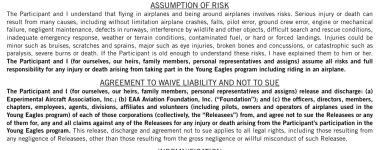
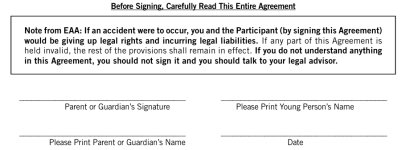
Thanks for the EAA form that participants sign.

It would be good to know if anyone still filed suit after the YE accidents. Is there some way to reliably learn this?
 
Age and earnings potential are pretty much the same as automotive.
They’re not, and apparently it’s a big part of the problem. From what I’ve read, one of several reasons it’s hard to get insurance commensurate with the risk in general aviation is that passengers killed in general aviation cases tend to be, like the pilots flying them, higher income types with (on average) much higher damage claims.

I’d agree this isn’t true of YEs, and perhaps that helps explain the availability of additional insurance through EAA. Or perhaps it’s volume/buying power, an EAA structure & rules that help ensure safer flying, other actuarial data I’m unaware of, who knows. It may also be that the EAA program is underinsured. These are kids who probably aren’t extra wealthy on average, but by definition they’ve got long earnings horizons.

I definitely don’t know all the details. But the proof that a general aviation liability problem (which is really an “availability of insurance” problem) exists in the US is there for anyone to see. As I read my policy, which appears to be quite typical, if I screw up and kill a passenger, my estate has a lawyer and $100,000 (not even the $1 million policy limit) to throw at that problem. Not nearly enough to take my other assets off the table, and far less than my auto policy plus umbrella.
 
Last edited:
IANAL, but I've been told by plenty I know that you simply can't sign away other peoples' rights. YOU can sign your own away, but you can't sign away your family's or your heirs' (or anyone else's).
The effectiveness of various types of releases and waivers, in various situations, varies quite a bit state by state. If the effectiveness of one is an important question, consult a lawyer in your jurisdiction. If that’s impossible, the relevant issues get litigated a lot, so the “supreme court” in your state (sometimes called something else) will likely have relatively comprehensible reported decisions on the topic, available online, summarizing the law. If you ask AI, ask it to cite specific cases, then READ the cases, because AI legal opinions can be… unreliable.
 
As I read my policy, which appears to be quite typical, if I screw up and kill a passenger, my estate has a lawyer and $100,000 (not even the $1 million policy limit) to throw at that problem.
Can you expand upon this please? I know that medical claims for passengers are capped at 100K, but always thought the liability portion would cover negligence suits from paasengers, due to those injuries. So, is the liability coverage only for property or possibly people injured on the ground. What exactly does the liability coverage provide for?

Very concerning info you provided, as different than my expectations.

Thanks
 
Can you expand upon this please? I know that medical claims for passengers are capped at 100K, but always thought the liability portion would cover negligence suits from paasengers, due to those injuries. So, is the liability coverage only for property or possibly people injured on the ground. What exactly does the liability coverage provide for?

Very concerning info you provided, as different than my expectations.

Thanks
It will depend on your policy. Some are smooth (no sublimits, I was unable to get that), some have sublimits applicable to passengers, and some apparently have sublimits applicable to all persons (whether passengers or not). Basic info here:

 
As usual, Doug makes some good points.

Smooth vs sublimit, in the context of Young Eagles flights...from eaa.org:

As an EAA member participating in the Young Eagles program, you are eligible for an additional $1 million of passenger liability insurance coverage, if you carry a minimum of $100,000 per seat liability insurance. This coverage is automatically in place when flying Young Eagles and the flight registration/waiver form has been complete. In addition to these requirements, you must also meet the current Federal Air Regulations (FARs) for the pilot certificate you hold.
 
I read this thread with both Saddness and apprehension. I've flown YE pilots in my RV-8. Some have been very quiet, others very exuberantly happy and excited. I love flying the kids because I started my own LOOONG aviation career as a kid flying with my Dad and never looked back. So I began flying YE's out of a sense of wanting to pay it forward.

However, something has been niggling at the back of my brain lately about the liability of flying kids in high performance Homebuilts and the liability risk incurred vs a certified Cessna or Cherokee. I could just imagine a jury picking apart an experimental airplane in every minute way compared to a certified aircraft. My stick is also not easily removable without cutting some wires for the transmit switch. Yes I need to wire up a quick disconnect plug....

Anywho.... the point is its given me pause lately whenever I get the invite to fly kids in local YE events. I'm torn between wanting to pay it forward vs the risk of a stranger in the airplane.
 
Last edited:
Liability fears, both product and personal liability, have been killing GA for 50 years, and now it's just about completely dead. Costs continue to rise to stunning levels, putting aviation out of reach for people with an average income. People on this aviation forum and others bemoan it's death, looking for an available culprit, while at the same time declaring that they won't fly Young Eagles because they're afraid of getting sued in the event of a mishap. I don't know the solution, but I'm puzzled by aviation threads that ponder the reason as to why GA is dying. We know the culprit and we've fallen victim to it too.
 
I'm on both sides of the fence on this one. I started off as a young eagle in 2003, and since then I've had a fantastic aviation career and amassed over 10,000 hours in a variety of airplanes. I flew for young eagles in a rented 172 when I was 18. I finished and test flew my RV-6 a few weeks before my 29th birthday. I still keep in touch with the pilot that took me up, we see each other around the airport and in a crowd he always brags about getting me my start in aviation. Doesn't get much better than that. It's truely a fantastic program.

On the other hand, perhaps is just me being a bit shy, I just don't think I'd be comfortable doing it in an airplane I built and maintain myself. I'm a professional pilot, not a professional mechanic. Not that my airplane is in bad shape, quite the opposite, but its still me wrenching it. Perhaps Im wrong but if it's a professionally maintained airplane, it's one less liability for me personally. I hate even using the word liability, but sadly these days one has to think of that. Especially as if something bad enough did happen, it would likely be my family paying for it in the end and not me.

So for me personally, the program is amazing, but not using my amateur built plane for it.

Alex

PS- the only guy I ever had freeze on the controls was a private pilot in his mid 60's. I was 19 and trying to teach him how to fly float planes.... Made for some eventful landings.
 
Liability fears, both product and personal liability, have been killing GA for 50 years, and now it's just about completely dead. Costs continue to rise to stunning levels, putting aviation out of reach for people with an average income. People on this aviation forum and others bemoan it's death, looking for an available culprit, while at the same time declaring that they won't fly Young Eagles because they're afraid of getting sued in the event of a mishap. I don't know the solution, but I'm puzzled by aviation threads that ponder the reason as to why GA is dying. We know the culprit and we've fallen victim to it too.
This here^^

I’m a bit puzzled by it too. The *risk of being sued can’t be any higher than the risk we all assume when we get in an airplane and leave the ground. Everyone finds justification to support what they already believe in, that part doesn’t puzzle me.
 
Back
Top