Van's Air Force

The definitive Van's Aircraft support community! Buying, building or flying an RV? Join our exclusive family of mentors and enthusiasts!

Wheel pants & gear fairing pro tips (that I stole)

mburch

Well Known Member
Patron
I put off finishing the undercarriage fairings on my RV for too long, but I finally have them done. The last time I built a set of these was almost 20 years ago (how time flies!). The process was easier this time around, thanks in large part to a series of hints and tricks I picked up in the intervening years, mostly from VAF. I figure I ought to list them here in case it helps somebody else:
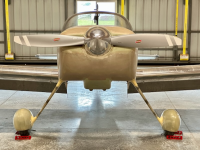
  • Buy some foam kneeling pads (like these). I kept one next to each wheel during this entire process, and they really helped save my knees.
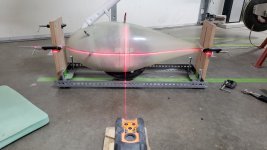
  • A laser level makes many aspects of this job a lot easier. You want one that projects both horizontal and vertical lines. A simple unit costing well under a hundred bucks (like this) will be more than adequate.
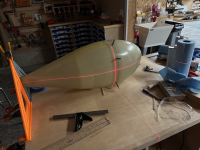
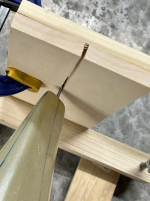
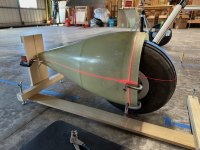
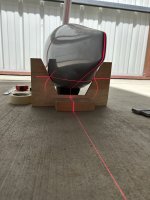
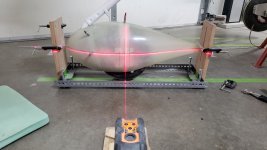
  • Once you get the two halves of a wheel fairing fitting well, you need to establish reference lines along the exact center of the top and sides. To find the top centerline, first put a mark on the top corner of the tail end, using the flat sides as a reference. Clamp two squares to a level table and use them to position the wheel fairing so the flat tail is straight up and down; use shims as needed. Next, find the forward-most part of the front dome with a square, and put another mark there. Then, carefully measure an equal distance up from the table along the split line, which will give you a center reference point at the "crown" - put a third mark there. Finally, put your laser level on a tripod or ladder, shift it around until the line hits all three marks, and trace the resulting centerline across the top contour.
  • To find the side reference line for a wheel fairing, make a reference mark at the aft end of the tail, in the exact middle of the flat part. Then simply use your laser to connect that mark to the one at the front you made in the previous step. It helps to level the fairing in the fore-aft direction by aligning the split line with the vertical laser beam.
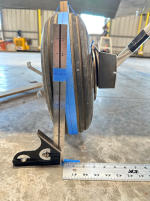
  • To mark an accurate centerline on the tire, first jack up the plane and wrap a length of tape all around the circumference. Make a dot with a sharpie at the exact center of the tire. Brace the sharpie against a block of wood or similar, touch the tip to the dot, and spin the wheel 360 degrees.
  • Use a square to project a position straight down from the centerline at leading edge of the tire, and mark this spot on the floor. This will give you a pretty good starting location for drawing a reference line that's parallel to the fuselage centerline and centered on the forward-most spot on the tire.
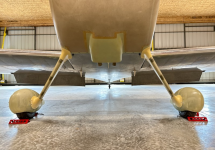
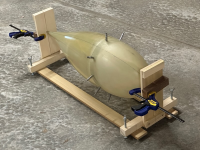
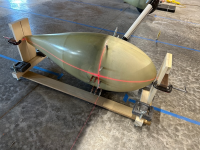
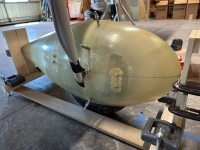
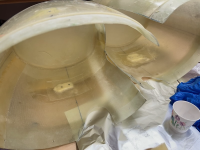
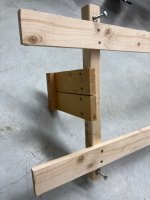
  • Rather than wrestling with the wheel fairing and attempting to hold it at the required position and angles, you can build a simple jig that holds it perfectly steady. My jig is open on one side, so I can fit it around the tire without having to jack the plane up higher than necessary, and I used some scuba weights to give it added stability. I drilled temporary holes in the fairing at the exact front and back, which accept some 1/8" steel pins. The pins slide in vertical slots in the jig, and are embedded in hardwood blocks that I can clamp at whatever elevation I need. The slots in the jig are lined up with the reference line on the floor, and the fairing is leveled with the laser - all you have to do is make sure the horizontal beam hits the side reference line and both of the pins, and the split line is aligned with the vertical beam. Later I filled the holes back in.
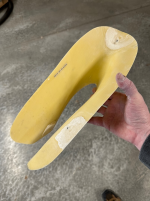
  • Anywhere you have a fiberglass fairing that's screwed or riveted to a metal bracket: If you just crank down on the fastener to make the two pieces mate up, there's a good chance that the fiberglass will eventually crack from the stress. It helps to spend time making a "liquid shim" by injecting flox between the two parts with a syringe. Use packing tape on the bracket to prevent it from sticking, and drill extra holes in the glass to squirt flox through if required. After you grind away the excess, the result will be a pair of perfectly-mating parts with no added stress. I also added an extra layer of glass over the top of the flox inside my wheel fairings, to add some extra strength.
  • Instead of riveting the outboard brackets to the aft wheel fairing halves, I attached them with screws and MK2000-06 nutplates. Now I don't have to mess with safety wiring the bolts every time I remove and reinstall the wheel pants.
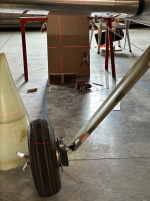
  • The plans call for a minimum of 5/8" clearance between the tires and the wheel fairings. I went for 3/4" all around, in the hopes that a flat tire won't turn into a fiberglass repair job.
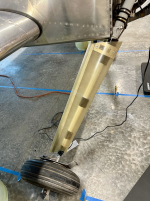
  • I left the trailing edges of the gear leg fairings about 1/8" longer than the template, and block-sanded them for a perfect fit after I was done installing the hinges.
  • When locating the gear leg fairing hinges, I first found where they "wanted" to be, then moved them 1/8" forward before drilling. This adds just a bit of preload to help the trailing edge close up nicely.
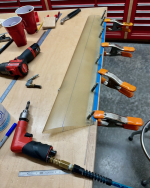
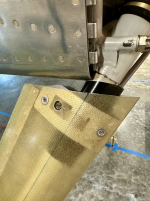
  • When drilling the hinges to the gear leg fairings, I taped the trailing edges together and clamped the whole thing to my workbench, which produced a nice straight result.
  • I used soft rivets ("A" instead of "AD") for attaching the hinges, to avoid cracking the glass. (make sure not to mix these in with your usual AD rivet supply!)
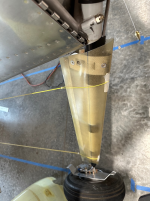
  • When setting up the strings to align the gear leg fairings, once again the laser is very helpful for alignment.
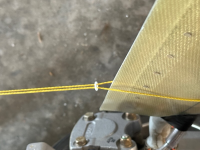
  • Sliding a lightweight washer over the strings will cinch them together at the trailing edge of the gear leg fairing, making it easier to eyeball the proper alignment.
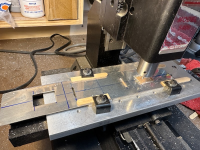
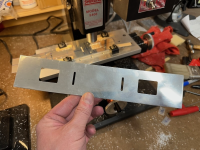
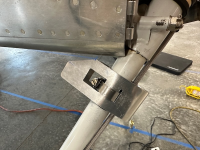
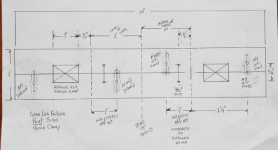
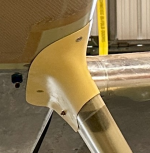
  • I remembered that the fiberglass "fingers" on my old gear leg fairings broke in pretty short order, so instead of using the plans method I made an aluminum bracket to secure them. The bracket attaches to the gear leg with a breeze clamp, and the fairing screws into nutplates in the bracket. It's super solid, and allows the fairings to be removed without disturbing the alignment.
  • The intersection fairings also got the liquid shim treatment: Anywhere I used a screw, I added a flox "screw boss" to prevent stress on the part when tightening the fastener.

1748057391313.png
1748064045559.png

Detailed pictures to follow in next replies...
 
Last edited:
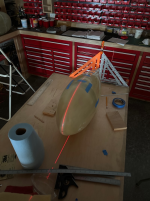
Drilling gear leg fairing hinge:

1748064446098.png

Gear leg fairing mounting bracket:

1748064473705.png
1748064483196.png
1748064496037.png
1748064509610.png
1748064520961.png

Using the laser to find the string attachment points:

1748064550788.png

String alignment technique, with washers:

1748064593625.png
1748064617342.png

Flox shims to make intersection fairing fasteners fit perfectly without warping the glass:

1748064629384.png
 
Last edited:
Hey, you didn't STEAL those tips! You learned from others and are sharing so others can also learn. As Martha Stewart would say, "That's a good thing."
 
“A Master Class in Wheel Pant Fitting!!!” (Says someone who has fitted too many and will bookmark this thread for the next set….)
 
As straight as you have the gear leg fairing what are your plans for securing the gear leg fairing hinge pin? You did an outstanding job covering everything else.
 
Looks very similar go an article I wrote fir Kitplanes. They haven't published.
I used the laser to lay down a center line then measured from that so the pant would be aligned to centerline. Same for the leg fairing.
Jig is very similar.
Nice work.
20220922_130009.jpg
 
Drilling gear leg fairing hinge:

View attachment 88455

Gear leg fairing mounting bracket:

View attachment 88456
View attachment 88457
View attachment 88458
View attachment 88459
View attachment 88460

Using the laser to find the string attachment points:

View attachment 88461

String alignment technique, with washers:

View attachment 88462
View attachment 88463

Flox shims to make intersection fairing fasteners fit perfectly without warping the glass:

View attachment 88464
Excellent! Do you have the dimensions of your fairing attach bracket? I’d love to draw that up in cad and have them cut easy.
 
As straight as you have the gear leg fairing what are your plans for securing the gear leg fairing hinge pin?

Good question. For now I have a little loop of safety wire at the bottom, per plans, but it's kind of hokey. I may attempt to improve it next time I have it apart.

Looks very similar go an article I wrote fir Kitplanes. They haven't published.

I absolutely borrowed many of your ideas, Larry - thanks again for letting me peek at your manuscript.

Any tips for getting a nice even seam between the halves?

For squaring up the inside corner of the joggle in the aft half, I used a piece of 1/8" angle with some coarse sandpaper glued to one side. For the forward half, my only advice is "sand a little, check the fit, repeat!" I ended up with a nice even split line, but it took a lot of iteration. I also still need to address some unevenness in height between the halves, but at the moment I don't want to think about more fiberglass work.

Do you have the dimensions of your fairing attach bracket? I’d love to draw that up in cad and have them cut easy.

I actually started with a sketch that Larry posted in this thread, which got me pretty close. Hope he doesn't mind me reproducing the image here:

Screenshot 2025-05-24 at 9.01.34 PM.png

I did end up trimming the aft end a little shorter, and I used different nutplate spacing, but the layout of the slots for the clamp worked out the first time (thanks Larry!). Offsetting the nutplates is important so the screws don't hit each other, and keep the brake line in mind too.
 
Last edited by a moderator:
1.5 years after first flight and first flight with leg fairings for me was this morning. All your tips are spot on. One question, are you using a screw at the trailing edge of the upper leg Intersection fairings to keep them together? I'm trying to figure that out right now.
 
Last edited:
One question, are you using a screw at the trailing edge if the upper leg Intersection fairings to keep them together?

Affirmative, there is a 3/8" long #6 screw that pinches the trailing edge together. The AN364 nut hanging in the breeze likely costs 0.01 knots. If you were really clever you could probably do something with a hidden nutplate embedded inside the fairing - it would probably have to be located farther forward - but I wasn't that inspired.

1748141406836.png
 
Marking reference lines on wheel pants:

View attachment 88445
View attachment 88446

Tire centerline and finding the corresponding reference point on the floor:

View attachment 88447

Wheel fairing jig:

View attachment 88448
View attachment 88449
View attachment 88450
View attachment 88451

Flox shims between wheel pants and mounting brackets:

View attachment 88452
View attachment 88453
Can I point of to those who will use a jig in the future? Note the jig has ONE LONG frame leg. This allows the 1/16" wheel "off the ground clearance" without having to re-jack the plane up to move the jig from around the wheel. You know how I found out.
 
Can I point of to those who will use a jig in the future? Note the jig has ONE LONG frame leg. This allows the 1/16" wheel "off the ground clearance" without having to re-jack the plane up to move the jig from around the wheel. You know how I found out.
Photo worth a few words.
AVBrief Article is pending.
This jig requires no jacking to relocate it from one wheel to the next. All you need is all three tires free of contact so you know the weight is off. Notice the bolts in the corners. Remove a bolt. Separate the assembly. Remove it. Assemble it on the next wheel/pant. They also serve as leveling feet to level the jig. Not required, but it does help.
20220922_130009.jpg
 
Photo worth a few words.
AVBrief Article is pending.
This jig requires no jacking to relocate it from one wheel to the next. All you need is all three tires free of contact so you know the weight is off. Notice the bolts in the corners. Remove a bolt. Separate the assembly. Remove it. Assemble it on the next wheel/pant. They also serve as leveling feet to level the jig. Not required, but it does help.
View attachment 105697
I guess my comment should have read: "I built a jib from wood scraps laying around the hangar. Don't make a design error like I did." Because these screw are on the bottom, they can't be removed to extricate the jig from around the wheel. I moved one set to the top.
1767649796473.jpeg
 
Last edited:
Photo worth a few words.
AVBrief Article is pending.
This jig requires no jacking to relocate it from one wheel to the next. All you need is all three tires free of contact so you know the weight is off. Notice the bolts in the corners. Remove a bolt. Separate the assembly. Remove it. Assemble it on the next wheel/pant. They also serve as leveling feet to level the jig. Not required, but it does help.
View attachment 105697
this looks slick!

Looks like you jacked the mains to give a longerons-level flight attitude. I wish you were in charge of aero on my plane!
 
Looks like you jacked the mains to give a longerons-level flight attitude.
I don't think you can do it any other way... this is pretty necessary, and the plans for my airplane spell it out:

Raise the airplane on jacks so the tires are just off the ground (zero to 1/16” gap). Level the airplane (longitudinally and laterally) at the upper longeron.
 
I found that the string alignment WITH WASHERS to be the equivalent of signing in a rifle at a 10' ft zero to shoot 1000yds. I ended up redoing without the washers and using a feeler gauge to get equal distance between the top and bottom string.
 
After 20 years of flying my RV-7, I found the upper gear leg fairings have opened up about 3/4" at the rear. Probably from heat coming from the opening into the cowl. I put a piece of rubber over inside of that opening now but I want to bring the two sides of the rear of both my upper gear leg fairings back together. I see a screw holding them together in post #13 above but is there another option? Can I warm them up with a heat gun to get the openings to stay closed and tight?
 
Back
Top