I put off finishing the undercarriage fairings on my RV for too long, but I finally have them done. The last time I built a set of these was almost 20 years ago (how time flies!). The process was easier this time around, thanks in large part to a series of hints and tricks I picked up in the intervening years, mostly from VAF. I figure I ought to list them here in case it helps somebody else:
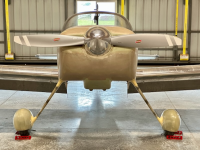
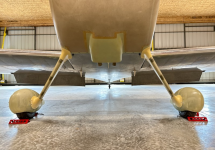
Detailed pictures to follow in next replies...
- Buy some foam kneeling pads (like these). I kept one next to each wheel during this entire process, and they really helped save my knees.
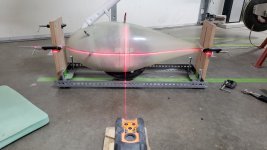
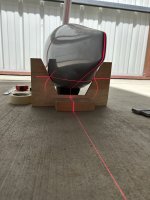
- A laser level makes many aspects of this job a lot easier. You want one that projects both horizontal and vertical lines. A simple unit costing well under a hundred bucks (like this) will be more than adequate.
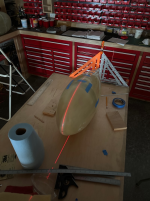
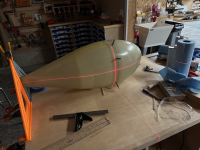
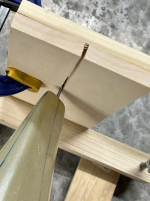
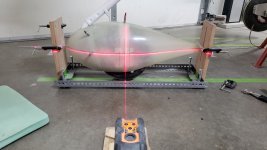
- Once you get the two halves of a wheel fairing fitting well, you need to establish reference lines along the exact center of the top and sides. To find the top centerline, first put a mark on the top corner of the tail end, using the flat sides as a reference. Clamp two squares to a level table and use them to position the wheel fairing so the flat tail is straight up and down; use shims as needed. Next, find the forward-most part of the front dome with a square, and put another mark there. Then, carefully measure an equal distance up from the table along the split line, which will give you a center reference point at the "crown" - put a third mark there. Finally, put your laser level on a tripod or ladder, shift it around until the line hits all three marks, and trace the resulting centerline across the top contour.
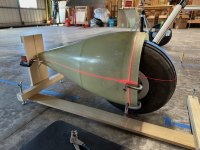
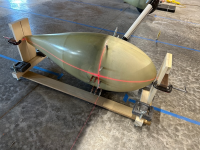
- To find the side reference line for a wheel fairing, make a reference mark at the aft end of the tail, in the exact middle of the flat part. Then simply use your laser to connect that mark to the one at the front you made in the previous step. It helps to level the fairing in the fore-aft direction by aligning the split line with the vertical laser beam.
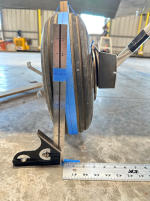
- To mark an accurate centerline on the tire, first jack up the plane and wrap a length of tape all around the circumference. Make a dot with a sharpie at the exact center of the tire. Brace the sharpie against a block of wood or similar, touch the tip to the dot, and spin the wheel 360 degrees.
- Use a square to project a position straight down from the centerline at leading edge of the tire, and mark this spot on the floor. This will give you a pretty good starting location for drawing a reference line that's parallel to the fuselage centerline and centered on the forward-most spot on the tire.
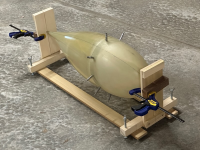
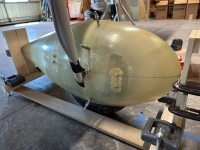
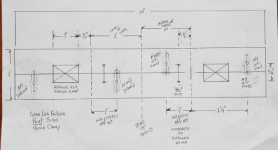
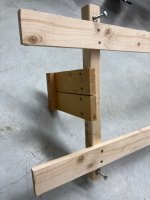
- Rather than wrestling with the wheel fairing and attempting to hold it at the required position and angles, you can build a simple jig that holds it perfectly steady. My jig is open on one side, so I can fit it around the tire without having to jack the plane up higher than necessary, and I used some scuba weights to give it added stability. I drilled temporary holes in the fairing at the exact front and back, which accept some 1/8" steel pins. The pins slide in vertical slots in the jig, and are embedded in hardwood blocks that I can clamp at whatever elevation I need. The slots in the jig are lined up with the reference line on the floor, and the fairing is leveled with the laser - all you have to do is make sure the horizontal beam hits the side reference line and both of the pins, and the split line is aligned with the vertical beam. Later I filled the holes back in.
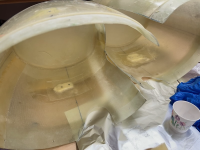
- Anywhere you have a fiberglass fairing that's screwed or riveted to a metal bracket: If you just crank down on the fastener to make the two pieces mate up, there's a good chance that the fiberglass will eventually crack from the stress. It helps to spend time making a "liquid shim" by injecting flox between the two parts with a syringe. Use packing tape on the bracket to prevent it from sticking, and drill extra holes in the glass to squirt flox through if required. After you grind away the excess, the result will be a pair of perfectly-mating parts with no added stress. I also added an extra layer of glass over the top of the flox inside my wheel fairings, to add some extra strength.
- Instead of riveting the outboard brackets to the aft wheel fairing halves, I attached them with screws and MK2000-06 nutplates. Now I don't have to mess with safety wiring the bolts every time I remove and reinstall the wheel pants.
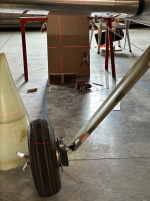
- The plans call for a minimum of 5/8" clearance between the tires and the wheel fairings. I went for 3/4" all around, in the hopes that a flat tire won't turn into a fiberglass repair job.
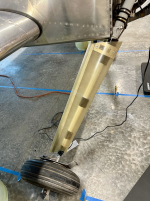
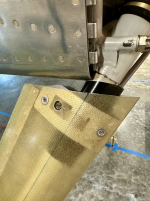
- I left the trailing edges of the gear leg fairings about 1/8" longer than the template, and block-sanded them for a perfect fit after I was done installing the hinges.
- When locating the gear leg fairing hinges, I first found where they "wanted" to be, then moved them 1/8" forward before drilling. This adds just a bit of preload to help the trailing edge close up nicely.
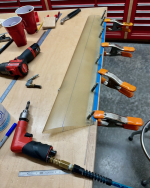
- When drilling the hinges to the gear leg fairings, I taped the trailing edges together and clamped the whole thing to my workbench, which produced a nice straight result.
- I used soft rivets ("A" instead of "AD") for attaching the hinges, to avoid cracking the glass. (make sure not to mix these in with your usual AD rivet supply!)
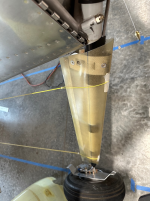
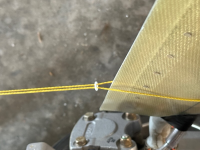
- When setting up the strings to align the gear leg fairings, once again the laser is very helpful for alignment.
- Sliding a lightweight washer over the strings will cinch them together at the trailing edge of the gear leg fairing, making it easier to eyeball the proper alignment.
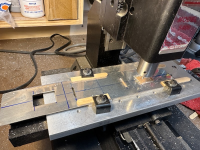
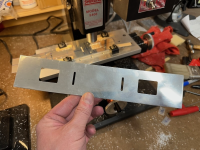
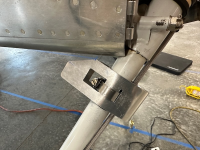
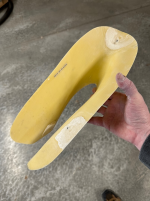
- I remembered that the fiberglass "fingers" on my old gear leg fairings broke in pretty short order, so instead of using the plans method I made an aluminum bracket to secure them. The bracket attaches to the gear leg with a breeze clamp, and the fairing screws into nutplates in the bracket. It's super solid, and allows the fairings to be removed without disturbing the alignment.
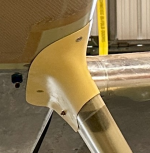
- The intersection fairings also got the liquid shim treatment: Anywhere I used a screw, I added a flox "screw boss" to prevent stress on the part when tightening the fastener.
Detailed pictures to follow in next replies...
Last edited: