Van's Air Force

The definitive Van's Aircraft support community! Buying, building or flying an RV? Join our exclusive family of mentors and enthusiasts!

What's the current situation with tunnel heat?

kirkbauer

Well Known Member
I have done exhaustive searching here on VAF about the RV-10 tunnel heat issue, but it is difficult to figure out how it will (or won't) affect my new RV-10 that I'm building. This is because a lot of the information is fairly old and it's difficult to determine what has changed.

Here is a summary:
  • Per the plans, there is no insulation on the firewall. I have seen people insulate the firewall which should obviously keep some heat out of the tunnel. I plan to insulate the hot side of my firewall.
  • It also seems that heat can enter from the bottom since the exhaust is directly under the tunnel. But it also seems that Van's modified the exhaust kit at some point that might mitigate this issue.
  • I have also seen people put a stainless steel plate on the outside of the airplane to protect the fuselage from the exhaust heat. How necessary is this?
Here are my plans:
  • As I said above, insulate the hot side of the firewall
  • To protect against exhaust heat, insulate the floor of the forward tunnel
  • Since it will be a trivial additional effort, insulate the forward wall of the tunnel (the cold side of the firewall)
The last step is probably unnecessary with insulation on the hot side of the firewall, but again, if I'm going to insulate the floor I might as well add a little extra on the firewall.

If I'm going to insulate the inside of my tunnel, I think the following are important criteria:
  • Must provide effective heat insulation
  • Must not be flammable or generate smoke
  • Must not harm the aluminum (e.g. attracting moisture)
  • Bonus: fire resistance (as an extra layer of protection, since the fuel lines are in there)
I am considering a few options (the blue text are links to the items I'm considering):
  • A lot of products out there provide protection from radiant heat, but I don't think that will be helpful inside the tunnel. I think I need insulation.
  • Heatshield Armor: I saw some other people used Lava Shield, which again is for radiant heat. But the same company makes this product that I think might be useful for insulation
  • SealTech: It looks like it provides insulation and doesn't attract moisture
  • Silicone Sponge: Or a similar type of product
 
I have done exhaustive searching here on VAF about the RV-10 tunnel heat issue, but it is difficult to figure out how it will (or won't) affect my new RV-10 that I'm building. This is because a lot of the information is fairly old and it's difficult to determine what has changed.

Here is a summary:
  • Per the plans, there is no insulation on the firewall. I have seen people insulate the firewall which should obviously keep some heat out of the tunnel. I plan to insulate the hot side of my firewall.
  • It also seems that heat can enter from the bottom since the exhaust is directly under the tunnel. But it also seems that Van's modified the exhaust kit at some point that might mitigate this issue.
  • I have also seen people put a stainless steel plate on the outside of the airplane to protect the fuselage from the exhaust heat. How necessary is this?
Here are my plans:
  • As I said above, insulate the hot side of the firewall
  • To protect against exhaust heat, insulate the floor of the forward tunnel
  • Since it will be a trivial additional effort, insulate the forward wall of the tunnel (the cold side of the firewall)
The last step is probably unnecessary with insulation on the hot side of the firewall, but again, if I'm going to insulate the floor I might as well add a little extra on the firewall.

If I'm going to insulate the inside of my tunnel, I think the following are important criteria:
  • Must provide effective heat insulation
  • Must not be flammable or generate smoke
  • Must not harm the aluminum (e.g. attracting moisture)
  • Bonus: fire resistance (as an extra layer of protection, since the fuel lines are in there)
I am considering a few options (the blue text are links to the items I'm considering):
  • A lot of products out there provide protection from radiant heat, but I don't think that will be helpful inside the tunnel. I think I need insulation.
  • Heatshield Armor: I saw some other people used Lava Shield, which again is for radiant heat. But the same company makes this product that I think might be useful for insulation
  • SealTech: It looks like it provides insulation and doesn't attract moisture
  • Silicone Sponge: Or a similar type of product
Don’t insulate the cabin side of the firewall; there are numerous threads on this. It can be a huge safety risk. See DanH’s testing on this.

I have a Barrett IO540 with CAI and a Custom AircraftExhaust system. I have had ZERO hot tunnel issues. It never even gets warm. No insulation on the firewall at all.
 
My thoughts:
- Insulate the engine side of the firewall using the Dan Horton method FireFrax and SS clad. Do this and skip insulating the cabin side of the firewall.
- You left out what I consider the major tunnel heat source, the cabin heat control valves. These valves get blasted with heat muff air when the valves are shut. The heat then conducts to the firewall and the tunnel. For this I place a piece of KoolMat between the firewall and the valves. I then extend the KoolMat over the top of the valve and down such that the not used hot heat muff air gets directed down toward the cowl exhaust - not just bounce back at the engine driven fuel pump.
- I do not consider the exhaust to be a major source of heat in the tunnel if using the standard exhaust setups.
- Skip insulating the inside of the tunnel. No need and it can absorb gas when you pull the fuel filter for inspection.
- The SS plate on the bottom of the fuselage is for fire protection.
Carl
 
Don’t insulate the cabin side of the firewall; there are numerous threads on this. It can be a huge safety risk. See DanH’s testing on this.

I have a Barrett IO540 with CAI and a Custom AircraftExhaust system. I have had ZERO hot tunnel issues. It never even gets warm. No insulation on the firewall at all.
Same here
 
Don’t insulate the cabin side of the firewall; there are numerous threads on this. It can be a huge safety risk. See DanH’s testing on this.

I have a Barrett IO540 with CAI and a Custom AircraftExhaust system. I have had ZERO hot tunnel issues. It never even gets warm. No insulation on the firewall at all.
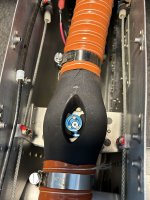
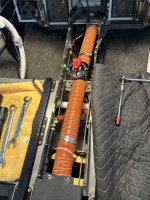
2020 RV 10 - no insulation anywhere, no special SS panels, no heat issues and I fly in FL. Stock tunnel setup. Except Aerosport tunnel diverter (worth every penny) to flow around fuel valve. (See pic)
 

Attachments

  • IMG_4871.jpeg
    IMG_4871.jpeg
    1.9 MB · Views: 282
  • IMG_4867.jpeg
    IMG_4867.jpeg
    2.6 MB · Views: 278
I bought two 2x2 thin sheets of stainless. One was installed on the bottom 2' of the the firewall, the other was installed on the fuse bottom, as far forward as possible. I put fiberfrax under both and secured them with stainless pop rivets. The bottom one was sealed with proseal to keep moisture and oil out, while remaining paintable. The one on the firewall was sealed with stainless tape. I placed insulation between the stainless heater valves and the firewall. With all that, after flying for a while, the tunnel is probably 20F above cabin temp when in flight and the heaters off. You could install a bigger firewall shield or a bigger belly shield, but the two 2x2's seem to work fine.

If you're worried about heat inside the tunnel, why not cut a couple of openings in it to vent it? Maybe some wire mesh over a couple of 2" openings at the bottom of the tunnel near the firewall and another one or two on the top of the tunnel, under the panel.
 
Carl, thank you as always for all of your help. And it is good to hear that others aren't having issues with heat.

I did have one question, you said:

For this I place a piece of KoolMat between the firewall and the valves. I then extend the KoolMat over the top of the valve and down such that the not used hot heat muff air gets directed down toward the cowl exhaust - not just bounce back at the engine driven fuel pump.

Do you have a picture of this anywhere by chance? It sounds like a great solution. I'm actually about to mount these valves right now -- on the final page of Section 27 (Firewall).

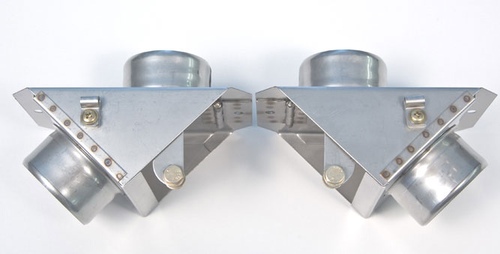
I just tried to find some pictures and that's also when I found out there are multiple options for stainless-steel replacements. I have already ordered this one from Aircraft Spruce -- do I need to reconsider?

 
Carl, thank you as always for all of your help. And it is good to hear that others aren't having issues with heat.

I did have one question, you said:


Do you have a picture of this anywhere by chance? It sounds like a great solution. I'm actually about to mount these valves right now -- on the final page of Section 27 (Firewall).

I just tried to find some pictures and that's also when I found out there are multiple options for stainless-steel replacements. I have already ordered this one from Aircraft Spruce -- do I need to reconsider?

Those valves will work fine.

I’m now working the firewall. I’ll have photos of the KoolMat install in a week or so.

Carl
 
I was also concerned with the hot tunnel issues but built to the current plans and have no issues, 250 hours, 2 years. Couple of items that may help:

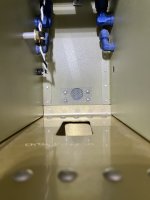
  • one inch hole in the belly (with scupper on the outside) to help suck out the air in the tunnel. Also benefit if you have a hydraulic leak/fuel leak as it will drain out. (pictured) I was concerned with exhaust entering the cabin but it has not been an issue.
  • Added high temp sealant to the heat valves to help seal them when they are closed. (Pictured)
  • I did not add anything to the firewall. The stainless firewall is easy to clean and does not hold residual oil from the blow-by swirling around in the area.
With regards to an engine fire, what would you really do? On a single engine aircraft, you probably don’t have much time to do anything other than shut the fuel off and find a place to land, most likely off airport, all in a matter of minutes.
 

Attachments

  • 20220423_183825139_iOS.jpeg
    20220423_183825139_iOS.jpeg
    1.8 MB · Views: 181
  • 20211001_013553819_iOS.jpeg
    20211001_013553819_iOS.jpeg
    1.4 MB · Views: 178
+1 - Built to plans except for the spruce stainless cabin valves and the control approach pedals which add holes on the top of the tunnel.

No tunnel heat issues.

My opinion: the firewall insulation isn't needed to keep the tunnel cool. OTOH there are good reasons for it. It will keep your feet from getting charred, and reduces smoke from other stuff getting real hot, during the quick decent to the field in case of a firewall forward fire.

Stainless vents keep the flames on the other side. As Dan's work shows, aluminum doesn't hold up against an oil or fuel fueled fire.

Derek
 
Do you have a picture of this anywhere by chance? It sounds like a great solution. I'm actually about to mount these valves right now -- on the final page of Section 27 (Firewall).
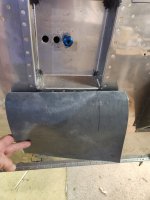
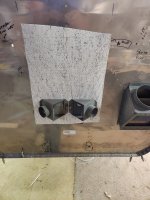
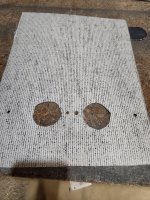
Here are some photos of putting a piece of KoolMat between the cabin heat control valves and the firewall to both reduce the conductive heat going into the tunnel, and redirect dumped heat muff hot air down to the exhaust instead of bouncing it toward the mechanical fuel pump.

The KoolMat sides will be trimmed later to make room for the SCAT hose coming from the heat muffs.

You can get KoolMat from ACS: https://www.aircraftspruce.com/catalog/appages/koolmat.php

Carl
 

Attachments

  • 20240906_171831.jpeg
    20240906_171831.jpeg
    1.8 MB · Views: 176
  • 20240906_171819.jpeg
    20240906_171819.jpeg
    2 MB · Views: 178
  • 20240906_170524.jpeg
    20240906_170524.jpeg
    2.8 MB · Views: 175
@Carl Froehlich I'm doing this on my -10 now. My only question is about Fire Barrier 2000 -- did you put any between the firewall and the Koolmat, or between the Koolmat and the vent valves? Or just on the cold side of the firewall around where the vent valves penetrate?
 
@Carl Froehlich I'm doing this on my -10 now. My only question is about Fire Barrier 2000 -- did you put any between the firewall and the Koolmat, or between the Koolmat and the vent valves? Or just on the cold side of the firewall around where the vent valves penetrate?
On this new build I’m insulating the engine side of the firewall using FiberFrax with a SS clad (Dan Horton’s process). The KoolMat goes on top. So not so much for insulation as the first build, but the gain in directing the waste heat muff heat away from the engine is still the driving factor.

I do not think Fire Barrier caulk is needed other than to seal the SS cladding edges (Dan’s Horton’s process).

Carl
 
On this new build I’m insulating the engine side of the firewall using FiberFrax with a SS clad (Dan Horton’s process). The KoolMat goes on top. So not so much for insulation as the first build, but the gain in directing the waste heat muff heat away from the engine is still the driving factor.

I do not think Fire Barrier caulk is needed other than to seal the SS cladding edges (Dan’s Horton’s process).

Carl
Could you elaborate on the "Don Horton" process? I don't know what that means.

I am also wondering if one could obtain an Autocad drawing of the firewall so one could buy a piece of Stainless Steel - any suggestions on thickness would be great - so one could machine the SS and attach it to the engine side of the firewall. Thanks
 
Could you elaborate on the "Don Horton" process? I don't know what that means.

I am also wondering if one could obtain an Autocad drawing of the firewall so one could buy a piece of Stainless Steel - any suggestions on thickness would be great - so one could machine the SS and attach it to the engine side of the firewall. Thanks
Dan (DanH on VAF) has many posts on how to do this.

I used 0.005 SS from McMaster. Others use thinner. The function of overlaying the FiberFrax with SS is to protect the FiberFrax and be able to keep the firewall clean. I make a paper template of the firewall and firewall penetrations and transfer that to the 1/8” Fiberfrax as well as the 0.005” SS. The SS cuts easy enough, just wear glove as it will slice you up like a razor.

Carl
 
Resurrecting an old thread - we talk about not insulating the backside of the firewall but do we consider not priming the structure that is riveted to the firewall?

Thanks
 
Resurrecting an old thread - we talk about not insulating the backside of the firewall but do we consider not priming the structure that is riveted to the firewall?

Thanks
Prime all structure before riveting to the firewall. Do not prime the stainless steel itself.

Carl
 
Thanks Carl. But I wonder what happens to the primer when heated to firewall fire temperatures? Smoke? I remember reading DanH’s test information. DanH made a comment on this in post 97 of this thread - https://vansairforce.net/threads/firewall-sealant-and-fire-safety.72087/page-2 .

Edited to add post reference
I fully agree with Dan’s assessement, “The potential issue would be smoke generation, if you got a good fire going on the forward side. I don't know at what temperature EkoPrime might start generating smoke, or its components. Probably low risk”.

I can tell you there are “aviation” insulation products out there that will off gas at normal firewall operating temps (not fires). Years ago an RV-10 builder used such black foam stuff on the cabin side of his firewall and ended up ripping it all out in short order after the first couple of flights.

Lesson learned, follow Dan Horton’s FiberFrax engine side firewall insulation process and fly on. I have this on my RV-8 and current RV-10 build. The cabin side of the RV-8 is much cooler than that on my first build that did not have it (RV-8A).

Carl
 
Thanks Carl. But I wonder what happens to the primer when heated to firewall fire temperatures? Smoke? I remember reading DanH’s test information. DanH made a comment on this in post 97 of this thread - https://vansairforce.net/threads/firewall-sealant-and-fire-safety.72087/page-2 .

It will smoke.

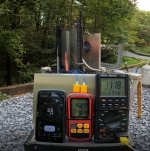
I did a lot of relatively recent burn runs with instrumentation. Below is a simple test approximating a Van's firewall assembly, i.e. an aluminum angle riveted to a stainless panel. A thermocouple attached to the aluminum angle recorded structural temperature with and without engine side insulation. This photo was pulled from a video record, at 35 seconds since burner ON. The structure is at 162F and climbing, with the hot side at 2046F. The "target", a small black panel 4" aft of the subject , is at 96F. Make no mistake, this is an insulated panel, a stainless foil reflector over an intumescent insulation.

Time and Thermocouples.jpg

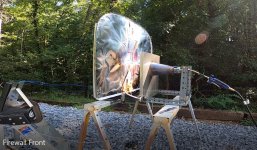
Did full scale burns too, plus burn runs with various seam sealants and seam constructions.

RV-7 Firewall  Test.jpg

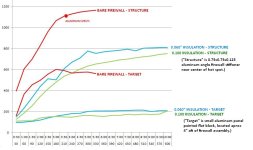
Below, recorded temperature plots. Uninsulated, the aluminum angle ("structure") and the rivets turn to jelly at about 2 minutes. With a decent hot side package, the aluminum structure stabilizes well below melt. Although it has lost a lot of strength, it remains intact.

Specific to the primer question, the recorded temperatures say the painted angle will definitely generate smoke. The issue is how much, and how well you can vent the cabin. In the case of an RV-10, we've already had one case where the pilot made a successful off-field landing after jettisoning the door. Paint burns, so open flame is also a possibility.

The "target" is a proxy for the soles of your shoes or components in the cabin. At three minutes, with a basic 0.060" package, temperature is 157F. Without insulation, i.e. a standard RV firewall, the temperature is 600F.

Temperature Plots.jpg

Big picture...insulation adds comfort, every day. That's the best reason to add it. In a worst case, it buys time, and a better chance of aircraft control.

I've been telling folks how to do this 15 years. Or I have kits if you would rather go that route. Either way works for me. Just don't do dumb stuff.
 
Last edited:
H
It will smoke.

I did a lot of relatively recent burn runs with instrumentation. Below is a simple test approximating a Van's firewall assembly, i.e. an aluminum angle riveted to a stainless panel. A thermocouple attached to the aluminum angle recorded structural temperature with and without engine side insulation. This photo was pulled from a video record, at 35 seconds since burner ON. The structure is at 162F and climbing, with the hot side at 2046F. The "target", a small black panel 4" aft of the subject , is at 96F. Make no mistake, this is an insulated panel, a stainless foil reflector over an intumescent insulation.

View attachment 92640

Did full scale burns too, plus burn runs with various seam sealants and seam constructions.

View attachment 92645

Below, recorded temperature plots. Uninsulated, the aluminum angle ("structure") and the rivets turn to jelly at about 2 minutes. With a decent hot side package, the aluminum structure stabilizes well below melt. Although it has lost a lot of strength, it remains intact.

Specific to the primer question, the recorded temperatures say the painted angle will definitely generate smoke. The issue is how much, and how well you can vent the cabin. In the case of an RV-10, we've already had one case where the pilot made a successful off-field landing after jettisoning the door. Paint burns, so open flame is also a possibility.

The "target" is a proxy for the soles of your shoes or components in the cabin. At three minutes, with a basic 0.060" package, temperature is 157F. Without insulation, i.e. a standard RV firewall, the temperature is 600F.

View attachment 92646

Big picture...insulation adds comfort, every day. That's the best reason to add it. In a worst case, it buys time, and a better chance of aircraft control.

I've been telling folks how to do this 15 years. Or I have kits if you would rather go that route. Either way works for me. Just don't do dumb stuff.
Where or how do I buy your kits?
 
Back
Top