

Van's Air Force
You are using an out of date browser. It may not display this or other websites correctly.
You should upgrade or use an alternative browser.
You should upgrade or use an alternative browser.
VFR to IFR pannel
- Thread starter SPRV12
- Start date



Practically and realistically, you’ll need a certified GPS navigator. A 430W would be an excellent value choice, giving you a nav radio as well.I have the standard single G3X VFR pannel. What would be the minimum equipment needed for IFR training?

I added a GPS175 and do not regret it. No ILS but more runways have RNAV approaches than ILS anyway.I have the standard single G3X VFR pannel. What would be the minimum equipment needed for IFR training?

I also added a Garmin GPS175 when I went from VFR to IFR. I really like it. If you don't already have one, you should should consider adding an autopilot. The GPS175 will feed "roll steering" commands to your autopilot and make your life much easier when doing course reversals or holds or when you have some obtuse angles to fly for whatever reason.I added a GPS175 and do not regret it. No ILS but more runways have RNAV approaches than ILS anyway.
Also make sure your operating limitations are written properly. My original operating limitations did not include the verbiage about IFR flight with proper equipment. It wasn't too difficult to change it but required a new airworthiness certificate also.
Keith
With your G3X you can start basic attitude flying instruction today. For your check flight, you will need to demonstrate navigation and approach skills. The lowest cost route is to install a conventional nav com with vor and ILS capability. You need to be able to find vor and ils approaches that are nearby, and that don’t require additional equipment, like DME. These are getting harder and harder to find. In the real world, these days, you’ll want an approach certified (‘TSO’d’) gps. As mentioned, a used Garmin 400-420-430W may be the cheapest route. These boxes are starting to get old. Now, again, the real world: as a cfii I would refuse to fly in actual IMC without back up flight instruments. Garmin G5, GRT mini efis, Dynon D6, for example. And each with a 2 hour Li backup battery.
Only you can decide if you want an autopilot, heated pitot, adsb-out. I presume you have a transponder.
Only you can decide if you want an autopilot, heated pitot, adsb-out. I presume you have a transponder.
Good idea if the budget permits. You’ll definitely want one eventually, and it makes good sense to make it part of your training. One of the real advantages of EABs is that we can get (relatively) cheap and highly capable autopilots.If you don't already have one, you should should consider adding an autopilot.

Six months after Phase 1 I decided to add IFR capabilities and start training To my existing dual Dynon HDX panel. Added Garmin GPS-175 and G5 all tied into the Dynon and autopilot. Works sweet.
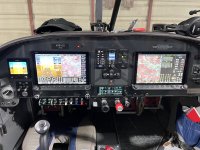

A lot of people toss out advice like "I put this in my RV-8" or "This worked great in my RV-10". If you don't own an RV-12 go take a look at how much panel space is available for radios. If it is an original RV-12 the answer is "not much". Here is my original panel with a Garmin (Apollo) SL40 in the middle...
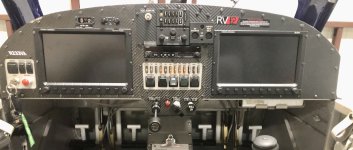
That switch and fuse panel eat up valuable panel space. I suppose I could get by without the external autopilot and knobs panels (and the "Fasten Seatbelts" and "No Smoking" switch plate) but I don't want to. They are just too darn handy and I have gotten used to them. And they cut down the work load when things are busy (I'm thinking ahead to single pilot IFR). I thought I could get rid of the SL40, move a few things around, and install a Garmin GNC 355 combo GPS nav and comm. That was a great plan until I found the 355 is about 1/2" too long to fit. Grrrrr.
So now the plan is to get rid of the SL40 radio and replace it with a Dynon remote mounted radio. Then replace the fuses with a VP-X electronic circuit breaker. After that there should be enough panel space to install a shorter Garmin GPS 175. Here is where I am at now...
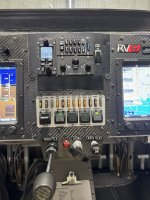
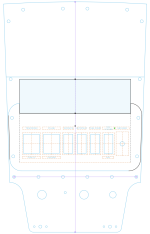
BTW, I love the Dynon radio. Here is a drawing showing the location of the Garmin GNC 355 as well as the new switch panel in the redesigned panel. It looks a little goofy in the drawing but I think I can make it look right.
Below shows where the VP-X and current sensing shunt will be installed behind the panel. There will also needs to be a shelf on top of the VP-X (not shown) to hold the SkyView to ARINC-429 converter and a few other things.
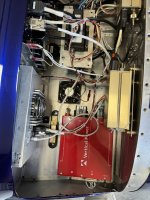
So the bottom line is that the RV-12 has some unique challenges to add more avionics. I haven't even mentioned power budget. There is more to adding avionics on this platform that just cutting a bigger hole in the dash. Keep that mind when you offer your solution!
That switch and fuse panel eat up valuable panel space. I suppose I could get by without the external autopilot and knobs panels (and the "Fasten Seatbelts" and "No Smoking" switch plate) but I don't want to. They are just too darn handy and I have gotten used to them. And they cut down the work load when things are busy (I'm thinking ahead to single pilot IFR). I thought I could get rid of the SL40, move a few things around, and install a Garmin GNC 355 combo GPS nav and comm. That was a great plan until I found the 355 is about 1/2" too long to fit. Grrrrr.
So now the plan is to get rid of the SL40 radio and replace it with a Dynon remote mounted radio. Then replace the fuses with a VP-X electronic circuit breaker. After that there should be enough panel space to install a shorter Garmin GPS 175. Here is where I am at now...
BTW, I love the Dynon radio. Here is a drawing showing the location of the Garmin GNC 355 as well as the new switch panel in the redesigned panel. It looks a little goofy in the drawing but I think I can make it look right.
Below shows where the VP-X and current sensing shunt will be installed behind the panel. There will also needs to be a shelf on top of the VP-X (not shown) to hold the SkyView to ARINC-429 converter and a few other things.
So the bottom line is that the RV-12 has some unique challenges to add more avionics. I haven't even mentioned power budget. There is more to adding avionics on this platform that just cutting a bigger hole in the dash.
Keep that mind when you offer your solution!

turbo
Well Known Member
just the basics Wass gps, auto pilot 2 G5's, iPad with foreflite. xm wx, and great radio skills! . View attachment 67918View attachment IMG_3810.jpeg
Just to be clear: any gps used for navigation under ifr must - at least currently in the US - have a TSO. WAAS is cheap these days. The TSO costs are hideously expensive.just the basics Wass gps, auto pilot 2 G5's, iPad with foreflite. xm wx, and great radio skills! . View attachment 67918View attachment 67919
Interesting. No issues with the DPE and the 3 different approaches (without the NAV radio, how did you make the ILS/VOR approaches in your check ride?)? I would love to find a DPE nearby that accepts just GPSYou don't need a nav radio. Get the 175. I did all my training and took my check ride in an all gps plane.


Interesting. No issues with the DPE and the 3 different approaches (without the NAV radio, how did you make the ILS/VOR approaches in your check ride?)? I would love to find a DPE nearby that accepts just GPS
Where do we find the part that says an ILS/VOR is required for the check ride?

In the past the test standards said ‘3 different types of approaches’, which was interpreted to mean different nav aides (gps, loc, vor, etc.). A few years ago the FAA administrator announced a change; the new interpretation was 3 different types of approaches not navaids (e.g., LNAV, LPV to a DA of 300’ or lower, LNAV to a circle to land). However the faa bureaucracy was very slow to re-write the test standards, so there’s confusion. Some DPE’s took the administrator’s word, others stuck to the old PTS. The latest test standards now say ‘different approaches’, making it possible to take the test in a gos-only airplane. Edit: and yes, the latest test standards say an LPV to 300’ agl or lower can be used as the required precision approach even though technically it’s not one.Where do we find the part that says an ILS/VOR is required for the check ride?
I have been considering the GPS175 or a used GTN650. Were you looking at other GPS units, and if so, what ultimately make the 175 win a spot in your panel?I added a GPS175 and do not regret it. No ILS but more runways have RNAV approaches than ILS anyway.

I agree about back up instruments. I will say that the back up batteries are only as good as their up keep. For example I had a total electrical failure in a certified airplane rented from a school (Aspen units) and it lasted…you guessed it…5 minutes. No it didn’t have an old school ADI either. My RV8, I test my batteries annually. I also use a TCW standby battery to power my GNC355 navigator.With your G3X you can start basic attitude flying instruction today. For your check flight, you will need to demonstrate navigation and approach skills. The lowest cost route is to install a conventional nav com with vor and ILS capability. You need to be able to find vor and ils approaches that are nearby, and that don’t require additional equipment, like DME. These are getting harder and harder to find. In the real world, these days, you’ll want an approach certified (‘TSO’d’) gps. As mentioned, a used Garmin 400-420-430W may be the cheapest route. These boxes are starting to get old. Now, again, the real world: as a cfii I would refuse to fly in actual IMC without back up flight instruments. Garmin G5, GRT mini efis, Dynon D6, for example. And each with a 2 hour Li backup battery.
Only you can decide if you want an autopilot, heated pitot, adsb-out. I presume you have a transponder.
I went with the 355 for the money you can’t beat the capability. You get a radio in the same panel space as the 175. You don’t get the nav/com ability of the larger 650, but it also isn’t as expensive. With an RV8 space is an issue so I liked the smaller size. Both will do EFB syncing and both will run your RNAV approaches just the same.I have been considering the GPS175 or a used GTN650. Were you looking at other GPS units, and if so, what ultimately make the 175 win a spot in your panel?
You could use a 375 if you want the transponder version instead. In that case you will also get ADSB in/out displaying TISB and WX on your navigator screen.
Avidyne has something competitive but I prefer Garmin’s menu and logic that works very similar to their 530/430 units.
When making my decision I referenced the FAR’s. The ‘3 different types of approaches’ made me go with the GNC 355 and the GNC 215. I have the G3X the G5 and the GFC 500 autopilot.
That’s assuming you are wanting to do an instrument check in your airplane? You can have a RNAV only aircraft capable of flying IFR legally.When making my decision I referenced the FAR’s. The ‘3 different types of approaches’ made me go with the GNC 355 and the GNC 215. I have the G3X the G5 and the GFC 500 autopilot.
Already having dual Garmin G3X PFD & MFD (as well as Garmin autopilot) the 175 was the only option for me. Picking up a 430W or 530W would;ve also been an option but I didn't want to add an audio panel or another antenna; GPS approaches are fine for me. The FAA is beginning to wind down support for ILS approaches so why spend the tons of money to have ILS navigator and another antenna when in a decade or less GPS approaches will be the primary method of doing an approach?I have been considering the GPS175 or a used GTN650. Were you looking at other GPS units, and if so, what ultimately make the 175 win a spot in your panel?
As just one data point, I fly in the system a lot and I haven’t done a real ILS or VOR approach in at least 10 years. There’s just no reason to. Obviously this could vary with geography and country.Already having dual Garmin G3X PFD & MFD (as well as Garmin autopilot) the 175 was the only option for me. Picking up a 430W or 530W would;ve also been an option but I didn't want to add an audio panel or another antenna; GPS approaches are fine for me. The FAA is beginning to wind down support for ILS approaches so why spend the tons of money to have ILS navigator and another antenna when in a decade or less GPS approaches will be the primary method of doing an approach?
The ILS system goes down often at my home base airport KLEX and the FAA takes their sweet time getting around to correcting it. Once down it will be down for 3 to 4 weeks at least. RNAV approaches are all I have done for at least five years.As just one data point, I fly in the system a lot and I haven’t done a real ILS or VOR approach in at least 10 years. There’s just no reason to. Obviously this could vary with geography and country.
Yes I see this a lot. By the way we really enjoyed our visit to KLEX last year, great airport and a fun town.The ILS system goes down often at my home base airport KLEX and the FAA takes their sweet time getting around to correcting it. Once down it will be down for 3 to 4 weeks at least. RNAV approaches are all I have done for at least five years.
I concluded there isn't quite enough panel depth to accommodate the 355 in my RV-12. It's close and maybe it could be made to work. The 355 drawing says it is 0.2" shorter than the (very tight) SL40 that I took out. But the 355 depth doesn't take into account space for the RF connector or for wires to come out the back of the DB connector. It was tempting to try but I was disinclined to drop $8000 to find out. I just went with the Dynon remote radio, and I am working on the install for the 175. I think that is going to work well.I went with the 355 for the money you can’t beat the capability.
Opposite data point. RNAV(gps) LPV into KLVK, vmc. I’m right seat, pilot flying is left seat under the hood. About 4 nm out the green G650 annunciation turns yellow, LPV goes to LNAV. Pilot flying doesn’t notice. But then he says, ‘I don’t think the glide slope is working’. I say, ‘maybe that’s why it’s flagged’. Then, a big red X goes across the 650, all gps data disappears. We landed vfr, and I like to think that we could have made a safe dead reckoning departure if it was IMC (LVK is surrounded by higher terrain), but the pucker factor would have been high. Or, if we were prepared, we could have switched to the ILS. So I’ve only seen it once (best guess is a trucker on the nearby interstate had a jammer). But I’m happy to carry around an ILS box. YMMV.Yes I see this a lot. By the way we really enjoyed our visit to KLEX last year, great airport and a fun town.
That isn’t the scary part, the scary part is flying into an airport like that with an RNAV approach and the ILS being NOTAMed out! And then getting your issue. It’s becoming more and more common.Opposite data point. RNAV(gps) LPV into KLVK, vmc. I’m right seat, pilot flying is left seat under the hood. About 4 nm out the green G650 annunciation turns yellow, LPV goes to LNAV. Pilot flying doesn’t notice. But then he says, ‘I don’t think the glide slope is working’. I say, ‘maybe that’s why it’s flagged’. Then, a big red X goes across the 650, all gps data disappears. We landed vfr, and I like to think that we could have made a safe dead reckoning departure if it was IMC (LVK is surrounded by higher terrain), but the pucker factor would have been high. Or, if we were prepared, we could have switched to the ILS. So I’ve only seen it once (best guess is a trucker on the nearby interstate had a jammer). But I’m happy to carry around an ILS box. YMMV.
