Van's Air Force

The definitive Van's Aircraft support community! Buying, building or flying an RV? Join our exclusive family of mentors and enthusiasts!

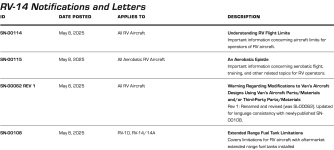
Vans ER tank VNE SB

Richard Connell

Well Known Member
Sponsor
For discussion:


This doesn’t pose a particularly onerous operational condition for most I suspect but strict compliance with the EFIS auto adjusting VNE anytime soon seems optimistic.
I haven’t thought too much about whether the Garmin advanced gauge configuration / logic signals will support this but I suspect it won’t as it exists at the moment.
It might require some software changes from EFIS manufacturers.
 
All fuel configurations regardless of location and no reference to specific surface flutter, yielding a generalized restriction of 3 knots per gallon?

I would like to see the engineering analysis on this. The way it reads, it sounds like lawyer speak.
 
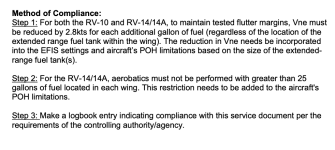
I would be very interested in seeing the calculations for 2.8 Kts per gallon of gas.

That's a 65 Kt reduction in Vne...I assume someone did the math and can show their work?

I also assume no one intends to exceed the proper loading or maximum gross weight with ER tanks? Thus wing loading won't change?

I can see Van's concern with RV14 aerobatics but it seems to me ER tanks are simply to provide some extra range to folks on long x-countries.

23 gals of 100LL at 6.02lbs/gal = 138.46 lbs at a more or less neutral c/g.

RV10 - 200 Ktas Vne - 65 Ktas correction = 135 Ktas Vne full ER tanks.... which is probably close to 110-115 KIAS at altitude?

 
Last edited:
I would be very interested in seeing the calculations for 2.8 Kts per gallon of gas.

That's a 65 Kt reduction in Vne...I assume someone did the math and can show their work?

I also assume no one intends to exceed the proper loading or maximum gross weight with ER tanks? Thus wing loading won't change?

I can see Van's concern with RV14 aerobatics but it seems to me ER tanks are simply to provide some extra range to folks on long x-countries.

23 gals of 100LL at 6.02lbs/gal = 138.46 lbs at a more or less neutral c/g.

RV10 - 200 Ktas Vne - 65 Ktas correction = 135 Ktas Vne full ER tanks.... which is probably close to 110-115 KIAS at altitude?
I think the whole point is vans doesn’t want you using er tanks.
 
I imagine that they are quite salty about the whole ER tank situation. Especially now that Ken can provide all the parts.
I can’t imagine too many new 10/14 are being built with standard tanks anymore.
Being a little too clever I think.

Well they could be even more clever and offer the option themselves imho. Do the testing and analysis and then offer the option including building them! Vans did that with the flap motor.
 
From my neighbor -

Interesting that the reduction in Vne is the same for both the RV-10 and the RV-14. Yes, it's the same airfoil, but the span, spar, flaps and rib spacing are different - which would imply different flutter characteristics.

I'm perfectly comfortable with the analysis that Ken has done (to include ground vibration testing) and have no intention on reducing Vne based on this latest SN.
 
Or just do your own testing. Maybe someone can speak to why they needed to address this at all? People are entitled to do any modification to the kit they want to do. Same as how the the original RV came to be. Deviating from plans and making changes incurs risk. It’s not like 10’s and 14’s fall under E-LSA rules.

I built my 10 with no intention of extended range tanks. The range was plenty good for my intended use in my intention of stopping every 2 to 3 hours.
 
Or just do your own testing. Maybe someone can speak to why they needed to address this at all? People are entitled to do any modification to the kit they want to do. Same as how the the original RV came to be. Deviating from plans and making changes incurs risk. It’s not like 10’s and 14’s fall under E-LSA rules.

I built my 10 with no intention of extended range tanks. The range was plenty good for my intended use in my intention of stopping every 2 to 3 hours.
Liability?
 
Maybe? Has liability been a concern historically with major modifications? I can say I don’t know either way. But I would be surprised if so.
It's the cost of defending yourself even if you're blameless. Remember Vans was sued by the estate of a pilot whose RV's engine stopped. He had used gobs of RTV to seal his fuel lines, including some inside the lines (which led to a fuel blockage). I'm sad to say that the legal profession is held in pretty low regard by lots of people.
 
I imagine that they are quite salty about the whole ER tank situation. Especially now that Ken can provide all the parts.
I can’t imagine too many new 10/14 are being built with standard tanks anymore.
Being a little too clever I think.
The 10 makes a certain amount of since with ER. I can run LOP with a 540 and get call it 12 GPH. That's 4 hours of flight with a 1-hour reserve standard 60 gal tanks. On a long cross country would be nice for a little more flexibility where to tank up with decent prices. My14 with standard 50-gal tanks and now 8 GPH LOP that's 5 hours 15 mins with a 60 min reserve. That's more than enough for me and my passenger. 10 I get, 14 is a stretch. As always everyone build what you want, probably won't get a second chance in the same model.
 
The 10 makes a certain amount of since with ER. I can run LOP with a 540 and get call it 12 GPH. That's 4 hours of flight with a 1-hour reserve standard 60 gal tanks. On a long cross country would be nice for a little more flexibility where to tank up with decent prices. My14 with standard 50-gal tanks and now 8 GPH LOP that's 5 hours 15 mins with a 60 min reserve. That's more than enough for me and my passenger. 10 I get, 14 is a stretch. As always everyone build what you want, probably won't get a second chance in the same model.

That seems to be reflected in Sky designs sales. Last they reported in Jan they’d sold 185 RV10 sets and 37 x RV14 sets.
So by now let’s call that 200 RV10 sets in 3y.
There are only 1059 RV10s flying so it’s fair to assume that very few RV10s are being completed with stock tanks from here on out.
I haven’t kept up with Vans kit deletions policy post restructuring but I assume that if they still allow deletion then everyone is deleting tank parts!
 
Really people?? Your speculation has you totally dismissing the manufacturers limitations? The explanation in the letter is quite believable in my opinion. Have you done the ground vibration testing? They have. Maybe I’m too naive to think the factory knows what they’re doing.
I’m not getting it. JMHO.
 
Last edited:
The empty weight of my RV-14A came in at 1308 pounds. That makes for a 742-pound useful load. When I go on a cross-country trip with my wife, i.e. the time when I would need extra fuel the most, and we have bags of clothes to last us a week, I'm right at the maximum gross weight of the airplane with 50 gallons of fuel. When I go to Oshkosh solo, and have all of my camping gear, I am only about 50 pounds under max gross. Extra capacity tanks would do me no good because I could never fill them up (extra 108 pounds of fuel) without having a weight problem, never mind a Vne problem.
 
Really people?? Your speculation has you totally dismissing the manufacturers limitations? The explanation in the letter is quite believable in my opinion. Have you done the ground vibration testing? They have. Maybe I’m too naive to think the factory knows what they’re doing.
I’m not getting it. JMHO.
The guy that designed the original is the guy who designed the ER tanks and did the modal impact testing on the new ones. So most of us are pretty confident it’s not TLAR engineering.
Where was the reduced VNE SB when the factory unilaterally removed the forward spar to fuselage attatch because they were cracking? No new GVT or MIT?
 
The empty weight of my RV-14A came in at 1308 pounds. That makes for a 742-pound useful load. When I go on a cross-country trip with my wife, i.e. the time when I would need extra fuel the most, and we have bags of clothes to last us a week, I'm right at the maximum gross weight of the airplane with 50 gallons of fuel. When I go to Oshkosh solo, and have all of my camping gear, I am only about 50 pounds under max gross. Extra capacity tanks would do me no good because I could never fill them up (extra 108 pounds of fuel) without having a weight problem, never mind a Vne problem.
From my neighbor -

At least with the Sky Designs ER tanks, there is an engineering justification for an increased max gross weight (essentially the amount of the increased fuel weight) due to a reduction in wing bending. Max landing weight does not change. This information is provided in the very thorough engineering analysis done by Ken K at Sky Designs.

And as Richard said in the post above - take a close look at the pedigree of the engineer behind Sky Designs and this might answer many of your concerns.

I’d like to see the analysis and ground vibration testing that Van’s has done on ER tanks to justify this Service Notice. I’ve seen Ken’s analysis and testing done for the Sky Designs ER tanks and am perfectly comfortable with the gross weight increase and the 200 knot Vne with the additional fuel.
 
From my neighbor -

At least with the Sky Designs ER tanks, there is an engineering justification for an increased max gross weight (essentially the amount of the increased fuel weight) due to a reduction in wing bending. Max landing weight does not change.

You are going to make a post from your neighbor??? What happens if you need to abort and land after you fuel?? Let your neighbor land your plane?? (Above engineered gross weight?) Hopefully your insurance Co. will understand, I doubt your "neighbor" will.
 
Last edited:
Really people?? Your speculation has you totally dismissing the manufacturers limitations? The explanation in the letter is quite believable in my opinion. Have you done the ground vibration testing? They have. Maybe I’m too naive to think the factory knows what they’re doing.
I’m not getting it. JMHO.
Sorry but from an engineering standpoint, their bulletin seems to be written lawyers.

From the same standpoint, I want to see the analysis that they did and how they came up with 3 knot decrease per gallon of fuel, regardless of where the fuel is located, and what surfaces are prone to flutter.
 
The bottom line is that there are hundreds of RVs flying around with ER tanks of various design - and have been for decades incident free.
Wet tip tanks, HW style, entire wet leading edges, and now the Sky Designs ER.
It’s ironic that the neatest and pedigreed design of the lot has elicited this response from Vans.
I think everyone can see it for what it is.
 
Or just do your own testing. Maybe someone can speak to why they needed to address this at all? People are entitled to do any modification to the kit they want to do. Same as how the the original RV came to be. Deviating from plans and making changes incurs risk. It’s not like 10’s and 14’s fall under E-LSA rules.

I built my 10 with no intention of extended range tanks. The range was plenty good for my intended use in my intention of stopping every 2 to 3 hours.
Because whenever an rv breaks up in flight and kills people, their reputation takes the hit, not the builder. Vans endeavors to engineer the plane to be safe and builder modifications can change the margins. Not saying it’s wrong to modify, only answering the question of why vans would care.

I agree that the three knot per gallon thing is just made up to stick a thumb in kens eye. I get addressing the risk, like they have always done, but this went too far imho. Miss the good old days when Van ran the show. He was fair and honest. He had an opinion, but was somewhat tolerant.

Remember the 6? Gross weight was 1600. The 6A came out and it weighed 30-40 pounds more and, surprise, its gross weight was 1650 even though nothing else changed. Hummm.. whats good for the goose…
 
Last edited:
Sorry but from an engineering standpoint, their bulletin seems to be written lawyers.

From the same standpoint, I want to see the analysis that they did and how they came up with 3 knot decrease per gallon of fuel, regardless of where the fuel is located, and what surfaces are prone to flutter.
When Van’s said don’t worry about laser cut parts, proponents said trust the engineers, now these same folks are saying they don’t trust the engineers.
Seems like you only trust them when it doesn’t effect you, or am I missing something?
 
There are hundreds of Vans flying with ER tanks. And thousands of certified AC with ER tanks.

This must be a first.
 
When Van’s said don’t worry about laser cut parts, proponents said trust the engineers, now these same folks are saying they don’t trust the engineers.
Seems like you only trust them when it doesn’t affect you, or am I missing something?
I’m guessing that a jab at me, Walt. The difference is that there was a published engineering analysis for the LCP problem, detailing what was tested and how which yielded a conclusion.

If you didn’t notice, the Vne restriction had none of that, and a limitation was applied for every case. Considering the number of different installations, locations, and capacities available, it is highly unlikely, more like impossible, that each gallon of fuel carried affects the flutter margin in the same way.

You can think what you want but this one doesn’t pass the smell test.
 
There are hundreds of Vans flying with ER tanks. And thousands of certified AC with ER tanks.

This must be a first.
Not trying to be rude but I’m pretty sure you have zero data to backup that ‘observation’, so it’s basically an “opinion”.
I’m certain that in the certified world the engineering data is there to support an ER mod.
 
Not trying to be rude but I’m pretty sure you have zero data to backup that ‘observation’, so it’s basically an “opinion”.
I’m certain that in the certified world the engineering data is there to support an ER mod.
It's available for the Skydesigns tank as well.
 
I’m guessing that a jab at me, Walt. The difference is that there was a published engineering analysis for the LCP problem, detailing what was tested and how which yielded a conclusion.

If you didn’t notice, the Vne restriction had none of that, and a limitation was applied for every case. Considering the number of different installations, locations, and capacities available, it is highly unlikely, more like impossible, that each gallon of fuel carried affects the flutter margin in the same way.

You can think what you want but this one doesn’t pass the smell test.
Van’s has no obligation to publish engineering design details.
They did in the LCP fiasco because they had to, or suffer a huge loss at replacing defective QB kits and parts.
That fiasco played a role in their bankruptcy hence their obligation to share data to limit losses.
 
Just to hijack for a moment: the 7 and 8 are popular older models which use the same wing (as each other, not as the 10/14) and have a few thousand examples flying. Why does nobody (SD?) make extended tanks for these models? 42 gallons is OK, but could be better. One more rib on each wing would be approximately 50-52 gallons, which is in the ballpark of what a fair number of similarly-engined certified planes might have (like an R-model 172 or some of the older models with extended tanks).

EDIT: at 10gph, 50 gal is "only" 2h out, 2h back and 1h reserve for someone who wants to visit a place that doesn't have fuel, or has expensive fuel. If you fly more frugally at 8gph it's still only about 2.5h out and 2.5h back with 1h reserve... not a totally bladder-busting amount like 5-6 hours of endurance would imply.
 

Van’s has no obligation to publish engineering design details.
They did in the LCP fiasco because they had to, or suffer a huge loss at replacing defective QB kits and parts.
That fiasco played a role in their bankruptcy hence their obligation to share data to limit losses.
You miss the point, though. The engineering analysis was done and specific results were noted.

The new limitation on Vne applies to every different installation, location, and capacity exactly the same. When speaking of flutter margins, that is highly improbable and very unlikely.

No, I think most critical thinkers will actually see it for what it is…
 
I have the utmost respect for Steve, but did their testing include airframe vibration and flutter tests?
In fairness to the counter point, I am pretty sure that vans did not run those tests again with ER tanks installed, so how did they arrive at the 3 kts per gal. reduction? Seems to be poor engineering to hypothesize on how weight distribution across the wing would change the results they got without them and then provide specific guidance to mitigate. Again, I fully concur with their warnings. "We tested and got X. If you change things, we don't know what you'll get and are at the mercy of your own testing." as they have always said. But that is not what they said this time.

To be clear, I am in the middle on this one. I get vans concerns and I get others making mods anyways. I trust Vans engineering fully, but have real questions on this one as it doesn't sound like engineering was done here. If they are just assuming that a mod makes it worse, they are no better than the builders assuming it is not.
 
You miss the point, though. The engineering analysis was done and specific results were noted.

The new limitation on Vne applies to every different installation, location, and capacity exactly the same. When speaking of flutter margins, that is highly improbable and very unlikely.

No, I think most critical thinkers will actually see it for what it is…
The point is Van’s can’t possibly afford to test/evaluate every mod that builders incorporate into their designs.
However, There is little doubt that ER tanks would be considered a major alteration.
I have no idea how they came up with the numbers, but I’m pretty sure they didn’t just pull them out of thin air.
Now you get to think about that every time you fly, and hope they weren’t right.
 
I wonder….

On the new RV-10 I always planned on including plumbing to have a removable ~20 gallon ferry tank in the rear passenger area. This would be for infrequent use when on long cross countries with only two on board.

This tank will add ~130 pounds. With two people and baggage the plane will still be well under gross weight. Does this SB apply or is this ferry tank just like adding baggage but total under gross?

Carl
 
Just to hijack for a moment: the 7 and 8 are popular older models which use the same wing (as each other, not as the 10/14) and have a few thousand examples flying. Why does nobody (SD?) make extended tanks for these models? 42 gallons is OK, but could be better. One more rib on each wing would be approximately 50-52 gallons, which is in the ballpark of what a fair number of similarly-engined certified planes might have (like an R-model 172 or some of the older models with extended tanks).

EDIT: at 10gph, 50 gal is "only" 2h out, 2h back and 1h reserve for someone who wants to visit a place that doesn't have fuel, or has expensive fuel. If you fly more frugally at 8gph it's still only about 2.5h out and 2.5h back with 1h reserve... not a totally bladder-busting amount like 5-6 hours of endurance would imply.
Chris, I think its not a popular option for the 7/8 because more 14s are being built now? There have been a few 7/8s with full leading edge tanks. Something on the order of 84 gallons. Mike Stewart had them on his super 8 during the Team AeroDynamix days. But he did NOT fly the airshow routines with fuel in them--as i recall. So could there be ER tanks done for the 7/8s? Sure. Can they be sold? Sure, but I dont suspect that many.
OK---what IF Vans engineering developed the ER tanks and wing mods on their own? This probably would be an entirely different discussion.
And to tag onto Larry's post, sadly when an RV goes down, it published as a Vans RV**, not a John Doe experimental. The public perception is another Vans homebuilt went down. Oh Man. Yeah, a publicist nightmare. Doesnt matter if the John Doe experimental was a modified RV, its still a Vans RV. The NTSB has files of reports like this. Same goes for the factory built SLSA RV12. Whether factory built, or owner built, its still a Vans RV in most minds. So, yes, I think the legal team has made a statement here. HUM------I wonder what the turn key cost of a Factory Built 10, or 14 would be, outfitted with what 'most' builders would install. $600,000? I'd be interested to know from the RV12IS SLSA Factory built owners, what the cost was to fly it away, verses the same plane built from a kit. Maybe someone will chime in.
 
I fail to understand why everyone is so riled up over this.

People expect kit manufacturers to own their design and take responsibility for everything related to that design, but they also want the freedom to deviate from that design and execute modifications as they wish.

I am all for that as well. That’s what makes the experimental amateur built category so great here in the USA.

But now it seems a lot of people think that a kit manufacture should own responsibility for any modification that they or others design and/or choose to incorporate. 🤨

This publication is just Van’s way of emphasizing to you that choose to modify, that you need to own responsibility for modifications that you choose to make. They also included recommendations based on their engineering, data and experience, to help keep modifiers safe when they have chosen to deviate from the standard design.
Are those recommendations made based on physical testing and analysis?
I doubt that it is and why would it be? Why would Vans invest the dollars to test modifications designed by someone else. Not to mention all of the different configurations that have been available over the years.

The bottom line is, if you choose to build your kit, configured differently from what Vans supplies, you need to own everything related to that modification you made.

If you don’t have the engineering skills to determine whether the modification might have changed the Vne or other performance aspects, then you need to either rely on an outside source, such as the designer of the modification, or accept whatever information the kit manufacturer has provided. You get to choose… that is what owning your decisions entails.
Remember
These aircraft are experimental. If you choose to make modifications, then whether you think so, or not, you are making it even more experimental.
Own those decisions!
 
I fail to understand why everyone is so riled up over this.

People expect kit manufacturers to own their design and take responsibility for everything related to that design, but they also want the freedom to deviate from that design and execute modifications as they wish.

I am all for that as well. That’s what makes the experimental amateur built category so great here in the USA.

But now it seems a lot of people think that a kit manufacture should own responsibility for any modification that they or others design and/or choose to incorporate. 🤨

This publication is just Van’s way of emphasizing to you that choose to modify, that you need to own responsibility for modifications that you choose to make. They also included recommendations based on their engineering, data and experience, to help keep modifiers safe when they have chosen to deviate from the standard design.
Are those recommendations made based on physical testing and analysis?
I doubt that it is and why would it be? Why would Vans invest the dollars to test modifications designed by someone else. Not to mention all of the different configurations that have been available over the years.

The bottom line is, if you choose to build your kit, configured differently from what Vans supplies, you need to own everything related to that modification you made.

If you don’t have the engineering skills to determine whether the modification might have changed the Vne or other performance aspects, then you need to either rely on an outside source, such as the designer of the modification, or accept whatever information the kit manufacturer has provided. You get to choose… that is what owning your decisions entails.
Remember
These aircraft are experimental. If you choose to make modifications, then whether you think so, or not, you are making it even more experimental.
Own those decisions!
I'm not riled up, but I would like to see the data and analysis that supports their new recommendation of reducing V ne 2.8 for each additional gallon carried.

Also it might have been helpful to include how to modify Dynon and Garmin programming to reflect these new V ne.

We all just saw first hand how one small, seemingly insignificant modification on high performance, high value experimental aerobatic aircraft cost a very experienced pilot his life so yes the consequences of mods are probably on all our minds right now.
 
Chris, I think its not a popular option for the 7/8 because more 14s are being built now?
I assume you have a finger on the pulse of the market better than I do, but it seems implausible to me that there aren't enough older models that are still under construction, or existing models that might be retrofitted, to justify a product. There are So Many 7s out there.

There have been a few 7/8s with full leading edge tanks. Something on the order of 84 gallons.
This seems maybe overkill and too custom for me to consider it, where a nice ER kit would be more likely something I would install.
 
I'm not riled up, but I would like to see the data and analysis that supports their new recommendation of reducing V ne 2.8 for each additional gallon carried.

Also it might have been helpful to include how to modify Dynon and Garmin programming to reflect these new V ne.

We all just saw first hand how one small, seemingly insignificant modification on high performance, high value experimental aerobatic aircraft cost a very experienced pilot his life so yes the consequences of mods are probably on all our minds right now.
Did you purchase an RV kit and build it?
If so, did you demand to review all of the engineering and analysis that went into designing that kit, before you made the purchase?
If not, do you not see the irony in excepting the design as presented, but then not accepting a caution regarding modifications without the opportunity to review all of the analysis that went into making that recommendation?
 
Did you purchase an RV kit and build it?
If so, did you demand to review all of the engineering and analysis that went into designing that kit, before you made the purchase?
If not, do you not see the irony in excepting the design as presented, but then not accepting a caution regarding modifications without the opportunity to review all of the analysis that went into making that recommendation?
I have to agree with Scott. Yes there are modifications done to alot of RVs. Vans cant be responsible for those modifications OR how those mods might affect other things on the plane. If that were the case, then Vans would be building factory planes (like the SLSA RV12IS) instead of selling kits.
 
Well they could be even more clever and offer the option themselves imho. Do the testing and analysis and then offer the option including building them! Vans did that with the flap motor.
Anybody remember a company called "Barnard Aircraft Company" ?? Steve was an aircraft engineer, built one of the first 6a's and developed the match hole/pre-punched wing kits?? Vans even used to offer to ship the wing parts to BAC just like they did with the wing spar being shipped to Phlogestine (or however it is spelled) for assembly.

Vans saw so much activity with BAC that they started doing the pre-punched stuff themselves, just like is being suggested for the extended tanks.
 
I fail to understand why everyone is so riled up over this.

The bottom line is, if you choose to build your kit, configured differently from what Vans supplies, you need to own everything related to that modification you made.

.
Remember
These aircraft are experimental. If you choose to make modifications, then whether you think so, or not, you are making it even more experimental.
Own those decisions!

Well said Scott.
 
Did you purchase an RV kit and build it?
If so, did you demand to review all of the engineering and analysis that went into designing that kit, before you made the purchase?
If not, do you not see the irony in excepting the design as presented, but then not accepting a caution regarding modifications without the opportunity to review all of the analysis that went into making that recommendation?

No irony in trying to learn more when it comes to aviation safety imho. I would settle for a small sentence: "we came up with 2.8 kts because...."

YMMV
 
I have to agree with Scott. Yes there are modifications done to alot of RVs. Vans cant be responsible for those modifications OR how those mods might affect other things on the plane. If that were the case, then Vans would be building factory planes (like the SLSA RV12IS) instead of selling kits.

That's true and the cautions about mods have been old as Vans first shipping kits, but now we have a "safety" bulletin that requires it to be added to the plane's mx manual and also requires some major modifications to Vne to include programming of EFIS airspeed read outs.
 
I fail to understand why everyone is so riled up over this.

People expect kit manufacturers to own their design and take responsibility for everything related to that design, but they also want the freedom to deviate from that design and execute modifications as they wish.

I am all for that as well. That’s what makes the experimental amateur built category so great here in the USA.

But now it seems a lot of people think that a kit manufacture should own responsibility for any modification that they or others design and/or choose to incorporate. 🤨

This publication is just Van’s way of emphasizing to you that choose to modify, that you need to own responsibility for modifications that you choose to make. They also included recommendations based on their engineering, data and experience, to help keep modifiers safe when they have chosen to deviate from the standard design.
Are those recommendations made based on physical testing and analysis?
I doubt that it is and why would it be? Why would Vans invest the dollars to test modifications designed by someone else. Not to mention all of the different configurations that have been available over the years.

The bottom line is, if you choose to build your kit, configured differently from what Vans supplies, you need to own everything related to that modification you made.

If you don’t have the engineering skills to determine whether the modification might have changed the Vne or other performance aspects, then you need to either rely on an outside source, such as the designer of the modification, or accept whatever information the kit manufacturer has provided. You get to choose… that is what owning your decisions entails.
Remember
These aircraft are experimental. If you choose to make modifications, then whether you think so, or not, you are making it even more experimental.
Own those decisions!
I certainly agree with all of that and fully understand the warnings. So, why didn't Vans just say that? They have been very clear through the years that modifications bring risk and Vans hasn't quantified the risk, so builder beware. Even though they likely didn't test these modifications, why do they come out with a VERY specific reduction in Vne? If there was no testing , where did this reduction come from?
 
That's true and the cautions about mods have been old as Vans first shipping kits, but now we have a "safety" bulletin that requires it to be added to the plane's mx manual and also requires some major modifications to Vne to include programming of EFIS airspeed read outs.
And now you have potential insurance issues. Have to wonder what happens in an accident with records of the plane eceeding Vne. Doesn't seem to be an issue for builders who get to set their own Vne, but have to wonder how this affects owners in general. Are they obligated to follow these bulletins? I believe the regs are clear, but wonder about insurance. So, if a builder sets Vne at 200 and this safety bulletin comes out mandating a reduction, what are the legalities involved? Can exceeding them be grounds for reckless flying on behalf of the pilot? (the faa's favorite catch all violation) Well outside my expertise.

A hole big can of worms and have to wonder if that was the intent. This just feels punitive and not the traditional "avoid modifications" advice.
 
Last edited:
That's true and the cautions about mods have been old as Vans first shipping kits, but now we have a "safety" bulletin that requires it to be added to the plane's mx manual and also requires some major modifications to Vne to include programming of EFIS airspeed read outs.
Can I get a copy of that Maintenance Manual?
No such thing as a mandatory SB in EAB world.
I would like to know Mel's opinion on issuing AW certificates with this mod now?
 
Last edited:
Doesn't matter what it says, there is no legal requirement to comply.
Same thing applies in the certified world, SB/SL's are optional, no legal requirement to be done.
Stating its "Mandatory" doesn't change the legal requirement.
Only AD's are required to be accomplished.
 
Back
Top