
An aircraft maintenance engineer (;LAME in Australia) suggested I I use thermal conducting paste on the threads of the auto spark plugs that I will install with my PMags. I know there is no recommendation from EMag, but I understand this paste is used in Rotax installations. I plan on using antiseize on the outer adapter threads anyway. Any helpful advice? Jeff R Australia

Van's Air Force
You are using an out of date browser. It may not display this or other websites correctly.
You should upgrade or use an alternative browser.
You should upgrade or use an alternative browser.
Use of Thermal Paste on Auto Spark Plug Thread Associated with P Mag Install
- Thread starter bardample
- Start date


Are you using the 14mm-18mm adapters? If so, a little antiseize on the 18mm adapter threads isn't a bad idea. If you have 14mm spark plug holes, it shouldn't be required. See #1 @ https://ngksparkplugs.com/en/resources/5-things-you-should-know-about-spark-plugs.An aircraft maintenance engineer (;LAME in Australia) suggested I I use thermal conducting paste on the threads of the auto spark plugs that I will install with my PMags. I know there is no recommendation from EMag, but I understand this paste is used in Rotax installations. I plan on using antiseize on the outer adapter threads anyway. Any helpful advice? Jeff R Australia
Southern Pete
Well Known Member
Trying to solve a problem that doesn't exist? I've only ever used copper grease.

rocketbob
Well Known Member
There is no reason to ever use any kind of paste or antiseize on any spark plug installed in a Lycoming. The helicoils are stainless therefore no galling is possible. Use of these products causes problems down the road as any paste eventualy dries and gums up the helicoil threads. Even the approved Champion stuff causes far more problems than it solves.
+1There is no reason to ever use any kind of paste or antiseize on any spark plug installed in a Lycoming. The helicoils are stainless therefore no galling is possible. Use of these products causes problems down the road as any paste eventualy dries and gums up the helicoil threads. Even the approved Champion stuff causes far more problems than it solves.
In addition there is NO value in improving thermal conduction here. Plenty of heat transfer via thread & flange face contact. Have no idea why Rotax recommends it our what flaws they have requiring it.

Here is Lycoming’s instruction on spark plugs:
Note the clear direction to use copper based antiseize.
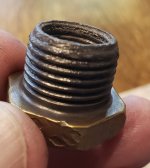
But - for use with pMags and spark plugs adapters I experienced a problem with the adapters once I changed to copper based antiseize, the adapter threads eroded. I have been running these adapters for 20+ years and did not have this issue until after I changed to the copper based antiseize. The photo shows one of these adapters after ~200 hours or so. I replaced the adapters and went back to the old school graphite spark plug antiseize and the problem went away.
I recommend staying with graphite antiseize when using spark plugs adapters.
Carl
Note the clear direction to use copper based antiseize.
But - for use with pMags and spark plugs adapters I experienced a problem with the adapters once I changed to copper based antiseize, the adapter threads eroded. I have been running these adapters for 20+ years and did not have this issue until after I changed to the copper based antiseize. The photo shows one of these adapters after ~200 hours or so. I replaced the adapters and went back to the old school graphite spark plug antiseize and the problem went away.
I recommend staying with graphite antiseize when using spark plugs adapters.
Carl
Attachments

I have the brass 18mm --> 14mm adapters, and I use nickel anti-seize on the 18mm side, and nothing on the 14mm side, since that's what NGK recommends. I started with the graphite and as @rocketbob said, it leaves a lot of gunk behind.
My understanding its to improve thermal cooling performance in their water cooled aluminum head, avoiding a "hot spot" around plug which may reduce hardness over time. The paste aids heat transfer from plug to cylinder head acting as a water cooled heat sink. Remember as well that the Rotax plug fires more frequently than in a Lycoming, as typical RPM range is twice that of direct drive engines plus a wasted spark cycle on every other stroke. FWIWHave no idea why Rotax recommends it our what flaws they have requiring it.
rrvogelman
I'm New Here
"NGK spark plugs feature trivalent plating. This silver or chrome-colored finish on the threads is designed to provide corrosion resistance against moisture and chemicals. The coating also acts as a release agent during spark plug removal. NGK spark plugs are installed at the factory dry, without lubrication or anti-seize.
Anti-seize can act as a lubricant, altering torque values up to 20 percent, increasing the risk of spark plug thread breakage and/or metal shell stretch. Thread breakage can sometimes involve removing the cylinder head for repair. Metal shell stretch changes the heat rating of the spark plug and can result in serious engine damage caused by pre-ignition. Do not use anti-seize or lubricant on NGK spark plugs. It is completely unnecessary and can be detrimental."
Anti-seize can act as a lubricant, altering torque values up to 20 percent, increasing the risk of spark plug thread breakage and/or metal shell stretch. Thread breakage can sometimes involve removing the cylinder head for repair. Metal shell stretch changes the heat rating of the spark plug and can result in serious engine damage caused by pre-ignition. Do not use anti-seize or lubricant on NGK spark plugs. It is completely unnecessary and can be detrimental."

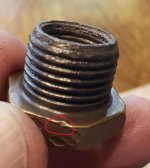
I hope you take a mill file to flatten out that dent so that the copper gasket has a flat surface to seal on. And, since this one was installed/removed via Vise Grips or Channellocks (aye no!), it would be a good idea to inspect ALL of the adapters.
EDIT: Nevermind. I see that you replaced them already and hopefully used a 6-point socket.
EDIT: Nevermind. I see that you replaced them already and hopefully used a 6-point socket.
Last edited:
That gouge was a result of me putting the adapter in a vice after removal from the engine. That adapter went into the "show and tell" box, not an engine.
Carl
Carl
Thank you for that info. Just curious about what factory you are speaking of...?NGK spark plugs are installed at the factory dry, without lubrication or anti-seize.
rrvogelman
I'm New Here
NGK factoryThank you for that info. Just curious about what factory you are speaking of...?
