Van's Air Force

The definitive Van's Aircraft support community! Buying, building or flying an RV? Join our exclusive family of mentors and enthusiasts!

Two alternators on one bus?

TedC

Active Member
Patron
I looked in the archive and couldn't find an answer to this, so I'll go ahead and ask.

I'd like to know builders' thoughts on connecting two alternators to a single bus at the same time. My configuration will be a Main alternator (60A) and a Backup alternator (~35A), a single Battery, and single bus. The idea is to set the main alternator at, say, 14.8V and the backup at 14.4V. If the load increases to the point where the main alternator is pulled down to 14.4V then the backup alternator adds to the total load carrying capability, giving a total of about 60 + 35 = 95A.

I know builders who have done this and not had any trouble, but the Ausman book states that you shouldn't have both alternators on the bus, although there isn't a detailed explanation why. I spoke to the boss of B&C at Oshkosh once and he thought it might be a fine idea. What do the experts here think? Would the system work as described above?

One concern I would have is the case where both alternators are active on the bus, the main alternator is operating at close to its limit, say 50A output, and it fails completely. Then the entire 50A load would be instantly placed on the 35A backup alternator, causing it to ... What? Overload or fail in some way? If I used the more conventional design of only one alternator on the bus at once, and it failed, I could of course first reduce the load and only then switch to the backup alternator, thus never overloading it. Would this be important?

Thanks for your thoughts.
 
I looked in the archive and couldn't find an answer to this, so I'll go ahead and ask.

I'd like to know builders' thoughts on connecting two alternators to a single bus at the same time. My configuration will be a Main alternator (60A) and a Backup alternator (~35A), a single Battery, and single bus. The idea is to set the main alternator at, say, 14.8V and the backup at 14.4V. If the load increases to the point where the main alternator is pulled down to 14.4V then the backup alternator adds to the total load carrying capability, giving a total of about 60 + 35 = 95A.

I know builders who have done this and not had any trouble, but the Ausman book states that you shouldn't have both alternators on the bus, although there isn't a detailed explanation why. I spoke to the boss of B&C at Oshkosh once and he thought it might be a fine idea. What do the experts here think? Would the system work as described above?

One concern I would have is the case where both alternators are active on the bus, the main alternator is operating at close to its limit, say 50A output, and it fails completely. Then the entire 50A load would be instantly placed on the 35A backup alternator, causing it to ... What? Overload or fail in some way? If I used the more conventional design of only one alternator on the bus at once, and it failed, I could of course first reduce the load and only then switch to the backup alternator, thus never overloading it. Would this be important?

Thanks for your thoughts.
Current hogging is real, look it up and if Marc Ausman says it's a bad idea, it's a bad idea. My solution to what you are trying to do is the Monkworkz 30 amp generator
 
I'm doing the Monkworkz and a main alt. Agree with Mark and Marc. The Monkworkz would be the same idea, set at the lower voltage, but it's design can handle what you are doing from talking with Bill Judge, owner and designer of Monkworkz.
 
50A load? That would be a lot of accessories running. I have two electrical sources wired to my bus, B&C 60 amp primary and Monkworkz 30 amp generator secondary. The primary is set at 14.3v and the secondary is set to 14.0v. Both are on from start to shutdown. The highest voltage runs the bus (primary) and the monkworkz is standing by until the bus voltage drops below 13.8 at which time it takes over. My amp load with everything on is 33 amps (pitot heat, landing lights, radios, etc). Normal flight is 20 ish amps (pitot heat off, landing lights off, etc)
 
Two alternators on one bus with one operating only as a backup is totally standard (see Aeroelectric Connections Z12). However, the backup would only come on if the main fails or is turned off. The potential issue with two running at the same time is that both would be trying to control the bus voltage and there *may* be issues with that because each alternator was designed to control voltage without interference from a 2nd alternator. IIRC the Monkworkz generator is ok with this. BTW, it would be unusual with modern avionics to consume more than 60 amps unless you have electric deice or electric a/c.
 
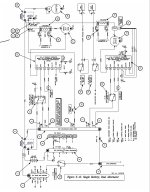
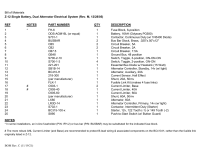
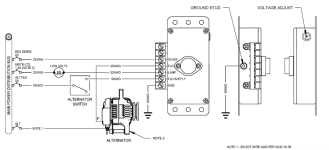
As others have said this is done all the time. Suggest checking your voltage set-points and amp draws. B&C makes available Z-12 with a full list of components needed on their web site:

Screenshot 2026-01-07 081840.jpg
 
Agree with others - no issue with design. I start my engine with the Alt off. When I turn it on, it loads down immediately. 1600 hours on it and hasn't complained yet. Alt's can handle loads like that. I would give more thought to 14.8 as your set voltage. Seems too high to me. You can drop the set voltage on the backup - it doesn't need to be 14.4.
 
50A load? That would be a lot of accessories running. I have two electrical sources wired to my bus, B&C 60 amp primary and Monkworkz 30 amp generator secondary. The primary is set at 14.3v and the secondary is set to 14.0v. Both are on from start to shutdown. The highest voltage runs the bus (primary) and the monkworkz is standing by until the bus voltage drops below 13.8 at which time it takes over. My amp load with everything on is 33 amps (pitot heat, landing lights, radios, etc). Normal flight is 20 ish amps (pitot heat off, landing lights off, etc)
My Flyleds landing lights are 8 amps each, a couple amps for some very bright pos/strobe lights, and the pitot heat can be 10, so that's 28 right there. I also plan a couple of powerful vent fans at 4 amps each, bringing me to 36A before I've even turned on the avionics or the flap motor. I can see getting to 50.

Thanks for everyone's responses.

I should say that my main goal right now is the electrical and panel design, so one decision is: one switch or two? Ausman usually shows a single DPST switch for the two sources that completely prevents both from being ON at once. It does save panel space, as my original proposal would need two SPST switches for the B&C and the Monkworkz so they can both be ON at once. But I like the extra capability that scenario seems to gives me.

I'm going to do some more research on the Monkworkz and the Z-12 architecture from Nuckolls. I've been focusing on Ausman's architecture because I'm using a VP-X.
 
As others have said this is done all the time. Suggest checking your voltage set-points and amp draws. B&C makes available Z-12 with a full list of components needed on their web site:

View attachment 106673
Thanks for posting that diagram, I'll have a look at that part of the Nuckolls book again, but your diagram seems to be annotated (the circled numbers) and the book isn't - was this from the website? It looks like those annotations could be useful.

And can you tell me what you mean about B&C making available 'Z-12 with a full list of components'? I couldn't find anything on their site when searching for that. Would you have a link?

Thanks again.
 
One concern I would have is the case where both alternators are active on the bus, the main alternator is operating at close to its limit, say 50A output, and it fails completely. Then the entire 50A load would be instantly placed on the 35A backup alternator, causing it to ...

...output at 35 amps.
 
My Flyleds landing lights are 8 amps each, a couple amps for some very bright pos/strobe lights, and the pitot heat can be 10, so that's 28 right there. I also plan a couple of powerful vent fans at 4 amps each, bringing me to 36A before I've even turned on the avionics or the flap motor. I can see getting to 50.

Thanks for everyone's responses.

I should say that my main goal right now is the electrical and panel design, so one decision is: one switch or two? Ausman usually shows a single DPST switch for the two sources that completely prevents both from being ON at once. It does save panel space, as my original proposal would need two SPST switches for the B&C and the Monkworkz so they can both be ON at once. But I like the extra capability that scenario seems to gives me.

I'm going to do some more research on the Monkworkz and the Z-12 architecture from Nuckolls. I've been focusing on Ausman's architecture because I'm using a VP-X.

On more consideration when thinking about power budgets -- the alternator itself (field/rotor) flows between 2A and 5A (proportional to the output current). A generator (e.g. MZ-30L) doesn't "eat from the pan" as it were...
 
On more consideration when thinking about power budgets -- the alternator itself (field/rotor) flows between 2A and 5A (proportional to the output current). A generator (e.g. MZ-30L) doesn't "eat from the pan" as it were...
Heh.

But a permanent magnet gen eats from the Power Plant pan whether it's making juice or not.
 
On more consideration when thinking about power budgets -- the alternator itself (field/rotor) flows between 2A and 5A (proportional to the output current). A generator (e.g. MZ-30L) doesn't "eat from the pan" as it were...
Sure, but the alternator has enough headroom to accommodate that 5A and also output full rated amps. Normal internal regulator configuration (i.e. not PlanePower etc) gets its field power from the alternator directly and you wouldn't see that 5A, yet the field is still pulling that.
.....But a permanent magnet gen eats from the Power Plant pan whether it's making juice or not.
Not the Monkworkz. There's pretty much no mechanical load on the engine when the MZ is not making power. I learned that from my 'iron bird' testing when we were developing the MZ-60TR (TwinRotor).

1767805478593.png
1767806631430.png
 
Last edited:
There's no issue putting two alternators on one bus - that is in the book and very common. The question is about how to control them.

You're proposing they are both active at the same time. While there are ways to do this, in the book I advocate for the simplest method which is to have only one active at a time. When the primary fails, you will get a low-voltage alert as voltage will drop from 14.2 volts to ~12 volts. It is not an emergency situation requiring split second response. You then, as the pilot, are aware of the failure and simply switch on the backup alternator then load shed as needed. The Alternator switch should be set up so that mechanically you can switch on either alternator but not both at the same time (an ON-OFF-ON switch).

If both are running at the same time you are not aware of the failure (again, there are alerting mechanisms available to do this but adds parts and complexity).
 
There's no issue putting two alternators on one bus - that is in the book and very common. The question is about how to control them.

You're proposing they are both active at the same time. While there are ways to do this, in the book I advocate for the simplest method which is to have only one active at a time. When the primary fails, you will get a low-voltage alert as voltage will drop from 14.2 volts to ~12 volts. It is not an emergency situation requiring split second response. You then, as the pilot, are aware of the failure and simply switch on the backup alternator then load shed as needed. The Alternator switch should be set up so that mechanically you can switch on either alternator but not both at the same time (an ON-OFF-ON switch).

If both are running at the same time you are not aware of the failure (again, there are alerting mechanisms available to do this but adds parts and complexity).
Are you suggesting that the pilot may actually have to do something?

🤣🤣
 
If both are running at the same time you are not aware of the failure (again, there are alerting mechanisms available to do this but adds parts and complexity).
Good advice here. I set mine up this way for this reason. This is especially true with the lower output backups that cannot deliver the full bus load.
 
....Not the Monkworkz. There's pretty much no mechanical load on the engine when the MZ is not making power. I learned that from my 'iron bird' testing when we were developing the MZ-60TR (TwinRotor).
Gonna have to disagree with you here. Unlike a alt or gen that uses excitation voltage to create a field to balance the load-demand, permanent magnets have a constant field; thus, there is always be a counter-torque.

400-ish watts will be over a 1/2 HP parasitic load not including inefficiencies. If someone can prove me wrong, awesome. Until such; conservation of energy, physics and sh!t.

Looking forward to getting my ME brain smarter outside of my briar patch..
 
I asked TJ at B&C about running both an LX60 with a LR3D-14 regulator and a BC410-H with a SB1B-14 regulator turned on at the same time. He said that as long as the LR3D-14 and SB1B-14 are set at the factory voltage setpoints, 14.2V and 13.0V respectively, the SB1B-14 won't turn on the BC410-H field as long as the LX60 and LR3D-14 are running properly, and if there's an undervoltage problem with the LX60 or LR3D-14, the backup system (BC410-H and SB1B-14) will come online, with reduced ampacity of course. I told him I plan to use an EarthX ETX900 battery. He said it's OK to crank the setpoint of the SB14-14 up to 13.5V so the backup alternator supplies the load (assuming the primary alternator can't) instead of draining the battery. I would NOT set the LR3D-14 to 14.8V, because the ETX900 specifies a standard charge voltage range of 13.9-14.6V. The nominal output voltage of that battery is 13.2V.
 
Gonna have to disagree with you here. Unlike a alt or gen that uses excitation voltage to create a field to balance the load-demand, permanent magnets have a constant field; thus, there is always be a counter-torque.

400-ish watts will be over a 1/2 HP parasitic load not including inefficiencies. If someone can prove me wrong, awesome. Until such; conservation of energy, physics and sh!t.

Looking forward to getting smarter.
Nope. The MZ just runs the 3-phase generator coils open-circuit when the regulator is not enabled, so no mechanical load. Yes, the generator is making whatever dozens of volts thanks to being permanent magnet, but because there's nothing attached across the coils, no amps are flowing, and therefore zero work being done (watts or HP, same thing).

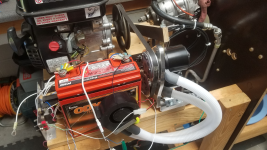
In the case of this MZ-60 TR, according to your logic, we'd have 800-ish watts, which is over 1 HP of parasitic loads. On my iron bird with the 1-cyl gas engine, 1 HP is a significant load and would be obvious in the engine sound if the generators were pulling that. When connecting a 60A load as I did in testing, you can definitely tell that the generators are pulling engine power, but no drag when the regulators are turned off.

IIRC, 'Old school' PM generator regulators would regulate by varying a shunt across the output, so then you have parasitic load all the time as you say. Bill J's regulator design is the secret sauce that enables the no parasitic load when turned off.

Also, you can demonstrate your "counter-torque" by taking one of Bill's generators without the regulator attached and spin the shaft by hand. Then tie all 3 generator wires together and try to turn the shaft. You won't be able to.
 
Thx
Nope. The MZ just runs the 3-phase generator coils open-circuit when the regulator is not enabled, so no mechanical load. Yes, the generator is making whatever dozens of volts thanks to being permanent magnet, but because there's nothing attached across the coils, no amps are flowing, and therefore zero work being done (watts or HP, same thing).

In the case of this MZ-60 TR, according to your logic, we'd have 800-ish watts, which is over 1 HP of parasitic loads. On my iron bird with the 1-cyl gas engine, 1 HP is a significant load and would be obvious in the engine sound if the generators were pulling that. When connecting a 60A load as I did in testing, you can definitely tell that the generators are pulling engine power, but no drag when the regulators are turned off.

IIRC, 'Old school' PM generator regulators would regulate by varying a shunt across the output, so then you have parasitic load all the time as you say. Bill J's regulator design is the secret sauce that enables the no parasitic load when turned off.

Also, you can demonstrate your "counter-torque" by taking one of Bill's generators without the regulator attached and spin the shaft by hand. Then tie all 3 generator wires together and try to turn the shaft. You won't be able to.
Cool and thx. So the counter-torque is either 0 or 100%?
 
There's no issue putting two alternators on one bus - that is in the book and very common. The question is about how to control them.

You're proposing they are both active at the same time. While there are ways to do this, in the book I advocate for the simplest method which is to have only one active at a time. When the primary fails, you will get a low-voltage alert as voltage will drop from 14.2 volts to ~12 volts. It is not an emergency situation requiring split second response. You then, as the pilot, are aware of the failure and simply switch on the backup alternator then load shed as needed. The Alternator switch should be set up so that mechanically you can switch on either alternator but not both at the same time (an ON-OFF-ON switch).

If both are running at the same time you are not aware of the failure (again, there are alerting mechanisms available to do this but adds parts and complexity).
There's another reason for possibly having two alternators active on the bus at once other than a main failure, alluded to in my original posting. What if you had more load than 60A on the system with the B&C LX60, possibly due to A/C or a drained battery charging? This would mean that because of the overload the system voltage would be pulled down to the setpoint of the backup alternator. Then wouldn't the backup come online and start adding to the output of the main alternator, preventing the system voltage from dropping any lower than the backup's setpoint, and thus adding to the total amperage output of the main to yield 60+35=95A? Then if the load kept increasing to beyond 95A the whole system voltage would start dropping again below the backup's setpoint. Yes, I'm hoping to be able to use the combined output of two alternators to supply the electrical system. Will this work in the way I'm envisioning?
 
Last edited:
There's another reason for possibly having two alternators active on the bus at once other than a main failure, alluded to in my original posting. What if you had more load than 60A on the system with the B&C LX60, possibly due to A/C or a drained battery charging? This would mean that because of the overload the system voltage would be pulled down to the set point of the backup alternator. Then wouldn't the backup come online and start adding to the output of the main alternator, preventing the system voltage from dropping any lower than the backup's set point, and thus adding to the total amperage output of the main to yield 60+35=95A? Then if the load kept increasing to beyond 95A the whole system voltage would start dropping again below the backup's set point. Yes, I'm hoping to be able to use the combined output of two alternators to supply the electrical system. Will this work in the way I'm envisioning?
While the approach of the main and backup alternator on the same bus, typically using e.g. the B&C approach of staggered set points is a generally accepted operating and reliability approach, I find the idea of load sharing between the main and backup alternators of a load in excess of the main alternator's rated capacity a dubious approach, at least if the expectation is of that being more than a transient condition. For that load sharing to occur, the main alternator gets operated at its maximum current capacity and therefor no longer being a fairly hard voltage source, but instead eating the voltage drop (and associated extra IR heating) to reach the set point of the backup, which is a very stressful and reliability reducing operation, quite possibly outright failure inducing.

If you really expect loads in excess of say a B&C 60A main alternator on any other than transient condition (e.g. post start Lithium battery re-charging), good engineering calls for sizing your main alternator for that maximum load. You could argue for lower capacity on the back up with the assumption that a main alternator failure is recognized and appropriate load shedding is implemented.
 
There is more than one way to wire an airplane, not necessarily a right way and a wrong way, just different. It is a matter of personal preference. Some builders connect both alternators to the bus through a selector switch. The pilot will get a low voltage warning if the main alternator fails. She can then flip the selector switch to the backup alternator. But what if the selector switch fails? Another option is to permanently connect both alternators with different setpoints to the bus. If the main alternator fails, the voltage will drop a few tenths of a volt and the backup alternator will come online automatically at a lower setpoint. The EFIS will detect the small voltage drop and notify the pilot. No pilot action is required unless the electrical load is too great for the backup alternator. In that case the voltage will drop down to battery voltage and then the battery will supply part of the current. Electrical loads will draw current from the source with the highest voltage.
Cool and thx. So the counter-torque is either 0 or 100%?
No machine is perfect, so an unloaded permanent magnet alternator will sill require a small amount of power to rotate.
The amount of power required to rotate a permanent magnet alternator depends on the load current.
I'm hoping to be able to use the combined output of two alternators to supply the electrical system. Will this work in the way I'm envisioning?
Theoretically it will work. But if an alternator is loaded above its rated output, it is going to get hot. Forced air cooling might not be adequate to prevent overheating.
 
I looked in the archive and couldn't find an answer to this, so I'll go ahead and ask.
This has been very well documented over and over. Z-12 is a decades old electrical diagram. Suggest hire someone who knows what you need to wire your airframe. Stein and others have a great support team, use them. Worth every penny.
 
Last edited:
Thanks for posting that diagram, I'll have a look at that part of the Nuckolls book again, but your diagram seems to be annotated (the circled numbers) and the book isn't - was this from the website? It looks like those annotations could be useful.

And can you tell me what you mean about B&C making available 'Z-12 with a full list of components'? I couldn't find anything on their site when searching for that. Would you have a link?

Thanks again.

Go on B&C website and search "Support" and then:

System Diagrams


Screenshot 2026-01-07 223413.png
 
Last edited:
The RV-14A I purchased has a B&C 60 A externally regulated wound field main alternator and Monkworkz MZ-30 backup generator:
  • B&C LR3 regulator set to 14.4 V
  • Monkworkz regulator set to 14.2 V by cutting the designated wire. There are two choices, 14.6 V and 14.2 V
  • Both B leads on the single main bus.
  • Single EarthX battery. Regulator settings would the the same with an AGM battery.
  • Dual Pmag ignition with mechanical fuel injection.
My alternator switchology SOP:
  • Separate switches for main (off, batt, batt + alt) alternator and backup (off, on) generator.
  • Backup alternator active light on panel next to backup alternator switch.
  • Backup generator switch always on, parked or flying.
  • Start, taxi, runup, and take off with main alternator off. Monkworkz active light will flash at low RPM indicating it is not able to keep up with the current demand.
  • In flight, the Monkworkz active light will glow steadily because it is able to keep up with the current demand.
  • When the Monkworkz charges the battery and brings bus voltage to 14.2, maybe ten minutes of flight, I turn on the main alternator, bus voltage rises quickly to 14.4 and the Monkworkz active light extinguishes.
    • BTW the Monkworkz active light takes several seconds to respond to its new state, to start blinking at startup and to extinguish when the main alternator is turned on.
  • If the main alternator were to fail, the Monkworkz active light would come on.
    • EFIS voltage alarms could also be used.
  • This procedure does two things:
    • Stress tests the Monkworkz generator in flight in addition to a functional ground test.
    • Limit current to battery after start to limit battery heating.
  • Turn off the main alternator for extended periods in flight to stress test the Monkworkz generator.
Overloading an alternator or generator does not overstress it, just the voltage sags. Ref my Bob Nuckolls note.

Monkworkz MZ-30 will start and run well with no battery present. AFAIK a “modern” wound-field alternator will run well enough with no battery present but cannot be counted on to restart if turned off.

Alternator output current rating is net of field current.

If I had dual B&C or other wound-field externally regulated alternators I would:
  • Use LR3 regulators for both. SB1 is OK also.
  • Set main to 14.4 V and backup to 13.8 V.
  • Fly with both on.
Z101 is Bob Nuckolls’ latest template, currently at rev B.
  • Find it in folder “Adobe_Architecture_Pdfs”, along with other Z templates that have been updated since the Aeroelectric Connection book was published at rev 12, at http://www.aeroelectric.com/PPS/
  • Z101 puts the backup alternator B lead on the single battery, Monkworkz generator B lead needs an isolation relay because its B lead presents a parasitic load.
  • If the engine bus is used, I put the Monkworkz generator B lead on the engine / essential bus at which point it is no longer correct to call it Z101.
 
Last edited:
There is more than one way to wire an airplane, not necessarily a right way and a wrong way, just different. It is a matter of personal preference. Some builders connect both alternators to the bus through a selector switch. The pilot will get a low voltage warning if the main alternator fails. She can then flip the selector switch to the backup alternator. But what if the selector switch fails? Another option is to permanently connect both alternators with different setpoints to the bus. If the main alternator fails, the voltage will drop a few tenths of a volt and the backup alternator will come online automatically at a lower setpoint. The EFIS will detect the small voltage drop and notify the pilot. No pilot action is required unless the electrical load is too great for the backup alternator. In that case the voltage will drop down to battery voltage and then the battery will supply part of the current. Electrical loads will draw current from the source with the highest voltage.

No machine is perfect, so an unloaded permanent magnet alternator will sill require a small amount of power to rotate.
The amount of power required to rotate a permanent magnet alternator depends on the load current.

Theoretically it will work. But if an alternator is loaded above its rated output, it is going to get hot. Forced air cooling might not be adequate to prevent overheating.
Very interesting point about the alternator getting hot in this scenario. That's the info I'm here for. Thanks.
 
Thanks for that, just what I wanted.

But sorry, can't hire Stein to determine 'one switch or two'. Stein is great (I talked to him for 45 min at OSH last year), but this is a simple question. And I think I have my answers, with everyone's help.

Thanks to everyone, I appreciate it. Now back to riveting!
 
... But if an alternator is loaded above its rated output, it is going to get hot....

As alluded to in post 12... it's not possible to load an alternator above its rated current... when overloaded, the alternator becomes a constant current source at approximately its current rating and the voltage sags.

Ref my Bob Nuckolls note.
 
Last edited:
As alluded to in post 12... it's not possible to load an alternator above its rated current... when overloaded, the alternator becomes a constant current source at approximately its current rating and the voltage sags.
Actually Bob N says that it is possible to overload an alternator a few percent above nameplate rating.
He doesn't mention heat.
 
Another perspective:

I specifically didn't want two alternators on the same bus because I'm using an electric ignition system and didn't want the failure mode of short to ground taking out both alternators or a run away alternator kicking off the over voltage system on its neighbor, among other possibilities that I don't know about.

Because of this, I simply have two alternators, two batteries, and two electrical systems. One large battery and larger alternator and one small battery and small alternator. This works fine because my critical avionics have dual inputs, and I'm not really worried about lights or other things in an alternator failure situation.

This also makes the system very easy to troubleshoot as my EFIS shows Bus A and Bus B volts, so don't need to understand voltage thresholds to know what is going on, if alternator A fails, I see buss A volts drop to battery voltage.
 
… two alternators on the same bus… a run away alternator kicking off the over voltage system on its neighbor…
FYI, in the case of B&C LR3 and SB1 regulators, they are “selective trip”, only the offending regulator will trip its crowbar.

These regulators are sold, with a different part number, into the certified marketplace. The certification process FMEA does not allow one regulator to take another offline.

My Bob Nuckolls note on this.
 
Last edited:
Another perspective:

I specifically didn't want two alternators on the same bus because I'm using an electric ignition system and didn't want the failure mode of short to ground taking out both alternators or a run away alternator kicking off the over voltage system on its neighbor, among other possibilities that I don't know about.

Because of this, I simply have two alternators, two batteries, and two electrical systems. One large battery and larger alternator and one small battery and small alternator. This works fine because my critical avionics have dual inputs, and I'm not really worried about lights or other things in an alternator failure situation.

This also makes the system very easy to troubleshoot as my EFIS shows Bus A and Bus B volts, so don't need to understand voltage thresholds to know what is going on, if alternator A fails, I see buss A volts drop to battery voltage.
Radios, xpdr, GPS units don’t have dual power inputs so curious how you handled those LRU’s.?
 
Last edited:
FYI, in the case of B&C LR3 and SB1 regulators, they are “selective trip”, only the offending regulator will trip its crowbar.

These regulators are sold, with a different part number, into the certified marketplace. The certification process FMEA does not allow one regulator to take another offline.

My Bob Nuckolls note on this.
How does that work? Looking at the LR3D documentation:

1768104065159.png

The sense is tied to the bus. How could it know the difference between voltage created by it or any other alternator tied to the same bus?
 
Radios, xpdr, GPS units don’t have dual power inputs so curious how you handled those LRU’s.?

I have a backup radio in my flight bag, if I had two radios in the panel I'd use the other bus. You are correct, my navigator would lose power, but one option is to turn off the main bus if the alternator fails and save the power for the approach while running off my G3X.

Another option is to have an avionics bus and put it on a on-off-on switch so you could define which bus to put the avionics on. I could also design a power switching circuit and put that in line.

Anyway, you raise a good point in that not everything is dual input, but I figured I was more comfortable with the concessions above than have a single bus. Also, the dual input gives me a cool startup procedure. Master on (ties the battery to the main bus and connects the main alternator), Aux on (now my g3x boots completely isolated testing the bus), ign 1 on, ign 2 on, start, then aux alternator on, then avionics on (which swings everything to the main bus since it's higher voltage).

Switches are lined up with the procedure and the shutdown is simply the reverse. It tests things as you go and keeps everything isolated from startup while showing you oil pressure.
 
How does that work? Looking at the LR3D documentation:

View attachment 106977

The sense is tied to the bus. How could it know the difference between voltage created by it or any other alternator tied to the same bus?there be two wound field alternators:
In the case of two wound field alternators with B&C regulators either LR3 or SB1. One could develop a matrix of scenarios but perhaps the commonest is:
  • Both alternators SOP on in flight.
  • Main alternator is capable of 60 A and is set to 14.4 V.
  • Backup alternator is capable of a little over 30 A at cruise Lycoming RPM and is set to 13.8 V
  • Main regulator is supplying field current and keeping bus to 14.4 V.
  • Backup regulator is idling.
  • In case of overvoltage:
    • Backup regulator is not supplying field current so does not activate its crowbar.
    • Main regulator is supplying field current, is the “offending” regulator, so activates its crowbar and trips its 5 A field CB.
    • Bus voltage drops. Backup regulator comes alive and holds bus voltage to 13.8 if it’s not overloaded.
    • Crew resets main regulator 5 A field CB once. If it trips again is is a real failure versus a “nuisance trip”.
BTW Bob Nuckolls recommends using two each LR3 versus one LR3 and one SB1 but SB1 is OK if you already have it. And it’s convenient to have identical regulators in case you want to swap them, just you need to adjust voltage setpoint appropriately.

OTOH I would choose Monkworkz MZ-30 generator for backup because it delivers 30A at 1,800 Lycoming crankshaft rpm and above, and it will start and run with no battery present. Note its B lead cannot be connected directly to the battery because it presents a passive load that will drain the battery when parked.
 
Last edited:
Back
Top