Van's Air Force

The definitive Van's Aircraft support community! Buying, building or flying an RV? Join our exclusive family of mentors and enthusiasts!

To Dimple or not to Dimple?

FlyAmerica

I'm New Here
In 29IS/U-10 step 3, they have us dimple the holes in the aft edge of F-01240-1. Then in 29IS/U-11 step 7 they have us cleco, then rivet both F-1202D-L&R onto F-01240-1 but I do not see anywhere where it says to dimple the holes in the F-1202D-L&R... given the skin is dimpled it seems like the angles should be dimpled... yes or no?

Any Advice would be appreciated.
 
So not sure if Angles is the right nomenclature, the F-1202D-L&R are very thin, and they go under the dimpled skin (on the underside).
 
I had the same question. Decided to dimple the angles, because I was afraid of a swivel effect if I didn’t. Keep in mind this moves the cover plate a little bit and I had to use a little force to mount the cover plate in place. It now sits very, very snug against the top, but it is not bending it. So I would do it again.
BTW: On the sides, I think I didn’t bend the top enough and now I have a hard time closing this 1mm 2(2/32 in.) gap.
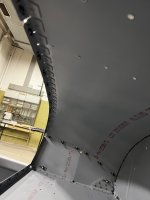
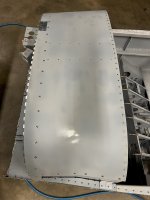
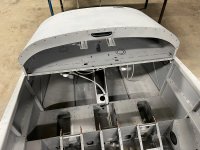
See pictures attached.
 

Attachments

  • 250212 29-11 f.jpeg
    250212 29-11 f.jpeg
    2.9 MB · Views: 76
  • 250212 29-11 d.jpeg
    250212 29-11 d.jpeg
    2.6 MB · Views: 77
  • 250212 29-11 k.jpeg
    250212 29-11 k.jpeg
    2.7 MB · Views: 76
In general.If it is thicker than 0.032" do not dimple, 0.040 marginal for dimple.

If it is thin sheet metal bent up angle, 0.032" thick max (or 0.040) dimple. If it is an extrusion (typically 0.062 or thicker) countersink. Never dimple extrusions.

RV-12 is dealing with POP rivets or Blind Fasteners your countersink may or dimple may be shallow... Call Van's or be more spacific.

For regular AN rivets it is:

3/32" flush rivet has over 0.032 depth countersink (close to 0.042), so you will knife edge a 0.032 sheet and go slightly into the structure below. This may be OK, but I hate it. Over 0.040 by all means countersink no dimple... NOT ALL DIMPLE DIES ARE CREATED EQUAL....

A 1/8" flush rivet has about 0.062" depth countersink. Dimpling 0.062 is not doable in the T3 or T6 heat treat condition (el crack oh). You can dimple in the "O" (Oh) soft non heat treat condition, then heat treat after. That is too exotic for us.

I hope I confused. My lawyer says use above at own risk... but do call van or post more detail. I recently did a RV-12iS Phase 1 and gave builder training. Nice plane. Pretty fast on 4.5 gal/hr, great Vis, good handling... with glass and 2 axis autopilot. Fancy.

 
I am building a 14A, but there is a flange in the forward fuselage that the plans call the be countersunk. It is .032 thick and I was tempted to dimple. In. The end I did countersink it but I drilled a hole in a thicker piece of aluminum and used that as a backer to prevent the countersink from enlarging the hole. Was also careful to not go any deeper than I had to to get a flush head.
 
The parts are .032 thick (ref: section 4 - RV-12iS parts index). Per Vans support, I dimpled the parts at those locations and it worked fine.
 
I noted the same issue, and just went ahead and dimpled the F-1202D-L/R based on the principle that if it's attaching to something that's dimpled, it either should be countersunk or dimpled. There's a discussion elsewhere in the forums about dimpling nutplates, which is something that's only mentioned once that I recall in the plans, but seems to me like good practice anywhere undimpled nutplates are attached by dimpled holes.
 
Back
Top