Which is perfectly fine, in particular when operated from smooth clean surfaces. You're accepting less margin if landed hard or swerved while heavily loaded or rolled over a pavement edge or into a big rock...but within the practical range, there is no specific pressure below which is
bad and above is
good. The tube failure
rate is simply inverse to pressure and multiplied by load.
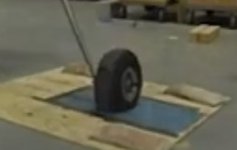
Here's an image snip from the RV-14 drop test video. I'll assume this tire was set to 35 psi, as I think that's the number in the build manual. Note how the tread is smashed close to the bead on the outside. What you can't see is the inside bead, which is mashed even closer and has a folded sidewall, because the leg moves outboard as well as up when compressed. The deformation is hard on the tube.
View attachment 104386
Now consider what the sidewalls look like when a taildragger gets a little sideways...you know, the
almost-groundlooped-but-I-saved-it episode. We've all seen wheels with grass stuffed between the bead and the rim. Strictly the other guys of course. After all, 90% of us are above average.
BTW, let's remember a lot of the desire for lower pressures is based on shimmy, not load. Any true damping is based on friction, the enemy of a tube.
Of course you can. GA gear is typically designed to withstand a 10 foot per second ground impact; in the US it's specified in Part 23. Everything is developed from that starting point.
The tire manufacturers have their say also. Did you know Goodyear lists "Maximum Bottoming Load" of a 5.00-5 6- ply at 50 psi as 3500 lbs per tire? Got two of them, so 7000 lbs/3.7 G allows a max aircraft weight a little over 1800 lbs. 3.7 is the right ballpark, although the actual G mostly depends on the flexibility of the gear leg, i.e. the distance available to bring the mass to a stop.
The difference between rated static rolling radius and flat tire radius is only 1.4" inches.