Van's Air Force

The definitive Van's Aircraft support community! Buying, building or flying an RV? Join our exclusive family of mentors and enthusiasts!

Tire pressure on 5.00 x 5???

rick57

Well Known Member
Sponsor
What pressures have ya'll found to work best for you on 5.00 x 5 tires? I let mine get a bit low and had to do some repair on the pants. (wheel pants)
I'm thinking nitrogen fill would work best and put inspection holes in the pants to check pressures regularly. Please advise...Rick
 
This is one of those endless debate questions. There's a camp that says if tire pressures get any lower than 30 psi, the tires will spin on the wheels and destroy the tube. The other extreme says if the pressure is over 40 psi, the gear will shimmy. It's very dependent on the individual plane, the gear alignment and the tire type--and the opinion of the pilot. I use 35 psi and find that works fine for me. Any lower and the tires get close to rubbing on the pants. Much higher and shimmy can sometimes set up. But that's just me & my plane.

As far as the access hole, I've seen them in use and you have to roll the plane forward and back to get the fill tube aligned just right. It can be cumbersome to try to get the screw cap off depending on the hole/cover size & shape. Of course, there are thousands of RV's out there with access covers and their owners are happy with that and wouldn't have it any other way. At the recommendation of others on this forum, I switched to Michelin Air Stop tubes to minimize the leak down rate. I pull the front half of the wheel pants off about once a quarter and check the tire pressure and have a general look around for anything amiss. It usually only takes a few psi to bring them back up to the desired pressure. Those tubes are pricey, but worth it.
 
On fill gas….I have always had good luck with slightly adulterated Nitrogen, say….19% of some other gas? 😉
I also use a nitrogen-oxygen-argon blend in my tires. It's easily available in most locations :p

Van's says to run the 5.00x5 tires on the -12 at 25 PSI to act as part of the suspension system; I'm sure it's not great for tire and tube life but it does work.
 
I also use a nitrogen-oxygen-argon blend in my tires. It's easily available in most locations :p

Van's says to run the 5.00x5 tires on the -12 at 25 PSI to act as part of the suspension system; I'm sure it's not great for tire and tube life but it does work.
I run 26-PSI in the (5.00 x 5) mains and 30-PSI in the (4.00 x 5) nose to achieve Vans spring (gear leg) / damper (tire) effect on my RV-9A. Otherwise, I find it's too bouncy for my liking, especially on uneven taxi and runways -- still appear to achieve good even tire wear and tube life by using quality tires and tubes. As far as shimmy goes, with a 22-lbs pull-out torque on the caster, I don't experience any nose shimmy, especially by keeping it trimmed "nose light" for takeoff and holding it off during landings.
 
Last edited:
This is one of those endless debate questions. There's a camp that says if tire pressures get any lower than 30 psi, the tires will spin on the wheels and destroy the tube.
I’ve repaired a few planes with destroyed tubes from that. Show the folded over tube to the owner, same startled face every time. Result, plane gets both tubes changed, & a few times the tires too, because the tube sometimes vulcanizes right to the tire.
 
I’ve repaired a few planes with destroyed tubes from that. Show the folded over tube to the owner, same startled face every time. Result, plane gets both tubes changed, & a few times the tires too, because the tube sometimes vulcanizes right to the tire.
Proper tube installation and ample usage of talcum powder will prevent this.

Seems like it's more from excessive braking than just hard braking.
 
Last edited:
SO: the consensus is not less than 30 and not more than 50. I would suggest starting with 35 and try that watching for, mostly, shimmy. And landing quality, as Vans would tell you. Go up 5 pounds at a time and see what works for your airplane. The harmonics seems to be different from airplane to airplane so what is good for SuzieQ might not be good for..........what's your airplane's name?...... 😊

I have the old wheel fairings (new ones are in the living room!). I figured out where the stem would be and drilled a 1" hole which is covered by a simple snap fitting when not needed. I have the WHEEL marked where the stem will line up with that hole (mark at the bottom when lined up). I stick a piece of rubber hosing in to remove the valve stem cover. I have an extension I screw onto the valve stem and can check pressures and fill to my 35 if necessary. I do not have the $$$expensive$$$ tubes but it is so easy to check pressures and keep them up. I'll spend the money I saved on fuel.

Stems: Amazon

4 PCS Valve Stem Extenders, 4inch 100mm Wheel Tire Valve Stem Extension, Wheel Valve Extension Rod Extender Stem Caps for Trucks Cars Motorcycles Rv Mowers​

YMMV but I like this system......
 
What pressures have ya'll found to work best for you on 5.00 x 5 tires? I let mine get a bit low and had to do some repair on the pants. (wheel pants)
I'm thinking nitrogen fill would work best and put inspection holes in the pants to check pressures regularly. Please advise...Rick
35 PSI because I didn't know any better and that pressure seems to work for me. I was getting ready to make a hole in the wheel fairing but decided to try FOBO instead. It's really a nice system. https://www.amazon.com/dp/B0822G8GYQ. I pump the tires up to 38 or so in the fall knowing the pressure will come down a little in the cooler weather. The FOBO monitors tire temp also and I was amazed at how hot the tire can get in warn weather and long taxi or heavy breaking.
 
I’ve repaired a few planes with destroyed tubes from that. Show the folded over tube to the owner, same startled face every time. Result, plane gets both tubes changed, & a few times the tires too, because the tube sometimes vulcanizes right to the tire.
Similar. I have replaced a few ruptured tubes when folks run too low of pressure. We are so spoiled with tubeless tires these days that can take so much abuse. Tube tires cannot.

For everyone other than the rv 9 above, please do research before running below 30 psi. My recommendation is 35 minimum, but feel that the risk curve doesn’t significantly ramp until you get down to 30. Don’t forget that you need some margin. If you run 30 and don’t notice a very small leak, you may be taking off at 25 and that is just asking for trouble with these small tires.

A local guy ran low pressure. Tire looked at little low and thought i will fill it when i get home. Tire blew on landing. Tube tires are far less resilient than the tubeless variety you are used to on your cars
 
Last edited:
What I can't understand is if Vans has been running their recommended lower tire pressure in all of their demonstrators for the number of years they have been doing demo rides and flying cross-country to fly-ins year after year, then why do some here feel that Vans recommend tire pressure is somehow not good? I've been running their recommended lower tire pressure for 21-years now with simply no issues whatsoever. I also notice very even tire wear across the tread, so that's not an issue either. I do replace my tires and tube with high quality replacements (Michelin or Goodyear) when they need to be, but I never wear them thin either. I keep spare innertubes with me when I fly but have never had the need to use one. However, I have seen other guys with issues after poor installations, especially with tubes getting pinched between the rims or folded over during installation, which I believe is a much bigger problem.
 
Last edited:
What I can't understand is if Vans has been running their recommended lower tire pressure, in all of their demonstrators for the number of years they have been doing demo rides and flying cross-country to fly-ins year after year, then why do some here feel that Vans recommend tire pressure is somehow not good? I've been running their recommended lower tire pressure for 21-years now with simply no issues whatsoever. I also notice very even tire wear across the tread, so that's not an issue either. I do replace my tires and tube with high quality replacements (Michelin or Goodyear) when they need to be, but I never wear them thin either. I keep spare innertubes with me when I fly but have never had the need to use one. However, I have seen other guys with issues after poor installations, especially with tubes getting pinched between the rims or folded over during installation, which I believe is a much bigger problem.
Pretty tough to get a tube folded over during installation. Not saying inexperienced folks can’t find a way to do it, but suspect the folding is occurring during usage and not installion. They can fold over in use when under inflated and this ultimately leads to pinching and ultimately leaking. I am sure vans recommended pressure is based upon load capacity and don’t argue that 26 meets that criteria. However, one must consider the type of service they will see beyond just load capacity.
 
Pretty tough to get a tube folded over during installation. Not saying inexperienced folks can’t find a way to do it, but suspect the folding is occurring during usage and not installion. They can fold over in use when under inflated and this ultimately leads to pinching and ultimately leaking. I am sure vans recommended pressure is based upon load capacity and don’t argue that 26 meets that criteria. However, one must consider the type of service they will see beyond just load capacity.
Vans does specify a very specific way to install tires and tubes in their manual, which I use myself. And, I tend to see pinched tubes in-between the rims when I help other RV owners fix flats (tubes usually torn right at the rim join). And, if you don't use ample talc and proper inflation technique while installing the tubes, they can get twisted and/or pinched, as Vans also points out in their manual.
 
Vans does specify a very specific way to install tires and tubes in their manual, which I use myself. And, I tend to see pinched tubes in-between the rims when I help other RV owners fix flats (tubes usually torn right at the rim join). And, if you don't use ample talc and proper inflation technique while installing the tubes, they can get twisted and/or pinched, as Vans also points out in their manual.
I fully agree that pinching tubes between the halves is a real installation issue that happens. I just don't think it is easy to get the tube folded over during installation. The carcass is pretty thick in the relaxed state. Not saying it could never happen; Just don't believe it is common.
 
+1
Run as high a pressure as possible up to the 50 psi load rated max based on shimmy characteristics.
I suggest you open up your pant openings a bit more also.
Will it tend to shimmy more at higher pressures or no? I am currently at 30.
 
Anche io.

78% nitrogen, 21% oxygen, 1% mix of a few others. If the OP is thinking about in diffusion rates, it’s marketing hype. Think about what you’ll be left with after a couple of top ups.
We tend to have more H2O in ours at sea level. Should I travel to the mountains to get some fresh mountain air and that may help?
 
Minimum inflation pressure is dependent on landing impact. Lots of RV owners have flown 25 to 30 psi for years without flats...but you can bet your last dollar those same guys don't land hard.

If you expect them to live at design load, stay north of 40 psi.
 
Minimum inflation pressure is dependent on landing impact. Lots of RV owners have flown 25 to 30 psi for years without flats...but you can bet your last dollar those same guys don't land hard.

If you expect them to live at design load, stay north of 40 psi.
Didn't go flat, just rubbed on the pant and pulled a small section off. Did the repairs with carbon fiber and microfill. I had a crosswind get under the wing and push me over a bit too far...
 
SO: the consensus is not less than 30 and not more than 50. I would suggest starting with 35 and try that watching for, mostly, shimmy. And landing quality, as Vans would tell you. Go up 5 pounds at a time and see what works for your airplane. The harmonics seems to be different from airplane to airplane so what is good for SuzieQ might not be good for..........what's your airplane's name?...... 😊

I have the old wheel fairings (new ones are in the living room!). I figured out where the stem would be and drilled a 1" hole which is covered by a simple snap fitting when not needed. I have the WHEEL marked where the stem will line up with that hole (mark at the bottom when lined up). I stick a piece of rubber hosing in to remove the valve stem cover. I have an extension I screw onto the valve stem and can check pressures and fill to my 35 if necessary. I do not have the $$$expensive$$$ tubes but it is so easy to check pressures and keep them up. I'll spend the money I saved on fuel.

Stems: Amazon

4 PCS Valve Stem Extenders, 4inch 100mm Wheel Tire Valve Stem Extension, Wheel Valve Extension Rod Extender Stem Caps for Trucks Cars Motorcycles Rv Mowers​

YMMV but I like this system......
Keri Mi, so whether I am at home or at the hangar, I am with Keri....and I thought of that all by myself! And thanks, I am gonna order some extensions until I get snap caps installed.
 
I also use a nitrogen-oxygen-argon blend in my tires. It's easily available in most locations :p

Van's says to run the 5.00x5 tires on the -12 at 25 PSI to act as part of the suspension system; I'm sure it's not great for tire and tube life but it does work.
Minimum inflation pressure is dependent on landing impact. Lots of RV owners have flown 25 to 30 psi for years without flats...but you can bet your last dollar those same guys don't land hard.

If you expect them to live at design load, stay north of 40 psi.
You can not just blunty look at "design" pressure, if there even is such a thing. The same set up runs on oleo gears as well as bungee as our spring steel rod. each brings it's own vibration, shimmy, not to mention difference in weight. The first Rv forum I was on was the Matronics list. Every few years a new generation of RV builders. Not out of the aviation trade, like Van himself (trained Aeronautical engineer) but some non related field. [ed. Removed political sentence. Please observe the posting rules. dr]

If people ask me, I refer them to manual. And I assume, the aircraft was build in accordance with the build manual. Me? Build a RV7, RV10 and now ground up restoration of a 1000hr RV4. For a living it's wrenching on A320/330 and B737 (EASA). We don't experiment. We follow the manual, people cleverer than us worked everything out. It's the same with the RV4. Van himself used one for years to commute to work. He worked it out. Don't reinvent the wheel (no pun intended)
 
Last edited by a moderator:
Minimum inflation pressure is dependent on landing impact. Lots of RV owners have flown 25 to 30 psi for years without flats...but you can bet your last dollar those same guys don't land hard.

If you expect them to live at design load, stay north of 40 psi.
Well -- at 40-psi and expecting to land hard at times, then you better plan on some big bounces and stay proficient at your go-arounds. The damping effect is all but gone in a normally designed for spring/damper landing gear system. Shock absorbers have both spring and damper for a very good reason! Perhaps sticking with a primary trainer until learning how to land would be a better idea! (y):cool:(y)
 
Last edited:
Well -- at 40-psi and expecting to land hard at times, then you better plan on some big bounces and stay proficient at your go-arounds. The damping effect is all but gone in a normally designed for spring/damper landing gear system. Shock absorbers have both spring and damper for a very good reason! Perhaps sticking with a primary trainer until learning how to land would be a better idea! (y):cool:(y)
I inflate all three tires to 50 psi on my 9A. I have not had a bounce problem. Reduced risk of flats at the higher pressure.
 
I inflate all three tires to 50 psi on my 9A. I have not had a bounce problem. Reduced risk of flats at the higher pressure.
Well -- then it sounds like you're a very good pilot and know how to land an airplane! Been running 28-psi in the mains and 30-psi in the nose, and I have never experienced a tire or tube failure in over 21-years of flying my RV-9A regularly. However, I use high quality tires and tubes (Michelin or Goodyear) and follow Vans tire/tube installation procedures "to the letter", which is VERY important even if you run 50-psi. And, I would venture to say -- if you get a puncture during takeoff or landing at 50-psi, you're more likely to experience a blow-out than simply going soft.
 
Last edited:
You can not just blunty look at "design" pressure, if there even is such a thing. The same set up runs on oleo gears as well as bungee as our spring steel rod. each brings it's own vibration, shimmy, not to mention difference in weight. The first Rv forum I was on was the Matronics list. Every few years a new generation of RV builders. Not out of the aviation trade, like Van himself (trained Aeronautical engineer) but some non related field. [ed. Removed political sentence. Please observe the posting rules. dr]

If people ask me, I refer them to manual. And I assume, the aircraft was build in accordance with the build manual. Me? Build a RV7, RV10 and now ground up restoration of a 1000hr RV4. For a living it's wrenching on A320/330 and B737 (EASA). We don't experiment. We follow the manual, people cleverer than us worked everything out. It's the same with the RV4. Van himself used one for years to commute to work. He worked it out. Don't reinvent the wheel (no pun intended)
Vans is not boeing. For years he told us vne was in ias; only later he realized his error, or later understood unforeseen consequences, and changed it. Vans put a tail on the 7 that didn’t have favorable results and changed it. Think the world of van and hold his skill in high regard, but that doesn’t make me think he nailed the tire pressure recommendation, especially when pilots with skills lesser than his own are using the planes. Clearly The recommended pressure will handle the load, but one must consider what happens when that lower pressure creates excessive deflection, especially in a tube tire. While many can get away with running those pressures, i firmly believe many cannot.

I often don’t follow car designers tire pressure recommendations on cars either. They are set by load and meeting goals on how marketing wants it to feel. What ends up with a proper tire contact patch is usually off by several psi.
 
Last edited:
Vans is not boeing. For years he told us vne was in ias; only later he realized his error, or later understood unforeseen consequences, and changed it. Vans put a tail on the 7 that didn’t have favorable results and changed it. Think the world of van and hold his skill in high regard, but that doesn’t make me think he nailed the tire pressure recommendation, especially when pilots with skills lesser than his own are using the planes. Clearly The recommended pressure will handle the load, but one must consider what happens when that lower pressure creates excessive deflection, especially in a tube tire. While many can get away with running those pressures, i firmly believe many cannot.

I often don’t follow car designers tire pressure recommendations on cars either. They are set by load and meeting goals on how marketing wants it to feel. What ends up with a proper tire contact patch is usually off by several psi.

Vans is not boeing. For years he told us vne was in ias; only later he realized his error, or later understood unforeseen consequences, and changed it. Vans put a tail on the 7 that didn’t have favorable results and changed it. Think the world of van and hold his skill in high regard, but that doesn’t make me think he nailed the tire pressure recommendation, especially when pilots with skills lesser than his own are using the planes. Clearly The recommended pressure will handle the load, but one must consider what happens when that lower pressure creates excessive deflection, especially in a tube tire. While many can get away with running those pressures, i firmly believe many cannot.

I often don’t follow car designers tire pressure recommendations on cars either. They are set by load and meeting goals on how marketing wants it to feel. What ends up with a proper tire contact patch is usually off by several psi.
If Vans was Boeing, there wouldn't be this discussion, it would be a certified aircraft and you'd have to comply with regulations and approved maintenance data.

But the daft thing is, that physics don't care whether or not there's a 2" stencil that says experimental. The Wittman gear is a system, a bit from here, a bit from there. The RV4 I currently work on, had a complaint about shimmy. Interestingly enough, I had no gear stiffners installed. It wasn't built to the drawings. An issue showed up. Poor engineering from Vans? No.

I built a 7 previously with the tail it came with, no SB issued to change it. Any proof of this claim?

With regards to pressure, if you stick to the build manual and the given clearances, then you will have no issue. The issue arises when the builder doesn't stick to the manual, introduces modifications like heavier engines, etc, etc without going through the consequences from A to Z.

Any comparison to a car is quite poor, in particular when it comes to American made cars. I know, I've been driving one for years.
 
I am sticking with 35 psi for now. I am fortunate to have a hangar neighbor who has built 10 airplanes over his lifetime, 4 of them RV's. When I asked him, he said stick with 35 and make sure you have enough energy to flare properly and you will be fine. Thanks, Rick
 
I am sticking with 35 psi for now.

Which is perfectly fine, in particular when operated from smooth clean surfaces. You're accepting less margin if landed hard or swerved while heavily loaded or rolled over a pavement edge or into a big rock...but within the practical range, there is no specific pressure below which is bad and above is good. The tube failure rate is simply inverse to pressure and multiplied by load.

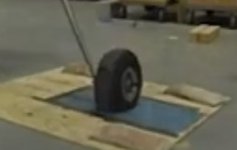
Here's an image snip from the RV-14 drop test video. I'll assume this tire was set to 35 psi, as I think that's the number in the build manual. Note how the tread is smashed close to the bead on the outside. What you can't see is the inside bead, which is mashed even closer and has a folded sidewall, because the leg moves outboard as well as up when compressed. The deformation is hard on the tube.

ScreenHunter_3058 Dec. 10 09.18.jpg

Now consider what the sidewalls look like when a taildragger gets a little sideways...you know, the almost-groundlooped-but-I-saved-it episode. We've all seen wheels with grass stuffed between the bead and the rim. Strictly the other guys of course. After all, 90% of us are above average.

BTW, let's remember a lot of the desire for lower pressures is based on shimmy, not load. Any true damping is based on friction, the enemy of a tube.

You can not just blunty look at "design" pressure, if there even is such a thing.

Of course you can. GA gear is typically designed to withstand a 10 foot per second ground impact; in the US it's specified in Part 23. Everything is developed from that starting point.

The tire manufacturers have their say also. Did you know Goodyear lists "Maximum Bottoming Load" of a 5.00-5 6- ply at 50 psi as 3500 lbs per tire? Got two of them, so 7000 lbs/3.7 G allows a max aircraft weight a little over 1800 lbs. 3.7 is the right ballpark, although the actual G mostly depends on the flexibility of the gear leg, i.e. the distance available to bring the mass to a stop.

The difference between rated static rolling radius and flat tire radius is only 1.4" inches.

 
I've been hearing that the Cirrus SR22 also experiences gear shimmy -- a certified design! In 21-years of flying our RV-9A regularly, we have never experienced shimmy nor tire failure, and we followed the RV-9A assembly manual for tires. In saying that, I would likely inflate an RV-10 tire with higher pressure given its higher gross weight rating -- heck, our RV-9A gross weight is just 1750-lbs. Honda 70's CB tube type motorcycle tire inflation is actually a function of loading according to their manual (i.e. for single rider, they recommend 28-30 psi and higher tire pressure for an additional passenger and/or additional baggage loading). So, if I run single-rider with any higher tire pressure than 30-psi, the ride becomes very uncomfortable on anything other than a smooth road, and you also risk rim damage! Therefore, there is no single answer for RV tire inflation -- if you like your number, then stick with it! (y):cool:(y)
 
Which is perfectly fine, in particular when operated from smooth clean surfaces. You're accepting less margin if landed hard or swerved while heavily loaded or rolled over a pavement edge or into a big rock...but within the practical range, there is no specific pressure below which is bad and above is good. The tube failure rate is simply inverse to pressure and multiplied by load.

Here's an image snip from the RV-14 drop test video. I'll assume this tire was set to 35 psi, as I think that's the number in the build manual. Note how the tread is smashed close to the bead on the outside. What you can't see is the inside bead, which is mashed even closer and has a folded sidewall, because the leg moves outboard as well as up when compressed. The deformation is hard on the tube.

View attachment 104386

Now consider what the sidewalls look like when a taildragger gets a little sideways...you know, the almost-groundlooped-but-I-saved-it episode. We've all seen wheels with grass stuffed between the bead and the rim. Strictly the other guys of course. After all, 90% of us are above average.

BTW, let's remember a lot of the desire for lower pressures is based on shimmy, not load. Any true damping is based on friction, the enemy of a tube.


Of course you can. GA gear is typically designed to withstand a 10 foot per second ground impact; in the US it's specified in Part 23. Everything is developed from that starting point.

The tire manufacturers have their say also. Did you know Goodyear lists "Maximum Bottoming Load" of a 5.00-5 6- ply at 50 psi as 3500 lbs per tire? Got two of them, so 7000 lbs/3.7 G allows a max aircraft weight a little over 1800 lbs. 3.7 is the right ballpark, although the actual G mostly depends on the flexibility of the gear leg, i.e. the distance available to bring the mass to a stop.

The difference between rated static rolling radius and flat tire radius is only 1.4" inches.

Your mathematics are doubtful, the aircraft still has forward motion and thus lift. I doubt a RV will survive a 3.7G impact as in the aircraft is still useable without repairs.
 
The G value? Entirely possible, given I didn't actually do any math. I'll look into it.
FWIW, on my 4th landing since new to the RV-8, I oopsed and did a 3,1 G (Dynon Data) stalled, carrier landing at 1800 lbs.
I probably was at 35 - 40 psi as per Van's.
Would love to have a camera film that...
I was worried something broke or bent. Glad nothing was amiss after an extrensive inspection nose to tail (was worried with the main gear and tail spring etc) . Says something on the strengh of these airplanes.

4 years later and 221 thankfully softer landings later (thanks FlySto), all is still very well.
Since at least 3 years, I now inflate my tires at 50 psi at the annual, Air Stop Michelins inside the Classic tires supplied in the finishing kit.
The tires still show very little wear.

If I'm at Gross weight, or land hard, or a bit sideways, or on one wheel because of crosswind, or any combination, I believe my tires/tubes have a better chance of staying whole.
I mainly do wheel landings.

Landing roll-outs seem smoother and less fishtailing than when at 35 psi.
They lose 8 - 9 psi in a year, ask me how I know.
 
Why so much argument? Given all the responses from all the 90% of the pilot population who have it down pat with their desired pressure, it is obvious the tire pressure works well for those who set it at 20 psi as well as for those who set it at 50 psi. Since this is so, how about we all agree our tire pressures on our planes can work well within that range of 20-50 psi and leave to each individual pilot to decide his/her pressure even though it might not be what you run.

Live Long and Prosper!
 
How about we all agree our tire pressures on our planes can work well within that range of 20-50 psi and leave to each individual pilot to decide his/her pressure even though it might not be what you run.

Live Long and Prosper!
+1
 
No.

I built a 7 previously with the tail it came with, no SB issued to change it. Any proof of this claim?
The original tail was an 8 tail and van didn’t like the spin recovery so moved to the 9 tail. He felt strongly enough that he offered the new tails to builders with the original for free.
 
What I can't understand is if Vans has been running their recommended lower tire pressure in all of their demonstrators for the number of years they have been doing demo rides and flying cross-country to fly-ins year after year, then why do some here feel that Vans recommend tire pressure is somehow not good? I've been running their recommended lower tire pressure for 21-years now with simply no issues whatsoever. I also notice very even tire wear across the tread, so that's not an issue either. I do replace my tires and tube with high quality replacements (Michelin or Goodyear) when they need to be, but I never wear them thin either. I keep spare innertubes with me when I fly but have never had the need to use one. However, I have seen other guys with issues after poor installations, especially with tubes getting pinched between the rims or folded over during installation, which I believe is a much bigger problem.

I ran my rv4 500x5s at 26 psi for over 20 years never had an issue until a few years ago Ianded out and everything was fine until I was sitting at the gas pump refueling and one tire just went flat. Luckily a guy on the field had a tire and tube and enough tools to fix it. After I looked it over I believe I did not use enough talc powder when I built up the tire, but I upped my pressures to 30 psi because having a flat is a royal pain in the arse!!
 
This sounds like one of those “get the popcorn” debates. I’ve owned an RV-3, and RV-4 and now fly an -8. I’ve tried all different pressures and found the lower pressures make it a bit harder to roll the plane out of the hangar. The lower pressures around 30 also seem to be a little sloppy during taxi. Not a scientific evaluation but a just an observation. The RV-4 had a little shimmy on landing just above taxi speed that was solved with higher pressures (or so I thought). At the next annual I changed the rather worn tires and tubes and never had shimmy again at any speed. On the -8 I use 45 psi and seems to be a good balance of getting the plane out of the hangar easily, taxi is smooth and no issues on landing so that’s my number.
 
This sounds like one of those “get the popcorn” debates. I’ve owned an RV-3, and RV-4 and now fly an -8. I’ve tried all different pressures and found the lower pressures make it a bit harder to roll the plane out of the hangar. The lower pressures around 30 also seem to be a little sloppy during taxi. Not a scientific evaluation but a just an observation. The RV-4 had a little shimmy on landing just above taxi speed that was solved with higher pressures (or so I thought). At the next annual I changed the rather worn tires and tubes and never had shimmy again at any speed. On the -8 I use 45 psi and seems to be a good balance of getting the plane out of the hangar easily, taxi is smooth and no issues on landing so that’s my number.
🍿
 
Why so much argument? Given all the responses from all the 90% of the pilot population who have it down pat with their desired pressure, it is obvious the tire pressure works well for those who set it at 20 psi as well as for those who set it at 50 psi. Since this is so, how about we all agree our tire pressures on our planes can work well within that range of 20-50 psi and leave to each individual pilot to decide his/her pressure even though it might not be what you run.

Live Long and Prosper!
See post #14.........and then the 33 posts that followed that....... :ROFLMAO: :ROFLMAO: :ROFLMAO: 🤪 🤪 🍿🍿🍿
 
Back
Top