
I have experienced erratic egts when my plug wires were run next them, so they are sensitive. Consider pulling the tie wraps and separate the wires to see if things improve. Possibly the alternator is generally ok, but is getting noiser. This explains your symptoms to a degree.Yeah they all go through the firewall at the same spot. #1 and #3 spend more time with the B lead wire since the pass through is on the bottom left of the firewall (from the pilot's perspective). But it's still odd that #1 CHT and #3 EGT don't have the noise since they have the same distance on the run with the B lead.

Van's Air Force
You are using an out of date browser. It may not display this or other websites correctly.
You should upgrade or use an alternative browser.
You should upgrade or use an alternative browser.
Thoughts on the Plane Power AL12-EI60
- Thread starter bjdecker
- Start date


Seems you reference Denso Alternators quite a bit, PP is a copy without the billions of hours on the product like Denso, designed for 160,000 to 200K mikes of auto use , B&C took that and made it better, their Alternators with the Crowbar Regulator , set it and forget it who wants to worry about power in your plane ?I have experienced erratic egts when my plug wires were run next them, so they are sensitive. Consider pulling the tie wraps and separate the wires to see if things improve. Possibly the alternator is generally ok, but is getting noiser. This explains your symptoms to a degree.
Peter RV 6.2

Separate them and see what happens. I know it may not be easy given someone ran them through the same firewall hole, but even just inserting small spacers into the harness before and behind may show a difference. Or consider running a temporary B-lead for a ground run.Yeah they all go through the firewall at the same spot. #1 and #3 spend more time with the B lead wire since the pass through is on the bottom left of the firewall (from the pilot's perspective). But it's still odd that #1 CHT and #3 EGT don't have the noise since they have the same distance on the run with the B lead.
One experiment is often worth a lot of opinions....
Last edited:

Separate them and see what happens. I know it may not be easy given someone ran them through the same firewall hole, but even just inserting small spacers into the harness before and behind may show a difference. Or consider running a temporary B-lead for a ground run.
One experiment is often worth a lot of opinions....
Then there's this ---
Crash shared his failed alternator with me -- easy to understand why all the probe values went haywire....
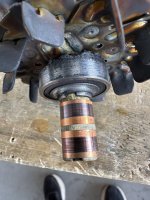
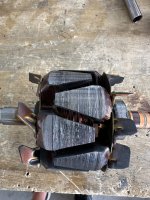
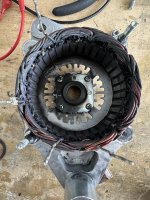
SRE bearing spun -> rotor dragged on stator -> stator melted and became a dead short -- holes & electrons flying everywhere...
Reminds me of a great movie scene:
...
"Don't cross the streams."
"Why not?"
"It would be bad."
"I'm fuzzy on the whole good/bad thing. What do you mean , "bad?""
"Try to imagine all life as you know it stopping instantaneously and every molecule in your body exploding at the speed of light."
"Total Protonic Reversal"
"Right, That's bad. Okay, All right. Important safety tip.. Thanks, Egon."
Then there's this ---
Have you noticed if the later generation PP alternators are still having the spun bearing problems or have they fixed it?
They claimed to have fixed it -- however, I see no differences between the 2015 version, the 2018 version, or my brand new 2024 version...Have you noticed if the later generation PP alternators are still having the spun bearing problems or have they fixed it?
They claimed to have fixed it -- however, I see no differences between the 2015 version, the 2018 version, or my brand new 2024 version...
Keep checking them on a regular basis.
Plane Power Alternator Failure - Redux...Redux...
...since we haven't talked about alternators in a few hours... :) I received the following unit from our comrade Brian Beatty (@bdbeatty) today. This alternator failed enroute to OshKosh a couple of years ago, after only a few hundred hours. Initial analysis by Hartzell/Plane Power was...
www.vansairforce.net
I realize I am a bit late to this discussion, but as the author of the Kitplanes article regarding the larger Denso alternator pulley and gauging the interest on this thread, I figured I could offer to make a batch of pulleys. The issue with the 8192700 pulley is that it is for 13mm or 1/2" belts. I made my pulley to match the 3/8" belt of my lycoming 320 ring gear pulley. The bearing failures and discussions about heat all point to excessive RPM in my mind which is why I went down this path in the first place.
If folks are still interested, I would prefer to make a couple to send out for some to test, as I dont have an RV, regarding cowling clearance, general install, etc. (as we know no 2 lycoming engines are the same). Then I can make a batch. It would also be good to know what price point folks expect which will determine I make them in my shop, or overseas.
I am curious to hear your thoughts.
If folks are still interested, I would prefer to make a couple to send out for some to test, as I dont have an RV, regarding cowling clearance, general install, etc. (as we know no 2 lycoming engines are the same). Then I can make a batch. It would also be good to know what price point folks expect which will determine I make them in my shop, or overseas.
I am curious to hear your thoughts.
I'm interested.I realize I am a bit late to this discussion, but as the author of the Kitplanes article regarding the larger Denso alternator pulley and gauging the interest on this thread, I figured I could offer to make a batch of pulleys. The issue with the 8192700 pulley is that it is for 13mm or 1/2" belts. I made my pulley to match the 3/8" belt of my lycoming 320 ring gear pulley. The bearing failures and discussions about heat all point to excessive RPM in my mind which is why I went down this path in the first place.
If folks are still interested, I would prefer to make a couple to send out for some to test, as I dont have an RV, regarding cowling clearance, general install, etc. (as we know no 2 lycoming engines are the same). Then I can make a batch. It would also be good to know what price point folks expect which will determine I make them in my shop, or overseas.
I am curious to hear your thoughts.
The belt that's used on the Plane Power AL12-EI60 is a Dayco 15355 or Gates 7355XL. The top dimension (width) of these belts is 10" or 11" mm, and I believe the side angle is ~36° (this is from memory -- need to double check this).
The other kink is the depth (or height) of the spindle to the D.E. bearing face and the depth of the casting around the D.E. bearing -- the Plane Power/Unipoint/Victory D.E. bracket has less "meat" on it, compared to the WAI/Transpo/ND-Clone (Denso 101211-2130), https://as-pl.com/en/p/ABR6179S. This translates into the inside shoulder height of the pulley.
DM me for contact details.
Brian

I've already reverse-engineered the actual PlanePower pulley: https://vansairforce.net/threads/thoughts-on-the-plane-power-al12-ei60.234327/#post-1837552.........If folks are still interested, I would prefer to make a couple to send out for some to test, as I dont have an RV, regarding cowling clearance, general install, etc. (as we know no 2 lycoming engines are the same). Then I can make a batch. It would also be good to know what price point folks expect which will determine I make them in my shop, or overseas.
I am curious to hear your thoughts.
and: https://vansairforce.net/threads/thoughts-on-the-plane-power-al12-ei60.234327/page-2#post-1847037
I've attached a STEP file below which has the proper offset and belt groove. You can edit the file to whatever outer diameter you want.
EDIT: @bjdecker said previously that the stock PP pulley will not clear certain non-PP nose castings; so could make the shaft boss a bit smaller in diameter to clear those.
Attachments
Last edited:
Using this STEP file as a reference, it looks like the PP alternator has a much longer shaft out the front than the original Denso that I have. It would be a different pulley design for the Plane Power vs. anyone using a Denso like me. The 3.75" would reduce the alternator RPM by 28%. It is interesting the PP is meant for a 10 or 11mm belt as the original Lycoming part is a 0.380" wide belt (37A19773-376).I've already reverse-engineered the actual PlanePower pulley: https://vansairforce.net/threads/thoughts-on-the-plane-power-al12-ei60.234327/#post-1837552
and: https://vansairforce.net/threads/thoughts-on-the-plane-power-al12-ei60.234327/page-2#post-1847037
I've attached a STEP file below which has the proper offset and belt groove. You can edit the file to whatever outer diameter you want.

I used this pulley from Summit Racing.
I see full voltage on my alternator even at low idle of about 600-700 RPM, so I guess that I could have gone with an even larger pulley. This pulley has a 4" diameter.
The 185 does not seem to be available any more, and the 182 should also work: https://www.summitracing.com/parts/pwm-182
I had to make space with a blister on the cowl for the larger pulley.
I had my buddy turn down the area on the pulley that makes contact with the nut to make sure I had enough threads.
Rather than going through all this hassle, you could just buy a B&C or a Monkworkz.
I see full voltage on my alternator even at low idle of about 600-700 RPM, so I guess that I could have gone with an even larger pulley. This pulley has a 4" diameter.
The 185 does not seem to be available any more, and the 182 should also work: https://www.summitracing.com/parts/pwm-182
I had to make space with a blister on the cowl for the larger pulley.
I had my buddy turn down the area on the pulley that makes contact with the nut to make sure I had enough threads.
Rather than going through all this hassle, you could just buy a B&C or a Monkworkz.
Show us your Denso with shaft, please, and include the original application. I happen to have some PP units here as well as an original Denso off of an '87 Civic. Both have identical shafts, as far as the machined dia section. And that PP pulley fits my Denso fine too.Using this STEP file as a reference, it looks like the PP alternator has a much longer shaft out the front than the original Denso that I have. It would be a different pulley design for the Plane Power vs. anyone using a Denso like me. The 3.75" would reduce the alternator RPM by 28%. It is interesting the PP is meant for a 10 or 11mm belt as the original Lycoming part is a 0.380" wide belt (37A19773-376).
And as to belts; the Lycoming-branded belt which I have is ~7/16" wide and sits proud of the flywheel groove by at least 1/16" inch. I'll grab a photo of my old Lyc belt I have in the hangar later.
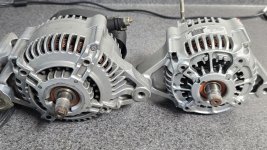
Last edited:
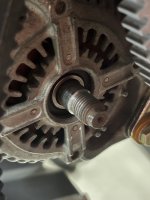
Unfortunately this is the best pic of my alternator with the pulley removed, but the maximum thickness of the pulley on the shaft to retain sufficient threads was 3/16". I also recall a steel spacer bushing behind the pulley which I reused. Clearly I need to go do some measuring at the hangar.Show us your Denso with shaft, please, and include the original application. I happen to have some PP units here as well as an original Denso off of an '87 Civic. Both have identical shafts, as far as the machined dia section. And that PP pulley fits my Denso fine too.
And as to belts; the Lycoming-branded belt which I have is ~7/16" wide and sits proud of the flywheel groove by at least 1/16" inch. I'll grab a photo of my old Lyc belt I have in the hangar later.
My Denso is the design used on the 1986 Suzuki Samurai.
Attachments
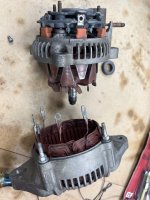
Last edited:
Unfortunately this is the best pic of my alternator with the pulley removed, but the maximum thickness of the pulley on the shaft to retain sufficient threads was 3/16". I also recall a steel spacer bushing behind the pulley which I reused. Clearly I need to go do some measuring at the hangar.
My Denso is the design used on the 1986 Suzuki Samurai.
Just a comment --
That thing is "Beefy"; 4 "hold down" bolts, silicone vibration isolators on the stator leads, screw lugs on the stator leads, studs instead of screws to hold the rectifier in place.
That's a better core design than the Plane Power AL12-EI60...

Rdog420
Well Known Member
Do you have the serial numbers for the ones you have disassembled?Then there's this ---
Crash shared his failed alternator with me -- easy to understand why all the probe values went haywire....
View attachment 94364
View attachment 94365
View attachment 94366
SRE bearing spun -> rotor dragged on stator -> stator melted and became a dead short -- holes & electrons flying everywhere...
Reminds me of a great movie scene:
...
"Don't cross the streams."
"Why not?"
"It would be bad."
"I'm fuzzy on the whole good/bad thing. What do you mean , "bad?""
"Try to imagine all life as you know it stopping instantaneously and every molecule in your body exploding at the speed of light."
"Total Protonic Reversal"
"Right, That's bad. Okay, All right. Important safety tip.. Thanks, Egon."
Your Samurai Denso looks to have the same shaft config as my '87 Civic Denso, so I'd guess that the assembled height of your steel pulley plus the spacer equals ~0.44, which is what the PP pulley is.Unfortunately this is the best pic of my alternator with the pulley removed, but the maximum thickness of the pulley on the shaft to retain sufficient threads was 3/16". I also recall a steel spacer bushing behind the pulley which I reused. Clearly I need to go do some measuring at the hangar.
My Denso is the design used on the 1986 Suzuki Samurai.
Also, on that Lyc belt width: my 37A19773-357 is 0.425. Are you certain yours is 3/8"?
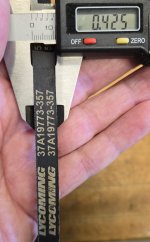
Yeah I think you are right on the pulley. I will have to check my steel spacer to confirm.Your Samurai Denso looks to have the same shaft config as my '87 Civic Denso, so I'd guess that the assembled height of your steel pulley plus the spacer equals ~0.44, which is what the PP pulley is.
Also, on that Lyc belt width: my 37A19773-357 is 0.425. Are you certain yours is 3/8"?
That is interesting you were able to measure the belt first hand. All the Lycoming documentation I have seen list it as 0.380" width including the engine parts manuals. I ended up ordering a 3VX belt of the right length for my engine and it fits the ring gear pulley perfectly (3/8" wide).
Last edited:
Fellow RV folks, Plane power, Auto Zone Remans are all just a shadow of the quality of a OEM Nippondenso (now called Denso) . Electrical power is something we really don't want to worry about we really need those electrons , buy a new Denso Alternator or better yet a B&C ( blueprinted Denso Alt) and forget about it it will just work.I've been doing a lot of work (testing/experimenting, goofing off) with various alternators of late, and I thought I would share some observations about the ubiquitous Plane Power alternator; Ubiquitous insomuch as it's the alternator that comes with the FWF kit from Van's (ES ALTERNATOR DELUXE). This is the 99-1012 model, circa 2015 and later.
View attachment 85148
The basis of the unit is the Unipoint ALT-5020. All of the internals (regulator, rectifier, stator, rotor/armature) are Unipoint implementations of Nippondenso parts & designs as follows:
1. The Drive End (DE) brackets and Slip Ring End (SRE) brackets contain NTN bearings (6202LU and 6002LU respectively).
2. DE bracket is a Unipoint casting/machined to clone the Nippondenso unit 101211-2130, 101211-3030 DE bracket.
3. SRE bracket is also a Unipoint casting/machined to clone the Nippondenso unit 101211-2950, 101211-3720 SRE bracket.
* The combination of 2&3 allows the unit to be "re-clocked" to position the B+ terminal, 3 pin connector to a more desirable location.
4. The regulator begins life as a Unipoint YR-662, modified to a -6621 with an overvoltage crowbar circuit on the field circuit. The equivalent regulator is a Nippondenso part 12600-1630 or WAI/Transpo IN257 (w/out overvoltage mod.).
5. The rectifier is a Unipoint REC-644, comprised of 8 - 40/50A diodes. Equivalent to Nippondenso part 21580-3130, -3340 or WAI/Transpo INR718P, INR737, INR724.
6. The brush set is Unipoint BH-634. Equivalent to Nippondenso part 021620-2010 and a dozen others.
7. The stator is the Unipoint equivalent of the Nippondenso part 021100-2860, 50A.
8. The rotor is a bit of a mystery - the nearest Nippondenso equivalent part is 011200-5420, *BUT* the end fans are pitched differently - and I cannot find it in the various catalogs I have access to (ASPL, ElectroLog, Lester).
My impressions -- this isn't a bad unit, or poor quality, or echoing the xenophobic-manosphere -- "cheap Chinese [excrement]...". From an engineering point of view, this alternator suffers from a couple of failure modes that are attributable to the usage model, and I think they can be easily mitigated:
1. Failure of the wiring at the 3 pin plug. The Hartzell provided plug is incomplete; it lacks the strain-relief seals and the pin spacing alignment shim. These parts are available from here:
Sumitomo TS 3 Way Alternator Plug Production Kit, (Toyota # 90980-11349)
https://www.bmotorsports.com/shop/product_info.php/products_id/1704
2. Broken Stator wires under the screw terminals, or inside the DE. I believe this is vibration related - the wire has enough mass and is the right length to resonate at "airplane" frequencies. Copper is very ductile, but it has its limits. Adding a small blob of neutral cure RTV (GE Silicone II, etc.) around the wire penetration points (4) in the SRE should help with this.
3. Failed Regulator. I believe the 6621 is the weakest link, and the crowbar modification doesn't help with reliability (ed: this is why we don't ship motherboards with blue wires, dead bugged parts, and Kapton tape any more...or not a whole lot...). Since heat is the enemy, add a blast tube to bring some of the inlet ram air on to the backside of the SRE. Also, consider substituting a WAI/Transpo IN257 regulator and install a DIY crowbar module at the Alt - Field switch.
View attachment 85149
4. Failed Diode(s) in Rectifier. Again, heat is an enemy of semiconductors - bring some fresh air on to the back of the alternator. And for those of you worried about water incursion - forget it; the electronics are potted in various materials, resistant to IP67 or beyond.
View attachment 85150
So, I think I'm done with this obsession for now...My wife can take back her desk and I'm going to go flying...
Denso OE spec is 160,000 mile min, so a reman is way old and generally they just replace the broke part. Our RV's deserve quality stuff. Cheers Peter RV6.2
Yep !Maybe I’m not as knowledgeable about this subject but I don’t understand why anyone would bother with a Plane Power alternator. One post said “I'm expecting my PP to fail at some point ”. If that’s the case why do you even have one. I put a B&C alternator in my RV-3, RV-4 and now in my RV-8 and never had a lick of trouble with any of them. Seems like the alternator problems addressed on this forum always seem to be related to the Plane Power brand. Neither brands are cheap and maybe I’m missing something but the B&C alternator is $650-850 depending on the model and the PP alternators start at $1200. I respect the dissection and research some are conducting to find the problems but if you just buy a B&C you won’t have to bother and you can just go fly instead.
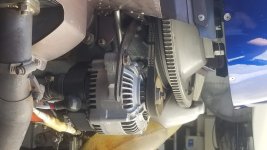
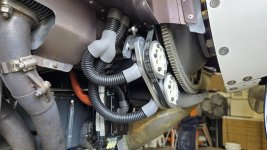
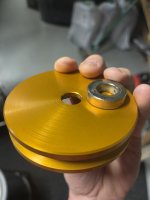
I never really liked the fit of the wider belt into the 3/8" flywheel groove either, but it works fine that way. Yeah, the alternator pulleys are sized for the wider belt, and so is the one I made 20 years ago for my Denso Civic unit. And later when I built the Monkworkz Twin-Rotor, I used the same wider groove width. Click on the photos for full-size view.Yeah I think you are right on the pulley. I will have to check my steel spacer to confirm.
That is interesting you were able to measure the belt first hand. All the Lycoming documentation I have seen list it as 0.380" width including the engine parts manuals. I ended up ordering a 3VX belt of the right length for my engine and it fits the ring gear pulley perfectly (3/8" wide).
I think this thread perfectly encapsulates the point of my article and how the Denso alternator and "hotrodding" parts in general on a kit plane fits into a much older mindset of builders. Anyone willing to spend $1200 on an alternator of course would have little interest in something like the Denso and that is completely fine. There's a similar trend with avionics, new engines, etc. My only point is that the choice of tinkering with a $50 alternator vs buying a new $1200 one is like apples vs. oranges. Remember that not all RVs are $250k fire breathing, IFR machines, and some RV4s and RV6s can be found for less than 60-70k, so the budget mindset can still exist!
I finally got a pic of mine disassembled and it looks similar but my housing seems flatter. Comparing your STEP file to my stackup with the spacer, the belt centerline of my pulley is 3.5mm further out than your PP pulley.Show us your Denso with shaft, please, and include the original application. I happen to have some PP units here as well as an original Denso off of an '87 Civic. Both have identical shafts, as far as the machined dia section. And that PP pulley fits my Denso fine too.
And as to belts; the Lycoming-branded belt which I have is ~7/16" wide and sits proud of the flywheel groove by at least 1/16" inch. I'll grab a photo of my old Lyc belt I have in the hangar later.
View attachment 98444
Attachments
Kind of - sort of...Do you have the serial numbers for the ones you have disassembled?
Ranges/Generations H-Qxxxxxx, H-Rxxxxxx, H-Sxxxxxx. I don't want to publish exact numbers due to privacy concerns.
Rdog420
Well Known Member
This I do know. Hartzell products will have and H-(letter - year code) -Kind of - sort of...
Ranges/Generations H-Qxxxxxx, H-Rxxxxxx, H-Sxxxxxx. I don't want to publish exact numbers due to privacy concerns.
Z = 2025
Y = 2024
X = 2023
and backwards from there
The website is down, but he can be reached at 512-522-1406 text or [email protected]There's a guy local to me that will print up a shroud for a 1" blast tube and fits the 106mm O.D. Plane Power -- I'm using one, works great.
View attachment 88608
I just had to use a slightly longer screw on one of the back covers, and install a couple of #6 screws to mate the "apron" to the side of the regulator cover.
He can be reached at atx3dsolutions.com
Cheers!

I know this post is about 9 months old, but…Maybe I’m not as knowledgeable about this subject but I don’t understand why anyone would bother with a Plane Power alternator. One post said “I'm expecting my PP to fail at some point ”. If that’s the case why do you even have one. I put a B&C alternator in my RV-3, RV-4 and now in my RV-8 and never had a lick of trouble with any of them. Seems like the alternator problems addressed on this forum always seem to be related to the Plane Power brand. Neither brands are cheap and maybe I’m missing something but the B&C alternator is $650-850 depending on the model and the PP alternators start at $1200. I respect the dissection and research some are conducting to find the problems but if you just buy a B&C you won’t have to bother and you can just go fly instead.
I just priced out a 60A B&C alternator. Once I included the mounting bracket and voltage regulator, it was $1,190.
Where are these $650-850 B&C alternators you speak of? I’ll take some of that!
Rdog420
Well Known Member
99-1012 plane power is 650$ on air power and QAA…. But $3092 on spruce…. Which make no sense

The 99-1012 (or ALT-5020T) is just the unit. No installation brackets, harness, nuts, bolts...99-1012 plane power is 650$ on air power and QAA…. But $3092 on spruce…. Which make no sense
Rdog420
Well Known Member
I know this post is about 9 months old, but…
I just priced out a 60A B&C alternator. Once I included the mounting bracket and voltage regulator, it was $1,190.
Where are these $650-850 B&C alternators you speak of? I’ll take some of that!
Looks like the whole kit is $759…. And on spruce it’s $1685….. so it’s cheaper to buy another kit vs a replacement alternator on spruce….The 99-1012 (or ALT-5020T) is just the unit. No installation brackets, harness, nuts, bolts...
Okay-Looks like the whole kit is $759…. And on spruce it’s $1685….. so it’s cheaper to buy another kit vs a replacement alternator on spruce….
But I was asking about where to find $650-850 B & C alternators.
Not Plane Power.
Okay-
But I was asking about where to find $650-850 B & C alternators.

SF601 SilverFlite Alternator, 60 Amps (Homebuilt) - B&C Specialty Products
Straightforward installation meets ample output to make the SilverFlite SF601 a tremendous value. Rated at 60A output @ cruise RPM, the SF601 features built-in regulation and our exclusive Dynamic Over-Voltage Protection, combined in a space-saving, lightweight frame. As with every belt-drive...
 bandc.com
Excellent- thanks!SF601 SilverFlite Alternator, 60 Amps (Homebuilt) - B&C Specialty Products
Straightforward installation meets ample output to make the SilverFlite SF601 a tremendous value. Rated at 60A output @ cruise RPM, the SF601 features built-in regulation and our exclusive Dynamic Over-Voltage Protection, combined in a space-saving, lightweight frame. As with every belt-drive...

Call these guys:Excellent- thanks!


RC62
Member
I just replaced my failed Plane Power with the B&C SF601. Excellent service, shipped up to me very quickly and the whole kit was an easy install with no surprises. So far so good. It cost $650 which is less than half what a plane power costs and I didn’t have to send a core back.Excellent- thanks!
I'm six months on the B&C silverflite dropped in after two failed PP ones; it works greatI just replaced my failed Plane Power with the B&C SF601. Excellent service, shipped up to me very quickly and the whole kit was an easy install with no surprises. So far so good. It cost $650 which is less than half what a plane power costs and I didn’t have to send a core back.
“We’ll see” - Zen Master; Charlie Wilson’s WarI'm six months on the B&C silverflite dropped in after two failed PP ones; it works great
40 amps is all I need, what takes 60 amps? My Denso 40 amps been working great for ten years, $159. https://www.ase-supply.com/product_p/nd-021080-0760.htmExcellent- thanks!
.

I'll post this question in here as I strongly believe the problem I'm about to describe is related to my Plane Power 60A.
I've owned my RV-8 for about 3 years now (purchased from the 3rd owner). About 2 years ago, I started to get a lot more noise in my CHT #3 and EGT #1 indications. I assumed this noise was related to the probes going bad but now strongly suspect it is related to the alternator. My engine monitor is an AFS 4500s which uses ungrounded probes. Here's an example:
View attachment 92473
This airplane had a reputation with the previous owners for eating alternators; I think the one installed was its 3rd Plane Power, and as a result, the guy I bought it from had procured a spare to fly around with. When I bought it, we found a spot where the starter cable was arcing against the engine case, so I'm sure that wasn't helping. Anyway, a few weeks ago, I started having intermittent system voltage drops. They were odd...my alternator warning lamp didn't come on but I was showing a slight discharge on the ammeter and the system voltage came down to approximately battery level (around 12.0V). If I pulled the field CB, the warning lamp came on and the discharge increased to 8-10A, about what I'd expect my in-flight load to be. I was about to go on a big cross country trip so when it happened the third time I gave in and installed my spare alternator. I think the old one may have been going bad due to the brushes on account of all the black schmutz coming out of it. On the other hand, the lack of voltage regulation it was displaying would seem to indicate it was a voltage regulator issue.
View attachment 92474
After replacing the alternator, my CHT #3 and EGT #1 noise reduced dramatically...for about 15 hours.
View attachment 92475
During my most recent 3 flights, the previous large amount of signal noise has returned.
Questions for the crowd:
1. How would the PP alternator cause this noise? The oscillations are on the scale of seconds long, so I would have thought any noise from rectification would be too fast for my engine monitor to see. It also seems to not affect, or have much less effect, on EGT #3 and CHT #1, despite all those probes being near the alternator and wire. All the probe wires also run together in the same conduit through the firewall with the alternator wire.
2. Could this be an indication that the regulator in my new alternator is already going bad?
Thanks!
I'll post this question in here as I strongly believe the problem I'm about to describe is related to my Plane Power 60A.
I've owned my RV-8 for about 3 years now (purchased from the 3rd owner). About 2 years ago, I started to get a lot more noise in my CHT #3 and EGT #1 indications. I assumed this noise was related to the probes going bad but now strongly suspect it is related to the alternator. My engine monitor is an AFS 4500s which uses ungrounded probes. Here's an example:
View attachment 92473
This airplane had a reputation with the previous owners for eating alternators; I think the one installed was its 3rd Plane Power, and as a result, the guy I bought it from had procured a spare to fly around with. When I bought it, we found a spot where the starter cable was arcing against the engine case, so I'm sure that wasn't helping. Anyway, a few weeks ago, I started having intermittent system voltage drops. They were odd...my alternator warning lamp didn't come on but I was showing a slight discharge on the ammeter and the system voltage came down to approximately battery level (around 12.0V). If I pulled the field CB, the warning lamp came on and the discharge increased to 8-10A, about what I'd expect my in-flight load to be. I was about to go on a big cross country trip so when it happened the third time I gave in and installed my spare alternator. I think the old one may have been going bad due to the brushes on account of all the black schmutz coming out of it. On the other hand, the lack of voltage regulation it was displaying would seem to indicate it was a voltage regulator issue.
View attachment 92474
After replacing the alternator, my CHT #3 and EGT #1 noise reduced dramatically...for about 15 hours.
View attachment 92475
During my most recent 3 flights, the previous large amount of signal noise has returned.
Questions for the crowd:
1. How would the PP alternator cause this noise? The oscillations are on the scale of seconds long, so I would have thought any noise from rectification would be too fast for my engine monitor to see. It also seems to not affect, or have much less effect, on EGT #3 and CHT #1, despite all those probes being near the alternator and wire. All the probe wires also run together in the same conduit through the firewall with the alternator wire.
2. Could this be an indication that the regulator in my new alternator is already going bad?
Thanks!
Crash'nF16:
I am having t he exact same issue on my IO-390 with PP alternator. Were you ever able to isolate the cause of your "Noise"?
My #1 and #3 CHTs oscillate in synch +/- 30 degrees. The issue started in 2024, being very minor, but has increased over time. I have checked the wiring, crimps and grounds, and found nothing. I just now found your post, and am amazed at the similarity. Why are the EGTs, routed in the same locale, not equally affected?
Thank you, in advance, for your feedback!
Greg Novotny
GigAir
RV-14a N14ZP
Gig Harbor, WA KTIW
This is a long thread, but I believe this post showed that there was a catastrophe issue with one of Crash's alternators:I am having t he exact same issue on my IO-390 with PP alternator. Were you ever able to isolate the cause of your "Noise"?
Thoughts on the Plane Power AL12-EI60
Yeah they all go through the firewall at the same spot. #1 and #3 spend more time with the B lead wire since the pass through is on the bottom left of the firewall (from the pilot's perspective). But it's still odd that #1 CHT and #3 EGT don't have the noise since they have the same distance on...
vansairforce.net

Put me in the category of another unhappy PP user. The one on the airplane when I bought it in 2015 worked fine until a couple of years ago when it started giving me problems, so I replaced it with a new PP. Similar sounding issues to others....voltage drops, amperage droops into the negative with a slow recovery, etc.
I put up with it for a while and as my warranty was about to expire, called PP and they sent me out a new regulator and set of brushes, which were easy to install, but didn't help a lick. Same problem.
I'm not beating my head against the wall any more for this manufacturer and have my new B&C SF601 in hand and will be installing it end of month when doing the condition inspection.
For those trailblazers who have already done this exact swap out, my question to you is, can I use the existing drive belt that drove the PP alternator or will I have to pull the prop and put on a different belt?
I just replaced the existing belt last year when I had to pull the prop for a front crank seal leak and had an IRAN done on the Hartzell prop since it was off...and I wouldn't look forward to doing that again, so if I can avoid it I'd like to.
Cheers,
Rob
I put up with it for a while and as my warranty was about to expire, called PP and they sent me out a new regulator and set of brushes, which were easy to install, but didn't help a lick. Same problem.
I'm not beating my head against the wall any more for this manufacturer and have my new B&C SF601 in hand and will be installing it end of month when doing the condition inspection.
For those trailblazers who have already done this exact swap out, my question to you is, can I use the existing drive belt that drove the PP alternator or will I have to pull the prop and put on a different belt?
I just replaced the existing belt last year when I had to pull the prop for a front crank seal leak and had an IRAN done on the Hartzell prop since it was off...and I wouldn't look forward to doing that again, so if I can avoid it I'd like to.
Cheers,
Rob
.....and the root cause of the "issue" was???Put me in the category of another unhappy PP user. The one on the airplane when I bought it in 2015 worked fine until a couple of years ago when it started giving me problems, so I replaced it with a new PP. Similar sounding issues to others....voltage drops, amperage droops into the negative with a slow recovery, etc.
I put up with it for a while and as my warranty was about to expire, called PP and they sent me out a new regulator and set of brushes, which were easy to install, but didn't help a lick. Same problem.
I'm not beating my head against the wall any more for this manufacturer and have my new B&C SF601 in hand and will be installing it end of month when doing the condition inspection.
For those trailblazers who have already done this exact swap out, my question to you is, can I use the existing drive belt that drove the PP alternator or will I have to pull the prop and put on a different belt?
I just replaced the existing belt last year when I had to pull the prop for a front crank seal leak and had an IRAN done on the Hartzell prop since it was off...and I wouldn't look forward to doing that again, so if I can avoid it I'd like to.
Cheers,
Rob
-break-
The existing belt should work, unless - that's the reason for your issues.
So what is tha root cause.. not much in an alt.. vr and dieodes and bushes... if the new vr dint fix it and brushes no help either... you are making my brane start revvin up wondrin what it can b.... oh and a pic of the alt would help I would drop a Denso in like the one a few posts up.. they have a very good repitition
Thanks!!!.....and the root cause of the "issue" was???
-break-
The existing belt should work, unless - that's the reason for your issues.
I made sure when I put the new belt on that it was installed exactly per Lycoming Service Instruction 1129D, so I don't think it was the belt or how it was installed.
I never found a root cause. The unit looked clean when I disassembled it, with none of the debris/gunk found on the alternators pictured earlier in the thread. I have no idea why it's working the way it is; significantly, I came across a much older/earlier manufacture PP alternator a buddy was getting rid of (also swapping to B&C) which he thought was at least 15+ years old and when removed was doing fine, so I bought it off of him and hung it on the aircraft to see how it worked while I had the new alternator on the bench and did the regulator/brushes swapout.
It worked fine with none of the symptoms displayed like the much newer one was doing.
After my repairs, I took it off and put the newer one back one only to find that none of the work I had done on it had helped at all.
At that point, I mentally checked out of continuing futzing with the PP unit and trying to get it to work....and started looking for other options. I could have put the old one back on, but didn't know how much life that unit had left in it. When I discovered the B&C internally regulated unit with the same/similar form factor, I made the decision to swap out without a second thought.
Rob
Guess I would cjeck the diods, bet ya have a catawompus one and they arnt expensive, but I would still junk the peepee for a much better Denso.
If you do decide to do the Denso make sure you get a Real McCoy a real Denso not a junk copy, my truck just had a lifetime warranty Duralast alternator take crap after 7 months. think it was the voltage regulator it was just putting out weird voltage work sometimes and not work sometimes. peepower probably gets their parts from the same place that that Duralast lifetime warranty Place gets theirs
If you do decide to do the Denso make sure you get a Real McCoy a real Denso not a junk copy, my truck just had a lifetime warranty Duralast alternator take crap after 7 months. think it was the voltage regulator it was just putting out weird voltage work sometimes and not work sometimes. peepower probably gets their parts from the same place that that Duralast lifetime warranty Place gets theirs
Last edited:
Thanks!!!
I made sure when I put the new belt on that it was installed exactly per Lycoming Service Instruction 1129D, so I don't think it was the belt or how it was installed.
I never found a root cause. The unit looked clean when I disassembled it, with none of the debris/gunk found on the alternators pictured earlier in the thread. I have no idea why it's working the way it is; significantly, I came across a much older/earlier manufacture PP alternator a buddy was getting rid of (also swapping to B&C) which he thought was at least 15+ years old and when removed was doing fine, so I bought it off of him and hung it on the aircraft to see how it worked while I had the new alternator on the bench and did the regulator/brushes swapout.
It worked fine with none of the symptoms displayed like the much newer one was doing.
After my repairs, I took it off and put the newer one back one only to find that none of the work I had done on it had helped at all.
At that point, I mentally checked out of continuing futzing with the PP unit and trying to get it to work....and started looking for other options. I could have put the old one back on, but didn't know how much life that unit had left in it. When I discovered the B&C internally regulated unit with the same/similar form factor, I made the decision to swap out without a second thought.
Rob
I'd be happy to take a look at it after you swap for the SF601 -- or before...
KBAZ is a short flight from KGTU -- DM if you're interested.
I'd be happy to take a look at it after you swap for the SF601 -- or before...
KBAZ is a short flight from KGTU -- DM if you're interested.
I will take you up on that, as I would be happy to find out why it's doing what it is....however it will probably not happen until May as I have my 7 up at my place at Hicks (T67) outside of Ft Worth until I get the CI behind me on the 28th of this month. (Had to bring my old airport car I keep up there down home for a complete AC overhaul. Texans can't operate w/o AC!)
KGTU is always a great place to stop for cheap avgas and Taco Tuesday's work too....I used to get up there quite a bit when flying with the Falcon Flight bubbas but wife health issues have made me step away from that, unfortunately.
Rob
Crash'nF16
Member
Hi Greg,Crash'nF16:
I am having t he exact same issue on my IO-390 with PP alternator. Were you ever able to isolate the cause of your "Noise"?
My #1 and #3 CHTs oscillate in synch +/- 30 degrees. The issue started in 2024, being very minor, but has increased over time. I have checked the wiring, crimps and grounds, and found nothing. I just now found your post, and am amazed at the similarity. Why are the EGTs, routed in the same locale, not equally affected?
Thank you, in advance, for your feedback!
Greg Novotny
GigAir
RV-14a N14ZP
Gig Harbor, WA KTIW
What you describe does sound very similar to my situation, although it was my #1 EGT and #3 CHT that were getting most of the noise. EMI can be fickle; if proximity and length of wire run near the alternator and B lead were the sole drivers, I'd expect my #1 CHT to get the most noise but it was probably my most stable reading of the 8. I replaced both the #1 EGT and #3 CHT probes before isolating the alternator and had identical noise between the new and old probes.
As you probably saw in the graphs, I did get a marked uptick in noise on all the engine sensors just prior to complete alternator failure (x2). The first alternator (the one that I sent to @bjdecker after it more or less melted) produced a gradual rise in engine monitor noise over the course of more than a year. The 2nd alternator (the one that was "new" and came with my airplane (uninstalled) when I bought it in 2022) started producing a rise in engine monitor noise only 15 hours after I installed it last July. It then quit on me on a cross country 2 months later in September.
To Hartzell's credit: I sent it in and they honored the warranty. They even overnighted it since I was paying $150 a day to be in the FBO's hangar (it was monsooning and the "tie-downs" were buckets of sand they dragged out on the ramp so I didn't really have a choice). The rep told me the rear bearing slipped inside the housing and that was a known problem on the year 2020 and prior alternators (like this one). He did emphasize they were honoring the warranty because I provided detailed log entries, so that's yet another good reason to be thorough with documenting your maintenance actions. Given the somewhat ambiguous history of this alternator (5 years old when I installed it) and my inability to produce an invoice for it (it just came with the airplane, stuffed in the rear baggage area when I bought it), I think they would have been well within their rights to deny the claim. I realize HET's reliability doesn't have the best reputation on this board but I really can't speak highly enough of my customer service experience.
The alternator they sent me has been working great for the past 6 months and ~40 hours. I am back to (almost) no EMI on the engine sensors. However, the whole episode made me not want to rely on a single source of electricity in my all-electric-panel, IFR airplane, so I installed a Monkworkz over Christmas and have been very happy with it. When I run it instead of the PlanePower, my EGT's and CHT's just about completely smooth out. Also, there's a very faint whine in the intercom I can only hear on the ground with the PlanePower energized; that goes away when I'm running the Monkworkz.
I'm still not sure what specifically caused the EMI. Even though the first alternator shorted and failed catastrophically, I had that gradual uptick in EMI over the course of more than a year, well before the failure event. The 2nd one failed much more quickly, but still provided a "warning" of increased EMI prior to failure. I just wish I would have heeded it before getting stuck AOG.
I'd definitely recommend a Monkworkz if you have the space on the vacuum pad. I spent more on that AOG event between nights in the hangar and roundtrip airfare home than I did on the MZ-30.
Just to confirm, if you switch off your alternator / pull the field CB, does the noise on your CHT's go away?
Last edited:

watto6
I'm New Here
How is your experience with the SF601? My PP EI60 just failed and I like the idea of changing to B&C. One guy said “you have to modify the mount and it whines”. Any truth to those claims?Our PP EI60 recently failed after 10-years and 500hrs. Just ordered a B&C SF601 and look forward to installing after all I'm hearing about PP failures. The cost for a new PP is unbelievable!
