Van's Air Force

The definitive Van's Aircraft support community! Buying, building or flying an RV? Join our exclusive family of mentors and enthusiasts!

Thoughts on the Plane Power AL12-EI60

bjdecker

Well Known Member
Ambassador
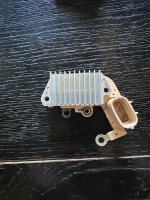
I've been doing a lot of work (testing/experimenting, goofing off) with various alternators of late, and I thought I would share some observations about the ubiquitous Plane Power alternator; Ubiquitous insomuch as it's the alternator that comes with the FWF kit from Van's (ES ALTERNATOR DELUXE). This is the 99-1012 model, circa 2015 and later.
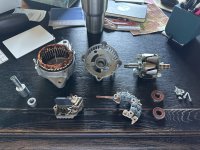
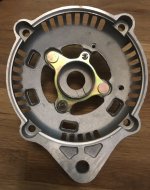
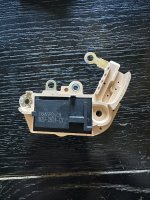
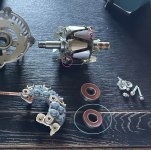
IMG_7099.jpg

The basis of the unit is the Unipoint ALT-5020. All of the internals (regulator, rectifier, stator, rotor/armature) are Unipoint implementations of Nippondenso parts & designs as follows:

1. The Drive End (DE) brackets and Slip Ring End (SRE) brackets contain NTN bearings (6202LU and 6002LU respectively).
2. DE bracket is a Unipoint casting/machined to clone the Nippondenso unit 101211-2130, 101211-3030 DE bracket.
3. SRE bracket is also a Unipoint casting/machined to clone the Nippondenso unit 101211-2950, 101211-3720 SRE bracket.

* The combination of 2&3 allows the unit to be "re-clocked" to position the B+ terminal, 3 pin connector to a more desirable location.

4. The regulator begins life as a Unipoint YR-662, modified to a -6621 with an overvoltage crowbar circuit on the field circuit. The equivalent regulator is a Nippondenso part 12600-1630 or WAI/Transpo IN257 (w/out overvoltage mod.).
5. The rectifier is a Unipoint REC-644, comprised of 8 - 40/50A diodes. Equivalent to Nippondenso part 21580-3130, -3340 or WAI/Transpo INR718P, INR737, INR724.
6. The brush set is Unipoint BH-634. Equivalent to Nippondenso part 021620-2010 and a dozen others.
7. The stator is the Unipoint equivalent of the Nippondenso part 021100-2860, 50A.
8. The rotor is a bit of a mystery - the nearest Nippondenso equivalent part is 011200-5420, *BUT* the end fans are pitched differently - and I cannot find it in the various catalogs I have access to (ASPL, ElectroLog, Lester).

My impressions -- this isn't a bad unit, or poor quality, or echoing the xenophobic-manosphere -- "cheap Chinese [excrement]...". From an engineering point of view, this alternator suffers from a couple of failure modes that are attributable to the usage model, and I think they can be easily mitigated:

1. Failure of the wiring at the 3 pin plug. The Hartzell provided plug is incomplete; it lacks the strain-relief seals and the pin spacing alignment shim. These parts are available from here:

Sumitomo TS 3 Way Alternator Plug Production Kit, (Toyota # 90980-11349)
https://www.bmotorsports.com/shop/product_info.php/products_id/1704

2. Broken Stator wires under the screw terminals, or inside the DE. I believe this is vibration related - the wire has enough mass and is the right length to resonate at "airplane" frequencies. Copper is very ductile, but it has its limits. Adding a small blob of neutral cure RTV (GE Silicone II, etc.) around the wire penetration points (4) in the SRE should help with this.

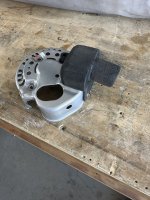
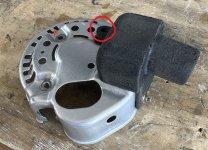
3. Failed Regulator. I believe the 6621 is the weakest link, and the crowbar modification doesn't help with reliability (ed: this is why we don't ship motherboards with blue wires, dead bugged parts, and Kapton tape any more...or not a whole lot...). Since heat is the enemy, add a blast tube to bring some of the inlet ram air on to the backside of the SRE. Also, consider substituting a WAI/Transpo IN257 regulator and install a DIY crowbar module at the Alt - Field switch.
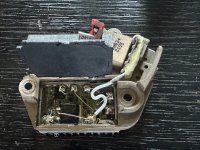
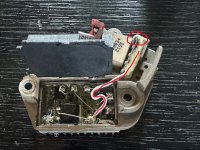
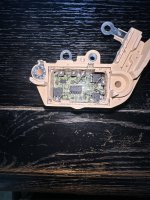
IMG_7100.jpg

4. Failed Diode(s) in Rectifier. Again, heat is an enemy of semiconductors - bring some fresh air on to the back of the alternator. And for those of you worried about water incursion - forget it; the electronics are potted in various materials, resistant to IP67 or beyond.
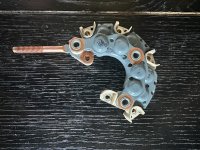
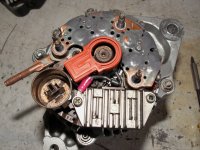
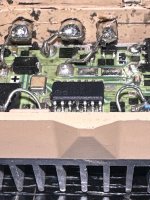
IMG_7101.jpg

So, I think I'm done with this obsession for now...My wife can take back her desk and I'm going to go flying...
 
My failure was at the rear bearing. To PP’s credit, they replaced it even though it was past warranty (calendar).
 
My failure was at the rear bearing. To PP’s credit, they replaced it even though it was past warranty (calendar).
I forgot to mention that - I know @DanH did a thorough autopsy, I just don't remember the root cause(s) -- did the DE bearing retaining ring shift and cause the SRE bearing to spin in the bracket and eat up the brushes, or did the SRE casting swell and allow the bearing to shift.? Or was it the highly energetic particle from deep space ;)
 
My AL12-EI60 failed last year. Plane Power customer service sent a replacement regulator, speculating that was the issue. But, no joy. I could see soot in the stator windings through the alternator housing. I bought another alternator. PP said it was the exact replacement, even though the test data showed it was a 70 amp unit and I routinely see 70 amps for a few seconds after engine start.
 
I forgot to mention that - I know @DanH did a thorough autopsy,

Bil Lane, not me.

I just don't remember the root cause(s) -- did the DE bearing retaining ring shift and cause the SRE bearing to spin in the bracket and eat up the brushes, or did the SRE casting swell and allow the bearing to shift.? Or was it the highly energetic particle from deep space ;)

Enlarged bearing cavity in the SRE casting, exact cause unknown. FWIW, I had a high level Hartzell guy in front of my EAA chapter last Thursday evening, and he said it was fixed circa 2020, but didn't say how. I'll see what I can do.
 
A couple of additional comments: The collection of stator, rotor, rectifier, regulator suggests that this is barely a 60A capable unit. However - looking at the run-in datasheet for my particular unit, I see that they spun it up to 6000 RPM and it was producing ~80A @ 14.5V.

The pulley ratio works out to 3.54:1 (9.75" and 2.75") -- An engine turning at 2500RPM is spinning the alternator at 8863RPM (Wow!).
 
Here is an aftermarket 70A housing that shows that the stock aluminum rear bearing pocket has been replaced with a steel insert. I suspect this was done to address the bearing wallowing issue.
 

Attachments

  • IMG_1865.jpg
    IMG_1865.jpg
    136.7 KB · Views: 96
BJ
Just curious, is there is a aftermarket replacement for the PP 99-1012 to purchase that requires no modification or parts swap that will be a direct swap? Can you install the Unipoint ALT 5020 into the original PP 99-1020 mount and hook up the wiring?
 
Here is an aftermarket 70A housing that shows that the stock aluminum rear bearing pocket has been replaced with a steel insert. I suspect this was done to address the bearing wallowing issue.
That's a different part entirely -- but thanks for the picture.
 
BJ
Just curious, is there is a aftermarket replacement for the PP 99-1012 to purchase that requires no modification or parts swap that will be a direct swap? Can you install the Unipoint ALT 5020 into the original PP 99-1020 mount and hook up the wiring?

Not that I've found, and the ALT-5020 is different in the areas that I identified in the original post.

However, I believe the Nippondenso 101211-0070 (13499) will fit but require some shims, and it won't have the little workaround for overvoltage protection, and the bolts are metric as well.

I have one on order, and it should be here Wednesday/Thursday...oh and it's a new build from WAI/Transpo ~$112.
 
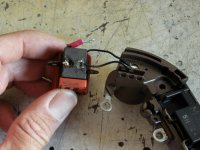
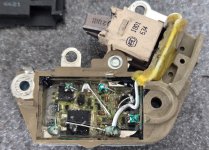
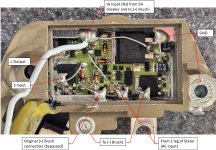
One detail about the modified regulator: it's not just an added crowbar circuit. The main difference is that one of the brushes now has a different power source. That's what that white wire is all about. Instead of powering that brush from the rectifier bridge +12V side, it now gets its power from the 'IG', or 'Field' input, so that it can be positively shut off via the 5A breaker. See pic below.

I made that same mod 20 years ago on the '86 Honda Civic alternator I used to use. At the time, I wrote a rudimentary how-to which Bob Nuckolls posted on his site.

Below Brian's pic is my brush holder with the same mod. I connected it to the backside of the connector terminal, but same circuit-wise as the PP unit. The second wire is to a diode to protect the regulator when/if the 5A Alt breaker is opened while operating.

1744693817053.jpeg

1744694207050.jpeg
1744694641557.jpeg
 
Last edited:
One detail about the modified regulator: it's not just an added crowbar circuit. The main difference is that one of the brushes now has a different power source. That's what that white wire is all about. Instead of powering that brush from the internal regulator circuit, it now gets its power from the 'Field' input, so that it can be positively shut off via the 5A breaker. See pic below.


View attachment 85313

Is the crowbar already there as an OEM circuit, and the wire added specifically for external field control? I guess I'm what is going on with all those other soldered connections. Is there a diagram available?

As an aside, I'll bet I'm not the only one thinking we might expect more attractive solder work in a $1300 alternator...
 
I've been doing a lot of work (testing/experimenting, goofing off) with various alternators of late, and I thought I would share some observations about the ubiquitous Plane Power alternator; Ubiquitous insomuch as it's the alternator that comes with the FWF kit from Van's (ES ALTERNATOR DELUXE). This is the 99-1012 model, circa 2015 and later.

View attachment 85148

The basis of the unit is the Unipoint ALT-5020. All of the internals (regulator, rectifier, stator, rotor/armature) are Unipoint implementations of Nippondenso parts & designs as follows:

1. The Drive End (DE) brackets and Slip Ring End (SRE) brackets contain NTN bearings (6202LU and 6002LU respectively).
2. DE bracket is a Unipoint casting/machined to clone the Nippondenso unit 101211-2130, 101211-3030 DE bracket.
3. SRE bracket is also a Unipoint casting/machined to clone the Nippondenso unit 101211-2950, 101211-3720 SRE bracket.

* The combination of 2&3 allows the unit to be "re-clocked" to position the B+ terminal, 3 pin connector to a more desirable location.

4. The regulator begins life as a Unipoint YR-662, modified to a -6621 with an overvoltage crowbar circuit on the field circuit. The equivalent regulator is a Nippondenso part 12600-1630 or WAI/Transpo IN257 (w/out overvoltage mod.).
5. The rectifier is a Unipoint REC-644, comprised of 8 - 40/50A diodes. Equivalent to Nippondenso part 21580-3130, -3340 or WAI/Transpo INR718P, INR737, INR724.
6. The brush set is Unipoint BH-634. Equivalent to Nippondenso part 021620-2010 and a dozen others.
7. The stator is the Unipoint equivalent of the Nippondenso part 021100-2860, 50A.
8. The rotor is a bit of a mystery - the nearest Nippondenso equivalent part is 011200-5420, *BUT* the end fans are pitched differently - and I cannot find it in the various catalogs I have access to (ASPL, ElectroLog, Lester).

My impressions -- this isn't a bad unit, or poor quality, or echoing the xenophobic-manosphere -- "cheap Chinese [excrement]...". From an engineering point of view, this alternator suffers from a couple of failure modes that are attributable to the usage model, and I think they can be easily mitigated:

1. Failure of the wiring at the 3 pin plug. The Hartzell provided plug is incomplete; it lacks the strain-relief seals and the pin spacing alignment shim. These parts are available from here:

Sumitomo TS 3 Way Alternator Plug Production Kit, (Toyota # 90980-11349)
https://www.bmotorsports.com/shop/product_info.php/products_id/1704

2. Broken Stator wires under the screw terminals, or inside the DE. I believe this is vibration related - the wire has enough mass and is the right length to resonate at "airplane" frequencies. Copper is very ductile, but it has its limits. Adding a small blob of neutral cure RTV (GE Silicone II, etc.) around the wire penetration points (4) in the SRE should help with this.

3. Failed Regulator. I believe the 6621 is the weakest link, and the crowbar modification doesn't help with reliability (ed: this is why we don't ship motherboards with blue wires, dead bugged parts, and Kapton tape any more...or not a whole lot...). Since heat is the enemy, add a blast tube to bring some of the inlet ram air on to the backside of the SRE. Also, consider substituting a WAI/Transpo IN257 regulator and install a DIY crowbar module at the Alt - Field switch.

View attachment 85149

4. Failed Diode(s) in Rectifier. Again, heat is an enemy of semiconductors - bring some fresh air on to the back of the alternator. And for those of you worried about water incursion - forget it; the electronics are potted in various materials, resistant to IP67 or beyond.

View attachment 85150

So, I think I'm done with this obsession for now...My wife can take back her desk and I'm going to go flying...
This is a great autopsy of PP alternator. Now if you can do the same with Denso alternator "refurbished" by Auto zone...................you could put to rest all speculations.
 
Here is an aftermarket 70A housing that shows that the stock aluminum rear bearing pocket has been replaced with a steel insert. I suspect this was done to address the bearing wallowing issue.
Is that for the same stator as the EI60?

The bearing issue is fundamental to any two bearing arrangement. That is ONE of the four races must be allowed some axial float, otherwise differential expansion of the rotor and housing can overload the bearings axially. The outer race in the SRE if the EI60 is the one that should move with temperature. The issue is expansion of the bearing vs the housing. at room temp a light press fit will allow the bearing to fall out at 120F. The lube and seal drag play a role in reducing torque on the bearing when the outer race is not tightly held, i.e. when hot. Rotor balance was said by PP to be the root cause of the rash of failures years ago, but several detail dimensional changes also had to be made at the same time. Removal of the plastic ring on the bearings stopped rotation. W/O the ring the race was subject to orbit with unbalance and that is clearly fatal to the housing. The delicate dance between clearances, balance and temperature is known by Denso but apparently a secret to the rest of us. Unipoint seems to have a quality challenge, hopefully resolved.

Soapbox: We, GA and Experimental need a real database of all failures (with serial numbers) collected to generate good reliability data for our field population. EAA would be the best org to do this, but since the highest volume of production units is Vans is in the best position. That is what real OEM's do to protect customers from supplier quality issues. Back on the ground.

Brian, this is the best and most complete assessment of the EI60 to date - - you are to be commended for finding all the component part numbers, I will add to my library!! The SRE housing is the ND part number I could not ever find. The rotor, stator, brushes/housing, diode bridge, bearings, and front housing were all known and available but not the SRE. I must have spent 100 hrs over the years and never found the original numbers - -WELL DONE !!
 
8. The rotor is a bit of a mystery - the nearest Nippondenso equivalent part is 011200-5420, *BUT* the end fans are pitched differently - and I cannot find it in the various catalogs I have access to (ASPL, ElectroLog, Lester).
Brian, I looked a many of these parts by various manufacturers and it is not conclusive that the direction of the attached fan blades are that important. Ambient temp certainly is.

1. Failure of the wiring at the 3 pin plug. The Hartzell provided plug is incomplete; it lacks the strain-relief seals and the pin spacing alignment shim. These parts are available from here:

Sumitomo TS 3 Way Alternator Plug Production Kit, (Toyota # 90980-11349)
https://www.bmotorsports.com/shop/product_info.php/products_id/1704

Brian, I might add that these plugs dont fail on cars or on Perkins diesel engines. My theory is that changing the wires to Tefzel made them so stiff that they convey the vibratory and airflow induced motion more directly to the terminals. I potted mine before finding the plugs.

Brian, Again, outstanding findings!!! See comments above.
 
This is a great autopsy of PP alternator. Now if you can do the same with Denso alternator "refurbished" by Auto zone...................you could put to rest all speculations.
@flysrv10 I have a new WAI/Transpo unit on the way, I guess I can shuffle down to AutoZone and buy another Duralast something. Will do a more gentle tear down and post findings.

-break-

@hgerhardt , @DanH

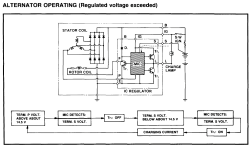
I've been searching for a schematic to the Denso regulator and I think I found one in an Toyota Service manual -- except the regulator IC is labeled "MIC", so I can't cross reference it to a commercial discrete component.

To Dan's point, I believe the whole Denso IRF series does have certain protections and features built in (LRC, Soft Start, OV, etc.), but precious little documentation is available.

@hgerhardt - Kudos on the workaround and article, I knew about the modification prior to this. Aside from connecting the brush to the drain on the BAF (Big @ss FET), what's driving the gate and source? Also, the diode modification is missing or it doesn't work correctly in the PP alternators. Adding and removing current to the alternator field causes an arc; if it worked, the collapsing field current would dissipate through the diode+load and not the opening switch (Alt-Field).

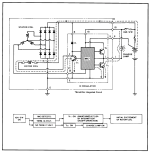
Edit: Found the schematic - attached for reference. Anyone care to hazard a guess as to what the MIC is?

Screenshot 2025-04-15 at 9.16.43 AM.png
 
Last edited:
Is that for the same stator as the EI60?

The bearing issue is fundamental to any two bearing arrangement. That is ONE of the four races must be allowed some axial float, otherwise differential expansion of the rotor and housing can overload the bearings axially. The outer race in the SRE if the EI60 is the one that should move with temperature. The issue is expansion of the bearing vs the housing. at room temp a light press fit will allow the bearing to fall out at 120F. The lube and seal drag play a role in reducing torque on the bearing when the outer race is not tightly held, i.e. when hot. Rotor balance was said by PP to be the root cause of the rash of failures years ago, but several detail dimensional changes also had to be made at the same time. Removal of the plastic ring on the bearings stopped rotation. W/O the ring the race was subject to orbit with unbalance and that is clearly fatal to the housing. The delicate dance between clearances, balance and temperature is known by Denso but apparently a secret to the rest of us. Unipoint seems to have a quality challenge, hopefully resolved.

Soapbox: We, GA and Experimental need a real database of all failures (with serial numbers) collected to generate good reliability data for our field population. EAA would be the best org to do this, but since the highest volume of production units is Vans is in the best position. That is what real OEM's do to protect customers from supplier quality issues. Back on the ground.

Brian, this is the best and most complete assessment of the EI60 to date - - you are to be commended for finding all the component part numbers, I will add to my library!! The SRE housing is the ND part number I could not ever find. The rotor, stator, brushes/housing, diode bridge, bearings, and front housing were all known and available but not the SRE. I must have spent 100 hrs over the years and never found the original numbers - -WELL DONE !!
Thanks Bill!

I forgot to mention this; the bearing in the SRE was held in with some kind of adhesive -- think red loktite, or similar cyanoacrylate. The cavity is also machined very close tolerance-wise -- .0001 or less. Even after I beat it out of the SRE with a socket/hammer, I had to beat it back into place. It's not a "drop in" by any stretch.
 
Is the crowbar already there as an OEM circuit, and the wire added specifically for external field control? I guess I'm what is going on with all those other soldered connections. Is there a diagram available?

As an aside, I'll bet I'm not the only one thinking we might expect more attractive solder work in a $1300 alternator...
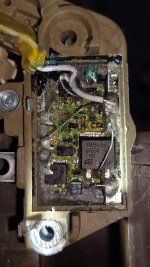
Looking at the regulator more closely, I don't see a crowbar Edit: Yes, there is indeed a crowbar. See post #24 below. I remember very early PP alternators with a crowbar glued onto the rear cover, but those went away after a while. I assumed they were internal after that. Apparently they just did away with the crowbar.

It appears to me that the only new soldering is the white wire. The rest of those jumper wires are Unipoint-factory installed as they're under the silicone coating.
Also, that 2-wire device in the black cover measures as a 2.2uF capacitor, but it's actually out of circuit with the PP brush wire mod. It goes to where the +12V brush originally connected to.

Those green marks appear to be from a Sharpie as QC checks?

1744738386295.jpeg

1744738604781.jpeg
 
Last edited:
To Dan's point, I believe the whole Denso IRF series does have certain protections and features built in (LRC, Soft Start, OV, etc.), but precious little documentation is available.

@hgerhardt - Kudos on the workaround and article, I knew about the modification prior to this. Aside from connecting the brush to the drain on the BAF (Big @ss FET), what's driving the gate and source? Also, the diode modification is missing or it doesn't work correctly in the PP alternators. Adding and removing current to the alternator field causes an arc; if it worked, the collapsing field current would dissipate through the diode+load and not the opening switch (Alt-Field).

Edit: Found the schematic - attached for reference. Anyone care to hazard a guess as to what the MIC is?
The +12V brush is now connected to the "IG" terminal so that the 5A breaker can remove power. Originally that brush was connected to the rectifier bridge +12V side, as you can see in your schematic. The VR just varies ground to the other brush to regulate voltage output.

PP didn't add a diode in their mod, but as you note, they should have. That was my idea and easy to implement in my own variation of a PP unit.

The MIC is the regulator: soft start, voltage sensing, etc. Since these alternators are clones of early-80's Denso's, back then they used transistors instead of FET's. At least that's what the Toyota schematic shows.
 
The +12V brush is now connected to the "IG" terminal so that the 5A breaker can remove power. Originally that brush was connected to the rectifier bridge +12V side, as you can see in your schematic. The VR just varies ground to the other brush to regulate voltage output.

PP didn't add a diode in their mod, but as you note, they should have. That was my idea and easy to implement in my own variation of a PP unit.

The MIC is the regulator: soft start, voltage sensing, etc. Since these alternators are clones of early-80's Denso's, back then they used transistors instead of FET's. At least that's what the Toyota schematic shows.
Good modification -- and as I just posted on another thread; we really should do something about the rotor field back EMF.

I can report with 100% certainty, that the OV Crowbar is alive and working -- I just have no idea where it is :(
 
.......I can report with 100% certainty, that the OV Crowbar is alive and working -- I just have no idea where it is :(
Yet another rabbit hole to explore! Sling's aircon can wait.

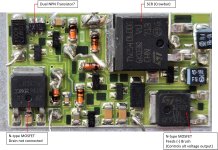
Yeah, there's an SCR, TN2540-600G-TR, which is connected to the +12V brush feed/IG terminal. That's the crowbar!

Of course, this brings up another thought: I suppose Unipoint is making these boards under contract for PP... there wouldn't be room on a generic regulator PCB to accommodate this SCR, and without the custom +12V brush feed, there wouldn't be any reason to have it there at all.

1744752219405.jpeg
 
Yet another rabbit hole to explore! Sling's aircon can wait.

Yeah, there's an SCR, TN2540-600G-TR, which is connected to the +12V brush feed/IG terminal. That's the crowbar!

Of course, this brings up another thought: I suppose Unipoint is making these boards under contract for PP... there wouldn't be room on a generic regulator PCB to accommodate this SCR, and without the custom +12V brush feed, there wouldn't be any reason to have it there at all.

View attachment 85352
Did you happen to catch the part number? YR-662x?
 
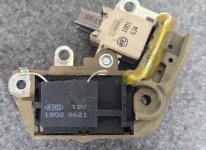
Just for posterity, did some characterizing of the PP regulator (which looks to be a custom part made by Unipoint to PP's specs). This is not just a modified existing automotive part. This is a part number 6621, as can be seen on this unopened regulator in post 18 above.

All in all, a pretty crude design. There's no 'MIC' here, just passive components. No soft start, no rotor power hold-off until the rotor starts spinning (like a 'normal' Denso would have, and which my old Honda Civic unit does have). No temperature compensation either, which most automotive units have: output voltage reduces with temp rise to avoid overcharging a hot underhood battery.

Edit: one correction: below caption says "original (+) brush connection bypassed". That's partially true; that wire to the PCB is still connected to the B+ output, just not to the brush (as a stock Denso would have).

1744927894993.jpeg
1744927916859.jpeg
 
Last edited:
Brian: excellent!
Regarding your Nippondenso 101211-0070 on order. You mention that it needs shims. I'd be very curious to know what you had to alter/modify/add to drop this in as a replacement on the aircraft. I also see that it is a 70A unit; I (and others probably) have a 60A fuse for the output I guess that would need changing too?

I'm expecting my PP to fail at some point and would like to see about something better without having to add an external voltage regulator to the plane.
 
Brian: excellent!
Regarding your Nippondenso 101211-0070 on order. You mention that it needs shims. I'd be very curious to know what you had to alter/modify/add to drop this in as a replacement on the aircraft. I also see that it is a 70A unit; I (and others probably) have a 60A fuse for the output I guess that would need changing too?

I'm expecting my PP to fail at some point and would like to see about something better without having to add an external voltage regulator to the plane.
I received the 101211-0070, and you are right, it's the 70 - 90A unit, in a bigger case (125mm OD) -- not going to fit.

However, I ordered the 101211-2130 / 3030 and it's the right size case, but the clocking is different for the B+ wire and plug and the tension arm is going to need to change, along with a shim (maybe). It'll be here later today. Unit arrived and as expected the B+ & plug are positioned at the 12 o'clock instead of the 3 o'clock. This shouldn't be a problem however. I'll check out the mounting bracket later.

As an aside, I too expect the PP regulator and diodes to fail so I ordered replacements from WAI -- they're drop in and better quality and feature set.

See WAI INR737 and IN257. (https://www.waiglobal.com/)
 
Last edited:
Good info - do those have the crowbar or would that need to be added?

I don't think so. And if I may wax philosophical, none of my cars have an OV module...I'm wondering why the push to have it in an airplane? Probably fixing some problem that there used to be in the "before times"
 
Just for posterity, did some characterizing of the PP regulator (which looks to be a custom part made by Unipoint to PP's specs). This is not just a modified existing automotive part. This is a part number 6621, as can be seen on this unopened regulator in post 18 above.

All in all, a pretty crude design. There's no 'MIC' here, just passive components. No soft start, no rotor power hold-off until the rotor starts spinning (like a 'normal' Denso would have, and which my old Honda Civic unit does have). No temperature compensation either, which most automotive units have: output voltage reduces with temp rise to avoid overcharging a hot underhood battery.

Edit: one correction: below caption says "original (+) brush connection bypassed". That's partially true; that wire to the PCB is still connected to the B+ output, just not to the brush (as a stock Denso would have).

View attachment 85518


The 1960's just called -- They want their voltage regulator back. :(
 
Note to you guys contemplating the WAI parts: You have two ways you can skin this cat; you can modify the WAI regulator to attach the custom (+) brush feed (easy enough to do). If desired, you could add a standalone crowbar by using the one Bob Nuckolls has (or had?) available, like I did with my Honda unit.

OR you can convert the PP alternator to emulate a standard Denso by changing out the regulator AND the brush holder (the (+) brush would be fed via the B+ terminal as a stock Denso).

Of course by doing the 2nd option, you'd lose absolute control to remove power from the rotor, nor could you retrofit a standalone crowbar (well, you could, but it wouldn't have complete control).
 
I've never really understood the need for a crowbar overvoltage protection "system". My hangar neighbor (who is from the "before times") 'knows' about the overvoltage condition, but can't explain the failure mode -- "It just did, deal with it..."

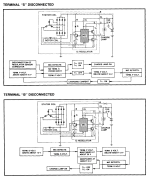
It seems to me that the "real" Denso regulator (schematic attached), is more than capable of controlling an overvoltage condition, by design...

Screenshot 2025-04-19 at 8.34.05 AM.png


Also noteworthy, they seem to be able to handle the condition of the Sense input and B+ leads disconnecting (Read: Lost sense and Load Dump)

Screenshot 2025-04-19 at 8.40.05 AM.png

Sooooo - Is the failure mode which induces an overvoltage condition still an issue to be dealt with by external means?
 
I received the 101211-0070, and you are right, it's the 70 - 90A unit, in a bigger case (125mm OD) -- not going to fit.

However, I ordered the 101211-2130 / 3030 and it's the right size case, but the clocking is different for the B+ wire and plug and the tension arm is going to need to change, along with a shim (maybe). It'll be here later today. Unit arrived and as expected the B+ & plug are positioned at the 12 o'clock instead of the 3 o'clock. This shouldn't be a problem however. I'll check out the mounting bracket later.

As an aside, I too expect the PP regulator and diodes to fail so I ordered replacements from WAI -- they're drop in and better quality and feature set.

See WAI INR737 and IN257. (https://www.waiglobal.com/)

@JDA_BTR

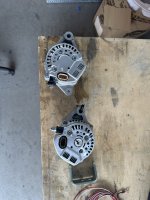
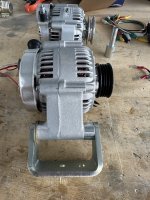
I received the 101211-2130 unit; a new construction WAI 13485N. Here are the "modifications" necessary to adapt to the Plane Power Installation.

1. Swap sheaves (pulleys); and you will need to add a shim at under the sheave. The WAI D.E. bracket has a little more "meat" on the front, so it interferes with the Plane Power sheave.

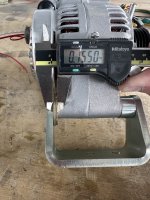
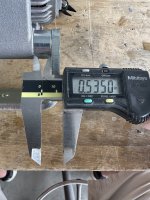
2. The "big" bracket on the alternator will reuse the spacer (99-1002) from the Power on the front side, it's about 0.53" wide, and a shim/spacer on the aft side of about 0.155" on the aft side. This will allow it to fix in Plane Power boss mount bracket. Given the need for a shim in #1 above, you will probably need to adjust these dimensions slightly, ~0.117" or so, depending upon the width of the shim.

3. I think it would be a good idea to rewire the plug to remove the S-IG jumper, install a dedicated Sense wire connecting back toward the battery buss (or to the B+ connection at the battery master). I am not 100% convinced that the ND regulator will handle a condition of disconnected Sense and disconnected IG at the same time; will find out after I swap out the regulator this week. :)

Here are some pics. Enjoy.

IMG_7115.jpg

B+ Lead and Plug clocked differently.

IMG_7120.jpg

Just a trial fit..

IMG_7121.jpg
IMG_7122.jpg

Above dimensions >>before<< I had the sheaves off and could measure the fit. It took an impact wrench to remove the nut holding the sheaves in place.

Happy Easter!
 
Is there a place to source the same sheave as the PP so it isn't a swapped item? Also, how did you hold the pulley/sheave while using the impact wrench on the nut? I presume you reinstalled it in the same way - with an impact wrench. Maybe some loctite too?
 
Is there a place to source the same sheave as the PP so it isn't a swapped item? Also, how did you hold the pulley/sheave while using the impact wrench on the nut? I presume you reinstalled it in the same way - with an impact wrench. Maybe some loctite too?

I haven't found one yet -- the I.D. is 15.00mm if that helps any. Timely article this month in KitPlanes -- ( https://www.kitplanes.com/denso-alternator-homemade-adaptation/ ) The author machined his own pulley and the dimensions are in there. Maybe he can make some for us :)

He did highlight a concern that we've all had/shared about the operating speed of these alternators, I think it would be better for everything if we grew the sheave an Inch -- get the RPM down ~9000 to ~6000.

I just put the alternator in the vise and held the sheave by hand. I'll use red locktite when I put these back to together.
 
Last edited:
Here are some 15mm shaft pulleys: https://store.alternatorparts.com/15mm-bore-alternator-pulleys.aspx

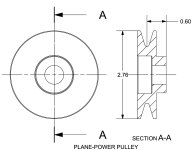
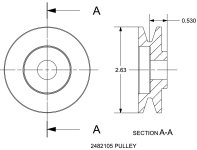
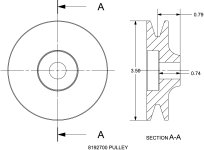
Two of them would work, dwgs below, as well as a reverse-engineered PP pulley to compare. The 8192700 pulley can be machined on a lathe to achieve the same offset as the 2482105 or PP pulley.

Keep in mind the pulley which I have on my home-brew Honda Civic unit is 2.50" dia and that alternator so far has gone 1000+ hours and 18 years without any bearing or brush distress. I recently had it apart for inspection. My thought on the alternator speed issue is the faster it goes, the better the cooling with the internal fans. And I have NO external cooling to the unit. This being a pre-2000 Honda unit, it of course has CCW fans, as desired for Lycoming installations.

1745109375709.jpeg1745109410395.jpeg1745109439494.jpeg
 
.........I just put the alternator in the vise and held the sheave by hand. I'll use red loctite when I put these back to together.
No need for Loctite on that nut. You might have to heat it to remove if you did use it.

Holding the pulley by hand and a 1/2" drive impact is all you need. The nut has locking serrations on its face.
 
Would this bracket work: Steiner ABC-404
With that bracket no shim would be required and the 8192700 pulley would work
Did you have to change the jumper, or leave the plug as-is?
 
Would this bracket work: Steiner ABC-404
With that bracket no shim would be required and the 8192700 pulley would work
Did you have to change the jumper, or leave the plug as-is?
I really don't know -- buy it, try it :\

Part of my quest was to find a regulator that was pin/function compatible with the Plane Power / Unipoint YR6621 -- I didn't want to rewire the airplane. There are 3 that I've found; using the WAI/Transpo schema, they are:

IN240, (S-IG-L), ND OE 126000-2400
IN257, (S-IG-L), ND OE 126000-1630
IN259, (S-IG-L), ND OE 126000-1740 & 126000-3790 *

* This has some extra functionality that I'm not sure about...

There are dozens of additional regulators with the oval 3 pin plug -- facing different directions, for larger alternators (63mm instead of 57.5), different voltage set points, or the pin functions were different -- eg. STA/W/F instead of S, etc.

From there, I wanted similar external dimensions on the DE and SRE -- ~106mm o.d., the offset mounting points (1 and 6o'clock) and the B+ at 12 or 3 o'clock, and so forth...

Put all of that together, and the closest I found was the ND 101211-2130/3030 (WAI 13485N) -- it needs shims to work with the PP boss mount bracket, and a sheave with a shim (...or a shim with a sheave? :))
 
I've been doing a lot of work (testing/experimenting, goofing off) with various alternators of late, and I thought I would share some observations about the ubiquitous Plane Power alternator; Ubiquitous insomuch as it's the alternator that comes with the FWF kit from Van's (ES ALTERNATOR DELUXE). This is the 99-1012 model, circa 2015 and later.

View attachment 85148

The basis of the unit is the Unipoint ALT-5020. All of the internals (regulator, rectifier, stator, rotor/armature) are Unipoint implementations of Nippondenso parts & designs as follows:

1. The Drive End (DE) brackets and Slip Ring End (SRE) brackets contain NTN bearings (6202LU and 6002LU respectively).
2. DE bracket is a Unipoint casting/machined to clone the Nippondenso unit 101211-2130, 101211-3030 DE bracket.
3. SRE bracket is also a Unipoint casting/machined to clone the Nippondenso unit 101211-2950, 101211-3720 SRE bracket.

* The combination of 2&3 allows the unit to be "re-clocked" to position the B+ terminal, 3 pin connector to a more desirable location.

4. The regulator begins life as a Unipoint YR-662, modified to a -6621 with an overvoltage crowbar circuit on the field circuit. The equivalent regulator is a Nippondenso part 12600-1630 or WAI/Transpo IN257 (w/out overvoltage mod.).
5. The rectifier is a Unipoint REC-644, comprised of 8 - 40/50A diodes. Equivalent to Nippondenso part 21580-3130, -3340 or WAI/Transpo INR718P, INR737, INR724.
6. The brush set is Unipoint BH-634. Equivalent to Nippondenso part 021620-2010 and a dozen others.
7. The stator is the Unipoint equivalent of the Nippondenso part 021100-2860, 50A.
8. The rotor is a bit of a mystery - the nearest Nippondenso equivalent part is 011200-5420, *BUT* the end fans are pitched differently - and I cannot find it in the various catalogs I have access to (ASPL, ElectroLog, Lester).

My impressions -- this isn't a bad unit, or poor quality, or echoing the xenophobic-manosphere -- "cheap Chinese [excrement]...". From an engineering point of view, this alternator suffers from a couple of failure modes that are attributable to the usage model, and I think they can be easily mitigated:

1. Failure of the wiring at the 3 pin plug. The Hartzell provided plug is incomplete; it lacks the strain-relief seals and the pin spacing alignment shim. These parts are available from here:

Sumitomo TS 3 Way Alternator Plug Production Kit, (Toyota # 90980-11349)
https://www.bmotorsports.com/shop/product_info.php/products_id/1704

2. Broken Stator wires under the screw terminals, or inside the DE. I believe this is vibration related - the wire has enough mass and is the right length to resonate at "airplane" frequencies. Copper is very ductile, but it has its limits. Adding a small blob of neutral cure RTV (GE Silicone II, etc.) around the wire penetration points (4) in the SRE should help with this.

3. Failed Regulator. I believe the 6621 is the weakest link, and the crowbar modification doesn't help with reliability (ed: this is why we don't ship motherboards with blue wires, dead bugged parts, and Kapton tape any more...or not a whole lot...). Since heat is the enemy, add a blast tube to bring some of the inlet ram air on to the backside of the SRE. Also, consider substituting a WAI/Transpo IN257 regulator and install a DIY crowbar module at the Alt - Field switch.

View attachment 85149

4. Failed Diode(s) in Rectifier. Again, heat is an enemy of semiconductors - bring some fresh air on to the back of the alternator. And for those of you worried about water incursion - forget it; the electronics are potted in various materials, resistant to IP67 or beyond.

View attachment 85150

So, I think I'm done with this obsession for now...My wife can take back her desk and I'm going to go flying...
Soldering work in the regulator isn't very good.
 
I finally got around to dissecting an alternative regulator for the Plane Power AL12-EI60 -- Follows are the innards of the WAI INR257 (ND 126000-1630) regulator.

It is hugely different from the Unipoint YR-6621 that is used in the Plane Power AL12-EI60 alternator.

IMG_7374.jpg

57.5mm form factor. Aluminum heat sink. The typical connections; L to R -- Ground (underneath), Stator, Field, B+. Three pin plug code 3314 (or 312) w/ (S)ense, (Ig)nition, (L)amp.

IMG_7375.jpg

The dust cover does NOT have a capacitor in/under it like the Unipoint YR6621.

1746987696914.jpg

IMG_7379.JPG


Yes, that's a Microchip PIC16HV616 uController. ( Datasheet ).

PCB etch, device placement, soldering is all done by machine. Only "hand" operation is the soldering of the 7 wires to lead frame, which looks good.

Next up is to replace the regulator in my PP alternator with this one and run a few tests -- basic ops, Lamp, LRC, Over and Undervoltage operation and report back.
 
Spun Bearing / Wallowed Cavity Failure mode revisited...
So I didn't stop with the one Plane Power - I've disassembled half a dozen; and I think I have an understanding of the "spun bearing" or "opened rear case" failure mode and Hartzell's remediation steps. (Thanks @rocketbob for the unit)

History: Hartzell/Unipoint uses NTN bearings (good/great) -vs- generic "Guangzhou Ball Bearing and Frying Pan Factory #6" bearings. The NTN's are spec'd to 15K RPM (plenty of margin, even as fast as we spin them.). One of the reported failures has been the odd "creak" or spun bearing, wallowed out rear cavity - which leads to all kinds of nastiness - worn brushes, seized unit....

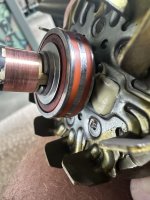
The older Plane Power units used an "Expansion Compensated" aft bearing - NTN EC-6002LU, 32mm x 15mm x 9mm (first picture).

IMG_7427.jpeg

The idea is that the elastomeric material has a faster/greater expansion rate than the surrounding steel, so this allows the rotor assembly to shift axially due to thermal effects, then stop the bearing from spinning in its mounting cavity as the plastic expands.

The newer Plane Power unit uses a solid surface bearing (6002LU) instead. (pic, circled in cyan)
Screenshot 2025-05-26 at 10.50.00 AM.png

Also noteworthy, the rotor prawls have material removed in a couple of locations (circled in Magenta); this was done to balance the rotor.

My suspicion is that the reduced contact area of the EC bearing when 'cold', and an unbalanced/poorly balanced rotor caused the bearing to work against (think run-out or wobble) the rear cavity - over time it opens up and the bearing will spin.

...Just a theory...

Ok, now I'm done -- and my wife can have the office desk, kitchen counter, and living room floors back --- what the heck am I going to do with all these alternators? :)
 
Last edited:
First, thanks for all the very interesting research and detail. Great work Brian.

My questions for you is - In light of what you've found during your various autopsies, what would be your recommendation for routine maintenance actions?

For example, would you recommend replacement of the bearings every 1,000 hours? Brushes every 500 hours? Do nothing and wait until it stops working? Anything else?
 
@planenutz Mike - I would just give it a good look every time I pulled the cowling off for an oil change or other semi-regular event; check the belt for excessive wear, check belt tension, wiggle the pulley, turn the pulley and listen for noises, look at the electrical connections, etc. When/if it fails, fix the failure...

The one thing that worries me about these internally regulated alternators (Plane Power and ND Clones writ large) is heat. The air temperature under the cowling at this area isn't excessive, but the alternator does have a really good view of the exhaust, and that infrared energy has to go somewhere. I advocate aiming a blast tube at the back of the unit - the diodes in the rectifier pack and the regulator will thank you for it.
 
Cheers for those thoughts, Brian.

I was looking at the exhaust during the last Annual and thought about making up a little heat shield to protect the alternator and the wiring from that radiant and infrared heat you refer to. Imight revisit that next time I have the cowls off. My blast tube could probably be better directed too by the sounds of things... I'm not sure it's aimed at the best location now I think about this. Another 5 minute job (!).

Thanks.
 
Cheers for those thoughts, Brian.

I was looking at the exhaust during the last Annual and thought about making up a little heat shield to protect the alternator and the wiring from that radiant and infrared heat you refer to. Imight revisit that next time I have the cowls off. My blast tube could probably be better directed too by the sounds of things... I'm not sure it's aimed at the best location now I think about this. Another 5 minute job (!).

Thanks.
There's a guy local to me that will print up a shroud for a 1" blast tube and fits the 106mm O.D. Plane Power -- I'm using one, works great.
IMG_6978.jpeg

I just had to use a slightly longer screw on one of the back covers, and install a couple of #6 screws to mate the "apron" to the side of the regulator cover.

He can be reached at atx3dsolutions.com

Cheers!
 
There's a guy local to me that will print up a shroud for a 1" blast tube and fits the 106mm O.D. Plane Power -- .......
Just be aware those 3 screws which hold the cover also clamp the rectifier bridge and make electrical contact. So if the screw over the plastic boss loses its preload from extruding under heat, you might have an issue with electrical conductivity of the bridge.

You could mitigate that risk by checking screw preload at annual/oil change times.

1748305549199.jpeg
 
Last edited:
Just be aware those 3 screws which hold the cover also clamp the rectifier bridge and make electrical contact. So if the screw over the plastic boss loses its preload from extruding under heat, you might have an issue with electrical conductivity of the bridge.

You could mitigate that risk by checking screw preload at annual/oil change times.

View attachment 88614
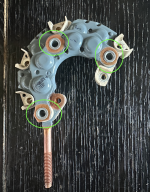
Only if the other two screws also lose their preload -- but, good point - keep 'em all tight.

Rectifier underlying ground contact points (in green). Screws go through the rear cover, penetrate these bosses and screw into the rear bracket. In the 70A version, these screws are replaced with studs and external nuts do the clamping.

Screenshot 2025-05-26 at 7.38.12 PM.png
 
Maybe I’m not as knowledgeable about this subject but I don’t understand why anyone would bother with a Plane Power alternator. One post said “I'm expecting my PP to fail at some point ”. If that’s the case why do you even have one. I put a B&C alternator in my RV-3, RV-4 and now in my RV-8 and never had a lick of trouble with any of them. Seems like the alternator problems addressed on this forum always seem to be related to the Plane Power brand. Neither brands are cheap and maybe I’m missing something but the B&C alternator is $650-850 depending on the model and the PP alternators start at $1200. I respect the dissection and research some are conducting to find the problems but if you just buy a B&C you won’t have to bother and you can just go fly instead.
 
Back
Top