Van's Air Force

The definitive Van's Aircraft support community! Buying, building or flying an RV? Join our exclusive family of mentors and enthusiasts!

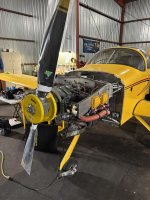
Test flying after re-installing overhauled prop

MacCool

Well Known Member
Patron
My A&P recently re-installed my overhauled MT-11 constant speed prop on my RV-9A (IO-320D1A). It came from the authorized MT repair facility static balanced only. When he finishes the Condition Inspection due this month, we'll ground test it then fly it. What do y'all recommend as the protocol for putting this prop back into service and testing it? I do have the 8130-3 airworthiness release.

F38A1FDD-2BAB-411C-86B3-7E8B592F3A77_1_105_c.jpeg
 
Last edited:
Make sure your low pitch stop is set properly. The shop will set it on the bench “per the book”, which may or may not be correct.
The shop that rebuilt my Hartzell put the wrong length set screw in mine and I couldn’t get it adjusted. Not sure how MT does the stop, but you will want to get it set.
Log the overhaul and note return to service.
As far as procedures, I treated it like any other maintenance item. A few short flights within reach of the airport, check operation, land, inspect. Unless MT specifically states it, there shouldn’t be any retorque requirements. Please verify.
 
When I do a field overhaul (engine) I tie the tail hook and do a full throttle test (watching CHT's).. if I've got a long enough runway (traffic permitting) full throttle test rolling (watching airspeed).. If just an overhauled prop I fly it
 
A quick search here will turn up threads discussing how people have damaged their tail sections and bent metal by doing this.
Yeh, I wouldn't do this with a tricycle gear. I'm told that the tail tiedown is designed mainly for vertical loads, not horizontal. Taildraggers might be different. Anyway, in my case for full throttle testing I'm just going to fly it and watch the tach as usual. If I'm make 2700 RPM in fine pitch and everything looks good for takeoff, I'll take off. Fortunately, we have a couple of nice 7000 foot runways here.
 
Last edited:
Recommend slowly coming up with the throttle on take off to avoid surging while the system purges all the air out.
Work on low pitch stop on subsequent flights.
 
Last edited:
This assumes that the prop governor was not touched or changed:
I recommend a through visual inspection of the prop, the area around the nose of the engine to be sure it's nice & dry & clean (so you can detect any prop seal leakage) which should be no different than before however I have seen prop to crank oil seal o-ring that leaked for various reason. I also like to see people do a blade track check about 10cm from the tips to validate correct assemble etc. Then, with cowling off - take plane outside & again check area for loose dirt, rocks, pebbles etc - never want those around a new prop OH - position so that you can do a NORMAL Mag check & prop cycle exercise (in to the wind is always a plus). Start & warm engine oil till 100F or so - then as Walt said bring RPM's up slowly to get to 1800 or wherever you do your normal check. Slowly bring back the blue prop lever and wait for a reaction - the governor will be generating enough added oil pressure to start filling the crank snout & the dry prop innards... this may take tens of seconds before prop starts reacting properly. Cycle the prop a few times noting expected vs actual responses.... then do a quick mag check - back to idle and shut down. Visual check all around front of engine for any signs of oil leakage or any out of normal situations. Verify crankcase oil level (prop & snout can hold more than you might think plus what you lost pulling prop & cleaning snout. Cowl-up for a test flight. If you have EFIS with engine monitoring (every second data points) then don't spend alot of time on your Tach... do a normal takeoff and stay in T-pattern for a circuit - get a feel for engine smoothness overall and note anything out of Non-standard for your plane. If after 1 circuit your comfortable with everything - then go fly some wider & higher circuits - when really comfy - go back to normal flying. Check the RPM with full power + blue knob full fwd and in a slight shallow dive - make sure RPM's not exceed redline (2700) by more that 10-20 rpm (this is governor limited) - you can verify from EFIS data also. Over the next several flights - line up & wait holding your brakes - give it full power and note Max rpm - this will be data for setting low pitch stop... your looking for 50-75RPM below redline (2700) for static full power RPM's with no wind unloading the prop. Make sure you read your prop Ops & Install manual - it will detail these numbers. Finally after maybe 10 hrs of ops so that everything has settled - you may want to consider dynamically balancing prop shooting for 0.2IPS as "excellent".
Do not worry if you see very minor signs of grease weeping from blade roots on 1st several flights - will be a little assemble slop working its way out - clean after every flight & monitor - 99% of the time it disappears quickly.
Good luck.

 
This assumes that the prop governor was not touched or changed:
I recommend a through visual inspection of the prop, the area around the nose of the engine to be sure it's nice & dry & clean (so you can detect any prop seal leakage) which should be no different than before however I have seen prop to crank oil seal o-ring that leaked for various reason. I also like to see people do a blade track check about 10cm from the tips to validate correct assemble etc. Then, with cowling off - take plane outside & again check area for loose dirt, rocks, pebbles etc - never want those around a new prop OH - position so that you can do a NORMAL Mag check & prop cycle exercise (in to the wind is always a plus). Start & warm engine oil till 100F or so - then as Walt said bring RPM's up slowly to get to 1800 or wherever you do your normal check. Slowly bring back the blue prop lever and wait for a reaction - the governor will be generating enough added oil pressure to start filling the crank snout & the dry prop innards... this may take tens of seconds before prop starts reacting properly. Cycle the prop a few times noting expected vs actual responses.... then do a quick mag check - back to idle and shut down. Visual check all around front of engine for any signs of oil leakage or any out of normal situations. Verify crankcase oil level (prop & snout can hold more than you might think plus what you lost pulling prop & cleaning snout. Cowl-up for a test flight. If you have EFIS with engine monitoring (every second data points) then don't spend alot of time on your Tach... do a normal takeoff and stay in T-pattern for a circuit - get a feel for engine smoothness overall and note anything out of Non-standard for your plane. If after 1 circuit your comfortable with everything - then go fly some wider & higher circuits - when really comfy - go back to normal flying. Check the RPM with full power + blue knob full fwd and in a slight shallow dive - make sure RPM's not exceed redline (2700) by more that 10-20 rpm (this is governor limited) - you can verify from EFIS data also. Over the next several flights - line up & wait holding your brakes - give it full power and note Max rpm - this will be data for setting low pitch stop... your looking for 50-75RPM below redline (2700) for static full power RPM's with no wind unloading the prop. Make sure you read your prop Ops & Install manual - it will detail these numbers. Finally after maybe 10 hrs of ops so that everything has settled - you may want to consider dynamically balancing prop shooting for 0.2IPS as "excellent".
Do not worry if you see very minor signs of grease weeping from blade roots on 1st several flights - will be a little assemble slop working its way out - clean after every flight & monitor - 99% of the time it disappears quickly.
Good luck.

Really excellent post. Thanks for taking the time. My A&P and I will do this together, he even requested to ride along on the first flight :). Always a confidence-builder...
 
This assumes that the prop governor was not touched or changed:
I recommend a through visual inspection of the prop, the area around the nose of the engine to be sure it's nice & dry & clean (so you can detect any prop seal leakage) which should be no different than before however I have seen prop to crank oil seal o-ring that leaked for various reason. I also like to see people do a blade track check about 10cm from the tips to validate correct assemble etc. Then, with cowling off - take plane outside & again check area for loose dirt, rocks, pebbles etc - never want those around a new prop OH - position so that you can do a NORMAL Mag check & prop cycle exercise (in to the wind is always a plus). Start & warm engine oil till 100F or so - then as Walt said bring RPM's up slowly to get to 1800 or wherever you do your normal check. Slowly bring back the blue prop lever and wait for a reaction - the governor will be generating enough added oil pressure to start filling the crank snout & the dry prop innards... this may take tens of seconds before prop starts reacting properly. Cycle the prop a few times noting expected vs actual responses.... then do a quick mag check - back to idle and shut down. Visual check all around front of engine for any signs of oil leakage or any out of normal situations. Verify crankcase oil level (prop & snout can hold more than you might think plus what you lost pulling prop & cleaning snout. Cowl-up for a test flight. If you have EFIS with engine monitoring (every second data points) then don't spend alot of time on your Tach... do a normal takeoff and stay in T-pattern for a circuit - get a feel for engine smoothness overall and note anything out of Non-standard for your plane. If after 1 circuit your comfortable with everything - then go fly some wider & higher circuits - when really comfy - go back to normal flying. Check the RPM with full power + blue knob full fwd and in a slight shallow dive - make sure RPM's not exceed redline (2700) by more that 10-20 rpm (this is governor limited) - you can verify from EFIS data also. Over the next several flights - line up & wait holding your brakes - give it full power and note Max rpm - this will be data for setting low pitch stop... your looking for 50-75RPM below redline (2700) for static full power RPM's with no wind unloading the prop. Make sure you read your prop Ops & Install manual - it will detail these numbers. Finally after maybe 10 hrs of ops so that everything has settled - you may want to consider dynamically balancing prop shooting for 0.2IPS as "excellent".
Do not worry if you see very minor signs of grease weeping from blade roots on 1st several flights - will be a little assemble slop working its way out - clean after every flight & monitor - 99% of the time it disappears quickly.
Good luck.

 
I failed to mention the mains are very well chocked and Cleveland brakes are set. The tail being tied is just to make me feel better
I think another poster pointed out why a full power static run-up is unnecessary (and risky). But hey...YMMV.
 
Back
Top