Van's Air Force

The definitive Van's Aircraft support community! Buying, building or flying an RV? Join our exclusive family of mentors and enthusiasts!

Spark plug testing

FORANE

Well Known Member
I've been running NGK 3961 BR8ES plugs in my old plane with Titan X-340. They're inexpensive and I've been replacing them with new at condition inspection. That has worked well. Recently bought a new plane with IO-360 that has NGK 6619 iridium spark plugs. The iridiums are more expensive than the 3961's. I read the iridiums are good for much longer also. As such I'm considering not replacing at annual.

For those running iridium plugs, what is your plan at condition inspection? Do you simply reinstall the old so long as the engine monitor looks good? Do you test them for resistance, or with a spark plug tester? Do you replace with new at condition inspection?
 
I’ve been running NGK BR8ES (3961) with dual pMags for 20 years. Normally I just toss them at each Condition Inspection. This year however after pulling them from the engine, all but two were in perfect condition. Two had a minor amount of lead. The engine had right at 100 hours on these plugs.

I cleaned them up, dug out the lead and checked the gap. I alway check plug resistance (new or otherwise) before installing. I’ll use them for another year.

Considering the low cost or replacement I do not view the more expensive iridium plugs as a good value - other than for an engine having a plug fouling problem that cannot be cured by other means.

Back before the six cylinder pMag I had standard mags and massive plugs in the RV-10. I had a rash of bad plugs (all Champion). It seems they went to a stacked center electrode causing very high center electrode resistance after a few hours. A great way to kill a mag. From that point on I check plug resistance anytime it was out of the engine (and only few Tempest plugs after this incident).

Side note - thankfully the six cylinder pMag came out. I hated the annual drill of cleaning those grossly overpriced aircraft plugs.

Carl
 
I check resistance, gap, clean, (aircraft plugs get sandblasted).. reinstall after high voltage spark observation. Cheap Non-irridiums get tossed
 
What Carl said. No need for the Iridium plugs. I don't know the proper resistance on those but the BR8ES should be between 4 and 5k Ohms. I also agree with checking new plugs for proper resistance. I've found that the last thread in the adapter makes it very difficult to reinstall used plugs, so they always get replaced with new. I keep an extra set of adapters so replacement after compression checks and borescope inspection is quick.
 
A standard plug is good for around 1000 hours and an iridium plug for about 3000 hours, depending on how you run your engine. I replace them when they need to be replaced based upon inspection. I have run Std plugs for well past 500 hours. An iridium plug should make it to TBO, if you remove the lead accumulation and re-gap as needed.
 
I use wear as the go/no-go gauge. I think 032 is factory setting, if they get to 035 I replace.
Not knowing the gap, I just looked it up. The NGK 6619 is .043 when new.
What Carl said. No need for the Iridium plugs. I don't know the proper resistance on those but the BR8ES should be between 4 and 5k Ohms. I also agree with checking new plugs for proper resistance. I've found that the last thread in the adapter makes it very difficult to reinstall used plugs, so they always get replaced with new. I keep an extra set of adapters so replacement after compression checks and borescope inspection is quick.
Not knowing the resistance either, I just looked it up. The NGK 6619 is 5k ohms when new. I was unable to find an acceptable range limit. So, what does one do when they find one a little more or less than 5k?

Guess I'll be checking my new ones against my old ones to see how tight they are grouping in ohms.
I like the extra set of adapters idea.

A standard plug is good for around 1000 hours and an iridium plug for about 3000 hours, depending on how you run your engine. I replace them when they need to be replaced based upon inspection. I have run Std plugs for well past 500 hours. An iridium plug should make it to TBO, if you remove the lead accumulation and re-gap as needed.
I've read this elsewhere also, hence the question. Think I will give it a try with resistance and gap checks along the way.
 
Not knowing the gap, I just looked it up. The NGK 6619 is .043 when new.
Never gap your plugs based upon how the plug mfr sets it. The gap is dictated by the coil. Always follow the EI or coil suppliers recommendation for plug gap. If you gap a plug at .035 for a mag, you will trash the coil in short order, if it even fires. .016-.018 is their range. Most auto coils can easilly handle .035 and you typically don't need anymore in a lyc.
 
Never gap your plugs based upon how the plug mfr sets it. The gap is dictated by the coil. Always follow the EI or coil suppliers recommendation for plug gap. If you gap a plug at .035 for a mag, you will trash the coil in short order, if it even fires. .016-.018 is their range. Most auto coils can easilly handle .035 and you typically don't need anymore in a lyc.
Ah, ok thanks for that.
Looks like emag specs: Set plug gaps at 0.030” to 0.035”.
Looks like Lightspeed specs: Gap spark plugs fired by Light Speed Engineering PLASMA CDI systems to .032"-.045" for standard compression engines (7 - 8.5:1) and .026"-.034" for high compression engines (8.7 - 10:1). Turbo and Supercharged engines should run a spark plug gap of .026" - .034".
 
Not knowing the gap, I just looked it up. The NGK 6619 is .043 when new.
Is the 6619 an NGK long reach?
All the NGK BR-ES/EIX and Denso IK27 use .032-.033
The LR denso IKH is also the same as above.
 
I always order twice as many as I need but tell the clerk that I will check for resistance and return 1/2 of them. I just make sure they are below 5K ohms, I wonder if they can go too low? Last time I returned 1/2 when I got back home checked my receipt they had credited all 16 back. I returned to the store immediately and when I walked in the clerk thanked me and said the inventory would have been off. Usually I'm lucky to get 8 out of 16 below 5K.
 
I always order twice as many as I need but tell the clerk that I will check for resistance and return 1/2 of them. I just make sure they are below 5K ohms, I wonder if they can go too low? Last time I returned 1/2 when I got back home checked my receipt they had credited all 16 back. I returned to the store immediately and when I walked in the clerk thanked me and said the inventory would have been off. Usually I'm lucky to get 8 out of 16 below 5K.
Interesting - I never had a NGK BR8ES fail a resistance check. Perhaps this store sells Chinese knockoffs?

I've found that the last thread in the adapter makes it very difficult to reinstall used plugs, so they always get replaced with new. I keep an extra set of adapters so replacement after compression checks and borescope inspection is quick.
I never had this problem UNTIL I followed the Lycoming revised instruction to only use copper based anti-seize (instead of the old Champion graphite). I used the copper once and it ruined a full set of adapters. I do not know why, but going back to graphite the problem is gone.

Carl
 
A standard plug is good for around 1000 hours and an iridium plug for about 3000 hours, depending on how you run your engine. I replace them when they need to be replaced based upon inspection. I have run Std plugs for well past 500 hours. An iridium plug should make it to TBO, if you remove the lead accumulation and re-gap as needed.

I'll assume Larry is speaking of aircraft plugs here (massive electrode standards and fine wire iridiums). The Denso IKH27 I use in the 390 are not going anywhere near that long, although they could be re-gapped for more hours.

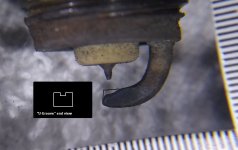
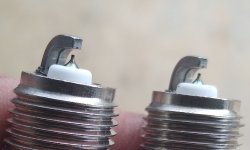
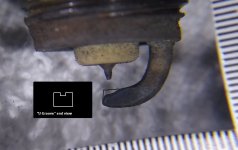
My notes say 213 hours. Note the loss of material at the tip of ground electrode.

Eroded Ground Electrode Illustrated.jpg

New.

U-Groove.jpg
 
Pardon my ignorance but I'm struggling a bit following this thread as it relates to spark plug lifespan.

I've got a smooth-running, quick starting IO-360 with Tempest Massive UREM 37BY plugs. They're 10-years old with approximately 370 hours. No performance issues, just wondering about their age. Other than pulling them and visually inspect/test each year should I worry about their age or just go till issues/wear begin to surface? Related question what would be the expected time-frame & hours at which they should be replaced? My A&P says 400-500 hours, but didn't provide a calendar-year estimate, that sound about right?

Guess I'd rather replace before any issues surface but also don't want to waste money if it's way too early. Then again, if they begin to fail I can't just pull over to the shoulder and call a tow-truck.

Thanks
 
I'll assume Larry is speaking of aircraft plugs here (massive electrode standards and fine wire iridiums). The Denso IKH27 I use in the 390 are not going anywhere near that long, although they could be re-gapped for more hours.

My notes say 213 hours. Note the loss of material at the tip of ground electrode.

View attachment 90835

New.

View attachment 90834
Wow, that is a lot of wear for 200 hours. I have 400 hours on the br8es' in my 540 and they do not show electrode wear like that. The center conductor wears a bit and requires re-gapping. Maybe the combustion patterns are different in the AV engines (don't know what the chamber shape is) and eat the electrodes more quickly. The LR4Us (simple copper/nickel) that i run in the 320 show very little wear at 800 hours. Also with re-gapping necessary.
 
Last edited:
I'll assume Larry is speaking of aircraft plugs here (massive electrode standards and fine wire iridiums). The Denso IKH27 I use in the 390 are not going anywhere near that long, although they could be re-gapped for more hours.

My notes say 213 hours. Note the loss of material at the tip of ground electrode.

View attachment 90835

New.

View attachment 90834
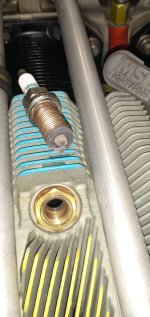
Is that a picture of your 390 after a hard run. Looks a little lean and/or right at detination. I'm using 18 degrees timing BTDC on mine.
 

Attachments

  • Eroded Ground Electrode Illustrated.jpg
    Eroded Ground Electrode Illustrated.jpg
    49.5 KB · Views: 21
  • IMG_20220512_200040426.jpg
    IMG_20220512_200040426.jpg
    1.3 MB · Views: 21
I've been running NGK 3961 BR8ES plugs in my old plane with Titan X-340. They're inexpensive and I've been replacing them with new at condition inspection. That has worked well. Recently bought a new plane with IO-360 that has NGK 6619 iridium spark plugs. The iridium's are more expensive than the 3961's. I read the iridium's are good for much longer also. As such I'm considering not replacing at annual.

For those running iridium plugs, what is your plan at condition inspection? Do you simply reinstall the old so long as the engine monitor looks good? Do you test them for resistance, or with a spark plug tester? Do you replace with new at condition inspection?
No I do not. is the fast answer.
I personally see no reason to replace plugs willy=nilly. A car can easily go 70,000 miles on the iridium plugs and 50,000 on standard before they even look like they need replacement. And checking the fuel economy before and after replacement at those intervals proves they were working well.
NO do not buy Chinese KO plugs.
I have SDS fuel and ignition and burn Costco Premium around home in my 0-360 and see no reason to be replacing plugs all the time.
I do run the NGK plugs and have replacements on the shelf.
But at 100 plus hours a year I've yet to see one fail.
It's not about the money either. I feel quite safe using the plugs for a long time. CAUSE I've seen new plugs give problems also.
There are two per cylinder just incase one fails to fire.
But I've only been a mechanic for 58 years so have a bit to learn yet.
My three cents worth and still learning FIXIT
 
Back
Top