Van's Air Force

The definitive Van's Aircraft support community! Buying, building or flying an RV? Join our exclusive family of mentors and enthusiasts!

Serious inspection after 5 years and 500 hours on the hardest working RV-14 in the fleet!?

Status
Not open for further replies.
Better engineering design and analysis tools?
Hard to call that better. Cheaper…sure.but better…if that’s what you consider an improvement, I can’t wait till the decision is made to just let the forward spar flop around with no connection, in response to the earlier post-er who stated all the loads are bore by the rear spar.

The silliness here, is that all these comments are only half correct. Virtually all loads are shared to some degree….comparing the aft spar double shear connection of the wing, to the forward spar of the vertical stab as the same, just because they are pinned connections, doesn’t really make any sense…

What does make sense is seeing this elongation, should have people a bit alarmed. A single shear, pinned connection isn’t better…or necessarily worse…until you start to see evidence that doesn’t look right. Then it’s worth considering.

I’ll shut up about it….and rest comfortable that my 6, my 4’s and my Rockets, have not shared this attribute, nor would I accept it, for any aircraft used even in light aerobatics, for the obviousness of the failure mode in an excitation event…but certainly not a 200+ 6g machine…

If I had that tail…I’d be adding two extra bolts in short order, after reaming the first up a size.
 
Just like the wing main spar will flex under vertical loads, the VS rear spar will flex under side loads and loads from the rudder hinges. The question is, how will that rear spar sideways flexing affect the VS front spar? The VS front spar tip will move sideways with the sideways flexing of the rear spar and if the base of the front spar is solidly bolted to the fuselage, fatigue and cracking may result. The single bolt allows for this movement without stretching and compressing metal, similar to the wing rear spar being attached by a single bolt.
 
Last edited:
Are you basing that on the successful 8000or so flying RV’s that have multiple bolts? Or just personal opinion?/ Because frankly…I much prefer the way the -3, -4, -6 and Rockets do it…along with the evidence shown above that something ain’t right there….
 
Hard to call that better. Cheaper…sure.but better…if that’s what you consider an improvement, I can’t wait till the decision is made to just let the forward spar flop around with no connection,
It is hard to take you seriously with this type of rhetoric…..

Personally, I think you better sell that RV that you own, and buy a well designed airplane, because apparently you don’t realize that the same engineering team that designed all the structural details of your airplane engineered the subject, vertical stabilizer attach point. 😳
 
I don’t personally know of any other instance where an issue has been discovered with this attached point on an RV 10 or 14. If there are others, I’m not aware of them.
What I will offer to this discussion, and take it for what it’s worth, is that one instance of an issue is not a reason to start screaming the sky is falling.

The point I’m trying to make is if the engineering team at Vans dove into investigating every single issue that was reported by any builder, they would need a large team working full-time on that alone.
I can think of a number of different factors that could have come in to play to cause the elongation in this one particular instance. I have no way of knowing whether any of those factors are relevant, and I said this in no way meaning to pass judgment on the builder and or owner of the airplane.
I’m just pointing out that something that hasn’t shown itself to be a problem on four factory airplanes, which have a considerable amount of flight time, or a large number of the currently currently flying fleet, it requires some investigation to try and discover what would have caused it in this instance.
 
Are you basing that on the successful 8000or so flying RV’s that have multiple bolts? Or just personal opinion?/ Because frankly…I much prefer the way the -3, -4, -6 and Rockets do it…along with the evidence shown above that something ain’t right there….

He’s just basing it on simple mechanics of structures. The design intent really
is not in question here. Someone from the factory has even explained that as well.
This really isn’t a place for TLAR engineering.
Sure something has happened to that hole.
What I don’t think you appreciate is that by unpinning (fixing) that joint (unnecessarily) that you are introducing an obvious failure mechanism. One the designer was specifically addressing by making it a pin!

Maybe someone from the factory can chime in but it would not surprise me at all so see that they changed the design there precisely because more modern FEA techniques showed that this joint was problematic fixed.
 
I feel the real question is - why was it re-engineered to remove multiple load paths if the previous and proven design worked so well? This is a perfectly fair question but probably better answered by one of Van's actual aircraft design engineer's. When Ken Krueger was still working for Vans Aircraft, he would always answer such questions, especially at shows when asked. My guess is that Ken Krueger probably designed and analyzed much of the RV-10 himself back when he worked at Van's Aircraft.
 
Scott, while your personal attacks don’t really bother me, from the perspective of defending your position as 100% correct all the time… it’s just that it’s not possible.

I completely understand the pinned connection. I understand the reason you think it’s fine.

Totally respect your opinion to do whatever you like.

Specifically what engineering team was the same for the 3,4 and 6… that designed the multiple bolted design, versus changing to this single pinned connection… ?

I don’t believe engineering has changed enough to completely invalidate the previous method and state this method is better.

As far as taking me seriously…. It’s hard to take your position seriously, when all you are offering is personal attacks.

You are being shown direct evidence of a worn hole…from reported light aerobatics and only 375 hours.

My airplane has way more hours than that without a pinned vertical joint and displays none of that and I pull on it pretty good abd put it through its paces.

Defending a position in the direct face of evidence to the contrary seems odd.

Maybe it’s only one…. Or maybe it’s the first one noticed.

I think it’s worth the discussion.
 
It’s definitely a pivot. Like the rear spar attachment on the wing. The reason it’s a castlated nut is exactly because it can rotate about the bolt and undo.
The antiseize is to prevent the mating faces from fretting.
The movement is not large but it exists.
I disagree. Nobody designs a joint to pivot then has you torque down a bolt to prevent it from pivoting; that would cause major fretting and wear. I think the joint is designed so that it could pivot in certain cases, like an accident or wind issue. The castleated nut would be for those exceptional cases where it did move.
 
Scott, while your personal attacks don’t really bother me, from the perspective of defending your position as 100% correct all the time… it’s just that it’s not possible.

I completely understand the pinned connection. I understand the reason you think it’s fine.

Totally respect your opinion to do whatever you like.

Specifically what engineering team was the same for the 3,4 and 6… that designed the multiple bolted design, versus changing to this single pinned connection… ?

I don’t believe engineering has changed enough to completely invalidate the previous method and state this method is better.

As far as taking me seriously…. It’s hard to take your position seriously, when all you are offering is personal attacks.

You are being shown direct evidence of a worn hole…from reported light aerobatics and only 375 hours.

My airplane has way more hours than that without a pinned vertical joint and displays none of that and I pull on it pretty good abd put it through its paces.

Defending a position in the direct face of evidence to the contrary seems odd.

Maybe it’s only one…. Or maybe it’s the first one noticed.

I think it’s worth the discussion.
A change from legacy design, in no way invalidates previous design. If advancements were not acceptable, we would still be using wing warping for roll control.

It is true that Richard VanGrunsven was the primary designer of the RV-3, 4, and 6.
It is also true that he was very much an active part of the engineering team that designed the RV-8, 9, 7, 10, 12, and 14.

If you think stating that it is hard to take someone seriously after they wrote “I can’t wait till the decision is made to just let the forward spar flop around with no connection“, is a personal attack, then for that I apologize. It was not meant as an attack. Just a statement of fact.
 
A bolted joint is designed based on the loads that need to be passed.
The rear spar on the wing is a double shear clevis style joint because the loads are much much higher. Note how much thicker all of the material is compared to the joint being discussed here.

In this case, the loads are much much lower. So a single bolt in single sheer is more than adequate.

Do you know that there is actually movement at the rear spar attach point, as a result of high G load? That is why it also has a castellated nut with a cotter pin.
But if there is movement at the rear spar, there must be movement at the fwd spar. We’ve all sat in the big birds and watch the wings go up and down; known activity. Clearly that movement is absorbed via flexing of the spar itself, not joints, so who is to say that is not happening at the rear spar. Due to the single bolt and risk of movement, a castle nut is required. But if that joint is constantly moving with a fully torqued bolt, I don’t see how you can not have significant fretting there. At least until you wore awat enough material to loosen the bolt, then the wear would move to making the holes oblong.
 
A change from legacy design, in no way invalidates previous design. If advancements were not acceptable, we would still be using wing warping for roll control.

It is true that Richard VanGrunsven was the primary designer of the RV-3, 4, and 6.
It is also true that he was very much an active part of the engineering team that designed the RV-8, 9, 7, 10, 12, and 14.

If you think stating that it is hard to take someone seriously after they wrote “I can’t wait till the decision is made to just let the forward spar flop around with no connection“, is a personal attack, then for that I apologize. It was not meant as an attack. Just a statement of fact.
And you seem to lack a sense of humor that was simply poking fun at the notion that movement is somehow okay…so if a little is good, them more is maybe better??

No offense taken…but we can all recognize when a lighthearted jest is offered to point out a counter-point…such as…the rear spar bears all the loads…when we know that’s not accurate…my tongue in cheek rebuttal, missed its point apparently…( as does my stupidly dry sense of humor)


My sole point in all this, is not that the sky is falling….but maybe let’s not be so quick to sweep it under the rug, with a bigger bolt. It’s a good thing to keep an eye on and see what’s actually going on…or if anything is….or not going on.

I, as an engineer am skeptical by nature. And having flown Dicks designs for a long time, I trust them. And when something like this crops up on a new model with a very different ideology…my skepticism certainly goes….Hmm….now why that? Particularly in the face of overwhelming evidence of previous success.

That’s all.
 
But if there is movement at the rear spar, there must be movement at the fwd spar. We’ve all sat in the big birds and watch the wings go up and down; known activity. Clearly that movement is absorbed via flexing of the spar itself, not joints, so who is to say that is not happening at the rear spar. Due to the single bolt and risk of movement, a castle nut is required. But if that joint is constantly moving with a fully torqued bolt, I don’t see how you can not have significant fretting there. At least until you wore awat enough material to loosen the bolt, then the wear would move to making the holes oblong.
Very well made point of exactly my curiosity.
 
But if there is movement at the rear spar, there must be movement at the fwd spar. We’ve all sat in the big birds and watch the wings go up and down; known activity. Clearly that movement is absorbed via flexing of the spar itself, not joints, so who is to say that is not happening at the rear spar. Due to the single bolt and risk of movement, a castle nut is required. But if that joint is constantly moving with a fully torqued bolt, I don’t see how you can not have significant fretting there. At least until you wore awat enough material to loosen the bolt, then the wear would move to making the holes oblong.
I never said the wing rear spar attach point was constantly moving….

I said that under high G load it can move.

This has been confirmed during static load testing.
 
I disagree. Nobody designs a joint to pivot then has you torque down a bolt to prevent it from pivoting; that would cause major fretting and wear. I think the joint is designed so that it could pivot in certain cases, like an accident or wind issue. The castleated nut would be for those exceptional cases where it did move.
I really don’t know how to put this in a way that won’t upset someone but this is just undergrad engineering statics 101.
Just because you don’t agree or understand for whatever reason dosent change the physics.
It’s a pin, a pivot. It transfers shear loads only. It won’t transfer bending. Intentionality. It’s designed to move. Not much. It has nothing to do with wind or protection from impact or whatever.
I feel like this is just going in circles and it’s clear that no matter how many qualified people explain the design that some people know better. I’m out.
 
I think you are missing the point… we all agree as a pinned joint it should move under high g scenarios.

This one moved a lot under low g scenario and low hours.

And it shouldn’t.
 
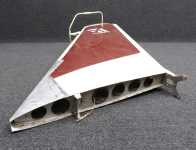
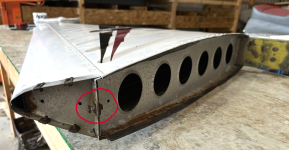
Below (first photo) is a Cessna 172 vertical stabilizer, and it shows 2-forward connect bolt holes. And, most Beechcraft aircraft routinely use 4-forward connect bolts. However, Piper appears to only use 1-forward connect bolt, much like the RV-14 and RV-10, but using a plate nut instead -- see second photo.

1776915046417.png
1776916608564.png
 
I have no concerns with what you’ve demonstrated above. It’s a great point.

We aren’t out pulling 4 g’s rolling and looping and spinning in that bolt and nut plated Piper.
 
Status
Not open for further replies.
Back
Top