Van's Air Force

The definitive Van's Aircraft support community! Buying, building or flying an RV? Join our exclusive family of mentors and enthusiasts!

SB-00116 Regarding Autopilot Servo Attach Brackets Published

How did you drill that center rivet out of the flange with the 5 rivets ?
I used a 1/8” x 12” long drill bit on a variable speed screw driver. Drill the shop head slowly with little pressure. When you are through the head it will pop off. Take it slow so you don't touch the sheet metal. Sometimes you can stop short and use the back end of another drill bit and snap the head of the rivet off. Once the head is off I “punch” the rivet through. My “punch” is a spring center punch that is ground into a 3/32 shaft with no point. A few snaps with it knocks the rivet through.

The center rivet isn’t straight on but the 12” bit will flex to get fairly straight. I took out the other 4 rivets completely first. Then I rotated the bracket to work at different angles on the center one. I did about 3 different angles and it was enough to pop the head.
 
Last edited:
Well so far in this thread we have had five negative reports - all from legacy planes. No 12iS yet. Maybe the 12iS installation with the new brackets is relevant?
 
Last edited:
Well so far in this thread we have had five negative reports - all from legacy planes. No 12iS yet. Maybe the 12iS installation with the new brackets is relevant?
Pattern but not enough data points to be significant. Legacy brackets with Dynon AP that appears to not quite match holes thus increased tension on rivets. If changed to current bracket control rod needs rebuilding /replacing.
 
Van's -- How about using CherryMax pull rivets as an alternative??

CHERRY MAX RIVETS, Van! Please amend the SB.

I just completed the SB, installing the recommended 4704-4.5 rivets. Getting any kind of squeezer in there is a challenge, and a conventional rivet gun on the thin material is asking for trouble.

The existing pull rivets are easy to drill out. Replacing the six existing rivets with cherry max structural rivets using a hand-pulled pop-riveter would be a piece of cake.

As the SB stands now, there's a big chance that a repairman will introduce sloppy replacements.
I've assisted building two RV-12s and this SB is not easy to do correctly.

Has someone called Van's Support on this?

Thanks....
 
CHERRY MAX RIVETS, Van! Please amend the SB.

I just completed the SB, installing the recommended 4704-4.5 rivets. Getting any kind of squeezer in there is a challenge, and a conventional rivet gun on the thin material is asking for trouble.

The existing pull rivets are easy to drill out. Replacing the six existing rivets with cherry max structural rivets using a hand-pulled pop-riveter would be a piece of cake.

As the SB stands now, there's a big chance that a repairman will introduce sloppy replacements.
I've assisted building two RV-12s and this SB is not easy to do correctly.

Has someone called Van's Support on this?

Thanks....

See post #13...
 
From post 13: The Cherry Option has not been tested by Vans engineers.

I believe what rswalden is asking is how to get Van's to test this option.
I don't think we need Van's to test anything new (nor should we expect them to). We just need them to clarify that the message from Builder Support relayed in post #13 was NOT intended to contradict the approved substitutions in the maintenance manual - which presumably were approved based on existing data to support their use.

Not that it matters for an already-flying E-LSA...
 
CHERRY MAX RIVETS, Van! Please amend the SB.

I just completed the SB, installing the recommended 4704-4.5 rivets. Getting any kind of squeezer in there is a challenge, and a conventional rivet gun on the thin material is asking for trouble.

The existing pull rivets are easy to drill out. Replacing the six existing rivets with cherry max structural rivets using a hand-pulled pop-riveter would be a piece of cake.

As the SB stands now, there's a big chance that a repairman will introduce sloppy replacements.
I've assisted building two RV-12s and this SB is not easy to do correctly.

Has someone called Van's Support on this?

Thanks....
I submitted a note about my SB situation to Vans Support on Nov 12 and received a reply on Nov 14. A confidentiality statement in the response prohibits me from publishing Vans comments.

I went ahead and completed my repair. I installed a 0.1” spacer on the left angle which corrected the misaligned servo holes. I also replaced the first and third rivets on each bracket with AN3 bolts (4).

I will publish photos of my fix for my situation next week.


Deene
 
Finished my legacy RV12 in 2009. Wonderful plane. 1,200 hours all over the United States. Thank God for the Dynon AP and servo "shelves" now the subject of a dangerous SB. In the past, difficult SB's came with a "best" repair technique, both in pics, directions and suggestions from Van's engineers (often on VAF)....all very similar to the wonderful directions similar to the excellent plans. Often, they even offered a "kit" put together of necessary parts such as the the AN470AD4-4.5 rivets. Most of us found it necessary to remove both bulkhead brackets just to get to the suspect brackets first and then hunt for 4-4.5rivets because Van's didn't have any. Unlike in the old days, pre-bankruptcy, it seems we all scrambled to"engineer" our own solutions, bought the solid rivets from Spruce and gave up buying a $200 worth of LP4-3's from Van's because they charge a minimum of $15 freight for a handful ...Instead we "bought them from friends" for the cost of a postage stamp. I agree with the lawyer's insisting a "before further flight" designation - a loose servo has the potential to cause a lot of in air damage. That said, I am truly thankful Van's let us know. And thank you VAF for all of the generous, successful alternatives and rivets to (simply) remove 6 bad pulled rivets and replace with solid rivets."
 
Last edited:
Not that it matters for an already-flying E-LSA...
While this is a true statement it is also a true statement that someone could choose to zip-tie the bracket on an already flying E-LSA. However THIS pilot would prefer to have a solution that aeronautical engineers consider "safe." Silly me.
 
I submitted a note about my SB situation to Vans Support on Nov 12 and received a reply on Nov 14. A confidentiality statement in the response prohibits me from publishing Vans comments.

I went ahead and completed my repair. I installed a 0.1” spacer on the left angle which corrected the misaligned servo holes. I also replaced the first and third rivets on each bracket with AN3 bolts (4).

I will publish photos of my fix for my situation next week.


Deene
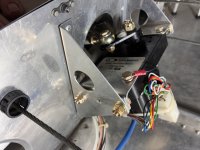
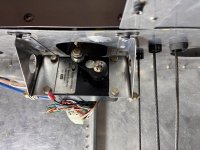
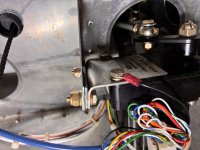
IMG_0170.jpegIMG_0162.jpegIMG_0165.jpeg
Photos of final configuration:
 
I like Deene's approach (bolts). If, in the future, it ever became necessary to drill out solid rivets, bolts eliminate the possibility of ruining the brackets and angles. Now, the failure point moves to the vertical rivets, why not go a step further and replace the vertical rivets with AN3 bolts as well?
 
I like Deene's approach (bolts). If, in the future, it ever became necessary to drill out solid rivets, bolts eliminate the possibility of ruining the brackets and angles. Now, the failure point moves to the vertical rivets, why not go a step further and replace the vertical rivets with AN3 bolts as well?
That could be useful. Difficult but useful. However, the vertical rivets are holding in tension rather than shear, so less likely to fail, #1 because the strength is better by far in that orientation, and #2 the adverse torque does not apply to that part in as meaningful a manner.
 
why an3 bolts? #6 and #8 are both larger than the rivets spec'd . even a #5 screw grade 8 or 9 would be stronger than a solid rivet. so many crickets.
 
An3 are commonly used aircraft hardware. Something equivalent in a smaller size would be hard to source. We all have AN3's and proper nuts and washers on the shelf.
 
I inspected my RV-12iS today and all the suspect rivets still looked like new. My airplane is only 6 months old with 82 flight hours, so I didn't expect to find any issues this soon. I plan to replace these rivets with the recommended AN470AD4-4.5's at the next condition inspection.

FYI, I had a handful of AN470AD4-5's left over from my kit and since I don't have a rivet cutter, I figured out a quick and easy method to shorten them down to 4.5's without heating them up with a grinding wheel (which could change their temper). Just mark 1/32" from the end with a Sharpie, hold them flat against the work bench with needle-nose pliers, and use a hand file to shorten them down to the Sharpie line. Then round the cut edges lightly with a fine file or emery paper. Takes about a minute per rivet. I wouldn't want to do that with a lot of rivets, but it's quick and easy to make just 6.
 
FYI, I had a handful of AN470AD4-5's left over from my kit and since I don't have a rivet cutter, I figured out a quick and easy method to shorten them down to 4.5's without heating them up with a grinding wheel (which could change their temper). Just mark 1/32" from the end with a Sharpie, hold them flat against the work bench with needle-nose pliers, and use a hand file to shorten them down to the Sharpie line. Then round the cut edges lightly with a fine file or emery paper. Takes about a minute per rivet. I wouldn't want to do that with a lot of rivets, but it's quick and easy to make just 6.
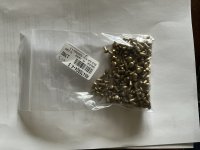
I’m lazy. Ordered the minimum 1/8 pound of 4-4.5’s from Spruce. Order placed Tuesday, arrived today. Pretty sure I’ll have some leftovers. 😆IMG_0093.jpeg
 
Yes, I figure that if I decide to remove the larger brackets first as some have done, I'll just use the -5's since I'll have unrestricted access to squeeze them easily. But if I chose to remove only the servo mount brackets and squeeze the rivets confined inside the airplane, I'll shorten them to -4.5 to minimize the risk of a bad set. I'll crawl back there and do a dry run with my Cleveland squeezer first to help me decide. But not until my next condition inspection.
 
The reason I removed the complete mount was because drilling out the 6 rivets in the confined space with a 90 degree drill and poor visibility was a recipe for botching a hole. If that happened the fix was parts from Van’s which would take time and be newer mounts with slightly different dimensions. Then maybe something different required on the pushrod. The other option is make my own replacement bracket. All this thinking, “what if”, and the easy way out was to drill out the other 10 rivets. Once the area was accessed I had the mount completely out, the squeeze rivets in and the mount back in place in less than 30 minutes, and the risk of a slip greatly reduced.
 
Reading this thread, I have the impression that it's the forward rivets that are most prone to failure, and the reason is that on some legacy RV12 aircraft, after the brackets are installed the hole spacing between those brackets for the Dynon autopilot servo mounting bolts is a little too large. This means that on those aircraft, when the bolts attaching the servo are installed, the forward rivets are placed under high tensile strength. Standard pop rivets are not designed to handle high tensile loads.

If I am right, then the SB should include removing the servo mounting bolts on one side in order to check that the spacing between the servo mounting bolt holes on the brackets matches the spacing on the servo, and installing a shim if necessary (see https://vansairforce.net/threads/sb...attach-brackets-published.238936/post-1888340). If the rivets are in good condition, perhaps it should only be necessary to remove the bolts on one side and check the hole spacing, to ensure that the existing rivets are not under tension.
 
I completed this SB yesterday and during initial inspection discovered two rivets had failed one on each side of the angles holding the servo. They were both located nearest the bulkhead. The two pieces riveted to the bulkhead were in good condition. I do recall the struggles associated with installing the servo originally.
I used a 3/16 shim and replaced the 6 rivets with SS 6-32 screws and nyloc nuts. This time installing the servo I could turn each bolt by hand and I felt there was no stress to this mounting design.
 
Last edited:
Seagull, Not trying to pic nits, but look at that bolt thru the rod end for thread protrusion... Might be just the lighting, but sure doesn't look there is any...
 
Seagull, Not trying to pic nits, but look at that bolt thru the rod end for thread protrusion... Might be just the lighting, but sure doesn't look there is any...
That pic was taken with everything in place “finger tight”, I had it closed up before I remembered to take more pics.
 
I don't have pics because things are tight and hands are busy during the work but I want to mention that with a Tight Fit drill kit and a Numatix squeezer the rivets can be drilled and squeezed in place with minimal interference from surrounding parts and plumbing. This is a case where luxury tools do make things a little easier.
 
I don't have pics because things are tight and hands are busy during the work but I want to mention that with a Tight Fit drill kit and a Numatix squeezer the rivets can be drilled and squeezed in place with minimal interference from surrounding parts and plumbing. This is a case where luxury tools do make things a little easier.
Any willingness to loan out your numatix tool?
 
Any willingness to loan out your numatix tool?
I'm pretty generous when it comes to tool loaning, but there is not practical way to ship around my numatix setup. I have the pedal and reg mounted to a pretty good sized board platform and the accumulator itself with hose coming out the top is awkward. This is a downside of the tool actually, the part in your hand is compact and awesome but it requires the pedal and accumulator setup to exist somewhere else.
 
Revision 1 of this Service Bulletin has been published today. It explicitly calls out the use of CherryMAX rivets as an alternative to the AN470s, though it should be noted that the holes still need to be round after drilling out the old rivets.

Here's the updated SB.
Thanks for this update. This should make the service bulletin easier to perform.

Correction:
I didn't realize the drawings were incorrect in the original release. They have been corrected on this revision.
 
Last edited:
Completed the SB on our School RV-12iS today.
175 hrs, No missing rivets.
As previously mentioned, the use of the Numatix Hydraulic Riveter makes this SB a non-event.
AP1GczNNetmGYe4s3WTdSq4TIr6wEoGddmRZv4-ll90SW446QnDEG3Sh_9y-j7G47UxT_1vyy4Zy4LjXGjk2A9hKCjbvRCaYsbi-BakRv9OXV48cvoqfXhM-FwkA5qWARNzHHp2Hli2eOGA-K2hi4B6ajpky0Q=w1000-h1400


AP1GczNVynz-ARaM4sMTnvKUsND8x9obh6nhIn1O2E4aKUnJmI-KF6wPaGNmOK5rd5KyTpFj_yzGhsbeI_yPLiGEDluAjoak-ABgEXkf-6omwMjHz8_Ur_MhemMYtw_56o4C4U1LntBp-JmzP0PRi-4Adt_YOA=w1000-h1400


AP1GczPy0XFgHtu5pf81AH_TMIGNULTPn4bDb9EzjUVe1PM-xTmdcowanXUtKQzcL4q8cVBR8lB4FzLiSmMDt0xmIjwNXLQrXvozKrMEA68-LkKu7icxoJ64MuNxfuIWfuxlU0NDRNZJDsWlYiRmiDZMtC5FHw=w1000-h1400
 
I don't have RV-12 plans on my hard drive. What am I looking at here? Appears to be a rod end near or exceeding angularity limits, and a pushrod rubbing a fuel line.

IMG_6212.jpg
 
I've inspected my plane and rivets are good. Went to order the CherryMax rivets from Van's and they show available to builders only. I'm registered with them and they won't let me complete the order. Wondering if that's because I'm not considered an active builder. Seems strange.
Rick
 
I've inspected my plane and rivets are good. Went to order the CherryMax rivets from Van's and they show available to builders only. I'm registered with them and they won't let me complete the order. Wondering if that's because I'm not considered an active builder. Seems strange.
Rick
Did you log into the store with your builder number?
 
Note that you can pull the coarse filter from underneath the aircraft, if you remove the inspection plate. The fine filter not so much.
I'm wondering if I can see the rivets from there with a flexible bore scope?
I used steel screws with self- locking nuts.
 
Currently working on my conditional inspection and was able to get a close look of my Servo Brackets.

2021 iS model, ELSA, 500Hrs, Garmin Servos.

No cracks, smoking rivets, or otherwise signs of wear noted. In the spirit of experimentation I went ahead and sprayed some SKL- SP2 Dye penetrant, admittedly my first time using this product, and sprayed on the bracket on the machine head of the rivets. Photos attached. After verifying everything I went ahead and drilled out the rivets using a right angle attachment.
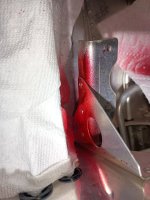
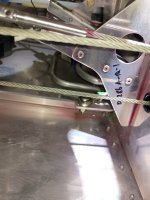
IMG_20260305_113910147.jpg
IMG_20260305_122052057.jpg
I COULD NOT for the life of my get my Cleveland main squeeze rivet squeezer in the tight quarters. The Fuel assembly among other tubes wires etc where just too constrained. Also 12 years in the military means my back cant tolerate hanging over the fuel tank into the tail cone for very long. (the Tail cone clip SB nearly killed me!!!) Furthermore, I liked the idea of using bolts instead of rivets. When you think about it, its actually easier to build back the bracket via AN bolts and nuts than it is to rivet. At least for me it is.

So I opted to remove as much as I could and work with it on the bench. I decided to use AN515-8R8 screws and K1000 nutplates. I also had some great looking AN525 Washer Heads, but they were just a bit too long and would have hit the servo when screwed down even with additional washers. All of this was hardware I had left over from the build. I did the whole shebang with countersinking and mounting nutplates and everything went together well...
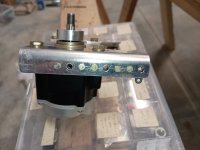
IMG_20260305_135321648.jpg
IMG_20260305_135259724.jpg
I am no engineer and am probably out of line deviating from the mothership, but i think it came out OK and it saved me from some back spasms vs trying the rivet approach. Again, I am not and engineer and I'm sure there are some weird forces at work on this servo bracket, but it seems the AN515 screws system could have AT LEAST equivalent tensile and shear strength as the AN470 rivets probably not the Cherrymax. Bu the real goal was to use some of the leftover hardware from the original build.

I ended up running out of room on the end nut plate and just went ahead and used a corner nut plate but only driving one rivet, leaving the other rivet hole free. I nipped it off later before I reinstalled the assembly.

I like the idea of this assembly being removable with just a stubby screwdiver vs a bolt and nut system or rivets, but honestly I don't see myself every having to remove it again...

 
In the spirit of experimentation I went ahead and sprayed some SKL- SP2 Dye penetrant
Having never used dye penetrant I'm unsure at what I am actually looking.

In the second photo there seems to be faint traces of the dye around the edges of the rivets. Is this indication of rivet failure?
 
Having never used dye penetrant I'm unsure at what I am actually looking.

In the second photo there seems to be faint traces of the dye around the edges of the rivets. Is this indication of rivet failure?
I dont beleive so. The dye penetrant will find and highlight the smallest of cracks. I think its simply finding the little gap between the edge of the LP4-3 rivet and the underlying material. Before i applied the dye I inspected closely for any signs of smoking rivets, or residue from rivet movement. Then I dried and cleaned the surface with acetone and and inspected again.

My understanding is that if you use the spray as directed then it will make even the smallest of hairline cracks obvious to spot with the naked eye. I see no obvious cracking, but chose to address the SB anyway albeit via an alternate, hopefully equivalent, method.

I am interested in the forums opinion. I'm learning just like everyone else on here and am genuinely open to criticisms.
 
I see no obvious cracking, but chose to address the SB anyway
Upon familiarizing myself on SB 00116 again I noticed that continued inspection is acceptable if no failure is detected. My condition inspection will begin in about six weeks. If in six weeks there is still no indication of failure I may elect to continue to inspect. Why potentially create a problem where there is none?
 

Attachments

  • IMG_1739.jpeg
    IMG_1739.jpeg
    252.8 KB · Views: 9
Back
Top