Van's Air Force

The definitive Van's Aircraft support community! Buying, building or flying an RV? Join our exclusive family of mentors and enthusiasts!

RV-14 Flap Questions

enigmakv

Well Known Member
I am deep in learning about my new (to me) RV-14A. Not being a builder and starting from square one does come with the challenge of learning the airplane and finding detailed information. This post will be about the flaps system on my plane with multiple questions.

1) The flap actuation switch is a toggle switch with a flap-shaped switch cover. The problem is that the toggle itself ROTATES. This means that the switch cover rotates as well making the flap-shaped cover end up in any position from normal to vertical and I find it distracting and annoying. Is there a flap switch available that does NOT rotate?

2) I am away from the airplane and am trying to remember how the switch works but I am pretty sure it has a center "Off" position, a latched "Up" position and I think a momentary "down" which I have to hit multiple times for each flap position. The problem I am currently seeing is that when the flaps are switched to their final down position (in hangar testing) the motor continues to run even after the flaps hit the stop and I have to cycle the switch up to turn the motor off. I worry that in flight I won't hear that motor and remember to stop it and I end up distracted by it. Any idea what the issue could be?

3) It has been difficult for me to find reliable information about the actual flap positions. There are many threads and conversations about "Up", "Reflex", "Trailing" and various numbers for "degrees". When I do searches such as "RV-14 flap positions I can't find reliable information". Where can I find the information about positions, descriptions and measurements for the flap settings/angles etc.?

4) Regarding cruise, is there a position for the flaps other than all the way up? Again, I have read different threads mentioning up, trail, flex. Looking out the window anything other that all the way at the up stop feels like I am flying with flaps at greater than flap limit speed.

5) Finally, I have read threads here indicating different limiting speeds for different flap settings. I have also read 100 KIAS limit for any flaps other than "up". Is there any detailed info out there about limiting flap speeds?
 
For your #1 do you just need to tighten the hex screws on the flap handle? Mine has a set screw on either side that holds it on a regular switch. Or is the switch itself rotating? Then need to tighten the nut on the switch to panel interface.
 
I am deep in learning about my new (to me) RV-14A. Not being a builder and starting from square one does come with the challenge of learning the airplane and finding detailed information. This post will be about the flaps system on my plane with multiple questions.

1) The flap actuation switch is a toggle switch with a flap-shaped switch cover. The problem is that the toggle itself ROTATES. This means that the switch cover rotates as well making the flap-shaped cover end up in any position from normal to vertical and I find it distracting and annoying. Is there a flap switch available that does NOT rotate?
i
2) I am away from the airplane and am trying to remember how the switch works but I am pretty sure it has a center "Off" position, a latched "Up" position and I think a momentary "down" which I have to hit multiple times for each flap position. The problem I am currently seeing is that when the flaps are switched to their final down position (in hangar testing) the motor continues to run even after the flaps hit the stop and I have to cycle the switch up to turn the motor off. I worry that in flight I won't hear that motor and remember to stop it and I end up distracted by it. Any idea what the issue could be?

3) It has been difficult for me to find reliable information about the actual flap positions. There are many threads and conversations about "Up", "Reflex", "Trailing" and various numbers for "degrees". When I do searches such as "RV-14 flap positions I can't find reliable information". Where can I find the information about positions, descriptions and measurements for the flap settings/angles etc.?

4) Regarding cruise, is there a position for the flaps other than all the way up? Again, I have read different threads mentioning up, trail, flex. Looking out the window anything other that all the way at the up stop feels like I am flying with flaps at greater than flap limit speed.

5) Finally, I have read threads here indicating different limiting speeds for different flap settings. I have also read 100 KIAS limit for any flaps other than "up". Is there any detailed info out there about limiting flap speeds?
Hopefully the person who did your pre-buy can help you with the basics. What avionics are you using? What controls your flaps? (VPX, EFIS, etc.) Rotating flap switches are new to me. Need to ensure the flaps are rigged to come up all the way against the spar. There are threads out there that show the correct position. Plans which you should have access will show this.

Vans does allow "in trail" which is down 3 degrees to also use 100 knots as a limit. (As opposed to reflex which is all the way up against the spar) After over 600 hrs. flying back and forth from Florida to Ohio found zero difference in performance reflex vs in-trail but that might be just my experience.
 
Last edited:
Check out the WIKI for build plans with associated threads. This should help you get to know your systems.
 
For your #1 do you just need to tighten the hex screws on the flap handle? Mine has a set screw on either side that holds it on a regular switch. Or is the switch itself rotating? Then need to tighten the nut on the switch to panel interface.
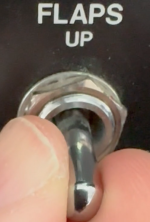
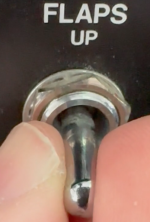
Here is a photo of the switch in the "vertical" rotation. I made sure the hex was FIRMLY seated against the toggle switch on both sides and it still rotates. I am certain that the toggle itself is rotating within its housing.
1766814712444.jpeg
 
Hopefully the person who did your pre-buy can help you with the basics. What avionics are you using? What controls your flaps? (VPX, EFIS, etc.) Rotating flap switches are new to me. Need to ensure the flaps are rigged to come up all the way against the spar. There are threads out there that show the correct position. Plans which you should have access will show this.

Vans does allow "in trail" which is down 3 degrees to also use 100 knots as a limit. (As opposed to reflex which is all the way up against the spar) After over 600 hrs. flying back and forth from Florida to Ohio found zero difference in performance reflex vs in-trail but that might be just my experience.
I have from the builder a large bound paper set of plans but can find no details of actual flap position settings. I am about to order the USB stick with the plans. Will that have what I need? I'll keep looking for other threads but they all seem to begin vague and deteriorate rapidly.

So is "full up" actually -3 degrees? And are you saying that anything lower is limited to 100 knots?
Is "full up" (-3°?) the "reflex" position and the next notch down the "in trail" position?

The plane has dual G3X. I am currently removed from the plane and documents so am not sure what controls the builder utilized. Next time I am there I'll dig into his spec sheets. He actually provided me with a pretty good amount of stuff. Condition Inspection expires 31Jan so I'll be looking at things in more detail soon.
 
Check out the WIKI for build plans with associated threads. This should help you get to know your systems.
Pete, I hate to sound like a real dummy but where is the WIKI for build plans?
Is that another section on these forums? Or something on the Vans website?
 
Okay….I have a -10 but I think the -14 is set up the same.
1. The stock -14 has a simple up down switch for the flaps. It sounds like yours has a very popular option with pre-set flap positions. I’ll assume this is what you have.
2. The switch should have an anti-rotation slot cut across the threads . It sounds like the builder was too lazy to make the proper ‘hole with a tab’ that fits into the slot. You can fix this.
3. The -14 wing is unusual, in that flaps full up are actually angled 3 deg above what would be a straight aft extension of the wing. Some builders call this “-3 deg” or “reflexed”. I call it ‘full up’. At ‘full up’ the front of the flap rests against the aft spar. Next position is just 3 deg below ‘full up’. This position is often called ‘in trail’, because the flaps look like an aft extension of the wing. Vans recommends no limiting speeds (other than red line) for full up and/or in trail. Next lower position is about 18 deg below in trail. For the -10 max speed at this setting is 95 kias. Last position, which I call ‘full flaps’, is about 35 deg below ‘in trail’. IIRC max speed for full flaps in the 10 is 88 kias.
Per Steve Smith (air foil designer) max speed down low is with flaps full up (‘reflexed’), although heavy and high enough ‘in trail’ may be slightly faster. (High enough means well into the oxygen levels, like 15000’). Steve also told me that he believes best rate of climb can be had with flaps in trail. But I know at least one builder who never uses full up, he uses in trail for cruise. At any rate the speed difference seems small.
4. You need to adjust the rigid wire with dips that sense the stops for the flap motor, to get them where you want. One push down (hold down for about 1/2 second to get off the ‘dip’) and release should run the flaps down to the next stop. You can only go down one stop at a time. If you change your mind while the flaps are moving down, just flip the flap switch up. Return the switch to neutral when the flaps are where you want them. At both full up and full down the sensor should be in a dip, and the motor should not run. (Note the stock design the motor will run, with the clutch slipping, until you move the switch to neutral (off).
Edit: if the toggle switch is rotating but its housing is not, it’s broken.
 
Last edited:
Another thing I would recommend is to download the G3X installation manual and look at the flap’s configuration part of that manual. It is a wealth of info that might help you understand your system. Just make sure you know exactly what you have installed so you know what parts of the manual pertain to you. Good Luck
 
I have from the builder a large bound paper set of plans but can find no details of actual flap position settings. I am about to order the USB stick with the plans. Will that have what I need? I'll keep looking for other threads but they all seem to begin vague and deteriorate rapidly.

So is "full up" actually -3 degrees? And are you saying that anything lower is limited to 100 knots?
Is "full up" (-3°?) the "reflex" position and the next notch down the "in trail" position?

The plane has dual G3X. I am currently removed from the plane and documents so am not sure what controls the builder utilized. Next time I am there I'll dig into his spec sheets. He actually provided me with a pretty good amount of stuff. Condition Inspection expires 31Jan so I'll be looking at things in more detail soon.
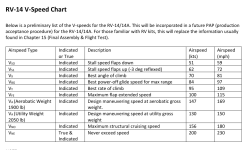
This is your Vans posted reference speeds for VFE for a 14: (Which is different from the 10 even though both have the same wing design) If tested properly in Phase 1 some use slightly higher speeds than this for Flaps 1. (For the 14)

Screenshot 2025-12-27 064047.png

The plans you can get the USB but if you call Vans and give them your build number, they will assign it to you, and you can log in and pull it up, no USB needed. I have not had to do this for my 10 and 14 but I've been told it's pretty easy.

Full up is "reflex" and from their down 3 degrees is "in trail". If you find a statistical performance difference, please publish as you would be the first. Here are the drawings for what is "probably" your flap motor design. I say probably because early 14's had the standard flap motor that Vans used for 20 plus years and a few years into the 14 build it was changed to a linear servo motor, first brought out by Pat Hatch and now Vans sells. It has built in position indicators where the original might not have any position indicators or indicators installed afterwards. Lots of ways to wire the flap system. VPX is also a popular device that has flaps and trims built in and communicates directly with your G3X. Adding to the confusion Garmin brought out the GAD27 which now also can control your flaps and trims and a lot more. (9 more discretes) I just added this (for the discretes) to my 10 panel and works well. The builder should have included a wiring diagram which would help you figure this out more easily.

Below are the 2 different versions of the flap motor design: (hopefully you can access without signing in)
.
Looks like you will need to sign in. I removed the links and can't attach PDF's.

You might want to start with checking to make sure the flaps are all the way up against the spar. I've seen several that were not. There are pics posted recently of the correct position I'll try to find. See this thread:


Good luck and ask as many questions as you need, VAF is a great bunch of builders with lots of experience.
 
Last edited:
Okay….I have a -10 but I think the -14 is set up the same.
1. The stock -14 has a simple up down switch for the flaps. It sounds like yours has a very popular option with pre-set flap positions. I’ll assume this is what you have.
2. The switch should have an anti-rotation slot cut across the threads . It sounds like the builder was too lazy to make the proper ‘hole with a tab’ that fits into the slot. You can fix this.
3. The -14 wing is unusual, in that flaps full up are actually angled 3 deg above what would be a straight aft extension of the wing. Some builders call this “-3 deg” or “reflexed”. I call it ‘full up’. At ‘full up’ the front of the flap rests against the aft spar. Next position is just 3 deg below ‘full up’. This position is often called ‘in trail’, because the flaps look like an aft extension of the wing. Vans recommends no limiting speeds (other than red line) for full up and/or in trail. Next lower position is about 18 deg below in trail. For the -10 max speed at this setting is 95 kias. Last position, which I call ‘full flaps’, is about 35 deg below ‘in trail’. IIRC max speed for full flaps in the 10 is 88 kias.
Per Steve Smith (air foil designer) max speed down low is with flaps full up (‘reflexed’), although heavy and high enough ‘in trail’ may be slightly faster. (High enough means well into the oxygen levels, like 15000’). Steve also told me that he believes best rate of climb can be had with flaps in trail. But I know at least one builder who never uses full up, he uses in trail for cruise. At any rate the speed difference seems small.
4. You need to adjust the rigid wire with dips that sense the stops for the flap motor, to get them where you want. One push down (hold down for about 1/2 second to get off the ‘dip’) and release should run the flaps down to the next stop. You can only go down one stop at a time. If you change your mind while the flaps are moving down, just flip the flap switch up. Return the switch to neutral when the flaps are where you want them. At both full up and full down the sensor should be in a dip, and the motor should not run. (Note the stock design the motor will run, with the clutch slipping, until you move the switch to neutral (off).
Edit: if the toggle switch is rotating but its housing is not, it’s broken.
Bob, Thanks so much for the detailed response.
I am stuck 3000 miles away from my plane/hangar and I only purchased the plane four months ago and have about 25 hours on it. I am certain that my flap switch is the "popular option" you mention as it has a locked "up", a middile neutral and a momentary click down for each extension. When I select full down flaps, the motor keeps running which leads me to think that it is the "stock" motor you mention as well. I have to move the switch to the up stop and then back to the neutral position to stop the motor.
When I can get back to my plane I will take apart and determine the status of the toggle switch. I may just end up removing the flap-shaped switch extension completely and just have a basic toggle switch for the flaps.
I appreciate the Steve Smith reference (although I have no clue who he is) regarding best conditions for flex vs. in-trail. That seems to be some "hidden" info as I have not seen it with actual conditions expressed in any of the many threads that have flap discussions. I worry in cruise about over-extending the flaps accidentally beyond in-trail at high speed so up to now I have just flown in "reflex" (full up).
 
Hopefully the person who did your pre-buy can help you with the basics. What avionics are you using? What controls your flaps? (VPX, EFIS, etc.) Rotating flap switches are new to me. Need to ensure the flaps are rigged to come up all the way against the spar. There are threads out there that show the correct position. Plans which you should have access will show this.

Vans does allow "in trail" which is down 3 degrees to also use 100 knots as a limit. (As opposed to reflex which is all the way up against the spar) After over 600 hrs. flying back and forth from Florida to Ohio found zero difference in performance reflex vs in-trail but that might be just my experience.
The plane has dual G3X. Since I don't have the documentation with me I have no diagrams to reference what controls the flaps. VPX does not sound familiar. There is a LOT of Garmin stuff on the plane (everything) and the GAD27 may be there.

When you say "which is down 3 degrees to also use 100 knots as a limit" you do mean "no more flaps than down 3º till below 100 knots", correct?
 
Another thing I would recommend is to download the G3X installation manual and look at the flap’s configuration part of that manual. It is a wealth of info that might help you understand your system. Just make sure you know exactly what you have installed so you know what parts of the manual pertain to you. Good Luck
Thanks! I do have that document (and all the user manuals and installation manuals for ALL of the installed equipment) and am indeed finding and learning a lot about the equipment I have. Unfortunately I am not currently in a "hands-on" postion/location so it is harder to absorb what I am reading. When I get back to the plane I will have a lot more information (and questions).
 
The plans you can get the USB but if you call Vans and give them your build number, they will assign it to you, and you can log in and pull it up, no USB needed. I have not had to do this for my 10 and 14 but I've been told it's pretty easy.

Full up is "reflex" and from their down 3 degrees is "in trail". If you find a statistical performance difference, please publish as you would be the first. Here are the drawings for what is "probably" your flap motor design. I say probably because early 14's had the standard flap motor that Vans used for 20 plus years and a few years into the 14 build it was changed to a linear servo motor, first brought out by Pat Hatch and now Vans sells. It has built in position indicators where the original might not have any position indicators or indicators installed afterwards. Lots of ways to wire the flap system. VPX is also a popular device that has flaps and trims built in and communicates directly with your G3X. Adding to the confusion Garmin brought out the GAD27 which now also can control your flaps and trims and a lot more. (9 more discretes) I just added this (for the discretes) to my 10 panel and works well. The builder should have included a wiring diagram which would help you figure this out more easily.

Below are the 2 different versions of the flap motor design: (hopefully you can access without signing in)
.
Looks like you will need to sign in. I removed the links and can't attach PDF's.

You might want to start with checking to make sure the flaps are all the way up against the spar. I've seen several that were not. There are pics posted recently of the correct position I'll try to find.

Good luck and ask as many questions as you need, VAF is a great bunch of builders with lots of experience.
One of the first things I did is register the serial number with Vans under my name. It is totally my airplane in the eyes of Vans, the FAA and NOAA!! So proud to be able to say that!!

I assume the failed links you offered were to the Vans store and parts information so I will go looking.

Thanks again for all of your info. I have been reading your contributions in other flap-related threads as well. Mucho appreciado!
 
This bulletin might help, too. The -14 flap settings are different from the 10: Full flaps = 30 degrees. I see a knot or two increase in top speed with flaps in reflex.
Thanks for the reference. I am in the process of weeding through all the info on the Vans site regarding the -14 to compile into my own comprehensive manual.
 
Bob, Thanks so much for the detailed response.
I am stuck 3000 miles away from my plane/hangar and I only purchased the plane four months ago and have about 25 hours on it. I am certain that my flap switch is the "popular option" you mention as it has a locked "up", a middile neutral and a momentary click down for each extension. When I select full down flaps, the motor keeps running which leads me to think that it is the "stock" motor you mention as well. I have to move the switch to the up stop and then back to the neutral position to stop the motor.
When I can get back to my plane I will take apart and determine the status of the toggle switch. I may just end up removing the flap-shaped switch extension completely and just have a basic toggle switch for the flaps.
I appreciate the Steve Smith reference (although I have no clue who he is) regarding best conditions for flex vs. in-trail. That seems to be some "hidden" info as I have not seen it with actual conditions expressed in any of the many threads that have flap discussions. I worry in cruise about over-extending the flaps accidentally beyond in-trail at high speed so up to now I have just flown in "reflex" (full up).
If you have the usual after market flap adjust system the motor should automatically turn off at full up and full down. Sounds like the sensor is misadjusted.
 
I am finally back in town with my plane and re-awakening this thread. I took a video today of my flap switch operation but I guess there is no way to add it to this post.

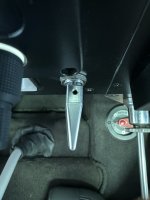
1) I loosened the set screws on the "flap" handle (they were tight) and removed the handle. I actually don't mind having just the raw toggle switch as it is less of a kick hazard than the handle sticking out from the panel.

2) I Still have questions about the toggle switch rotating. I confirmed that the toggle is rotating WITHIN the housing. Not the entire switch assembly. So when the flap handle was set tight on the toggle with the set screws it WAS the toggle itself that rotates. You can see from the dust in the housing that it is the toggle that rotates. Is this normal for this switch?

3) The toggle itself is three-positions. A locked up position (great for go-around or after landing flap retraction), a center neutral position and a momentary down position that sets one of the three flaps down positions with each "click".

4) After full flaps are extended (three down clicks) if I click the switch down again the motor starts running with no apparent intention of stopping (and obviously no further extension of flaps). I am concerned about this behavior burning out the motor. The only way to stop the motor is to move the toggle up to the uplock position and then back to the center neutral. This can accidnetally cause at least some flap retraction.

5) When I lock the toggle in the up position, the flaps retract all the way and the motor stops. I often forget to return the toggle to neutral after retraction, but it seems to not be a problem.

6) I forgot to look through the G3X settings to see which modules are installed. I'll do that next time at the hangar.

Appreciate any comments.

Screenshot 2026-01-23 at 16.26.22.pngScreenshot 2026-01-23 at 16.26.43.png
 
Mine does not rotate like that, so you could have a switch you need to replace. It could be causing other problems like you are mentioning I would assume.
 
I am finally back in town with my plane and re-awakening this thread. I took a video today of my flap switch operation but I guess there is no way to add it to this post.


2) I Still have questions about the toggle switch rotating. I confirmed that the toggle is rotating WITHIN the housing. Not the entire switch assembly. So when the flap handle was set tight on the toggle with the set screws it WAS the toggle itself that rotates. You can see from the dust in the housing that it is the toggle that rotates. Is this normal for this switch?
Could you make "walls" that captures both sides of the flap shaped handle (at the flat section) that would keep it from rotating?
Or maybe you need this?
 
Could you make "walls" that captures both sides of the flap shaped handle (at the flat section) that would keep it from rotating?
Or maybe you need this?
Wow!

First, I have done searches on many combinations of "rotating flap toggle switch" here and on Duck. Nothing brought me to the linked product.
Second, in their video they mention "most flap toggle switches rotate". I thought this was an anomaly on my plane but apparently it is quite common.
Finally, what a great product! Some day I may just purchase it, but for now I am happy with the harder to catch with my shoe basic toggle.
Thanks for the find.
 
Back
Top