Van's Air Force

The definitive Van's Aircraft support community! Buying, building or flying an RV? Join our exclusive family of mentors and enthusiasts!

Rocket Airfilter

Carl,
We explored this at length and made a flying prototype but ended up with a very creative flat plate filter without the scoop. We have achieved the pressure recovery as per Dan H latest post and as Dan commented, the Alt Air is by far a major challenge.
Sorry I am a bit vague with our details, however this is a major group effort and will share more when I can.

Carl, re the Airflow Performance duct for the Alt Air, there is just no room. With the SDS 90mm being half the length of the FM300B , there is still no room.
The Alt Air has to be part of the filtered airbox assy.
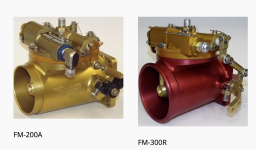
I think the modified RV-10 cowl for the Cold Air Sump will provide more room between my FM-200 and the cowl inlet. I’ll know more next month. But, I think your flat filter is the way to go.

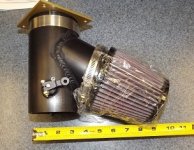
What K&N filter did you use?
Carl
 
Dynamic pressure is available with either inlet diameter.

Some assumptions are required, so I'll use 200 ktas, a 540 @2700 with typical VE around 0.875, and treat the inlet as a ring and tube. Including the effect of dynamic pressure, a 4"D inlet would produce roughly 0.4"Hg more than a 3"D inlet at 1000 ft, and 0.3 more at 8000 ft.

Recall dynamic pressure is 1/2 density * velocity squared. In a closed end pitot system we add it to static pressure by halting its motion. Here the system is not a closed end pitot, so conceptually the available dynamic pressure at the servo would be based on the difference between freestream velocity and velocity through the ring.

Ya'll check me:

View attachment 105279
Hey Dan,
That is where we ended up and why we started with the 4" intake.
Now getting that pressure to the intake ports is where the fun begins.
We have prototyped a tapered intake tubes from 2" to 1 3/4" and the results are promising but that project is on hold until we finalise the airbox.
I just wish a Skydynamic sump was not so darn expensive and un-obtainable.
 
I think the modified RV-10 cowl for the Cold Air Sump will provide more room between my FM-200 and the cowl inlet. I’ll know more next month. But, I think your flat filter is the way to go.

What K&N filter did you use?
Carl
Hey Carl,
There is very little difference in the length of the FM 200 and the FM 300.

We started with the K&N 2135 but have since moved on.........

1766456818694.png
 
Dynamic pressure is available with either inlet diameter.

Some assumptions are required, so I'll use 200 ktas, a 540 @2700 with typical VE around 0.875, and treat the inlet as a ring and tube. Including the effect of dynamic pressure, a 4"D inlet would produce roughly 0.4"Hg more than a 3"D inlet at 1000 ft, and 0.3 more at 8000 ft.

Recall dynamic pressure is 1/2 density * velocity squared. In a closed end pitot system we add it to static pressure by halting its motion. Here the system is not a closed end pitot, so conceptually the available dynamic pressure at the servo would be based on the difference between freestream velocity and velocity through the ring.

Ya'll check me:

View attachment 105279
Thank You for this. My current set up has a 3" Rd inlet. Currently I took the James assembly removed the filter it got better then took the alternator air door assembly portion and threw that in trash can and replaced it with a velocity Stack. Its amazing the power difference and how much it has leaned it out. This is a temporary fix for testing but short of adding a supercharger or turbo probably not going to get much better as far as performance.
 
So if my FM300R servo that is 4" dia do I need a 4" dia inlet in my cowl. I was always under the impression that the ram air effect made up the difference and even the 3" inlet if my math was some what right was good down to 100kts and anything under 100kts it would suffer losses.
There aer two opposing effects. There is a pressure increase due the slowing of the flow in the inlet (the ram effect), but there is a pressure loss across the restriction at the smallest diameter. How they sum out would be dependent on flight condtions, but I think a 4” inlet would give better overall performance .
 
There aer two opposing effects. There is a pressure increase due the slowing of the flow in the inlet (the ram effect), but there is a pressure loss across the restriction at the smallest diameter. How they sum out would be dependent on flight condtions, but I think a 4” inlet would give better overall performance .
Honest question here but where is the trade off from minimal engine performance gain by a bigger inlet say from 3"-4" to the drag penalty of the bigger scoop not that a 1" bigger scoop is increasing frontal area but more the drag from air flow spill out around the scoop. This could also be kind of a loaded question do it all depends what altitude one plans to consistently fly at.
 
Honest question here but where is the trade off from minimal engine performance gain by a bigger inlet say from 3"-4" to the drag penalty of the bigger scoop not that a 1" bigger scoop is increasing frontal area but more the drag from air flow spill out around the scoop.
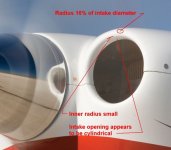
It's a good question. Years ago here, Steve pointed out the need to keep the flow attached as it moves out and around the entry, but I don't think we've ever quantified the potential for drag if done wrong.

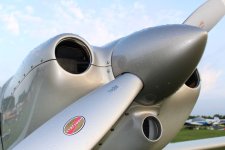
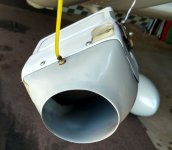
I had been lucky enough to speak with the design guy at Mooney who did the Acclaim cowl, who recommended an outer lip radius 16% of inlet diameter. I don't know where he got that value, but I used it as a target when I made a mold for the low Vi/Vo cooling inlets on my cowl. Can't speak to specifics, but they're not draggy, judging from performance on several airplanes.

That said, I got dumb when I did the airbox inlet and probably made it much too sharp. I seem to recall Steve did his with a generous lip, which means you should too.

Acclaim Intake with notes 600w.jpg

IMG_3696.JPG
 
Dynamic pressure is available with either inlet diameter.

Some assumptions are required, so I'll use 200 ktas, a 540 @2700 with typical VE around 0.875, and treat the inlet as a ring and tube. Including the effect of dynamic pressure, a 4"D inlet would produce roughly 0.4"Hg more than a 3"D inlet at 1000 ft, and 0.3 more at 8000 ft.

Recall dynamic pressure is 1/2 density * velocity squared. In a closed end pitot system we add it to static pressure by halting its motion. Here the system is not a closed end pitot, so conceptually the available dynamic pressure at the servo would be based on the difference between freestream velocity and velocity through the ring.
What DanH did here is not quite right. He correctly computed the velocity at the inlet, but ignored the potential for additional diffusion (pressure recovery) internally.
If you intake through a 3" diameter inlet, the velocity will be higher than if you intake through a 4" inlet, and so there will be less recovery of dynamic pressure at that location. However, if you can carefully diffuse the flow from the 3" inlet to the 4" servo without causing any flow separation, and we ignore viscous skin friction for a moment, you slow the flow down further, recovering the remaining dynamic pressure, resulting in the same pressure and velocity at the servo that you would have with a 4" inlet and a constant diameter duct.

Now, the rub is that there is viscous skin friction (you see what I did there?), so even with a carefully designed diffuser, there is still some pressure loss. Because the velocity is higher at the 3" inlet and the average velocity over the length of the duct is higher, there is more pressure loss from this skin friction than if you use the 4" inlet and have lower velocity from the inlet to the servo. How much? That would require a viscous-flow calculation which I have not done, but my instinct is that it is just a few inches of H2O. (* additional comment about this below)
There aer two opposing effects. There is a pressure increase due the slowing of the flow in the inlet (the ram effect), but there is a pressure loss across the restriction at the smallest diameter. How they sum out would be dependent on flight condtions, but I think a 4” inlet would give better overall performance .
Peter is correct. A different way to say what I just added above. Yes, the 4" inlet should perform slightly better. But the gain is not enough to justify cutting out and redoing an existing 3" inlet.
Honest question here but where is the trade off from minimal engine performance gain by a bigger inlet say from 3"-4" to the drag penalty of the bigger scoop not that a 1" bigger scoop is increasing frontal area but more the drag from air flow spill out around the scoop. This could also be kind of a loaded question do it all depends what altitude one plans to consistently fly at.
Yes, there are modest gains to be had by making the inlet even bigger, what we call external diffusion, because slowing the flow down out in front of the inlet does not have any losses. Then, when you re-accelerate the flow to the same velocity at the servo, the average velocity in the duct is lower, and, the flow is accelerating, both effects produce less skin friction. But again, we are talking about really small differences here. IF the external lip of the inlet is designed well, the spillage drag will be negligible, as DanH pointed out. Great picture by the way of the Mooney cowl to convey the point.

The real key thing here is to avoid any sudden increases in duct area that would lead to flow separation - that's where the big pressure losses are. The transitions from round ducts into and out of rectangular air boxes must be done very carefully - and realistically there isn't enough length available to do it well. Some losses from those abrupt area changes are inevitable.

(*) There are engineering handbook-type methods for estimating pressure losses from friction flow in pipes, but those are all for fully-developed pipe flow, meaning long lengths of pipe. Those methods don't apply to short lengths of pipe with fresh inlet flow. Von Karman's Integral Momentum theory is a reasonable approximation....but I'm retired ;)
 
Last edited:
He correctly computed the velocity at the inlet, but ignored the potential for additional diffusion (pressure recovery) internally.

Yep...specifically ignored the potential for internal diffusion (note "and treat the inlet as a ring and tube" ).

The real key thing here is to avoid any sudden increases in duct area that would lead to flow separation - that's where the big pressure losses are.

Reading material for the curious (credit Bill Lane).
 
The real key thing here is to avoid any sudden increases in duct area that would lead to flow separation - that's where the big pressure losses are. The transitions from round ducts into and out of rectangular air boxes must be done very carefully - and realistically there isn't enough length available to do it well. Some losses from those abrupt area changes are inevitable.

Steve, I love when you talk about practical application. You always make me think.

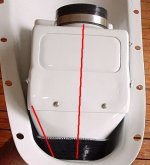
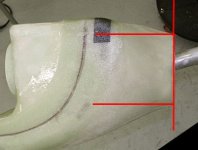
Stuffing a big flat filter into a short space can indeed force a lot of angle.

top angle.jpg

side angle.jpg

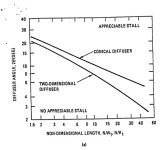
This one is about 40 degrees total angle in a top view and maybe 30 in a side view. N/R1 is about 2. The charts say the angles will push it into stalled territory, so it pretty much operates on external diffusion alone:

ScreenHunter_3087 Dec. 23 15.10.jpg

Question...in considering N/R1 (diffuser length / inlet radius), do we treat the filter as a ghost, something not really there, and consider only the shape of the enclosure all the way to the servo inlet?
 
Steve, I love when you talk about practical application. You always make me think.

Stuffing a big flat filter into a short space can indeed force a lot of angle.

View attachment 105373

View attachment 105374

This one is about 40 degrees total angle in a top view and maybe 30 in a side view. N/R1 is about 2. The charts say the angles will push it into stalled territory, so it pretty much operates on external diffusion alone:

View attachment 105376

Question...in considering N/R1 (diffuser length / inlet radius), do we treat the filter as a ghost, something not really there, and consider only the shape of the enclosure all the way to the servo inlet?
That's a very good question.
Placing a resistance element, like a filter or a heat exchanger DOES help make the diffusing flow stay attached to the duct, because it kind of imposes some bulk diffusion (back pressure), not relying on the walls to do all the work. The benefit is in some sense proportional to the loss imposed. So this unfortunately puts us at cross purposes. There are cases where you would want to put a loss element in the flow on purpose to keep the flow more uniform and attached to the walls, at the expense of the pressure loss. One example is in a wind tunnel upstream of the nozzle that accelerates the flow into the test section. But when the goal is to get the most pressure recovery, you would never choose to put a loss element in the circuit for that reason. But if you are going to have a loss element anyway, like an air filter or a radiator, you do get some benefit of being able to make the diffuser more aggressive without massive separation. This is why a wide-angle diffuser such as your airbox works so well, despite the wide turning angle.

Years ago I saw a report on the performance of a cooling air inlet and diffuser for a fighter plane with and without the radiator installed, and also with cold flow and hot flow in the radiator (the heat addition also helps). But I have not been able to find that report more recently when trying to do some design work on an overly aggressive cooling diffuser. I was almost to the point of building a small wind tunnel to evaluate this when the project got cancelled. The lack of experimental data on this sort of thing is frustrating. For example, the report you linked here does us the benefit of showing boundaries of the various flow conditions, and shows us what the theoretical pressure recovery should be, but provides no data on typical efficiency values, where efficiency would be defined as the actual achieved pressure recovery divided by the theoretical pressure recovery for a particular diffuser geometry. (Eq. 7-50 in the report). That would be the sort of data that would show us exactly the performance difference between a constant 4" inlet tube and a 3" inlet with a conical diffusion to 4" at the servo. Its almost enough motivation to set up a flow bench ;)
 
So really the biggest gain or advantage of the 4" inlet would be the ease of a smoother transition into the defuser to keep the air attached over the very short distance we have on our Rockets.
Im assuming the 4" inlet would also have a bigger advantage at higher altitudes in the thinner air say at the 15,000-17,000ft range for efficient cross country flights.
 
That's a very good question.
Placing a resistance element, like a filter or a heat exchanger DOES help make the diffusing flow stay attached to the duct, because it kind of imposes some bulk diffusion (back pressure), not relying on the walls to do all the work...This is why a wide-angle diffuser such as your airbox works so well, despite the wide turning angle.

I'm not convinced it actually does gain much from internal diffusion.

The early design assumption was the angles would be too steep, so I went with a 4" inlet and hoped for the best. Later I put a tap in the top of the airbox. At 2500 ft and 201 KTAS, measured pressure recovery at the airbox tap was 17.7" H2O. Calculated value (same method as post #49) is 16.89 for 100% VE, or 17.51 for 90% VE, assuming freestream velocity only (no addition from propeller outflow). This was before I opened up the plenum inlet behind the FM-200. The actual VE may have been the typical 0.875, which would put a calculated prediction almost dead nuts on the measured value.

Point is, if there was significant internal diffusion in addition to the calculated external, it should have showed in the measurement.

Airbox Tap.jpg


Its almost enough motivation to set up a flow bench ;)

I think you should. No one here more qualified.
 
… at higher altitudes in the thinner air say at the 15,000-17,000ft range for efficient cross country flights.

If you have a standard Sport wing (HR-II or F-1), I’d be surprised if you find any efficiencies above 10,000. My wing takes so much more AoA to fly up there it just creates more drag.
 
If you have a standard Sport wing (HR-II or F-1), I’d be surprised if you find any efficiencies above 10,000. My wing takes so much more AoA to fly up there it just creates more drag.
That’s an interesting theory.
Since most Van’s aircraft (except the RV-9, I believe) share the same airfoil, that would imply that flying at higher altitudes (where oxygen is needed) might not be worth the effort for most RVs.
I’m contemplating adding oxygen to be able to get over the Rocky Mountains.
Anyone have a sense of a practical service ceiling for our Rockets?
 
Last edited:
That’s an interesting theory.
Since most Van’s aircraft (except the RV-9, I believe) share the same airfoil, that would imply that flying at higher altitudes (where oxygen is needed) might not be with the effort for most RVs.
I’m contemplating adding oxygen to be able to get over the Rocky Mountains.
Anyone have a sense of a practical service ceiling for our Rockets?
Its not the airfoil that matters. Its the low aspect ratio. Rockets (at least the HR's) are significantly lower aspect ratio because of the shortened wings. I'm not sure about the F-1 Sport wing, but I think its the same as the HR's.
Stock RV's do ok up to 12,500 or so, and start to feel a bit burdened at 14,000. A Rocket is going to suffer some above 10,000, but with all that horsepower, you might not notice.

When I flew to OSH with my RV-8, I burrowed a portable O2 set-up and went the whole way at 11,500.

The EVO wing, and of course our tapered composite wings, really shine up there. Bob Mills goes really well at 14,000, and with the new longer tips I'm working on, he will probably cruise at 17,500 when he needs to get somewhere a long way away.

If you are really curious about this, you can keep track of your MPG (miles per gallon) at different altitudes. Just divide your TAS by your fuel flow at each altitude.

Nm/gal = Ktas/gph
 
I'm not convinced it actually does gain much from internal diffusion.

The early design assumption was the angles would be too steep, so I went with a 4" inlet and hoped for the best. Later I put a tap in the top of the airbox. At 2500 ft and 201 KTAS, measured pressure recovery at the airbox tap was 17.7" H2O. Calculated value (same method as post #49) is 16.89 for 100% VE, or 17.51 for 90% VE, assuming freestream velocity only (no addition from propeller outflow). This was before I opened up the plenum inlet behind the FM-200. The actual VE may have been the typical 0.875, which would put a calculated prediction almost dead nuts on the measured value.

Point is, if there was significant internal diffusion in addition to the calculated external, it should have showed in the measurement.

View attachment 105455


I think you should. No one here more qualified.
Dan, it sounds like with the 4" inlet, all your diffusion is indeed external. The flow coming in is slow enough that it really doesn't matter what happens internally - there is just not much dynamic pressure left to lose.
 
If you are really curious about this, you can keep track of your MPG (miles per gallon) at different altitudes. Just divide your TAS by your fuel flow at each altitude.

My ancient D-180 does this for me and above 10k, it stops improving. The FF does drop with increasing altitude, but with more and more AOA needed on that stubby little wing, so does the TAS.

Incidentally, I had Nasty in the back seat with me just last week AND Mr. Anders in the next ship over on a form flight and we discussed this very thing. I need more wing if I want to go high and fast.
 
Anyone have a sense of a practical service ceiling for our Rockets?

“Service ceiling” is generally defined as the point where climb performance diminishes to some defined small value (seems I recall 200 FPM). I’ve had my Rocket to 16k and it was still climbing fine, but that’s different than an efficient cruise. Dave Anders likes to go to 16k+ in his RV-4 and turns some incredible TAS and MPG numbers. Even though the Rocket shares the same airfoil and DNA with the RV-4, the Rocket is considerably heavier AND has less wing area. Compared to Dave, I have a higher wing loading and lower aspect ratio - bad news for efficient, high altitude flight.
 
What size air filter should I get for an IO540?
An honest question from a builder
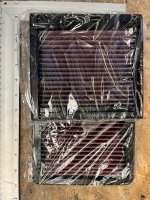
Did some basic calculations using RV14 EXP119 as a reference. I haven’t heard anyone complaining about inefficient induction in this aircraft, but it works well with a relatively small K&N 33-2060. The filter area is about 41 square inches.
If I understand correctly, the IO540 would need a filter that is about 1.38 times larger (540 divided by 390 equals 1.385).
A 33-2124 with an area of over 70 square inches seems like a good option.
Here’s a comparison: the 33-2060 is on top and the 33-2124 is on the bottom.

Q: Is my logic correct?
 

Attachments

  • IMG_5949.jpeg
    IMG_5949.jpeg
    4.2 MB · Views: 10
What size air filter should I get for an IO540?

There is no absolute answer, other than less restriction is better.

Nothing wrong with your math, but realize the size of the filter on the snorkel-equipped models is driven by available space, not max performance.

BTW, the key is media area, not flat plate size. Given two filters with identical flat plate dimensions, the thicker one will be the least restrictive. Deep pleats offer more media area.
 
Back
Top