Dynamic pressure is available with either inlet diameter.
Some assumptions are required, so I'll use 200 ktas, a 540 @2700 with typical VE around 0.875, and treat the inlet as a ring and tube. Including the effect of dynamic pressure, a 4"D inlet would produce roughly 0.4"Hg more than a 3"D inlet at 1000 ft, and 0.3 more at 8000 ft.
Recall dynamic pressure is 1/2 density * velocity squared. In a closed end pitot system we add it to static pressure by halting its motion. Here the system is not a closed end pitot, so conceptually the available dynamic pressure at the servo would be based on the difference between freestream velocity and velocity through the ring.
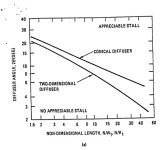
What DanH did here is not quite right. He correctly computed the velocity at the inlet, but ignored the potential for additional diffusion (pressure recovery) internally.
If you intake through a 3" diameter inlet, the velocity will be higher than if you intake through a 4" inlet, and so there will be less recovery of dynamic pressure
at that location. However, if you can carefully diffuse the flow from the 3" inlet to the 4" servo without causing any flow separation, and we ignore viscous skin friction for a moment, you slow the flow down further, recovering the remaining dynamic pressure, resulting in the same pressure and velocity
at the servo that you would have with a 4" inlet and a constant diameter duct.
Now, the rub is that there is viscous skin friction (you see what I did there?), so even with a carefully designed diffuser, there is still some pressure loss. Because the velocity is higher at the 3" inlet and the average velocity over the length of the duct is higher, there is more pressure loss from this skin friction than if you use the 4" inlet and have lower velocity from the inlet to the servo. How much? That would require a viscous-flow calculation which I have not done, but my instinct is that it is just a few inches of H2O. (* additional comment about this below)
There aer two opposing effects. There is a pressure increase due the slowing of the flow in the inlet (the ram effect), but there is a pressure loss across the restriction at the smallest diameter. How they sum out would be dependent on flight condtions, but I think a 4” inlet would give better overall performance .
Peter is correct. A different way to say what I just added above. Yes, the 4" inlet should perform slightly better. But the gain is not enough to justify cutting out and redoing an existing 3" inlet.
Honest question here but where is the trade off from minimal engine performance gain by a bigger inlet say from 3"-4" to the drag penalty of the bigger scoop not that a 1" bigger scoop is increasing frontal area but more the drag from air flow spill out around the scoop. This could also be kind of a loaded question do it all depends what altitude one plans to consistently fly at.
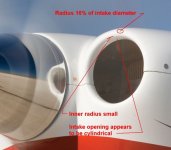
Yes, there are modest gains to be had by making the inlet even bigger, what we call external diffusion, because slowing the flow down out in front of the inlet does not have any losses. Then, when you re-accelerate the flow to the same velocity at the servo, the average velocity in the duct is lower,
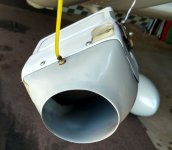
and, the flow is accelerating, both effects produce less skin friction. But again, we are talking about really small differences here. IF the external lip of the inlet is designed well, the spillage drag will be negligible, as DanH pointed out. Great picture by the way of the Mooney cowl to convey the point.
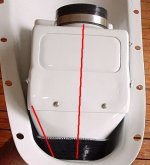
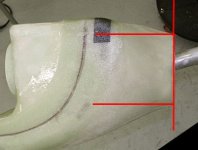
The real key thing here is to avoid any sudden increases in duct area that would lead to flow separation - that's where the big pressure losses are. The transitions from round ducts into and out of rectangular air boxes must be done very carefully - and realistically there isn't enough length available to do it well. Some losses from those abrupt area changes are inevitable.
(*) There are engineering handbook-type methods for estimating pressure losses from friction flow in pipes, but those are all for fully-developed pipe flow, meaning long lengths of pipe. Those methods don't apply to short lengths of pipe with fresh inlet flow. Von Karman's Integral Momentum theory is a reasonable approximation....but I'm retired