Van's Air Force

The definitive Van's Aircraft support community! Buying, building or flying an RV? Join our exclusive family of mentors and enthusiasts!

Reliability of full size Molex connectors

Have you had any problems with the full size Molex connectors in the factory supplied harness?

  • Yes

    Votes: 5 20.0%
  • No

    Votes: 20 80.0%

  • Total voters
    25
Well, this is the purpose of my poll. There are some very experienced folks who say the factory Molex connectors do NOT work. Of course, this is a VERY unscientific poll but as of right now, 5 out of 10 people say they've had problems with their Molex connectors. I could accept maybe a <5% failure rate but not 33%.

I'm going to wait for a few more folks to chime in and vote but based on what folks are sharing so far, I will likely end up replacing my Molex pins with Deutsch. If I was a wiring genius I wouldn't be sweating this but I need every advantage I can get to minimize the chances of wiring issues.
One of the great things about the Deutsch connectors is how easy it is to repin them if necessary or if you want to make a change.
 
I do have one nice thing to say about the Molex connectors. If I hadn't worked with them, I wouldn't appreciate how AWESOME Deutsch connectors are.
 
It's more about the crimper than the housing. I have good crimpers, and my molex pin crimps are excellent. Whatever you choose, the crimp and correct pin selection is more important than the Molex/Deutsch housing debate.

I think a lot of people who have had Molex problems didn't know or see that there are different pins for different wire gauge, or didn't use high quality tooling.

The housing and system are used in a wide variety of industrial environments. I wouldn't put dielectric grease in them; and I especially wouldn't solder the pin. Soldering pins creates a stiffness that is not desirable in vibration environments and will lead to premature pin failure, but YMMV. It is true that they aren't designed for a lot of separation cycles. But I anticipate zero cycles unless for some strange reason I can't imagine the wing has to come off.

But some people are more black/white. Only Deutsch will do.....

But if you want to know all you can know about the Molex, check this PDF:
 

Attachments

It's more about the crimper than the housing. I have good crimpers, and my molex pin crimps are excellent. Whatever you choose, the crimp and correct pin selection is more important than the Molex/Deutsch housing debate.

I think a lot of people who have had Molex problems didn't know or see that there are different pins for different wire gauge, or didn't use high quality tooling.

The housing and system are used in a wide variety of industrial environments. I wouldn't put dielectric grease in them; and I especially wouldn't solder the pin. Soldering pins creates a stiffness that is not desirable in vibration environments and will lead to premature pin failure, but YMMV. It is true that they aren't designed for a lot of separation cycles. But I anticipate zero cycles unless for some strange reason I can't imagine the wing has to come off.

But some people are more black/white. Only Deutsch will do.....

But if you want to know all you can know about the Molex, check this PDF:
Molex..."cause that how it's always been done", right?
 
Molex..."cause that how it's always been done", right?
I guess so. We could also use the submarine-grade sealed circular connectors used on missile systems that will take a torpedo, flood and still never fail but that would be overkill too, and pretty heavy and expensive.
I merely offer my experience and the thought that one should arm oneself with the relevant data when deciding. It isn't a black and white choice. Many of us get very good service out of the Molex connectors. I did say I would be using the Deutsch on my new build, because I have them....

On a separate thought, a lot of the wires could be easily and cheaply connected with dsub pins, or with blade contacts, or with knife contactors, or with terminal strips, or with barrel crimps. All of these have been used successfully and with low problems for a number of builders. One of the advantages of most of these is that it allows the termination to reside in the fuselage and not the wing root, out of the weather for the most part. Problem then is its under the floor. Always a tradeoff.
 
Last edited:
Since we are taking Deutsch.... what is the favorite crimper for them?
I'm always skeptical of "cheaper" tools but fortunately Amazon has a great return policy so bought a JR ready DT and DTM kit several years ago and have not looked back. Tool works great. Maybe due to the simplicity of the design tolerances are not a big deal. One thing I tested was not only trying 24 awg (DTM advertises you can go down to 22 awg) but the pull test down to 26 awg and worked great. Didn't have to fold the stripped conductor and worked perfect. I do use gold plated pins so maybe that help? Molex is ok but seems to require a good crimper and decent technique to work well.

 
I have the DMC for all the dsub pins and some other things and yes it is excellent.
There is a big DMC and a little one.

AFM8 is the one for D-Subs, AF8 is the big one for the Deutsch.

There is a positioner for the DTM pins that fits the AFM8, but the DT and DTP pins requires the big one (AF8).

I built during covid when lots of things were hard to get, so I actually ended up with both the JR Ready and the AF8. I'll grab either when I need to crimp.

Derek
 
I bought two JR Ready crimpers. The first was for Deutsch pins. Works great but no positioner. You have to manually set the depth of the pin when you switch pin sizes. I then used a DMC crimper with positioners at the electronics class I attended last week. Having figured out what the positions do while at the class, I ordered a second JR Ready crimper with positioners for D-Sub pins. Crimpers with positioners are much more convenient.
 
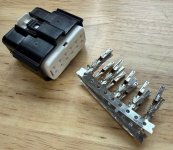
Thanks for that clarification. In this case, I'm only referring to the large Molex connectors (not the micro-Molex connectors) that Vans supplies with their factory wiring harness. And specifically, at the wing root of the RV-14.

View attachment 80980

Got it, they have been around a long time, kind of a power plug standard for many applications. Many CPU towers are full of them. The "other Molex" is this one at MX150L connector 2x2 . Or check the exploded views in the attachment. Easy to use, sealed, re-pin with a paper clip or a fancy pin tool. As I indicated earlier, this is what Van's/AeroLed shipped to me for Nav/Position lights and landing lights in wings of RV-12is. Much improved over the previous Molex plug offering. Crimps the same way and my old crimper worked fine, easy to use.
 

Attachments

The main reason for my connectors is to be able to complete all the necessary installation and testing tasks while in the workshop, 70' from my house. The hangar is at best 40 minute drive, it isn't heated or air conditioned, and nearly all the tools are in the workshop.

Reason enough for me...
The beauty of experimental, each can do the way they like it or suit their situation best. I also built, rigged and test as much as possible in my garage and made my cables that run to the wing long enough so not to have any connectors at the wing root or at the bulkhead right behind baggage area.
 
The beauty of experimental, each can do the way they like it or suit their situation best. I also built, rigged and test as much as possible in my garage and made my cables that run to the wing long enough so not to have any connectors at the wing root or at the bulkhead right behind baggage area.
Always more than one way to do things.
 
Keep in mind, there are three points of failure in any connector. Two crimps and the connector itself. I’ve seen a lot of bad crimps, not necessarily on Molex connectors, but they are more difficult to properly crimp than others….. I’ve seen very few connector failures of any type, even cheap auto store stuff…. Corroded connectors and bad crimps are far more common.
To the OP, your sample size is way too small to be meaningful. This has been brought up before in similar poles. Doesn’t mean it isn’t a good discussion but there are thousands of airplanes out there with Molex connectors, and of those, thousands of folks who have no idea if they have Molex connectors or not.
Good discussion always but as Bavafa stated, don’t use a connector if you don’t have to. A service loop works if it ever needs to be disconnected.
 
I'm pretty far along on my first build (RV-10) and even though I don't have any particular experience with Molex outside of the computer world, I went with DT and DTM connectors. I am putting connectors at my wing root because my fuselage will be done before I have my wings. This will allow me to complete the wiring in my fuselage, then transport it to the hangar, then later do the wiring in my wings, then transfer them to the hangar, then attach. Similar to a previous comment, I'm trying to minimize the amount of work I'll need to do at the final assembly stage.

 
I'm pretty far along on my first build (RV-10) and even though I don't have any particular experience with Molex outside of the computer world, I went with DT and DTM connectors. I am putting connectors at my wing root because my fuselage will be done before I have my wings. This will allow me to complete the wiring in my fuselage, then transport it to the hangar, then later do the wiring in my wings, then transfer them to the hangar, then attach. Similar to a previous comment, I'm trying to minimize the amount of work I'll need to do at the final assembly stage.

Makes sense but you can just left enough wire in the root to pull down the wings later. I used insulated seamless spade lugs and haven’t had any issues but in hind sight, could have just coiled up the wire there. My connectors are in a service loop under the seat pan.
 
Makes sense but you can just left enough wire in the root to pull down the wings later. I used insulated seamless spade lugs and haven’t had any issues but in hind sight, could have just coiled up the wire there. My connectors are in a service loop under the seat pan.

Definitely an option! But then after wing attach I would need to pull the wire and do all of the connections within the wing. I have quite a bit in my wings so that's a decent amount of work that would need to be done offsite.
 
Back
Top