

Van's Air Force
You are using an out of date browser. It may not display this or other websites correctly.
You should upgrade or use an alternative browser.
You should upgrade or use an alternative browser.
Prop Pitching Tool?
- Thread starter Brantel
- Start date



I JB Welded a Fowler digital level (it’s a mini block style level) to the Vans prop pitch tool because the slightest movement throws off the reading, and the magnetism of those is not strong enough to really hold it firmly without any movement at all. I also would recommend two levels, not one. And I like the Fowler ones because they don’t automatically turn off or at least not quickly. This is important to get even pitching between the props because you need to pitch one and then the other and that requires re-setting the blade leveling after rotating it 180 degrees. So I have one level set to the canopy deck per the instructions, and the other level set to the floor. You want the floor to be level but the most important factor in the blade pitch is that it’s the same on both blades. Minor variances in the floor leveling if you are zeroing the levels between checking each blade can easily throw the reading significantly more than the allowed variance between the blade pitch. The pitch is also going to change as you are tightening the hub, and it’s likely going to change a lot. You have to be predictive about which way it is swinging and undershoot the target so that it’s right where you want it after it’s torqued. It’s extremely tedious to get this correct, but it matters a lot.

Piper J3
Well Known Member
I use a bubble torpedo level with precision height blocks to set the prop hub level. I do this only one time and then measure distance from passenger-side blade tip to floor. In my case this dimension is 48-1/8”. Take out top spark plugs to allow easy turning of prop. Set prop “level” using tape measure and this dimension each time prop is spun to the next blade. Extremely repeatable…
I use Craftsman Digital Torpedo Level 48295 and Van’s sheetmetal pitch gauge to set prop pitch. Let digital level warm up before zeroing on canopy longeron and check frequently to verify “zero”. That said… place the sheetmetal gauge in the center of the magnetic holder on the bubble level to replecate any time you remove to check canopy longeron zero setting.
I have used the above procedure many times and can easily set blades to within 0.1 degree of each other…
I use Craftsman Digital Torpedo Level 48295 and Van’s sheetmetal pitch gauge to set prop pitch. Let digital level warm up before zeroing on canopy longeron and check frequently to verify “zero”. That said… place the sheetmetal gauge in the center of the magnetic holder on the bubble level to replecate any time you remove to check canopy longeron zero setting.
I have used the above procedure many times and can easily set blades to within 0.1 degree of each other…
I pulled from a couple ideas here on VAF. I used Van's prop pitch tool along with a digital level with integrated laser. Chocked all wheels to prevent movement of plane. I used the longerons to zero out the level, and a second level on the prop hub to maintain level there. Placed the level on the tool and set to desired pitch. I then placed some masking tape on the ground and marked the location of where the laser was pointing. Pulled the next blade around, attached the tool and level taking great care to ensure all locations were exactly (or as close as possible) as on the first blade. Lined up the laser with the first mark on the ground and verified on the level's readout that the pitch was the same number of degrees. For fun, I pulled the first blade back around to confirm a match. I did the math and determined the accuracy of this method was about as close to a perfect match as one is going to get.... Somewhere in the neighborhood of a small fraction of a degree. I hope that all makes sense.
This is not really clear how the laser is used.I pulled from a couple ideas here on VAF. I used Van's prop pitch tool along with a digital level with integrated laser. Chocked all wheels to prevent movement of plane. I used the longerons to zero out the level, and a second level on the prop hub to maintain level there. Placed the level on the tool and set to desired pitch. I then placed some masking tape on the ground and marked the location of where the laser was pointing. Pulled the next blade around, attached the tool and level taking great care to ensure all locations were exactly (or as close as possible) as on the first blade. Lined up the laser with the first mark on the ground and verified on the level's readout that the pitch was the same number of degrees. For fun, I pulled the first blade back around to confirm a match. I did the math and determined the accuracy of this method was about as close to a perfect match as one is going to get.... Somewhere in the neighborhood of a small fraction of a degree. I hope that all makes sense.
Strangely one of these.
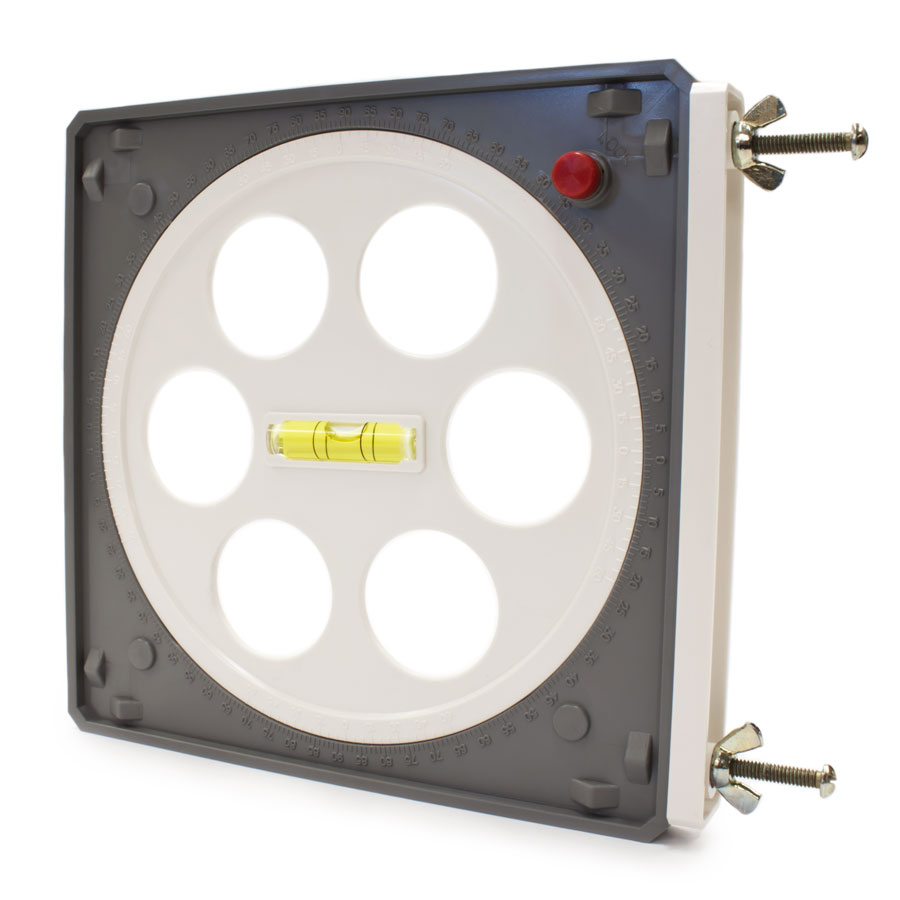
 warpdriveinc.com
Which I had from a previous aircraft.
John.
Warp Drive Protractor - Warp Drive Propellers
Warp Drive Protractor Used to set propeller blade pitch/angle.
warpdriveinc.com
Which I had from a previous aircraft.
John.
The laser-level hangs on the pitch tool, which hangs on the prop blade. The laser points at a spot on the ground. Mark the spot on the ground, remove from blade #1, pull next blade around to the same position, and hang it on blade #2. Adjust the pitch of blade #2 with the laser-level attached to it, until the laser points on the spot on the ground....this indicates the blades are pitch almost exactly to the same angle. More accurate that what the readout on most digital levels will show. Unless you spend a bunch of money on a level that gets down to the .00X range.This is not really clear how the laser is used.
There's an old thread discussing this topic: https://vansairforce.net/threads/digital-level-for-setting-prop-pitch.206549/
I ended up buying one of these:
Small enough to stick to the tool from Van's without having to glue it or tape it etc.
I ended up buying one of these:
Small enough to stick to the tool from Van's without having to glue it or tape it etc.

Can you post a link to the laser you use.The laser-level hangs on the pitch tool, which hangs on the prop blade. The laser points at a spot on the ground. Mark the spot on the ground, remove from blade #1, pull next blade around to the same position, and hang it on blade #2. Adjust the pitch of blade #2 with the laser-level attached to it, until the laser points on the spot on the ground....this indicates the blades are pitch almost exactly to the same angle. More accurate that what the readout on most digital levels will show. Unless you spend a bunch of money on a level that gets down to the .00X range.
Cant find the one that I used but this one is quite similar.Can you post a link to the laser you use.
Ok, that makes sense how you are using it.
I have a DUC 3 blade ground adjustable prop.
I use a standard digital protractor. I made a fixture with JB weld that conforms to the curve of the prop at correct the point of adjustment inboard of the tip. I mark that point with speed tape. This fixture also has a flat side to place the digital protractor against.
1st step is to adjust aircraft so the flywheel is 90 degrees straight up/down.
2nd step is to set the blade being adjusted to be absolutely horizontal.
Loosen the bolts and one blade at a time adjust the blade angle and snug it down.
It is match to match accuracy in all three blades to .05
I use a standard digital protractor. I made a fixture with JB weld that conforms to the curve of the prop at correct the point of adjustment inboard of the tip. I mark that point with speed tape. This fixture also has a flat side to place the digital protractor against.
1st step is to adjust aircraft so the flywheel is 90 degrees straight up/down.
2nd step is to set the blade being adjusted to be absolutely horizontal.
Loosen the bolts and one blade at a time adjust the blade angle and snug it down.
It is match to match accuracy in all three blades to .05
