Van's Air Force

The definitive Van's Aircraft support community! Buying, building or flying an RV? Join our exclusive family of mentors and enthusiasts!

PlanePower Alternator Alternative?

A lot of feedback here suggests the PP alternator is not that great. I am planning a full IFR panel. I understand now that B&C came out with an internally regulated unit, but I have not found details on it. Did anyone use an alternative alternator?
 
A lot of feedback here suggests the PP alternator is not that great.
And much other feedback disagrees. I think the polls usually run about 60/40 in favor of B&C. (that's by no means a real average of the results of the countless threads on the topic, it's a rough approximation)

Read a lot and you may conclude there is more buyer bias than fact in the results.

After all, we all like what we bought best, right?
 
A lot of feedback here suggests the PP alternator is not that great. I am planning a full IFR panel. I understand now that B&C came out with an internally regulated unit, but I have not found details on it. Did anyone use an alternative alternator?
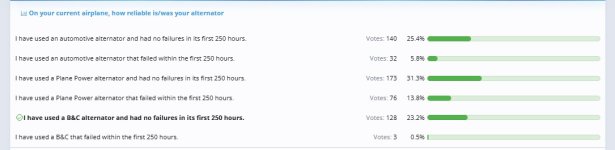
You decide but I'll summarize, failed in the first 250 hrs:

1) Automotive alternator - 5.8%
2) Plane Power - 13.8%
3) B&C - 0.5%


Screenshot 2024-12-15 205419.jpg
 
A lot of feedback here suggests the PP alternator is not that great. I am planning a full IFR panel. I understand now that B&C came out with an internally regulated unit, but I have not found details on it. Did anyone use an alternative alternator?
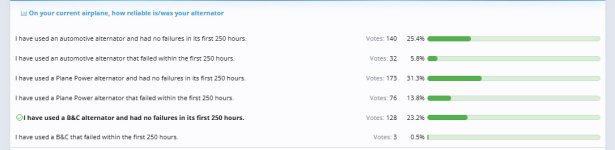
Save yourself some anguish... Go with B&C.

I've had three Plane Power alternators... and all have failed... once in IMC. In that case, the belt-driven 60a alternator failed and suddenly shifted the load to my engine driven Plane Power backup alternator. The sudden load shift caused the internal plastic gear to shear... resulting in total electrical failure after my airplane battery died.

Why did I originally go with Plane Power? Simplicity. Easy to wire. Like automotive alternators, an internal regulator avoids having an external regulator.

The B&C's external regulator offers additional fail-safe protection that automotive alternators don't. When things go south, it's much easier to troubleshoot the failure.
 
You decide but I'll summarize, failed in the first 250 hrs:

1) Automotive alternator - 5.8%
2) Plane Power - 13.8%
3) B&C - 0.5%


View attachment 76384

1734320147277.jpeg

Actually you misread/misreported the poll results…

auto: 32 early failures out of 172 = 18.6% failed prematurely
PP: 76 of 249 = 30.5% failed prematurely
B&C: 3 of 131 = 2.3% failed prematurely

This poll was created almost a decade ago. It could be that PP now makes alternators better than they used too. It’s also possible that they don’t. Take the numbers for what they are worth.
 
Last edited:
could someone link the original thread with the alternator poll and different automotive options that fit the plane power bracket? tried the search function but i think im using the wrong key words
 
could someone link the original thread with the alternator poll and different automotive options that fit the plane power bracket? tried the search function but i think im using the wrong key words
Here’s the original poll thread:

I don’t think a PP bracket fits the auto alternators. Vans used to sell the bracket, though they may no longer since it has been a long time since they used auto alternators in their FWF kits. That said, here’s the thread I created with a parts list. Again, some parts may no longer be available from suppliers noted in it:
 
On my -10 the PP alternator failed around the 400 hours mark, which unfortunately is more of a norm, converted to a B & C. Was not that hard, but had to install a voltage regulator. I’m on my second PP backup alternator. The first one made it just past the warranty period. The second one also had an issue where the plastic shear drive failed at 200 hours. Hartzell warranty people were terrible to deal with. I plan to switch to a B&C back up next time the PP fails.
 
<<SNIP>>

This poll was created almost a decade ago. It could be that PP now makes alternators better than they used too. It’s also possible that they don’t. Take the numbers for what they are worth.
I use BOTH brands. With that said ...

The above statement is important.

The PP alternator was "re-engineered" after Hartzell bought the company. I, too, had failures with the early models.

The "remoting" of the regulator is a MAJOR item for improved longevity.
Also, many of us *probably* did not adequately cool the onboard regulator of the PP.

PP now offers a remote regulator as well.

Use data on current models.
Decide based on your needs and "fears".

FYI/YMMV
 
I’ve been around a while and have installed 5 B&Cs over 20y with nil issues to speak of.
Seems like every week here someone has a PP issue of some description or another.
If you go back 10+ years then the argument was that the B&C was more expensive (and the regulator required extra wiring 🙄) and vans pushed the PP (probably because it was cheaper)
Now a vans supplied PP 60A is almost 50% more expensive than a B&C 60A alt+reg combo.
So the question should be why would one consider installing a PP at all?
 
View attachment 76388

Actually you misread/misreported the poll results…

auto: 32 early failures out of 172 = 18.6% failed prematurely
PP: 76 of 249 = 30.5% failed prematurely
B&C: 3 of 131 = 2.3% failed prematurely

This poll was created almost a decade ago. It could be that PP now makes alternators better than they used too. It’s also possible that they don’t. Take the numbers for what they are worth.
You are correct, was using the numbers in the poll which were failed individual units divided by total unit failures. My mistake.
 
And much other feedback disagrees. I think the polls usually run about 60/40 in favor of B&C. (that's by no means a real average of the results of the countless threads on the topic, it's a rough approximation)

Read a lot and you may conclude there is more buyer bias than fact in the results.

After all, we all like what we bought best, right?
Can you include that poll that shows 60/40? The last poll I looked here on VAF indicated a much different result.
 
I’ve been around a while and have installed 5 B&Cs over 20y with nil issues to speak of.
Seems like every week here someone has a PP issue of some description or another.
If you go back 10+ years then the argument was that the B&C was more expensive (and the regulator required extra wiring 🙄) and vans pushed the PP (probably because it was cheaper)
Now a vans supplied PP 60A is almost 50% more expensive than a B&C 60A alt+reg combo.
So the question should be why would one consider installing a PP at all?
You are correct.

When the PP first came out, I got one to replace an automotive alternator. It cost more than the automotive but less than the B&C at the time. It was also an easier/quicker installation for the already flying plane. In theory, it was supposed to be more reliable than the automotive.

With the price comparison you reference and given that one chooses external regulation, then the choice is more obvious. For someone who may have purchased a plane and not want to get into doing the (somewhat minor) work associated with wiring in a regulator, I wanted those individuals to be sure and check the current reliability data and go from there. I too had failures (plural) on the original PP model. My current project, started decades ago 🙂 is designed around Bob's Z-14 and the B&C products. And I replaced a failed PP with a B&C. So, I am simply encouraging the poster to do the research that matters for them and make their decision based on that. Be that for alternators, engines, props, or even airframes.
 
Can you include that poll that shows 60/40? The last poll I looked here on VAF indicated a much different result.
No. In fact I specifically stated: (that's by no means a real average of the results of the countless threads on the topic, it's a rough approximation)
 
On my -10 the PP alternator failed around the 400 hours mark, which unfortunately is more of a norm, converted to a B & C. Was not that hard, but had to install a voltage regulator. I’m on my second PP backup alternator. The first one made it just past the warranty period. The second one also had an issue where the plastic shear drive failed at 200 hours. Hartzell warranty people were terrible to deal with. I plan to switch to a B&C back up next time the PP fails.
My PP voltage regulator recently failed at well under 300 hours. Not great. Although in my case the PP warranty claim process was fine. B&C all the way for me next time.
 
I'm currently using an IndyAlt internal regulated alternator (with an OV module) after having great luck with the Plane Power that was on the plane when I bought it ( not clear exactly how many hours are on the PP but somewhere between 800 and 1100 hours and was still working).
 
Ordered a 60-amp B&C alternator from B&C yesterday for $ 635.00. They re-clocked it no-charge. Good customer service!
 
My PP voltage regulator recently failed at well under 300 hours. Not great. Although in my case the PP warranty claim process was fine. B&C all the way for me next time.
Was the failure mode mechanical or electronic/internal? Do you have the serial # handy?

I know the Denso brush holders are less sloppy, and the pins tend to fret and cause voltage issues, but they don't seem to have been high probability failure modes of the 60A PP, but used brushes are worn way off axis.

On price - -I paid under $400 for my PP, and now seem to be nearly $1575!! If only my income had increased 4X. B&C is now a totally no-brainer .
 
Was the failure mode mechanical or electronic/internal? Do you have the serial # handy?

I know the Denso brush holders are less sloppy, and the pins tend to fret and cause voltage issues, but they don't seem to have been high probability failure modes of the 60A PP, but used brushes are worn way off axis.

On price - -I paid under $400 for my PP, and now seem to be nearly $1575!! If only my income had increased 4X. B&C is now a totally no-brainer .
External regulator, so an electronic failure. Started failing, apparently inducing an overvoltage trip, whenever it got warm. PP asked me to send it back to them so that they could test/inspect it, and about a month later they sent me a new replacement without further comment.
 
What’s interesting about the externally vs internally regulated thread is that the rectifier diodes are internal to both types of alternators. You would think the diodes would suffer the same mortality rate as a regulator, however my B&C alternator is chugging along fine without any blast tubes. There must be a weak link that isn’t a semiconductor- typical automotive regulators use capacitors; capacitors don’t like heat so that might be the root cause. It would be an interesting experiment to install a new Plane Power alternator with healthy blast tubes at all inlets then see how long it runs.
 
Ordered a 60-amp B&C alternator from B&C yesterday for $ 635.00. They re-clocked it no-charge. Good customer service!
Can you share the model # of the alternator, internal regulator? Do you have the io390 210hp? Is it a big deal to mount where my pp alternator is supposed to go?
 
What’s interesting about the externally vs internally regulated thread is that the rectifier diodes are internal to both types of alternators. You would think the diodes would suffer the same mortality rate as a regulator, however my B&C alternator is chugging along fine without any blast tubes. There must be a weak link that isn’t a semiconductor- typical automotive regulators use capacitors; capacitors don’t like heat so that might be the root cause. It would be an interesting experiment to install a new Plane Power alternator with healthy blast tubes at all inlets then see how long it runs.
Another data point...I have a 9A with a Titan IO-370, Plane Power alternator, usual boss mount with blast tube. First failure was at 160 hours TT, second was on Dec 12 with 41 hours TT on a new replacement. During the first failure, I lost the EarthX battery, and b/u avionics battery. The engine shut down on the runway after landing (dual P mags).
Customer support at Plane Power has been very good. The first unit was replaced under warranty and, I suspect, the second will be also. The most frustrating part is that the failures seem to be intermittent and not reproducible. The first unit passed a bench test; I suspect the second will also. Neither unit responded to the usual alternator re-set in flight. The trouble shooting schematic on the PP website was followed , with no failure points noted external to the alternator. The situation doesn't make cross country flying very comfortable. Steve
 
Another data point...I have a 9A with a Titan IO-370, Plane Power alternator, usual boss mount with blast tube. First failure was at 160 hours TT, second was on Dec 12 with 41 hours TT on a new replacement. During the first failure, I lost the EarthX battery, and b/u avionics battery. The engine shut down on the runway after landing (dual P mags).
Customer support at Plane Power has been very good. The first unit was replaced under warranty and, I suspect, the second will be also. The most frustrating part is that the failures seem to be intermittent and not reproducible. The first unit passed a bench test; I suspect the second will also. Neither unit responded to the usual alternator re-set in flight. The trouble shooting schematic on the PP website was followed , with no failure points noted external to the alternator. The situation doesn't make cross country flying very comfortable. Steve
Curious! Your P-mags should have continued to operate, if you were above about 900 rpm. Why did they fail?
 
Pmags run on internal power down to 850-900 RPM. Below that they rely on ship´s power. So during rollout the windmilling decreases and so the RPM is going down to idle RPM whatever it is set to. The engine shuts down passing this critical RPM without electric power.
 
Pmags run on internal power down to 850-900 RPM. Below that they rely on ship´s power. So during rollout the windmilling decreases and so the RPM is going down to idle RPM whatever it is set to. The engine shuts down passing this critical RPM without electric power.
I understand that, but I am surprised idle rpm was set so low, lower than mine. Part of the set-up for P-mags is to determine the rpm below which they will fail and set idle accordingly.
 
I understand that, but I am surprised idle rpm was set so low, lower than mine. Part of the set-up for P-mags is to determine the rpm below which they will fail and set idle accordingly.
I did a quick review of the Pmag manual and couldn´t find the passus saying to set idle RPM to a special value. I would say that such a high idle RPM will cause long landings with both fixed pitch and CS props. What is your static idle RPM?
 
Another data point...I have a 9A with a Titan IO-370, Plane Power alternator, usual boss mount with blast tube. First failure was at 160 hours TT, second was on Dec 12 with 41 hours TT on a new replacement. During the first failure, I lost the EarthX battery, and b/u avionics battery. The engine shut down on the runway after landing (dual P mags).
Customer support at Plane Power has been very good. The first unit was replaced under warranty and, I suspect, the second will be also. The most frustrating part is that the failures seem to be intermittent and not reproducible. The first unit passed a bench test; I suspect the second will also. Neither unit responded to the usual alternator re-set in flight. The trouble shooting schematic on the PP website was followed , with no failure points noted external to the alternator. The situation doesn't make cross country flying very comfortable. Steve
Fails in the airplane then works on the bench is not a robust design; blast tubes won't fix the design or increase your confidence. What do you think of the B&C alternator?
 
A lot of feedback here suggests the PP alternator is not that great. I am planning a full IFR panel. I understand now that B&C came out with an internally regulated unit, but I have not found details on it. Did anyone use an alternative alternator?
One automotive & one plane power alternator; both failed within 200 hours time in service. Now 500 hours on B&C 40 amp alternator & still running strong.
 
Curious! Your P-mags should have continued to operate, if you were above about 900 rpm. Why did they fail?
My idle RPM is set at 700, below the critical P mag setting. I guess that I'm at a decision point regarding alternators.
 
Another data point...I have a 9A with a Titan IO-370, Plane Power alternator, usual boss mount with blast tube. First failure was at 160 hours TT, second was on Dec 12 with 41 hours TT on a new replacement. During the first failure, I lost the EarthX battery, and b/u avionics battery. The engine shut down on the runway after landing (dual P mags).
Customer support at Plane Power has been very good. The first unit was replaced under warranty and, I suspect, the second will be also. The most frustrating part is that the failures seem to be intermittent and not reproducible. The first unit passed a bench test; I suspect the second will also. Neither unit responded to the usual alternator re-set in flight. The trouble shooting schematic on the PP website was followed , with no failure points noted external to the alternator. The situation doesn't make cross country flying very comfortable. Steve
Did you have any EMS indications that the alternator was not producing 14+ volts or the main battery was going dead?
 
I did a quick review of the Pmag manual and couldn´t find the passus saying to set idle RPM to a special value. I would say that such a high idle RPM will cause long landings with both fixed pitch and CS props. What is your static idle RPM?
My idle rpm is about 850. My P-mags quit about 800. I have never seen such low rpms while flying, only at shutdown. Constant speed prop with a big chord.
 
Did you have any EMS indications that the alternator was not producing 14+ volts or the main battery was going dead?
The set-up that I have in my plane is a Garmin 3X system, Vertical Power electronic circuit breakers, EarthX battery, and TCW back-up battery. The panel was wired by Stein and well done, but there is little back-up once electrons are lost. The EarthX battery has advantages/disadvantages. One of the drawbacks (my opinion) is that it can be almost totally depleted prior to losing voltage and going offline. I have a battery warning light from the EarthX to the panel that alerted me to the problem. When the primary battery went offline, The TCW battery worked fine but only for about 30 minutes (I have since replaced it with a similar TCW of greater capacity). When the back-up battery went offline, I had no engine data, flight data, comms, or transponder. I only mention all this to emphasize that a single point of failure (alternator) resulted in a loss all useful flight/airplane information.
 
Can you share the model # of the alternator, internal regulator? Do you have the io390 210hp? Is it a big deal to mount where my pp alternator is supposed to go?
LX-60, not internally regulated. The 10's Showplanes cowling needed a re-clocked alternator. For the 14 with a Vans cowling the LX-60 does not need re-clocking, fits fine.
 
The set-up that I have in my plane is a Garmin 3X system, Vertical Power electronic circuit breakers, EarthX battery, and TCW back-up battery. The panel was wired by Stein and well done, but there is little back-up once electrons are lost. The EarthX battery has advantages/disadvantages. One of the drawbacks (my opinion) is that it can be almost totally depleted prior to losing voltage and going offline. I have a battery warning light from the EarthX to the panel that alerted me to the problem. When the primary battery went offline, The TCW battery worked fine but only for about 30 minutes (I have since replaced it with a similar TCW of greater capacity). When the back-up battery went offline, I had no engine data, flight data, comms, or transponder. I only mention all this to emphasize that a single point of failure (alternator) resulted in a loss all useful flight/airplane information.
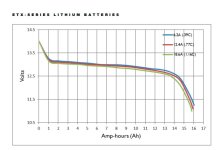
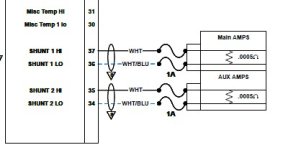
A properly operating alternator will output 14.2 - 14.6 volts (Voltage needed for an Earth X battery to charge, Earth X states down to 13.9 volts but I think that is too low, in my opinion) When you lose the alternator the bus will drop within almost secs to 13.4 to 13.6 volts (depending on where the sense wire is located) so set a yellow alarm for 13.9 volts and a red alarm and audio warning at 13.7 volts. (Turn off the alternator in flight and check exactly where the voltage drops to, it will drop.) Typically, Stein wires in for a shunt in your B-lead and that can detect the drop in amps and alarm. With today's EFIS systems you should know when you have an alternator issue within a minute or less. You are correct an Earth X battery stays fairly linear after the alternator goes offline but will drop off a noticeable amount when the alternator goes offline.

Screenshot 2024-12-23 151000.jpgScreenshot 2024-12-23 152009.jpg
 
Last edited:
A properly operating alternator will output 14.2 - 14.6 volts (Voltage needed for an Earth X battery to charge, Earth X states down to 13.9 volts but I think that is too low, in my opinion) When you lose the alternator the bus will drop within almost secs to 13.4 to 13.6 volts (depending on where the sense wire is located) so set a yellow alarm for 13.9 volts and a red alarm and audio warning at 13.7 volts. (Turn off the alternator in flight and check exactly where the voltage drops to, it will drop.) Typically, Stein wires in for a shunt in your B-lead and that can detect the drop in amps and alarm. With today's EFIS systems you should know when you have an alternator issue within a minute or less. You are correct an Earth X battery stays fairly linear after the alternator goes offline but will drop off a noticeable amount when the alternator goes offline.

View attachment 76873View attachment 76875
Thanks for the information. In my set-up, I'm not exactly sure where the voltage is measured. I assumed it was at the VPX unit since it has a graphical display of battery voltage, and cant say that I've seen it routinely greater than 13.5. There is a shunt coming off the B lead of the alternator, which I believe also goes back to the VPX. I have a question about alternator output: the day after the failure, I started the plane while monitoring the VPX and it had the usual amp surge after start (?40 amps). After a few minutes, I let the engine idle at a constant 1500 rpm. The amperage output varied between 0 and 20, with a constant load (EFIS, radios, etc) of about 7 amps. Is that normal or the sign of an alternator problem? In other words, should the produced amperage be linear function with RPM? I clearly don't know enough about airplane electrical systems.
 
Thanks for the information. In my set-up, I'm not exactly sure where the voltage is measured. I assumed it was at the VPX unit since it has a graphical display of battery voltage, and cant say that I've seen it routinely greater than 13.5. There is a shunt coming off the B lead of the alternator, which I believe also goes back to the VPX. I have a question about alternator output: the day after the failure, I started the plane while monitoring the VPX and it had the usual amp surge after start (?40 amps). After a few minutes, I let the engine idle at a constant 1500 rpm. The amperage output varied between 0 and 20, with a constant load (EFIS, radios, etc) of about 7 amps. Is that normal or the sign of an alternator problem? In other words, should the produced amperage be linear function with RPM? I clearly don't know enough about airplane electrical systems.
Since you are using a Plane Power alternator with an internally regulated VR (?) I'm going to claim ignorance. (I use B&C with an externally regulated VR) I do know that EarthX like all batteries with this chemistry need 13.9 volts to 14.6 volts to charge the battery fully. Regardless, you should see a decent drop in voltage when the alternator goes off-line. (A minimum of 1/2 a volt). Download your logs from the G3X. Savy is an excellent tool to read them, or you can review inputting the raw data into Excel. Normally the VPX can read amps the VPX system is pulling not the output of the alternator. (This is set in the G3X configuration for the engine and airframe and can be set to VPX amps or a true shunt that is wired to the GEA24). That is read (At least in my 2 set-ups) on the GEA24. You should have an interconnect drawing from Stein, that will tell you where it is being read. RPM and amperage output can be "linear" but only if the battery needs topping off. That is determined by the state of the battery, the sense voltage and what voltage the VR is set at. I think what gasman was alluding to like me you should get all kinds of warnings when you lose your alternator if the system is set-up correctly.
 
I understand now that B&C came out with an internally regulated unit, but I have not found details on it.
SilverFlite SF601. Spoke with TJ at B&C today and they will be shipping this internally regulated alternator early in the new year. $595.00

“This is an early-production unit, though the B-lead orientation shown is accurate to what will ship.

I am advised that there may be an interference between the alternator attachment bracket provided and the induction "snorkle" used on some RV's. An alternate bracket is being considered — nothing definite decided at this time — though it would also be possible to negotiate the interference with a modification to the snorkle if time is of the essence. I'm not sure if this would be relevant to your 14A, but I thought I would make mention of it just the same.

Also per our conversation, I will request that your name be added to the interest list for the SF601 alternator. A member of our staff will contact you once units are able to be shipped.

We appreciate your call. Thank you for your interest in our product.

Kind Regards,
"TJ" “

IMG_0366.png
 
On price - -I paid under $400 for my PP, and now seem to be nearly $1575!! If only my income had increased 4X. B&C is now a totally no-brainer .
When Arcline Investment Management bought Hartzell (including the PlanePower product line), they immediately jacked prices way up, and then bought Hartzell's only meaningful competition in the sport aviation CS prop market (Whirlwind). Bracing myself for the news that they are buying out B&C next...I'm sure they would love to monopolize the starter/alternator market as well, with additional 4x price markups to follow...
 
When Arcline Investment Management bought Hartzell (including the PlanePower product line), they immediately jacked prices way up, and then bought Hartzell's only meaningful competition in the sport aviation CS prop market (Whirlwind). Bracing myself for the news that they are buying out B&C next...I'm sure they would love to monopolize the starter/alternator market as well, with additional 4x price markups to follow...
Hang in their B&C and MT!
 
B&C entering the aircraft internally regulated alternator market tells me they see some low hanging fruit ripe for the picking!
Yes but it will take a long time to prove the new offering is better than current IR units out there.
 
Yes it takes time to get a good statistical sample- even good companies can screwup. I’m hoping the competition will help us out.
 
Personally I see no benefit in an internally regulated alternator unless the marginal benefit for you is running a few less wires. Which then raises all sorts of other questions for a home built airplane…
Also, with the range of battery chemistries you need to be able to tweak the regulator voltage.
There’s plenty of threads here about batteries and charging voltages but suffice to say an internally regulated plane power fixed at 13.6v is not a one size fits all proposition. Perhaps the internally regulated B&C is adjustable?
 
Back
Top