
Exactly. We have so much data available to us now in flight. Some careful experimentation is all you need to do.Same here. I am NOT a red box / fin / whatever disciple. Big believer in understanding the complete mix of variables that push an engine toward detonation, but something as simple as that box is really just over conservative and over simplified. Clearly safer, but a level of conservativeness that is unnecessary IMO.

Van's Air Force
You are using an out of date browser. It may not display this or other websites correctly.
You should upgrade or use an alternative browser.
You should upgrade or use an alternative browser.
Plane slower than spec at maximum throttle forward
- Thread starter Mdragon
- Start date


In my case, the 65% comes from the instructions that came with my GAMI injectors. Also, Mike Bush talks about 65% being a magic number (my words not his).
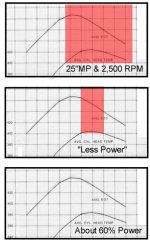
The Red Box as imagined by far too many pilots...

The Red Box as originally presented in an APS powerpoint. Note the CHTs. Anyone here seeing those values with a 390?
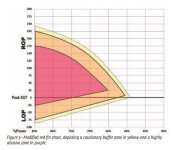
The Red Box as reimagined by Busch. Ignore the inflammatory language. Instead note 75% power intersects peak EGT...exactly what Lycoming published.
Now, about that buffer zone. The underlying factor with mixtures near stoich is a faster burn rate. Again from APS (and well supported in the literature):
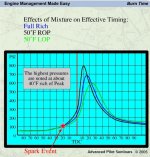
Rapid combustion moves the point of peak cylinder pressure closer to TDC, which raises it quite a lot. The classic Deakin/APS advice for long life (illustrated above) is to run LOP, moving the point of peak pressure further from TDC, thus reducing stress, both mechanical and thermal.
Now consider; a high percentage of RV owners are running variable timing ignitions, which moves peak pressure toward TDC. Should we generate a new Red Box based on timing advance? It's the same thing.
Lycoming also talks about 65% being recommended.
Where? I vaguely recall 65% recommended as cruise power for longest life, but nothing related to leaning, in particular LOP.
Last edited:
HAHA great post, and this is hilarious...


bpattonsoa
Well Known Member
. Try this simple trick. While on autopilot and lean of peak. Note airspeed and richen 1/4 turn. Let it settle a couple of minutes and check airspeed. Repeat until no further increase or speed drops .
I do this in my -10 and it is usually good for a bit more and helps you stay awake. Repeat every half hour or so or if you change altitude.
I do this in my -10 and it is usually good for a bit more and helps you stay awake. Repeat every half hour or so or if you change altitude.

Dan, how does an angle valve engine operating with CHT's 50 deg F cooler than a parallel valve engine effect these curves? For long cross countries I can't get more than 65% HP at the altitude I fly, and shorter cross countries just keep it below 65% because it makes ~5 maybe 10-minute difference in trip time. I'm retired an extra few minutes in flight is enjoyable.The Red Box as imagined by far too many pilots...
View attachment 102737
The Red Box as originally presented in an APS powerpoint. Note the CHTs. Anyone here seeing those values with a 390?
View attachment 102738
The Red Box as reimagined by Busch. Ignore the inflammatory language. Instead note 75% power intersects peak EGT...exactly what Lycoming published.
View attachment 102739
Now, about that buffer zone. The underlying factor with mixtures near stoich is a faster burn rate. Again from APS (and well supported in the literature):
View attachment 102741
Rapid combustion moves the point of peak cylinder pressure closer to TDC, which raises it quite a lot. The classic Deakin/APS advice for long life (illustrated above) is to run LOP, moving the point of peak pressure further from TDC, thus reducing stress, both mechanical and thermal.
Now consider; a high percentage of RV owners are running variable timing ignitions, which moves peak pressure toward TDC. Should we generate a new Red Box based on timing advance? It's the same thing.
Where? I vaguely recall 65% recommended as cruise power for longest life, but nothing related to leaning, in particular LOP.
So i see this common chart and fully subscribe to it, but question the cause and effect. I fully get how the flame travel rate of the different mixtures net different peak pressure points past tdc with the same spark point. The implication here is that the further distance from tdc is the sole reason that the peak pressure is different. But is that the complete answer? Could the energy density differences also be a factor in the different pressures also? Difference between 10 & 15* represents a pretty small piston movement. Is that the sole reason that the peak pressures are different?View attachment 102741
Rapid combustion moves the point of peak cylinder pressure closer to TDC, which raises it quite a lot.
The graph here doesn’t seem to match the physics involved at least as I understood them. Richer mixtures should burn faster and leaner mixtures slower. So why does 50 rop occur before full rich? I get that 50 rop is not a good place to be at high power, but have to wonder if more variables are involved here. Maybe once you get richer than best power, the flame travel speed slows down.
Not questioning the general message here, just trying to better understand all the factors.
Gentlemen,
I try to not to post data such as this without having some sort of back up. Note that I said nothing about Lycoming being OK running LOP, only that they recommend an engine power setting of 65% rated or less. I'm not saying you're wrong, only how I arrived at 65%. See below (the 65% statement is toward the bottom). Note: I also posted the link after the data.
Copied from Lycomning's web page:
I try to not to post data such as this without having some sort of back up. Note that I said nothing about Lycoming being OK running LOP, only that they recommend an engine power setting of 65% rated or less. I'm not saying you're wrong, only how I arrived at 65%. See below (the 65% statement is toward the bottom). Note: I also posted the link after the data.
Copied from Lycomning's web page:
Leaning the Normally Aspirated Engines
- Use full-rich mixture during takeoff or climb. Careful observation of engine temperature instruments should be practiced to ensure the limits specified in Lycoming Operator’s Manual are never exceeded. Refer to the aircraft POH (Pilot’s Operating Handbook) or AFM (Aircraft Flight Manual) for more specific instructions.
- For 5,000 feet density altitude and above, or high ambient temperatures, roughness or reduction of power may occur at full rich mixture. The mixture may be adjusted to obtain smooth engine operation. For fixed-pitch propellers, lean to maximum RPM at full throttle prior to takeoff where airports are at 5,000-feet density altitude or higher. Limit operation at full throttle on the ground to a minimum. For direct-drive and for normally aspirated engines with a prop governor, but without fuel flow or EGT, set throttle at full power and lean mixture at maximum RPM with smooth operation of the engine as a deciding factor.
- For cruise powers where best power mixture is allowed, slowly lean the mixture from full rich to maximum power. Best power mixture operation provides the most miles per hour for a given power setting. For engines equipped with fixed-pitch propellers, gradually lean the mixture until either the tachometer or the airspeed indicator reading peaks. For engines equipped with controllable pitch propellers, lean until a slight increase of airspeed is noted.
- For a given power setting, best economy mixture provides the most miles per gallon. Slowly lean the mixture until engine operation becomes rough or until engine power rapidly diminishes as noted by an undesirable decrease in airspeed. When either condition occurs, enrich the mixture sufficiently to obtain an evenly firing engine or to regain most of the lost airspeed or engine RPM. Some engine power and airspeed must be sacrificed to gain a best economy mixture setting. NOTE: When leaned, engine roughness is caused by misfiring due to a lean fuel/air mixture which will not support combustion. Roughness is eliminated by enriching slightly until the engine is smooth.
- The exhaust gas temperature (EGT) offers little improvement in leaning the float-type carburetor over the procedures outlined above because of imperfect mixture distribution. However, if the EGT probe is installed, lean the mixture to 100˚ F on the rich side of peak EGT for best power operation. For best economy cruise, operate at peak EGT. If roughness is encountered, enrich the mixture slightly for smooth engine operation.
- When installing an EGT probe, the probe must be installed in the leanest cylinder. Contact the airframe or kit manufacturer for the correct location. In experimental or custom applications, multiple probe instrumentation is required, and several power settings should be checked in order to determine the leanest cylinder for the specific application.
- Cylinder head temperature – limit listed in the Lycoming Operator’s Manual
- Oil temperature – limit listed in the Lycoming Operator’s Manual.
- For maximum service life, maintain the following recommended limits for continuous cruise operation:
- Engine power setting – 65% of rated or less
- Cylinder head temperatures – 400˚ F. or below.
- Oil temperature – 165˚ F. – 220˚ F
Last edited:
Dan, how does an angle valve engine operating with CHT's 50 deg F cooler than a parallel valve engine effect these curves?
One of the interesting things about the red box concept is the lack of quantified effect. Proponents are draped in expertise, and use words like abusive...but present no specific result for those who fail to follow the dictates of The Box. Exactly what is the nature of this abuse? Crickets. We're told our engines will "last longer".
Your question touches on another shortcoming. Are we to treat an 0-320 and a TIO-540 the same? Parallel valve and angle valve? Ignition advance or retarded? Lycoming and Continental?
Don't blame the original messengers. Braly and Deakin taught a concept based on lessons learned with turbo-compound radials, as applied to turbocharged Beechcraft. It's simple enough; lean well past peak to retard peak cylinder pressure, then increase manifold pressure to compensate for the loss of power. Fuel burn was reduced, engines ran cleaner, and CHT dropped, all good things. The Box was merely an illustration that stress, both thermal and mechanical, was higher on the rich side of peak where we had previously been taught to run. Higher power simply meant a bigger box. Go back and look at the APS illustration above. There is no EGT values. It's not intended to be specific. It's conceptual.
To your question...with all other factors equal, a lower CHT extends the detonation margin. If we consider The Box to be a set of pro-detonation operating conditions, the box would be smaller, at any power setting, with a lower CHT.
Reality is everyone's red box is different. Within the RV community we have a wide range of compression ratios and ignition timing. We have folks running auto gas. We see CHT's reported from 300 to 425, with two different combustion chambers. And we have very different attitudes about power use and long term wear. Anyone brave enough to define a specific line beyond which you will surly be cast into the depths of hell?
Last edited:
- For maximum service life, maintain the following recommended limits for continuous cruise operation:
- Engine power setting – 65% of rated or less
Like I said above, "I vaguely recall 65% recommended as cruise power for longest life, but nothing related to leaning, in particular LOP."
I have about 4500 hours on my Chevy pickup. It cruises the interstate at 35% power.
Last edited:
The graph here doesn’t seem to match the physics involved at least as I understood them. Richer mixtures should burn faster and leaner mixtures slower. So why does 50 rop occur before full rich? I get that 50 rop is not a good place to be at high power, but have to wonder if more variables are involved here. Maybe once you get richer than best power, the flame travel speed slows down.
Flame speed is fastest near best power mixture, and slower on both the rich and lean side.
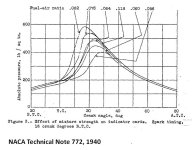
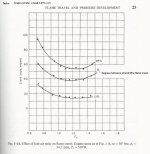
Creeping up on 100 years ago, we have NACA 772. This is just the lean side. "Indicator cards" were a record of mechanical measurement of cylinder pressure.
More contemporary, we have Taylor. This is mass fraction burned plotted against crank degrees, not the same thing as point of peak pressure. However, it does illustrate burn rate vs mixture. The nomenclature "Fr" may be confusing. Here Fr = F/Fc, where F = fuel/air and Fc is stoich. Thus Fr = 1 is roughly peak EGT, while Fr = 1.2 is around best power (aprox 12.5 to 1). Put another way, left of 1.0 is LOP, right of 1.0 is ROP.
Very interesting. Thanks for sharing that. Now makes a lot more sense knowing that richer than max pwr also burns slower. Kind of makes sense logically and also correlates with observed power decline as you go significantly richer than max pwr. Kind of wished I had taken more science classes when younger.Flame speed is fastest near best power mixture, and slower on both the rich and lean side.
Creeping up on 100 years ago, we have NACA 772. This is just the lean side. "Indicator cards" were a record of mechanical measurement of cylinder pressure.
View attachment 102832
More contemporary, we have Taylor. This is mass fraction burned plotted against crank degrees, not the same thing as point of peak pressure. However, it does illustrate burn rate vs mixture. The nomenclature "Fr" may be confusing. Here Fr = F/Fc, where F = fuel/air and Fc is stoich. Thus Fr = 1 is roughly peak EGT, while Fr = 1.2 is around best power (aprox 12.5 to 1). Put another way, left of 1.0 is LOP, right of 1.0 is ROP.
View attachment 102835
Which makes sense, where leaner mixtures are more capable of combusting more of the fuel, but rich mixtures are capable of combusting more of the air, which is limiting in a VE x displacement x RPM sense.This is mass fraction burned plotted against crank degrees, not the same thing as point of peak pressure. However, it does illustrate burn rate vs mixture. The nomenclature "Fr" may be confusing. Here Fr = F/Fc, where F = fuel/air and Fc is stoich. Thus Fr = 1 is roughly peak EGT, while Fr = 1.2 is around best power (aprox 12.5 to 1). Put another way, left of 1.0 is LOP, right of 1.0 is ROP.
Which makes sense, where leaner mixtures are more capable of combusting more of the fuel, but rich mixtures are capable of combusting more of the air, which is limiting in a VE x displacement x RPM sense.
In theory, lean of stoichiometric simply means excess air, while rich of stoich means not quite enough air. The mass fraction burned as charted above is the number of crank degrees required (i.e. time) to reach the listed percentage of available fuel combusted. It's only one factor in power produced.
BTW, while looking at the plot from Taylor, consider this classic OWT; EGT's drop with ignition advance because the advance gained enough time for all the fuel to be combusted before the valve opens.
Naaa.
Look at the 95% plot for the lab engine. At stoich, it's 95% burned in 60 degrees. Let's assume a variable timing system triggered at 35 BTDC. It means 95% of the fuel has been burned by 25 ATDC...and the exhaust valve doesn't open until 120 ATDC.
Last edited:
Maybe I missed the pics of your static ports ?? This is just the beginning of understanding your issues.......Thanks, I will get a picture up of the static ports soon.
Looking at the throttle linkage at the body, it looks like at full throttle the linkage rotates back on itself and backs off a bit when throttle fully push in. Adjusted this best i could. Seems to have resolved most of issue. Now able to get 168 knots out of it. Did the cardinal direction IAS vs GS test at several altitudes, still have to crunch the numbers, but looks like more inline with what is expected of the plane per Vans. Was not a static error, but a mechanical linkage issue.

Did you happen to notice an increase in takeoff performance since you were not developing full power WOT?Looking at the throttle linkage at the body, it looks like at full throttle the linkage rotates back on itself and backs off a bit when throttle fully push in. Adjusted this best i could. Seems to have resolved most of issue. Now able to get 168 knots out of it. Did the cardinal direction IAS vs GS test at several altitudes, still have to crunch the numbers, but looks like more inline with what is expected of the plane per Vans. Was not a static error, but a mechanical linkage issue.

That’s great.Looking at the throttle linkage at the body, it looks like at full throttle the linkage rotates back on itself and backs off a bit when throttle fully push in. Adjusted this best i could. Seems to have resolved most of issue. Now able to get 168 knots out of it. Did the cardinal direction IAS vs GS test at several altitudes, still have to crunch the numbers, but looks like more inline with what is expected of the plane per Vans. Was not a static error, but a mechanical linkage issue.
By the way, every CI checklist should include checking engine controls to insure they hit the stops, both ways.
One has to wonder who did the prior inspections and how this was missed. It’s pretty basic stuff for any aircraft.
