Van's Air Force

The definitive Van's Aircraft support community! Buying, building or flying an RV? Join our exclusive family of mentors and enthusiasts!

Placement of GPS antenna

kenpilot

Well Known Member
Friend
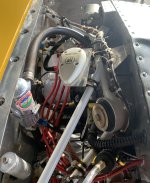
I have an RV-6A, and my GNS-400W antenna has always been placed in the engine compartment, above the magnetos, on a bracket attached to the engine mount:
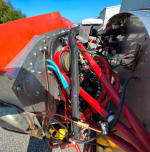
1762492815287.png

I have occasional loss of GPS signal. I've even had it happen while shooting an IFR approach (VMC luckily). I've read that this is a terrible place for it to be, so maybe that's why. Since I'm doing an engine change right now, I figured it's a good time to move it to the "correct" location.... top fuselage somewhere between the rear window and the vertical stabilizer? But I don't want to go cutting holes unless I'm 100% sure.

Could anyone point me in the right direction on this?
- What is the best / correct location?
- If I'm going to cut a hole, how big is "too big" and where is it unsafe (would compromise the structure)?
 
I have an RV-6A, and my GNS-400W antenna has always been placed in the engine compartment, above the magnetos, on a bracket attached to the engine mount:
View attachment 101459

I have occasional loss of GPS signal. I've even had it happen while shooting an IFR approach (VMC luckily). I've read that this is a terrible place for it to be, so maybe that's why. Since I'm doing an engine change right now, I figured it's a good time to move it to the "correct" location.... top fuselage somewhere between the rear window and the vertical stabilizer? But I don't want to go cutting holes unless I'm 100% sure.

Could anyone point me in the right direction on this?
- What is the best / correct location?
- If I'm going to cut a hole, how big is "too big" and where is it unsafe (would compromise the structure)?
Get a copy of the Garmin installation manual (free off the internet) for their guidance. They certainly do not recommend mounting in the engine compartment.
 
OB of my airplane originally had the Garmin GPS receiver on the turtledeck just aft of the rear canopy edge. It was relocated by the previous owner when he had a Flyboys canopy extension installed and put they it under the cowl just forward of the firewall about like the OP's picture. It worked fine for me in that location with the original 430W and continues to work fine with my current IFD440, never have had a GPS issue. I have the GPS antenna for my EFIS just velcro'ed on my glareshield and that works fine too.
 
Any receiver/transmitter’s performance is largely dictated by its antenna design and placement.
Follow the manufacturer’s advice for best results.
Someone reporting “Works fine” is basically meaningless.
 
Last edited:
Thank you for your replies so far. I was intending the question to be more on the airfare side, though....

How can I be reasonably sure I'm not compromising the fuselate structure by picturing the skin to run the coax cable through?
 
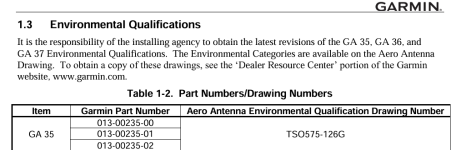
Can someone post where to find this document? Seems restricted to "Dealer Resource Center". Some TSO WAAS manufactures post 85 C or 185 F max operating temps but cannot find out what Garmin states. I'm sure for those that follow Garmin antenna specs to the letter one has this.

Along with meeting section 2.2 (Antenna mounting location) of the install manual any other specs Garmin publishes elsewhere ?

Screenshot 2025-11-07 083737.png
 
Last edited:
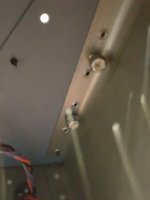
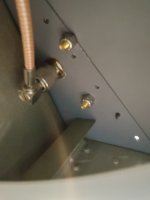
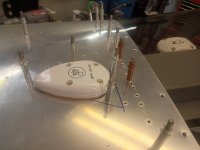
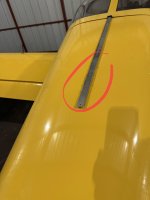
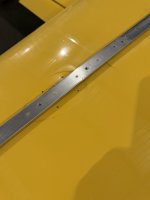
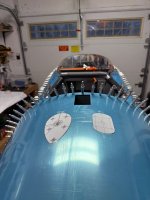
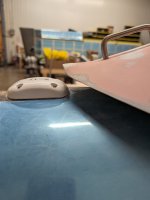
I just mounted mine aft of the rear window. Must be 12 inches from other GPS antennas per the installation manual. There is the center stiffening rail to be observant about and keep in mind the diameter of the TNC connector diameter related to the center rail. It has to be mounted slightly off center. I have a tip-up canopy, verify clearance on slider canopy. I measured closely and only had a 0.050 clearance with the rail and the TNC connector. You will also need a doubler under the antenna for stiffness, I used the existing doubler near the intersection of bulkhead behind the window. This would not work with a slider. The new cable will have to be run without the connector and soldered afterwards. Use non magnetic fasteners if near the magnetometer (stainless or brass). I did not have a high temperature controlled solder gun and fine solder, ordered off eBay (X-Tronic 3060-PRO 75 Watt "Double Digital" Soldering Iron Station Complete Kit). Stripper ( Coax Strip/Stripper/Striper/Stripping Tool RG6/RG59/RG58/RG62/RG400 cable/cord), I just used the stripper to cut the outer braided insulator. The temperature controlled solder gun/pencil made it super easy and it took less than 2 seconds to complete. Watch some YouTube videos on stripping the coax and buy a cheap stripper.
I will try and post some pictures.
 
Pictures of GPS install.
 

Attachments

  • IMG_20251107_074915994.jpg
    IMG_20251107_074915994.jpg
    436.2 KB · Views: 73
  • IMG_20251107_074840113.jpg
    IMG_20251107_074840113.jpg
    363.3 KB · Views: 73
  • IMG_20251107_074805568_HDR.jpg
    IMG_20251107_074805568_HDR.jpg
    1.4 MB · Views: 73
Thank you for your replies so far. I was intending the question to be more on the airfare side, though....

How can I be reasonably sure I'm not compromising the fuselate structure by picturing the skin to run the coax cable through?

You’re going to be drilling one hole for the Coax and four smaller holes for the mounting screws - not terribly hazardous. However, it’s not a b ad idea to use a doubler plate, riveted to the skin around the periphery to stiffen things up - this will compensate for the coupes of minor holes.

Of course, doing this on the curved fuselage means doing a little massaging of your doubler plate, but that’s not terribly hard. Somewhere on the interweb is an article I wrote about mounting a flat antenna on a curved surface using composite resin and micro to make a shim - has worked great on all my planes (I know Walt, that doesn’t technically mean a thing, but there you are….).

Paul
 
Thank you for your replies so far. I was intending the question to be more on the airfare side, though....

How can I be reasonably sure I'm not compromising the fuselate structure by picturing the skin to run the coax cable through?
The largest hole is just to pass the coax through. What's difficult is placement on a curved surface.
 
I'd suggest looking at section 20 the G3X installation manual, which is readily available and full of good information about antenna mounting. There you will also find drawings for fabricating the required doubler plate for your antenna.

On an RV-6A, you should have a flat or nearly-flat spot on the aft fuselage a couple feet behind the rear of the canopy (just aft of the slider track, if you have a slider). I've found this to be a great place for antennas.
 
Thank you so much, everyone!!

That is exactly what I was looking for.
- @dmattmul I probably have the Garmin manual somewhere. If not, my mechanic will. He's an A&P and avionics shop.
- @BenNabors and @Ironflight this is perfect... I was imagining just drilling a hole. But using a doubler alleviates my concern here. Not sure why I didn't think of that; I haven't done airframe work under my own cert for a very long time.
- @Walt I'm okay with merely anecdote in this case. It's experimental after all. :)

Now that I see what's all involved here, I might just do this work myself. Originally I was planning to have my mechanic do it. But this sort of tedious and careful work can get expensive fast.
 
You’re going to be drilling one hole for the Coax and four smaller holes for the mounting screws - not terribly hazardous. However, it’s not a b ad idea to use a doubler plate, riveted to the skin around the periphery to stiffen things up - this will compensate for the coupes of minor holes.

Of course, doing this on the curved fuselage means doing a little massaging of your doubler plate, but that’s not terribly hard. Somewhere on the interweb is an article I wrote about mounting a flat antenna on a curved surface using composite resin and micro to make a shim - has worked great on all my planes (I know Walt, that doesn’t technically mean a thing, but there you are….).

Paul
Paul,
Thanks for this note. I spoke with someone in the avionics business a few weeks ago and asked about a doubler, and I guess I am double checking here.
I specifically asked about the need for a doubler for a GPS antenna on the top of the fuselage on my -14A. He told me that there are many mounted without a doubler, but they generally suggest you add one. I asked if it needed to be riveted to the skin or just held on with the hardware for the antenna. He said the hardware only was (generally at least) fine. I asked if there was a doubler for sale to save me making one and he told me there was for about $80… so I will be making one…

Thoughts on the need to rivet it in addition to the antenna hardware?
Thanks!
Tim
 
Paul,
Thanks for this note. I spoke with someone in the avionics business a few weeks ago and asked about a doubler, and I guess I am double checking here.
I specifically asked about the need for a doubler for a GPS antenna on the top of the fuselage on my -14A. He told me that there are many mounted without a doubler, but they generally suggest you add one. I asked if it needed to be riveted to the skin or just held on with the hardware for the antenna. He said the hardware only was (generally at least) fine. I asked if there was a doubler for sale to save me making one and he told me there was for about $80… so I will be making one…

Thoughts on the need to rivet it in addition to the antenna hardware?
Thanks!
Tim
Thoughts? Well, you were talking to an avionics guy, not a structural guy…..😉

Technically speaking, using just the antenna hardware to secure the doubler in place doesn’t really transfer the loads to the the area the doubler is “doubling” - it makes things thicker, but doesn’t really compensate for the holes you’ve drilled. Think of the doubler as a “patch” instead of just making things thicker. So if I really feel I need a doubler, I rivet it to distribute the loads.

Bottom line is to follow Matt’s advice and look at the Garmin documents - they have structural guys reviewing their docs!
 
I'd suggest looking at section 20 the G3X installation manual, which is readily available and full of good information about antenna mounting. There you will also find drawings for fabricating the required doubler plate for your antenna.

On an RV-6A, you should have a flat or nearly-flat spot on the aft fuselage a couple feet behind the rear of the canopy (just aft of the slider track, if you have a slider). I've found this to be a great place for antennas.
+1

That is where I put mine after following advice here to place in the cowl; Had several GPS outages in that area.
 
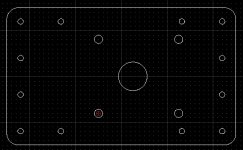
I used QCAD to draw up the doubler in Fig. 20.4 on p. 20-11 of the G3X Installation Manual. I shared the design as a .dxf file on Google Drive here.

The smaller holes are slightly undersized so they can be drilled/reamed out to #30 or #12 for AN426AD4 rivets or the studs in the base of the antenna as appropriate. The 0.625" hole for the connector is full sized.

You could get them made by SendCutSend in quantity 6 out of 0.063" 6061-T6 for $36.36 (today's price). You'd need to deburr them, final drill/ream the rivet and antenna base stud holes, countersink the rivet holes, and corrosion proof as per your standard practice.

Caveat emptor: I used layout lines to position the holes and did some dimension checking, but I haven't made a prototype of this doubler.

G3X Manual Fig. 20-4 Antenna Doubler.jpg

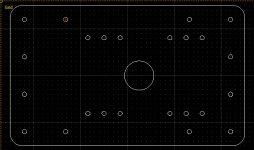
Update 5 Jan 2026: I decided to make a couple of these for myself, because I decided I'd like to have one under my Dynon SV-GPS-2020. I added holes for MS21059L08 floating nutplates or MS21047L08 (K1000-08) nutplates, which have the same 11/16" rivet hole spacing. I changed all of the hole sizes except for the 0.0625" hole to 0.093" so the doubler can be used as a drill template with a 3/32" drill and then the holes can be match-drilled or reamed to final size. See the second figure below. I shared the .dxf file for this version here. All of the rivet holes will need to be countersunk, either for a dimpled skin for an AN426AD3 or AN426AD4 rivet for the perimeter holes or for the head of an AN426AD3 rivet for the nutplates. I ordered two of them from SendCutSend to be made out of 0.040" 5052-H32, at a cost of $12.84 ($6.42 ea.) because I also ordered a couple of other things.

Garmin-Dynon GPS antenna doubler template nutplates.jpg
 
Last edited:
You could rivet in a doubler and touch up the paint if desired. Another option that’s less intrusive is to bond the doubler in place with pro-seal, G-flex, Hysol ect. Clamp the doubler in place with the antenna mounting screws or clecos until the adhesive cures. Ref: Grumman singles like the Tiger were entirely glued together with structural adhesive.

Don Broussard Older A&P/IA/ATP
RV9 Rebuild in the home stretch
57 Pacer
 
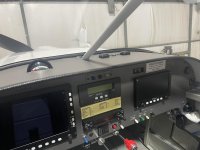
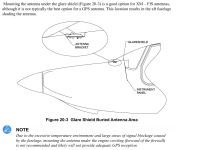
Have you considered your glareshield for your antenna mount? I have two GPS antennas on my RV6 glareshield. Mine are the small non-powered variety, but there should be enough room for one like yours. My canopy is a slider, so the glareshield is different than a tipper - which I assume yours is, but it can still work and is even easier to install. Leave some slack in the cable for tipping, but you’ll have very clear view of the sky, and even your antenna is low enough profile to not obstruct your forward visibility. It might obstruct some of your view of the top of your cowl in a small area, but who needs to see that anyway? Worth considering anyway. Mine work great and lock on quickly.
 

Attachments

  • AC96501D-F5F5-41EB-A899-ECF4EE9D004C.jpeg
    AC96501D-F5F5-41EB-A899-ECF4EE9D004C.jpeg
    105.7 KB · Views: 43
Have you considered your glareshield for your antenna mount?
I actually do have 2 antennas there as well. One is for my EFIS, and the other for the Stratux. But both are tiny, just like your photo. This one I have in the engine compartment is one of the large white ones (similar to the Garmin GA 35) for the GNS400W.

Thanks @CF86301 for the drawing. I'll keep that in mind for when I move the antenna.

My mechanic pointed out that I actually have the wrong antenna for WAAS use. I'm using an old AeroAntenna 575-9 (590-1104), but it should be a GA 35. This is likely the reason I'm getting signal loss. So he recommends I get the right antenna first, and if I still have problems then I move it to the aft fuselage as you are all describing.

Thanks, everyone, for your input.
 
Paul,
Thanks for this note. I spoke with someone in the avionics business a few weeks ago and asked about a doubler, and I guess I am double checking here.
I specifically asked about the need for a doubler for a GPS antenna on the top of the fuselage on my -14A. He told me that there are many mounted without a doubler, but they generally suggest you add one. I asked if it needed to be riveted to the skin or just held on with the hardware for the antenna. He said the hardware only was (generally at least) fine. I asked if there was a doubler for sale to save me making one and he told me there was for about $80… so I will be making one…

Thoughts on the need to rivet it in addition to the antenna hardware?
Thanks!
Tim
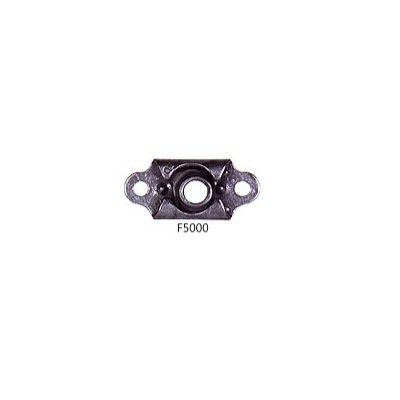
I would have you put wiggly nut plates on your doubler before you rivet it in. You will need an extra hand to buck the rivets, but you can perform future maintenance without crawling into the tailcone.

 
I have an RV-6A, and my GNS-400W antenna has always been placed in the engine compartment, above the magnetos, on a bracket attached to the engine mount:
View attachment 101459

I have occasional loss of GPS signal. I've even had it happen while shooting an IFR approach (VMC luckily). I've read that this is a terrible place for it to be, so maybe that's why. Since I'm doing an engine change right now, I figured it's a good time to move it to the "correct" location.... top fuselage somewhere between the rear window and the vertical stabilizer? But I don't want to go cutting holes unless I'm 100% sure.

Could anyone point me in the right direction on this?
- What is the best / correct location?
- If I'm going to cut a hole, how big is "too big" and where is it unsafe (would compromise the structure)?
I'm by no means an expert but my understanding is that it should be external on top of aircraft. I'm placing mine just aft of the canopy but I have a tip up. For sliders, you must consider clearance. Position such that you don't cut a j channel or double plate. Use a backup plate and tie that to a bulkhead or j channel if you can. Consider distance from other antennas (com most likely on that area). Talk to Garmin experimental tech support for help. Also...... there are antenna available that have both gps and com function.....and in fact, that's what I plan to use.
 
My mechanic pointed out that I actually have the wrong antenna for WAAS use. I'm using an old AeroAntenna 575-9 (590-1104), but it should be a GA 35. This is likely the reason I'm getting signal loss. So he recommends I get the right antenna first, and if I still have problems then I move it to the aft fuselage as you are all describing.

Thanks, everyone, for your input.
Not a bad idea to monitor the temperature of the location FWF. (You can purchase temp strips for a very reasonable price and seem to have fairly good accuracy in my testing) Also check signal strength top cowling on vs off rotating the airframe 360 degrees to insure there is no shadowing.

Garmin documents in section 20 G3X install manual possible issues with mounting FWF and even glare shield mounting as they probably don't know what temps your FWF under cowling will be or if your antenna is shaded by a metal structure. For me I have 2 thermocouples FWF coiled up so I can randomly monitor different areas that I want to monitor. I had the same in my 14 that I would monitor not only antenna tray temps but also battery temps. And yes, I've monitored the FWF temps for 15 mins after I shut down the engine and have never seen anything over 160 F on the antenna tray. It's nice to have temp monitoring FWF as hopefully I would get an early warning to a possible issue. (fire) I set alarms for these temperature monitoring. Good luck, sounds like getting the proper antenna is a good start.

Screenshot 2025-11-09 112242.pngScreenshot 2025-11-09 105614.png
 
The previous owner of my airplane had relocated the Garmin GPS WAAS antenna to firewall forward about 10 years ago to accommodate a Supertracks. I'm not promoting this location as best practice but neither he nor I ever had any GPS reception issues. The current placement works "just fine". I'd be inclined to follow Garmin's recommendations in installation but that wasn't an option with the canopy extension and the decision as tpo location had already been made for me. I guess I'd move it to the glare shield if I was having problems but it works just fine at this point so I ignore it.

1762707941237.jpeg 1762716793507.jpeg 1762716836025.jpeg
 
Last edited:
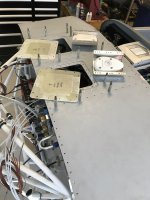
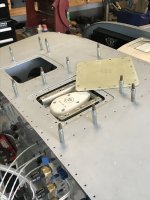
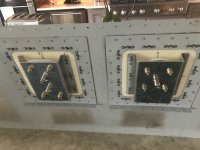
I did access panels ahead of the windscreen and made the covers out of fiberglass. My GPS antennas are under those access panels. Works great.

Ed
 
Absolutely -- "Follow the Garmin instructions."

But, if you're willing to dig a bit deeper into the functional aspects of circularly polarized, micro stripline, ceramic, active antenna designs and all aspects of GPS architecture & operation, you may discover that alternative locations will also work "just fine."

e.g.:IMG_0854.JPGIMG_0855.JPGIMG_0886.JPG

Masking to the rear is approximately 5° elevation and 20° azimuth to the horizon aircraft (RV-6,7,9, 14). See earlier comment about the architecture of the GPS system -- this masking isn't a problem except maybe within a few dozen miles of each of the poles ;)
 
Masking to the rear is approximately 5° elevation and 20° azimuth to the horizon aircraft (RV-6,7,9, 14). See earlier comment about the architecture of the GPS system -- this masking isn't a problem except maybe within a few dozen miles of each of the poles ;)

Be sure to make all your turns wings-level using rudder only...! ;)
 
I read Paul's article about mixing up micro to place the antenna on a curved surface, has any one tried this on the back of an -8 to be under the canopy? It seems like if I strive for level, there will be a lot of material on the outboard side, and then whatever washer/bolt will be uneven on the inside.

I am toying with the idea of the picture attached (obviously they'll have to move up to ensure canopy clearance, but thats the gist of it), I just don't know if thats feasible with as strong of a curve is there. Could also fabricate a platform to make it level as well, just search for first hand experience.

I know plenty of people who went under the cowl just fine, that's just not my thing as of right now. Thanks team.
 

Attachments

  • IMG_2182.jpeg
    IMG_2182.jpeg
    2.1 MB · Views: 37
You’re going to be drilling one hole for the Coax and four smaller holes for the mounting screws - not terribly hazardous. However, it’s not a b ad idea to use a doubler plate, riveted to the skin around the periphery to stiffen things up - this will compensate for the coupes of minor holes.

Of course, doing this on the curved fuselage means doing a little massaging of your doubler plate, but that’s not terribly hard. Somewhere on the interweb is an article I wrote about mounting a flat antenna on a curved surface using composite resin and micro to make a shim - has worked great on all my planes (I know Walt, that doesn’t technically mean a thing, but there you are….).

Paul
Lol. I always like your answers and comments. Fun to read.
 
I mounted my GPS antenna in the center on the back of the deck behind the canopy track. Clears the canopy just fine. Didn't like the idea of more stuff to deal with under the cowl.
 

Attachments

  • AE20B1AC-7F9C-4DD0-BAA1-91C3730BA47E.jpeg
    AE20B1AC-7F9C-4DD0-BAA1-91C3730BA47E.jpeg
    1.4 MB · Views: 32
  • 84654770-A7AE-4D24-921E-839747C0E18D.jpeg
    84654770-A7AE-4D24-921E-839747C0E18D.jpeg
    2.9 MB · Views: 31
I have an RV-6A, and my GNS-400W antenna has always been placed in the engine compartment, above the magnetos, on a bracket attached to the engine mount:
View attachment 101459

I have occasional loss of GPS signal. I've even had it happen while shooting an IFR approach (VMC luckily). I've read that this is a terrible place for it to be, so maybe that's why. Since I'm doing an engine change right now, I figured it's a good time to move it to the "correct" location.... top fuselage somewhere between the rear window and the vertical stabilizer? But I don't want to go cutting holes unless I'm 100% sure.

Could anyone point me in the right direction on this?
- What is the best / correct location?
- If I'm going to cut a hole, how big is "too big" and where is it unsafe (would compromise the structure)?


I mounted mine (RV 7) on the crossbar that supports the upper seat backs. There’s an open spot there, essentially between the pilot and passenger shoulders that is easy to do and works great.
Just one more option.
Jim
 
Back
Top