Van's Air Force

The definitive Van's Aircraft support community! Buying, building or flying an RV? Join our exclusive family of mentors and enthusiasts!

Panel planning

CZ79

Active Member
Sponsor
I'm at that stage where I am ready to start planning my panel. I know all the pros/cons, reading through pages here on the different manufacturers of EFISs, and I don't want to start another Garmin/Dynon/GRT, whose best thread, but I am curious about what you particularly like about whatever brand you decided to go with.
 
I went with the AFS 6600 (Dynon but it isn't) because it paired with my TailbeaconX, not requiring a control head, which made it the least expensive ADSB out option. The Stratux provides ADSB in info which displays on the AFS. I had the HDX (Dynon) in my 7 and really liked how you could select various sizes and types of widgets and position them as you liked on the display. I also found it a little more user friendly than the AFS but both are great units.
 
Read about Gamins GDU 4XX ADVANCED GAUGE CONFIGURATION, nobody has anything close.

If Garmin comes out with G4X there would not be another option for years to come.
 
I just finished installing my avionics for my RV-14 using a combination of Dynon and Garmin. I like both of them. The main difference between the two is in the documentation (Garmin wins), the mechanics of the hookups (I like Garmin's backshells and ground blocks, but am not fond of the more expensive high density connectors) and I like Dynon's use of the much cheaper and easier to handle standard D Sub connectors and pins. I've had more issues with Dynon over the years with having to return components for service. I've never installed a G3X system so I can't say anything about it. I can say that I've never had to have service for any Garmin component I've installed. In general, I can say I've owned many Garmin units from the Pro Nav in the early days, through the G1000 suite in certified planes, and I've found everything to be rock solid. Dynon is easier to install, but I think Garmin has the edge in quality...I'm sure others have different opinions
 
I’d advise at least one stand alone radio, not remotely controlled through the EFIS. Possibly the audio panel also. Keep the layout simple, with a good flow.
 
I suggest you first decide what you want the plane to do. Day VFR, IFR down to mins, multiple reduancy modes of operation?

The good news is for most these days the step from Day VFR using an EFIS to IFR involves adding a TSO certifed GPS navigator.

Carl
Four builds all using full integrated SkyView dual displays, Dynon radio, Dynon XPDR and such, and the overpriced Garmin GTN-650 (the least bad of the certified GPS navigator options with NAV/LOC/GS and a comm).

Carl
 
I suggest you first decide what you want the plane to do. Day VFR, IFR down to mins, multiple reduancy modes of operation?

The good news is for most these days the step from Day VFR using an EFIS to IFR involves adding a TSO certifed GPS navigator.

Carl
Four builds all using full integrated SkyView dual displays, Dynon radio, Dynon XPDR and such, and the overpriced Garmin GTN-650 (the least bad of the certified GPS navigator options with NAV/LOC/GS and a comm).

Carl
Already there on what the mission set looks like, the ability to shoot an IFR approach if needed, but mostly day VFR. So, I don't really need a multiple redundancy type setup, would be good with a GPS navigator to supply that. I'm just trying to see what folk like about the particular brand they went with and why. Think ergonomics, ease of use, ease of use in bumpy conditions, etc.
 
Mine is a Dynon HDX with Advanced Control Module. It really makes the integration easy. It's not for everyone. Single point of failure. Same for the VPX. I did wire P-mags to a dedicated bus.
I studied pricing and the ACM was a wash. VPX Pro would have been similar, but it doesn't integrate the audio and data. ACM has built in ARINC. I can add a NAV/COM/GPS by plugging it in. Panel work will be the biggest job.
You can assemble yourself, order a fully built panel or panel-less panel. The latter is fully tested then all components shipped ready for your installation. Cables all ready except termination for EMS, lights, sticks, ADAHRS & GPS puck. Interconnect cables are all provided.
 
Quick question to the group related to the original post - how many quality issues after install? The actual use case of the various brands has been discussed and easily searched but I haven't seen too much in regards to how many problems after everything has been installed and setup properly.
I just finished installing my avionics for my RV-14 using a combination of Dynon and Garmin. I like both of them. The main difference between the two is in the documentation (Garmin wins), the mechanics of the hookups (I like Garmin's backshells and ground blocks, but am not fond of the more expensive high density connectors) and I like Dynon's use of the much cheaper and easier to handle standard D Sub connectors and pins. I've had more issues with Dynon over the years with having to return components for service. I've never installed a G3X system so I can't say anything about it. I can say that I've never had to have service for any Garmin component I've installed. In general, I can say I've owned many Garmin units from the Pro Nav in the early days, through the G1000 suite in certified planes, and I've found everything to be rock solid. Dynon is easier to install, but I think Garmin has the edge in quality...I'm sure others have different opinions
You mention you've had to return a few Dynon products over the years but has the rate changed with newer products? Any reason to believe your experience was common or uncommon? Knowing you've had to return a few products, would this affect your decision on which components to use if you were building a new panel today?
 
I have installed used GRT in 3 planes. I love that update are free forever! Easy to install and use. Support from GRT is great...I have had them update old units so I did not need to cut new panel and they even added my private home field to the NAV database so I could do GPS precision approaches. I have a new RV9a with Dynon and TruTrack and I am going to redo the panel to GRT this winter.
 
Quick question to the group related to the original post - how many quality issues after install? The actual use case of the various brands has been discussed and easily searched but I haven't seen too much in regards to how many problems after everything has been installed and setup properly.
I did six SkyView installs. All but one with the GTN-650. That one used a Garmin GPS-175.

On problems:
- In one SkyView install one of the two ADHARS modules was dead out of the box. Dynon replaced it with a phone call.
- I was an early adopter of the GTN-650. That first box arrived with three problems, and it turned out two where known by Garmin. For example the comm section of the box needed a software patch. Garmin refused to send me the patch as I was too stupid to install it. I had to fly the plane to a Garmin dealer to do it. The new techs that drew the short straw to work the experimental come up to my plane and the comment was “wow, we have never seen a 650”. I had to show them how to do the patch and was rewarded with a $150 bill that I paid out of my pocket - again for a known by Garmin problem.
- On the RV-8 SkyView install I trashed the roll autopilot servo during paint prep (got it wet). It was out of warranty but Dynon sent me a new one anyway - on their dime.

The point. I find the Dynon after the sale service to be the gold standard. I hear the experimental side of Garmin is not bad, but I have no confidence the certified side of Garmin has adopted the same philosophy. So far I have not had reason to engage them to find out.

The only other experience flying with Garmin was when I did an RV-14 ferry (it had a GTN-650 and a GTR radio as Comm #2. I found the receiver in the GTR to have front end selectivity short falls. I consider the Dynon radio (made by Trig) as superior. For that matter the Trig line of products are very good options - like the SkyView XPDR also made by Trig.

Carl
 
I went with Grand Rapids 10.1 Horizon. G5 Garmin Backup EFIS, GPS175, ICOM IC220A, Trig TT22 Transponder (remote/ADS-B out) .

The ADS-B IN is a Stratux ADS-B Dual Band Receiver Aviation Weather and Traffic I built which is both WiFi and wired to the GRT EFIS.

Optional I panel mounted the GRT EIS 4000 (Engine Indication). It is optional because it is echoed on the EFIS.
If my EFIS goes out I have engine gauges, including MAP/RPM.

The ICOM IC-A220, Dualwatch and priority watch functions, tons of features, panel mounted and remoted tuned by the GRT EFIS. The EFIS data base can "push" a Freq into standby. The ICOM has serial port. If for some reason EFIS went out, I still have COM. That is the NICE thing about GRT it is playing NICE with ICOM and TRIG and STRATUX and even Garmin GPS, with approach info.

If EFIS goes out the Trig TT22 remote transponder will still work, just can't control it. It will stay on last squawk. I could put a control head (2.25" control head and a switch), but decided not to.

The Garmin G5 has infernal battery as back up. The GRT Horizon 10.1 EFIS has backup battery as well, but plane will be flown IFR. I did not go with the awesome GRT Mini as backup, which is a full meal deal EFIS (with map, engine gauges) because it was a tad too big. The G5 is smaller and like the idea of having a totally independent system (and brand) for keeping the plane upright in the clouds. (Note: I was not going to go with Garmin of any kind but found a used G5, GMU11 (remote magnetometer), GAD29 (ARINC429 interface), Backup battery, all the connectors (used with cut harness, but pins are cheap) used from Wentworth (out of an RV-6A that did s slow landing accident and parted out. Used can save money. Garmin will get you with all the extras. GRT includes most things, including wiring, but there are still ala carte items. Again Garmin, Dynon are great.)

To round it out the Garmin GPS175 is a TSO-C146, LPV approach, IFR Navigator. I was going to leave the IFR GPS out for upgrade in future, but it would be a pain to retro fit and wire. I got a screaming deal on sale from Gulf Coast, I recall a little over $5,000 with tray and antenna.

All in all I have about $13,000 into my IFR panel in 2021-2022 dollars. Oh yes, I have had Mil Spec switches and CB's for a long time, buying them a long time ago. If I had to buy those outright today it would cost a good chunk.. The ICOM A220 was used as well as the G5 as I mention. The GRT Horizon 10.1 EFIS drives two A/P servos for Roll and Pitch, has V/S mode, Alt capture, and of course couples to GPS navigator. The price includes the servos. So about $15k for an IFR panel using GRT, ICOM (used), TRIG, GARMIN (used).

The DRE Intercom is an auto panel, not really but it is stereo and has aux inputs, so it collects all the audio and an awesome intercom with a lot of isolation and selections (it will expand to 4 place, but it is nice passenger can listen to music while you do ATC only if you want. If you have music on it will of course cut the music out as most intercoms do.) The ICOM A220 has a VOX intercom built in. I did not use it. I could have saved money not going with the DRE, but like many things, I bought the DRE (no longer in business) on sale at Oshkosh thinking I will use it in future. Might as well use it. It came as part of the special full harness, jacks. Very nice quality. You need an intercom and many devices have it integrated is the point. Do you need stereo music? No and many headsets can pipe in music if you like with Bluetooth.

The GRT Horizon 10.1 EFIS drives two A/P servos for Roll and Pitch, has V/S mode, Alt capture, and of course couples to GPS navigator.

GRT is more friendly, not as proprietary. Free updates. I mostly did it because I have had GRT before. You can't go wrong with Dynon or Garmin, but they are more money. In the end is a big difference? Up to you. I do know I went through 5 stages of grief buying $5/ft CANBUS wire to connect the G5 to the Magnetometer and GAD429 (interface for GPS serial to CANBUS). Garmin does not tell you about all those other boxes, $400 there, $400 her, a couple of $100 for wire. I joke it is all relevant.

Decide your budget. If you are a PURE VFR Day/Night guy you can get a very simple functional panel for under $10k. Or you can go with a $40k turn redundant IFR Garmin Panel, and have a Pro panel builder service buy, fabricate, wire. finish, label, set up. I enjoyed learning to wire a "glass panel". My first RV was 100% steam driven with a portable GPS hanging off a mount. It was IFR with King KI155 VOR/LOC/GS but still very traditional circa late 80's.

Pic below is my panel "mockup" right after I got panel cut. The big hole to right is whatever I want: cover plate, service access, big beautiful open storage box, up to 4 x 2.25" instruments (example I have instrumements in my spare draw like DAVTRON clock and cool military G-meter for decades). I can play, than redo the cover panel without tearing up the panel. Picture right after getting panel laser cut locally. I used black sheet of 0.080 and had it cut and flange bent, not the stock 0.063 panel. I still have to paint, prime and label. I will set this up on bench and wire it as much as I can out of plane.

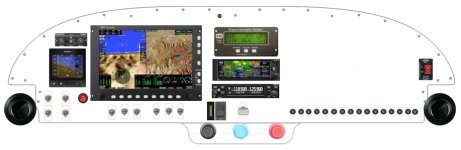
The draft is from Panel Designer from Hanger Flying. THANK YOU Hanger Flying... It is not CAD but close to scale. I used free CAD program LibreCAD to create DXF file to cut panel out. I went to FedEx Print and printed it out full size. I glued it to a plexi glass and cut it out by hand. It was helpful before cutting expensive metal. A local plexi fab shop had scrap I got free. Yeah. I did catch an issue with EIS hitting the structure for a slider at top. It was minor and made a spacer for the EIS on 3D printer to give the bezel thickness like the other instruments and add clearance behind. Also switches were moved around. NOT all items are drilled and mounted yet. I just did the priority items first and will add in light dimmer, elt control, A/P disconnect button....

You can spend as little or as much as you like on the panel. I could have saved $6k by not getting an IFR GPS... so yes a "deluxe" VFR panel with A/P can be done well under $10k with GRT at least. For NAV an IPAD or many of the other tablet like Aviation GPS can be used. if you shop around and DO ALL THE WORK yourself you can save $10k or more. I did pay $200 to have panel laser cut. It was worth it, but a luxury.
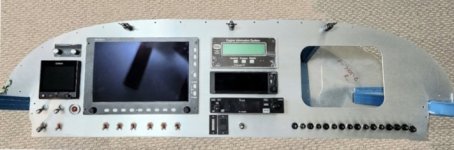
Panel B2.jpg

Panel Picture Draft.jpg
 
Last edited:
….I'm just trying to see what folk like about the particular brand they went with and why. Think ergonomics, ease of use, ease of use in bumpy conditions, etc.
I frequently find myself in the right seat of the local flying club’s planes. I’m right handed, which means I must operate the touch screens with my left. I hate it. Even in smooth air, I miss. Forget about turbulence. IMHO touch screens are the devil’s work!🥲
Now, for my airplane (-10), I have a happy mix of GRT, Dynon, Garmin, Trig. It all works. I suppose configuring protocols/formats from one brand to another is not everyone’s idea of fun but it works for me.
 
I frequently find myself in the right seat of the local flying club’s planes. I’m right handed, which means I must operate the touch screens with my left. I hate it. Even in smooth air, I miss. Forget about turbulence. IMHO touch screens are the devil’s work!🥲
Now, for my airplane (-10), I have a happy mix of GRT, Dynon, Garmin, Trig. It all works. I suppose configuring protocols/formats from one brand to another is not everyone’s idea of fun but it works for me.
Yeah I'm not a big fan of touch screens, but it is almost the standard now. In the BUFF, we had "press" screens where you had to hold it for a second, which was almost ideal and wouldn't cause issues if we were getting rocked around. Unfortunately, no one really offers that on the GA side.
 
Yeah I'm not a big fan of touch screens, but it is almost the standard now. In the BUFF, we had "press" screens where you had to hold it for a second, which was almost ideal and wouldn't cause issues if we were getting rocked around. Unfortunately, no one really offers that on the GA side.
I'm not flying behind them yet, but this is why I went with the AFS screens. Garmin is nice, but I just don't love the lack of buttons. Virtually all of the vendors provide the same basic functionality these days, so for me it just came down to what felt the most natural for me to use. I spent a lot of time test driving Garmin, Dynon and AFS at Oshkosh last year. I'd happily use any of them, but AFS won me over with the physical setup of their screen. I don't mind using touch screens, but I really like the added option of having dedicated buttons and knobs. AFS gives you both - typical touch screen plus gestures, or plenty of buttons and knobs that mean you can access fairly shallow menus with one click. I love their approach to the knobs - click the on-screen labeled button below or above the knob to swap what function the knob performs. There's no need for Dynon's add-on knob panel because of that.
 
Dynon HDX. 8 buttons. Two knobs. Shelf is an anchor. There are almost always at least two ways to do everything. Sometimes shortcuts for common stuff. Like press the Baro button and it sets baro pressure to the next Metar on the flight plan within 20 miles.
 
I've flown behind Garmin in the certified world for a couple of decades now and really didn't consider anything else. I'm sure they all have their pros and cons.

I had a warranty claim right off the bat and while nobody likes to deal with broken stuff, the service was exemplary. From the time my avionics were delivered until first flight was well over a year. Less than 10 hours in, my G5 tanked, I called Garmin up and after troubleshooting over the phone I had a warranty replacement on my doorstep within a couple of days.

There was none of that "we'll have to see if we can duplicate it-file a warranty claim in triplicate-no you need to fill out the pink form, not the blue form" nonsense.

It was more like; "sorry that happened, sounds like it's broke huh? Give us a credit card number for the core charge, it won't be charged if the broken one comes back within X days. Where do you want the replacement overnighted?"
 
Dynon HDX. 8 buttons. Two knobs. Shelf is an anchor. There are almost always at least two ways to do everything. Sometimes shortcuts for common stuff. Like press the Baro button and it sets baro pressure to the next Metar on the flight plan within 20 miles.
The Dynon was a close second to the AFS for me because of their use of buttons as well. Deciding between those two was basically a tossup and just came down to which one felt more natural to use for how my brain works (kind of like the iOS vs Android preference people have). All options these days are pretty amazing.
 
Quick question to the group related to the original post - how many quality issues after install? The actual use case of the various brands has been discussed and easily searched but I haven't seen too much in regards to how many problems after everything has been installed and setup properly.

You mention you've had to return a few Dynon products over the years but has the rate changed with newer products? Any reason to believe your experience was common or uncommon? Knowing you've had to return a few products, would this affect your decision on which components to use if you were building a new panel today
Well, I am building a plane today and I chose Dynon for most of the panel and Garmin for the GPS and the audio panel. Yes, I returned the Dynon EMS, autopilot panel (for putting me in an uncommanded descent), and one of the displays for issues. They were handled without charge but in all cases, it was a "yeah we know about this issue" kind of thing...well why don't you publish a list of know issues? For me this is my third Dynon install and I guess it is a case of familarity with the install. Both have their issues and good points.
 
AOA front top center. And look for a radar or laser audio feedback altimeter.
AOA is great, military using it for a long time.

Really a radar altimeter? A real radar altimeter is $8,000.

However there are some "experimental" LIDAR altimeters. Spruce has one for $650 "Stadia AGL LIDAR Landing Altimeter". It says "Because Stadia is considered a temporary attachment it is not subject to FAA regulatory purview." It goes on wing strut or on tiedown ring or tail tiedown, using bluetooth? It is kind of a big box and has the drag of a GoPro at least, looks boxy. That is a pass for me... but cool.

To avoid CFIT (Controlled Flight Into Terrain) radar altimeter (military uses this a lot) is great. Airlines have it but it feeds the GPWS (Ground Prox Warning System) and the "Terrain Terrain" warning. You don't have an actual radar altitude readout.

For most GA planes and pilots not needed? VFR definitely not.
IFR? GA planes don't have Inertial Nav" needing high end Baro systems and radar altimetry for LNAV/VNAV approaches.

We have GPS and that is pretty darn good. With GPS and terrain database maps, even "synthetic vision" on the EFIS we have a layer of protection. Bottom line never go below MDA or DA unless runway environment is insight.
 
Last edited:
AOA is great, military using it for a long time.

Really a radar altimeter?

Look at the Garmin GHA-15, though it presently is limited to integrating with G3, or the Recreational Mobility Flare Assist radar associated with SeaRey. There is also a laser altimeter on the market, land planes only, and these are all much cheaper than you think. Yes, AOA plus radar alt as together they make you King Kong in landing.


(Disclaimer - I'm an aircraft systems engineer with experience working on jet avionics)
I went Dynon with the interconnect board made by a member on here whose handle I forget. I built all the harnesses and wiring myself. But before the decision I looked at Dynon, Garmin, and GRT.

GRT had interesting capabilities the others did not have (including integration with a transponder I liked) but their documentation was harder to decipher than the others.

Garmin had very thorough and "pro level" documentation (it most closely resembled what I'm used to seeing at work) but I wasn't a fan of the CAN bus architecture. Also I played with one and it just didn't quite "click" with me. Finally, initial and recurring cost was highest (at the time they charged for database updates).

Dynon was a bit limited in options for comm and transponder compared to the other options, but their documentation is also very good and perhaps the best IMVHO for folks who want to DIY but don't do this stuff every day. I liked how each display can be completely configured independently. Plus, I had some time flying behind Dynon in my dad's airplane and found that it both visually resembled the Honeywell systems I was used to seeing in the airplanes and engineering sims at work, and it just naturally "clicked" with me. Brian's interconnect board made the wiring even easier.

I had very few problems with the installation and all were my fault--mispinning a connector for the com radio, and not realizing that the sidetone volume was a setting in the menu are the main ones I remember.
 
I went dynon with dual sky view hdx. Decision was made for me since the plane had two dynon servos and existing engine harness. Also have a garmin gnc 355 and GMA 245. So far I very happy with the system. I too used v. Littles interconnect and that made the connections simpler. Adsb in, transponder, remote dynon radio, baro knob panel and auto pilot panel. The baro/heading panel is used the most.

Was planning using vpx, but ended up goongb with simple switches and circuit breakers.

Overall I would by another dynon system. Only regret is not getting the garmin 650 to get the nav radio to do ILS approaches.
 
Ill add my 2cents. I have installed and flown Dynon, Garmin, GRT and AFS. Here are my likes/dislikes, I will skip Dynon as a lot of it overlaps with AFS.

AFS Likes:
  • Technical support is one of the best in the industry
  • Skyview network ease of installation and redundancy.
  • The ability to use gestures, touchscreen, buttons, and knobs.
  • Ability to easily assign PFD/MFD to either of the screens
  • AFS does not require a separate switch for the Tcw backup battery
  • ACM is really nice but one you go down that path you are committed to Dynon and AFS, VPX works with all 3 manufacturers and then some.

AFS Dislikes:
  • Software can be buggy but they take bugs (especially ones that affect in flight operations very seriously). That being said, it would be nice if they were not buggy to begin with.
  • Software development/feature release very slow/nonexistent. AFS has the opportunity to be the pioneer of experimental features. If I was them, I would be doubling down on feature releases that sets them apart from the competition however, ever since Dynon has bought them it feels like they’re trying to play it safe/not invest in new exciting experimental features. Either that or they no longer have the visionary mindset.
  • While they are great on VFR., I find them lacking in the IFR space. The IFR workflows involve engagement with the external navigator separately from their system, and, when loading an approach, until the final approach fix vertical navigation needs to be handled manually by bugging each leg.
  • Autopilot is decent, but nowhere close to Garmin

GRT Likes:
  • Installation not as easy as AFS/Dynon, but still easier than Garmin.
  • If you are daring and willing to install the beta, having IFR capabilities and control in your main EFIS is absolutely a game changer
GRT Dislikes:
  • Software development almost nonexistent
  • They never really embraced the touchscreen way of doing things. Their implementation of touch feels like a very hacky addon.
  • Looks and feel dated

Garmin G3X Likes:
  • Best in class synthetic vision
  • Best in class, Autopilot
  • Pretty good integration with the Garmin navigators allowing for good automation of IFR for all phases of flight.
  • Best in class redundancy handling, one example is if your system dies, you can run all of your IFR Autopilot automations, using the G5 and your navigator
  • Best in class reliability - this one is subjective but I find that their system (G3X, G5, GTNxxx, Autopilot and other LRUs) when installed correctly work flawlessly and the software is polished and practically bug free... it just works (relatively)

Garmin G3X Dislikes:
  • Complicated installation. But, on the flipside if done correctly using high-quality wires and connectors as recommended it is pretty much bulletproof.
  • Troubleshooting is extremely complicated, Garmin Support typically blames everything on the canbus not being reliable effectively pointing to your installation and I would say there is a high chance issues are encountered dur to canbus errors.
  • Very closed system, doesn’t play well with other manufacturers.
 
Last edited:
Back
Top