Van's Air Force

The definitive Van's Aircraft support community! Buying, building or flying an RV? Join our exclusive family of mentors and enthusiasts!

P-Mag Clocking for Angle Valve Done Wrong

Hi Phil. I have no specific experience with the Engine Bridge, but it does indeed appear to act the same as a 2-3 wire jumper, retarding the base 4.2 degrees. I might wish to confirm with the vendor that "advance shift" as seen on the Engine Bridge screen is always a shift toward retard.

So, to your question, for the 390 leave the Engine Bridge 4.2 shift as it is, and clock 5 to 7 degrees when you blow in the tube.

Clocked 5, the base will be 26.6 less 5 = 21.6, which although slightly advanced compared to Lycoming's recommendation, is fine for a 390. Max advance will be 21.6 + 8.4 = 30.8. Marvin has good data on very lean operation in that ballpark. Not much value, but it's ok.

Clocked 7, the base will be 26.6 less 7 = 19.6, essentially Lycoming's base number (20). Max advance will 28, which yields a very small advantage LOP. No advantage near peak.


Jumper connected between 2 and 3 merely shifts the base 4.2 as described above. All advance functions remain live.
If it was your 390, would you favor settings clocked at 7 or 5 ?
 
If it was your 390, would you favor settings clocked at 7 or 5 ?

My 390? After years of experimenting with multiple advance schedules, my own is set at 23 fixed.

I typically cruise at/near peak EGT. The system I'm flying allows me to swap back and forth, fixed or advanced, with the flip of a switch. Near peak at 8 to 12K, where I operate when going someplace, there is no speed difference between 23 fixed, and the 28 ballpark on the advancing schedule at those altitudes.

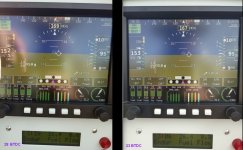
The surprise for me was the limited virtue when a little LOP. Here is an example while returning from OSH, two panel shots taken about 30 minutes apart. I've set roughly 1 gph leaner than peak so I can nonstop back to 08A and arrive with about 6 gallons. It slows me several knots (183 KTAS is typical at peak and 9500), but the chock to chock will obviously be better if I don't need to stop.

On the left, 28 BTDC. TAS is indicated as two knots slower, but here I would discount a small speed change as essentially no difference, because it's afternoon and the atmosphere is not dead still like early morning tests. The real clue is the increased CHT and oil temperature. The additional advance merely moved the point of peak cylinder pressure 5 degrees closer to TDC, where it is higher without the mechanical advantage to use it.

A note on those CHTs. OAT is 50F or less. I developed my variable cowl exit with 50 as the tipping point, above which I open up the exit and below which I can close it. Here I'm going for range efficiency while maintain good speed, so the exit is closed down to around 30 sq inches for low drag, while purposely accepting a higher CHT for thermal efficiency. Open with 23 timing, CHT would be about 320F.

As noted previously, the head and chamber which makes power with the least advance is the superior design. It's what Lycoming was trying to do, successfully, back when they developed the angle valve. The slower burning parallel valve and fast burn angle valve engines have very different timing requirements.

Your engine? With a P-mag I recommend clocking 7 degrees. As I've written previously, I usually speak of 5 merely to remain in accord with P-mag guidance...political correctness. The 28 degree ballpark has shown a very slight advantage when cruising significantly LOP (50 or more) where the advance can compensate for the much slower lean combustion rate.

28 vs 23.jpg
 
My 390? After years of experimenting with multiple advance schedules, my own is set at 23 fixed.

I typically cruise at/near peak EGT. The system I'm flying allows me to swap back and forth, fixed or advanced, with the flip of a switch. Near peak at 8 to 12K, where I operate when going someplace, there is no speed difference between 23 fixed, and the 28 ballpark on the advancing schedule at those altitudes.

The surprise for me was the limited virtue when a little LOP. Here is an example while returning from OSH, two panel shots taken about 30 minutes apart. I've set roughly 1 gph leaner than peak so I can nonstop back to 08A and arrive with about 6 gallons. It slows me several knots (183 KTAS is typical at peak and 9500), but the chock to chock will obviously be better if I don't need to stop.

On the left, 28 BTDC. TAS is indicated as two knots slower, but here I would discount a small speed change as essentially no difference, because it's afternoon and the atmosphere is not dead still like early morning tests. The real clue is the increased CHT and oil temperature. The additional advance merely moved the point of peak cylinder pressure 5 degrees closer to TDC, where it is higher without the mechanical advantage to use it.

A note on those CHTs. OAT is 50F or less. I developed my variable cowl exit with 50 as the tipping point, above which I open up the exit and below which I can close it. Here I'm going for range efficiency while maintain good speed, so the exit is closed down to around 30 sq inches for low drag, while purposely accepting a higher CHT for thermal efficiency. Open with 23 timing, CHT would be about 320F.

As noted previously, the head and chamber which makes power with the least advance is the superior design. It's what Lycoming was trying to do, successfully, back when they developed the angle valve. The slower burning parallel valve and fast burn angle valve engines have very different timing requirements.

Your engine? With a P-mag I recommend clocking 7 degrees. As I've written previously, I usually speak of 5 merely to remain in accord with P-mag guidance...political correctness. The 28 degree ballpark has shown a very slight advantage when cruising significantly LOP (50 or more) where the advance can compensate for the much slower lean combustion rate.

View attachment 109907

That is very interesting.
Thank you for sharing your experience! I will experiment with different setting and see what results I get. I have been flying LOP at 10000ft and burning average 9.8GPH If I try to go to lower 9 engine tells me he is not liking it. Interesting to see you can make it down to 8.5GPH. I wonder if I will see any difference now that I have the clocking corrected. Also curious to see if my oil temp will be lower.

I am flying this weekend and will report back my finds :)

Thanks! Have a good weekend!

Thank you!
 
I have been flying LOP at 10000ft and burning average 9.8GPH If I try to go to lower 9 engine tells me he is not liking it. Interesting to see you can make it down to 8.5GPH.

I'm a little surprised to hear 9.8 is LOP. Are you flying an earlier 390 with the standard horizontal intake sump, or a later version with the separate intake casting?

8.5 is about my lean limit running in the 10K ballpark. Constant flow injections will go much further LOP when throttled at lower altitude; higher nozzle bleed deltaP. The guys with EFI seem to be able to go far LOP at any altitude; high pressure spray.
 
A sincere thank you Dan.

To add a wrinkle, if I may.

I have the same engine and ignition as the guy you spoke about in the original post. However, I have an Engine Bridge installed.

The Engine Bridge wires into terminals 2 at 3 (Rx and Tx), the same terminals as the jumper wire. In effect, the Engine Bridge acts as the jumper wire. Please, someone tell me if I'm incorrect.

The Engine Bridge has the ability to shift the Advance.

In this picture you can see that it is shifted 4.2 degrees.
View attachment 109873

Using the technique in the original post, the Engine Bridge advance shift should be set to Zero. Again, please let me know if I'm off base.

Do I understand correctly, the numbers above would match "B" curve to "A"?
Or
Should it be set to zero?
 
To add to the data DanH has provided. He and I run our 390 engines very similar. After a few hundred hours of testing we agree the optimum advance is 23BTDC. Because my system offers the flexibility of designing my own curve I run mine slightly more conservatively. For takeoff and any power at and above 25.1MAP the ignition is 20BTDC. For all operations below 25.1MAP and PEAK to ROP EGT the ignition is at 23BTDC. Lean of PEAK becomes interesting, between 50LOP and PEAK the data becomes very hard to interpret; therefore, I stay with 23BTDC. At 50LOP I see a very slight advantage to 28BTDC at 100LOP I go to 30BTDC. For my engine any advance in excess of the values above simply increased the CHT and oil temperature with no measurable speed increase. In other words, the angle valve engine simply does not require the amount of advance a parallel valve engine can handle.

As a personal preference I simply do not like the speed vs fuel tradeoff of running below PEAK and especially in excess of 50 LOP, so unless I need to extend the range for a very long trip I spend the vast majority of flights at 23BTDC and PEAK EGT.

TooBuilder and I have the same ignition system and I believe he pulls his takeoff ignition back a few degrees more than do I and sees no performance degradation.

If I were running a P-mag, the best way to simulate the curve above would be to clock it the 7 degrees DanH has stated. I really was not aware he was able to be “politically correct” and stick with a 5 degree recommendation. 😊
 
I'm a little surprised to hear 9.8 is LOP. Are you flying an earlier 390 with the standard horizontal intake sump, or a later version with the separate intake casting?

8.5 is about my lean limit running in the 10K ballpark. Constant flow injections will go much further LOP when throttled at lower altitude; higher nozzle bleed deltaP. The guys with EFI seem to be able to go far LOP at any altitude; high pressure spray.

That is very interesting.
Thank you for sharing your experience! I will experiment with different setting and see what results I get. I have been flying LOP at 10000ft and burning average 9.8GPH If I try to go to lower 9 engine tells me he is not liking it. Interesting to see you can make it down to 8.5GPH. I wonder if I will see any difference now that I have the clocking corrected. Also curious to see if my oil temp will be lower.

I am flying this weekend and will report back my finds :)

Thanks! Have a good weekend!

Thank you!

I also have a 390 that is a non-exp and runs at 8.7 - 8.8 gph just lean of peak and can go below 8.5 gph. If the timing doesn't address your roughness below 9.8 then there is another issue. Is your red cube accurate?
 
At 50LOP I see a very slight advantage to 28BTDC at 100LOP I go to 30BTDC. For my engine any advance in excess of the values above simply increased the CHT and oil temperature with no measurable speed increase.

There's the operating case where 28 at full advance (clock 7, jumper in, base timing at full power 19.6) might actually be useful. However, lots of constant flow injections won't run real smooth past 50 LOP at WOT up in the 10K region. Not a problem for EFI users like Marvin.

I really was not aware he was able to be “politically correct” and stick with a 5 degree recommendation. 😊

Yeah, yeah. Marvin's employer sent him to charm school, and he has been bragging on it ever since ;)
 
This is all great info, and I'll drift the thread slightly. What timing would you expect to be best for a parallel valve engine at peak EGT?
 
. . .
If I were running a P-mag, the best way to simulate the curve above would be to clock it the 7 degrees DanH has stated. I really was not aware he was able to be “politically correct” and stick with a 5 degree recommendation. 😊
I too was not aware Dan knew about “political correctness “! I say this as a fellow in the same situation! 😜🤓😀
 
I have experimented quite a bit with P-mag advance with my 390... I started with traditional mags, went to one p-mag, then two, and much later added a third as a rotating spare. I started out using the emag software to program them and later went with an Engine Bridge module. After more than 3,000 hours I have mine set up to operate from 18.2 to 23.8 (using advance shift and advance limit). There might be a marginal benefit for LOP cruise over fixed timing but there is no magic.
 
Last edited:
It appears to be a case of poor atomization, low deltaP at the nozzle bleeds being the culprit. I've measured averages , and in 0.00133 second increments. At 10,500 ft, throttle plate wide open at 2700, average bleed delta was only 8.25 inches of water. That's 0.6" Hg or 0.3 psi...not much.

Contrast with pulling the red knob very LOP at lower altitudes where we have the throttle plate closed. Let's say you're loafing around the area on a nice Sunday evening, at 2500 ft and 145 knots, with the throttle closed to 20"Hg. Standard day static pressure would be 27.3" Hg. Assume a Cp for the cooling system at 0.8. Available dynamic pressure is 0.935" Hg, so (0.935 x 0.8) + 27.3 = 28" Hg at the nozzle bleed. 28 - 20 = 8" Hg bleed delta, 13x higher than the 10,000 ft WOT example.

The EFI folks always have 40~45 psi at the injectors. Constant flow injection for a 390 would have a nozzle pressure around 2 psi at 8.5 gph, and in the 10K ft example, only 0.3 psi bleed air to break it up into fine droplets. If it wasn't for the hot port walls and violent pressure/velocity changes when the valve opens, it wouldn't work at all.
 
Last edited:
I'm a little surprised to hear 9.8 is LOP. Are you flying an earlier 390 with the standard horizontal intake sump, or a later version with the separate intake casting?

8.5 is about my lean limit running in the 10K ballpark. Constant flow injections will go much further LOP when throttled at lower altitude; higher nozzle bleed deltaP. The guys with EFI seem to be able to go far LOP at any altitude; high pressure spray.
Hi Dan,
I just came back from the first flight test after correcting the timing settings and clocking. I can already report a drop on average CHT from 360 to 320's. Oil temp also dropped almost 10 degrees. I was able for the first time to make an 1 hour flight closing cooling flap completely.

I also noted that it looks like I will be able to lean further the engine. This time I got down to 9.7 at 6500 ft. I assume it will get closer to 9GPH once I climb to 10000ft.

Now I think I need to redo my idle mixture and RPM. looks like I have a lower idle now. dropped from 780 to 700.

I also noticed slightly different vibration patterns at full throttle and 2100 RPM at 6500.

My engine has a separate cast for the intake on the bottom.

Will do more flights and continue testing it but so far I see improvement.


Thanks!
 
I also have a 390 that is a non-exp and runs at 8.7 - 8.8 gph just lean of peak and can go below 8.5 gph. If the timing doesn't address your roughness below 9.8 then there is another issue. Is your red cube accurate?
Thanks for your comment jetmart. My engine is EXP340 (215HP). Maybe I should expect a very small higher value for GPH due to the additional 15HP. But, today I got down to 9.8GPH at 6500. I think it will get closer to 9 at 10000. I will test more and report back.

The red cube seems very accurate. It is never off when I refuel. Usually spot on within 0.1 gallons.
 
Thanks for your comment jetmart. My engine is EXP340 (215HP). Maybe I should expect a very small higher value for GPH due to the additional 15HP. But, today I got down to 9.8GPH at 6500. I think it will get closer to 9 at 10000. I will test more and report back.

The red cube seems very accurate. It is never off when I refuel. Usually spot on within 0.1 gallons.
That's great. Just a note of correction the difference in HP is 5HP not 15HP.
 
Hi Dan,
I just came back from the first flight test after correcting the timing settings and clocking. I can already report a drop on average CHT from 360 to 320's. Oil temp also dropped almost 10 degrees.

Yep.

I also noticed slightly different vibration patterns at full throttle and 2100 RPM at 6500.

Pop up to 8500, set WOT and 2400~2450, let it settle, then lean to peak. Trust me.

My engine has a separate cast for the intake on the bottom.

Ok, the C, D, and -119EXP models are rated 215 rather than 210. The key difference is manifold flange diameter. The 210 hp horizontal sump has a flange sized for an RSA-5 servo (2.3125"D) while the "cold air" intake is sized for an RSA-10 servo (3.4375 D). The AFP FM-200 on the 119 models is 3.0625 D.

An FM-200 on a the horizontal sump uses an adapter to squeeze down the diameter. I modified a sump to eliminate the adapter and restriction.
 
Unrelated pmag question. Can the Pmag be mounted with the long studs already in place using a spacer rather than changing to the short studs?
 
Sorry for a dumb question (actually 2 questions.... I just ordered my dual Pmag set from Van's, hopefully expecting them sometime in April. Although I'm not in a big rush..... I've been pouring through this and other timing threads but I'm still unsure how to setup them up when we get around to installing them wrt to the timing advance on an Angle valve motor. Most of the discussion here has been about an IO-390. I have a Lycoming IO-360-A1B6 200hp Angle valve 8.7:1. @DanH

The engine placard says 20 deg. But that's with standard magnetos. If I understand correctly, I would want to set it at 25 deg with jumpers when running the Pmags. Or maybe even 27.

Related to that, I am running a WW-300-3BA composite prop. The manual says to use Jumpers with Pmags. Is this a different set of jumpers or the same ones described above??

See I told you it was a dumb question.
 
There are only one set of jumpers. If you don't have an EngineBridge or another tool that can "manage" your pmags, then you just want the jumper in. Setting the timing is as explained in the first post in this thread and in the documentation. And another thread here, referenced in the first post. https://www.vansairforce.net/threads/p-mag-timing-offset-for-angle-valve-engines.235753/

I strongly recommend investing the time to understand exactly how these devices work. They seem simple, and in the end they are, but getting to understand that simplicity takes some learning. I also recommend the EngineBridge as currently the only system I'm aware of that's on the market to manage these ignitions.

Please keep asking the questions!
 
There are only one set of jumpers. If you don't have an EngineBridge or another tool that can "manage" your pmags, then you just want the jumper in. Setting the timing is as explained in the first post in this thread and in the documentation. And another thread here, referenced in the first post. https://www.vansairforce.net/threads/p-mag-timing-offset-for-angle-valve-engines.235753/

I strongly recommend investing the time to understand exactly how these devices work. They seem simple, and in the end they are, but getting to understand that simplicity takes some learning. I also recommend the EngineBridge as currently the only system I'm aware of that's on the market to manage these ignitions.

Please keep asking the questions!
Will do! Huge thanks!
 
Most of the discussion here has been about an IO-390. I have a Lycoming IO-360-A1B6 200hp Angle valve 8.7:1.

Same thing, more or less. Jumper wire between terminals 2 and 3, then clock it 7 at installation. Result is 19.6 base and 28 max.
 
Ok I'm sorry, one last dumb question.... I just ordered a dual Pmag set from Vans. While I know you CAN use automotive spark plugs with them - do you HAVE to use automotive plugs?? Or can you continue to use the existing Aviation plugs? Mine only have like 500 Hrs, so lots of life I presume.
 
Ok I'm sorry, one last dumb question.... I just ordered a dual Pmag set from Vans. While I know you CAN use automotive spark plugs with them - do you HAVE to use automotive plugs?? Or can you continue to use the existing Aviation plugs? Mine only have like 500 Hrs, so lots of life I presume.

No, you can use aviation plugs
 
Last edited:
Ok I'm sorry, one last dumb question.... I just ordered a dual Pmag set from Vans. While I know you CAN use automotive spark plugs with them - do you HAVE to use automotive plugs?? Or can you continue to use the existing Aviation plugs? Mine only have like 500 Hrs, so lots of life I presume.
As George @N890GF wrote, you can use aviation plugs, but since NGK BR8ES are about $2 each new from Rock Auto, not sure it is worth the hassle to make up some spark plug cables between the PMAGs and the aviation plugs when you will eventually start using auto plugs, I predict. Just my 1/100 of an NGK spark plug.
 
As George @N890GF wrote, you can use aviation plugs, but since NGK BR8ES are about $2 each new from Rock Auto, not sure it is worth the hassle to make up some spark plug cables between the PMAGs and the aviation plugs when you will eventually start using auto plugs, I predict. Just my 1/100 of an NGK spark plug.
Yeah, was thinking that too. The Vans' PMAG set come with all the new plug wires. I assume those are for the Automotive plugs.
 
is there any benefit to aviation plugs over automotive plugs when using PMAGs? I've only used automotive, so I'm genuinely curious
 
is there any benefit to aviation plugs over automotive plugs when using PMAGs? I've only used automotive, so I'm genuinely curious
None that i am aware of, beyond the need to purchase a 14->18mm adapter. One con for avia plugs is they only have 1K of resistance. With the more powerful coil in the pmag over the mag, you want 5K (std for auto plugs) to eliminate interference in your audio systems. More powerful coils require more resistance to prevent EMI.
 
I wrote up my own SOP for doing timing on a IO-390 (attached) and wanted to confirm my understanding.

If I use the B Curve and did the following:
  1. Set PMag timing to TDC
  2. Set B Curve
    1. Advance Shift = -7.0
    2. Max Advance = 26.6
This setup results in approximately 19.6° BTDC at high power and ~28° BTDC maximum actual advance.

I am testing my understanding that this mimics the A Curve with 7° ATDC timing? And is correct for a IO-390 engine?

Thanks everyone for the amazing information!!!
 

Attachments

If I use the B Curve and did the following:
  1. Set PMag timing to TDC
  2. Set B Curve
    1. Advance Shift = -7.0
    2. Max Advance = 26.6
This setup results in approximately 19.6° BTDC at high power and ~28° BTDC maximum actual advance.

I am testing my understanding that this mimics the A Curve with 7° ATDC timing? And is correct for a IO-390 engine?

There is no reference to "A curve" or "B curve" in the manual. It's hard for users to remember which does what, so I do not use those terms. "Jumper in " and "jumper out" is clearly understood by all.

My notes say B Curve is jumper out. (Anyone care to confirm?) If timed at TDC, base timing will be 30.8 BTDC.

If you connect a communication device and enter a minus 7 advance shift, base timing will be 30.8 - 7 = 23.8 BTDC, and max timing will be 23.8 + 8.4 = 32.2 BTDC.
 
There is no reference to "A curve" or "B curve" in the manual. It's hard for users to remember which does what, so I do not use those terms. "Jumper in " and "jumper out" is clearly understood by all.
Good call. I will remove the X Curve language.

I think where I’m getting tripped up is treating the PMag as a linear base + advance system vs a MAP-based curve.

My understanding is that with TDC timing and a -7 shift, the high-MAP timing ends up around ~19.6°, and the Max Advance setting clips the curve around ~28° actual.

That seems to match what people are seeing? Am I misunderstanding how the curve is applied?

Also, is there any good documentation on the curve or these settings? I thought I had seen a spreadsheet but can't seem to find it again.
 
Last edited:
Perhaps you're confusing increments with degrees? Seven isn't divisible by 1.4, so how would one set a -7 shift?

EDIT...brain fart here. 7 / 5 = 1.4
 
Last edited:
I think I’m following — thanks for sticking with me on this.

My understanding is that if I run jumper out, time at TDC, and set the PMag w/o a jumper at advance Shift = -7.0 & Max Advance = 26.6, it should land in roughly the ~19–20° high-power range and ~28° max actual advance.

So in practice that ends up similar to jumper in and clocking to about 7° ATDC, even if the underlying implementation is different.

Is that a reasonable way to think about it?
 
I'm not sure why they had to make the timing options so wonky. I'm able to live monitor the advance as outputted from the PMAG and its not always what I expect. My setup is:

Timed at 0 TDC
Advance Shift = -5.6
Max Advance = 23.8

That results in a full power take off reported by the PMAG as 19.6 and it jumps when manifold pressure drops below 25" to 25.2. If I hold the MP at 24.8 to 25" it will fluctuate the advance between 25.2 and 23.3 but there is really no range where it slowly increases between 19.6 and 25.2 as MP drops. I would have expected a linear increase in advance between something like 25 MP down to 21 MP between 19.6 to 25.2 but nope. It is almost like a switch flips and it goes from 19.6 to 25.2. If I go below MP 24.8" its solid at 25.2.

If you are putting in -7 advance I'd expect another 1.4 degree drop in the range of 18.2. But who knows! Also, these are the values provided by the PMAG and not actually verified with a timing light so I'm really unsure of when it is firing.

With all that, I have extremely easy starts, full power climb feels solid and temps manageable. In cruise it is super smooth. If I move the Max Advance higher it is not as happy so I'm sticking with this setup and enjoying the ride.
 
There is no reference to "A curve" or "B curve" in the manual. It's hard for users to remember which does what, so I do not use those terms. "Jumper in " and "jumper out" is clearly understood by all.

My notes say B Curve is jumper out. (Anyone care to confirm?) If timed at TDC, base timing will be 30.8 BTDC.

If you connect a communication device and enter a minus 7 advance shift, base timing will be 30.8 - 7 = 23.8 BTDC, and max timing will be 23.8 + 8.4 = 32.2 BTDC.

"... 30.8 - 7 = 23.8 BTDC, and max timing will be 23.8 + 8.4 = 32.2 BTDC."

I don't think this information is correct. When I first connected up my new PMAG to a laptop, (making it Jumper Out), the settings defaulted in the PMAG were:

Advance Shift = +4.2 which works out to 30.8 (why it adds another 1.6 not sure)
Max Advance = 39.2

If you want to mimic the A curve with the jumper out then it should be set to:

Advance Shift = 0 which seems to be 25 + 1.6 = 26.6 BTDC
Max Advance = 35 BTDC

All assuming timed at 0 TDC.

If you went with the Advance Shift of -7, it isn't 30.8 - 7 = 23.8 it ends up being 25 - 7 = 18 + the odd 1.6 = 19.6.

Kind of scary and I'm still not 100% sure I have this right. But going by the PMAG Output stating the advance, this is correct. Wish it was easy to verify with a light. But I do think you want to err on the side of less advanced over too far advanced. Even with the A Curve I was having knocking and very high CHTs. Dialed it way back and things are excellent.
 
Last edited:
When I first connected up my new PMAG to a laptop, (making it Jumper Out), the settings defaulted in the PMAG were:

Advance Shift = 4.2

Ahhh. The light dawns. I assumed advance shift was all negative numbers referenced to base timing as delivered, i.e. calculate shift starting from 30.8. Nope. It's positive and negative starting at 26.6, which is why 26.6 is zero shift. Duh.

advance shift positive 4.2 = 30.8 base
advance shift positive 2.8 = 29.4 base
advance shift positive 1.4 = 28.0 base
advance shift 0 = 26.6 base
advance shift negative 1.4 = 25.2 base
advance shift negative 2.8 = 23.8 base
advance shift negative 4.2 = 22.4 base
advance shift negative 5.6 = 21.0 base
advance shift negative 7.0 = 19.6 base

Thank you Paul. And Peter, setting the software advance shift at negative 7 would indeed get 'er done for a 390.
 
Back
Top