

Van's Air Force
You are using an out of date browser. It may not display this or other websites correctly.
You should upgrade or use an alternative browser.
You should upgrade or use an alternative browser.
Oil breather tube location
- Thread starter RNB
- Start date

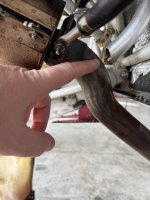


That’s the right spot. I added a whistle slot. I haven’t ever seen it ice up in this area though.
If you want it you can use a 1/4 drill, drill a hole and then bend the hole with the bit to make a slot.
If you want it you can use a 1/4 drill, drill a hole and then bend the hole with the bit to make a slot.

One port of engine dehumidifiers are commonly coupled to this breather tube. If you plan to use one, or would like to be able to easily do so in the future, I believe it would be best to extend the tube out of the bottom cowling. Mine exits adjacent an exhaust pipe. Per a post above, mine also includes a whistle slot.
It is your breather.
The racer's slice faces the wrong way and I found a dry engine after abandoning this common practice.
Aiming the breather at your exhaust pipe to vaporize the efflux is secondary to helping the engine breath.
In cold weather, you still want the whistle slot so ice cannot pressurize your nose seal.
Adding pressure by terminating your breather in the lower cowl seems like a great way to make leaks.
Fire away!
The racer's slice faces the wrong way and I found a dry engine after abandoning this common practice.
Aiming the breather at your exhaust pipe to vaporize the efflux is secondary to helping the engine breath.
In cold weather, you still want the whistle slot so ice cannot pressurize your nose seal.
Adding pressure by terminating your breather in the lower cowl seems like a great way to make leaks.
Fire away!
Last edited:
Correct, there is no whistle slot in what I see either. I think this was an AD for my old 172That’s proper. It drips onto the exhaust, not muffler, where it gets burned up, to a point.
I do not see a “whistle slot” in the tube in that picture which protects from freezing and a blown out prop seal.
So this only helps with freezing, not with oil though?That’s the right spot. I added a whistle slot. I haven’t ever seen it ice up in this area though.
If you want it you can use a 1/4 drill, drill a hole and then bend the hole with the bit to make a slot.
Thanks. I'd. like to extend this also. Any ideas on how to do so?One port of engine dehumidifiers are commonly coupled to this breather tube. If you plan to use one, or would like to be able to easily do so in the future, I believe it would be best to extend the tube out of the bottom cowling. Mine exits adjacent an exhaust pipe. Per a post above, mine also includes a whistle slot.
Yes it only gives another place for air to go in case the primary hole gets plugged with ice. I think the oil got a little more messy with this hole than with only the tube outlet over the exhaust.So this only helps with freezing, not with oil though?
I don't understand exactly what you are saying, can you say it again?It is you breather.
The racer's slice faces the wrong way and I found a dry engine after abandoning this common practice.
Aiming the breather at your exhaust pipe to vaporize the efflux is secondary to helping the engine breath.
In cold weather, you still want the whistle slot so ice cannot pressurize your nose seal.
Adding pressure by terminating your breather in the lower cowl seems like a great way to make leaks.
Fire away!
Racer's slice?
This already terminates in the lower cowl, I assume by plans.

He's saying that the "slice" should aim aft so that the slip stream is creating a vacuum, sucking air out of the tube instead of pressurizing it.I don't understand exactly what you are saying, can you say it again?
Racer's slice?
This already terminates in the lower cowl, I assume by plans.

The OP's breather as pictured is installed/aligned in accordance with the FWF guidance from Van's. I'd leave it alone.

Maybe on the buildIf you install an oil separator off the breather, you won't have to worry about oil spitting out again! However, you still want to position the aluminum breather tube such that it's not getting pressurized.
That is my plan. I suspect it is the source of left sided trace oil in the bottom of the engine. I am focusing on baffle seal replacement to better direct air flowThe OP's breather as pictured is installed/aligned in accordance with the FWF guidance from Van's. I'd leave it alone.
Actually, I have an oil breather/separator (this one: https://www.aircraftspruce.com/catalog/eppages/hboilbreather.php) connected to the engine, and the tube extending out the lower cowl is the outside vent port of the breather. Anti-Splat makes one that seems to be more popular with builders.Thanks. I'd. like to extend this also. Any ideas on how to do so?

andoman
Well Known Member
2 things:
-On my Rocket I terminate my breather in the free stream a few inches aft of the cowl exit.
-the popular AOS’s are criminally overpriced….
I have a small, super cheap ($20) Bilstein AOS attached to my engine mount. The separator drains into a line with a ball valve that I open after each flight. It accumulates about 1 tsp of oil and a few drops of water per hour.
The breather stays clean with never enough oil to form a drop at the exit.
The unit is mounted low in the cowl. The breather line routing is:
-out of the the top of the engine and down to the lower left corner of the cowl into the separator.
-out of the separator and up to the top of the cowl then over and down to the lower right side where it exits. The long upward run of the line out of the separator allows a lot of oil mist that the small separator misses to condense and run back into the separator.
-On my Rocket I terminate my breather in the free stream a few inches aft of the cowl exit.
-the popular AOS’s are criminally overpriced….
I have a small, super cheap ($20) Bilstein AOS attached to my engine mount. The separator drains into a line with a ball valve that I open after each flight. It accumulates about 1 tsp of oil and a few drops of water per hour.
The breather stays clean with never enough oil to form a drop at the exit.
The unit is mounted low in the cowl. The breather line routing is:
-out of the the top of the engine and down to the lower left corner of the cowl into the separator.
-out of the separator and up to the top of the cowl then over and down to the lower right side where it exits. The long upward run of the line out of the separator allows a lot of oil mist that the small separator misses to condense and run back into the separator.
Attachments
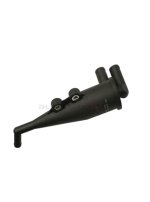
The engine shop in Winnipeg showed we an engine they O/H a few years earlier that had Air oil separator installed. The engine was full of rust from the moisture being returned to the engine instead of being jettisoned overboard. In places where its cold I would clean the Pelly every now and then and not take a change of moisture staying in the engine. I would also make sure there is whistle slot. Ie just like Vans says.

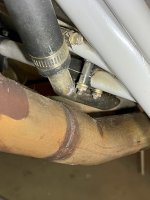
Here's my setup on my -4. Comes down from an old Mooney air-oil separator which does NOT dump the moisture into the engine. This keeps the belly CLEAN!! Only thing on the belly is exhaust 'stains' that are WAY easier to clean than oil stains. My 'whistle stop' is further up on the rubber hose which made more sense to me as it is in a warmer place. However, the chance of this setup freezing being so close to the HOT exhaust is remote.
Attachments

Whistle slot just like Vans says? Do tell.The engine shop in Winnipeg showed we an engine they O/H a few years earlier that had Air oil separator installed. The engine was full of rust from the moisture being returned to the engine instead of being jettisoned overboard. In places where it’s cold I would clean the Pelly every now and then and not take a change of moisture staying in the engine. I would also make sure there is whistle slot. Ie just like Vans says.
