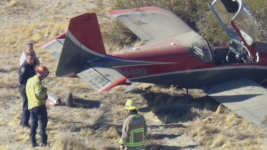
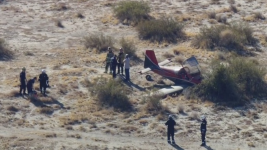
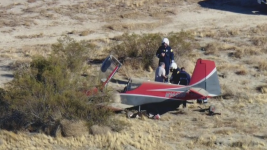
Syrus -- congrats on a job well done with that emergency. Sounds to me like you did everything right.
I was wondering if you could expound a bit on the part of your post that I quoted. Can you describe how the sight picture and control input differed from what you had practiced? I try to make training as close to reality as possible, and although I have an RV-6 (which, incidentally, I purchased from a guy named Cyrus!) rather than a -14, I'm curious about this.
With the propeller frozen, I'd expect an improvement in performance. Is that what you experienced?
--Ron
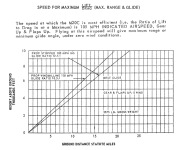
Ron--with a frozen prop your glide performance is far worse. So much so that that I became reluctant to attempt turns I would have otherwise done without hesitation for fear of losing more altitude than expected, or trust that I could accurately estimate my glide distance once I got close to the ground. By odd sight picture, I mean the ground was approaching faster than I expected it to at that speed. Once this is all behind me I can say more, but right now I don't know how the insurance company is going behave so I'm sticking to just facts. At the right time, I'll have a lot to say about how I'll handle any future engine-out emergency. To sum up, if you have a CS prop and your engine isn't turning, you can't feather your prop and it becomes an air brake.
Here's one objective fact I'll pass along that was never discussed in my previous training or a specific part of my engine-out practice: above 2,000' AGL, you can't see enough detail on the ground to pick out a possible landing site. You think you can, and we train as if we can, but it only gets real around 200'. (As a side note, 2 weeks prior I had my vision checked in an ophthalmologist's office and I have perfect distance vision.)
I lost my engine at about 8,500'. That's over a 1.5 miles away from the ground right below you. At 3,000', which is more than .5 miles, I saw a number of paved roads that were all reachable. At 2,000', I saw that they were narrow and guarded by power lines. At about 1,500', I saw dirt roads that looked like easy landing sites. At 200', I saw that the road I had picked out had a hump in middle with dense bushes.
Above about 3,000(ish)' AGL, there are only a few obviously right actions. (e.g., trimming for best glide and heading to a runway.) Beyond that, it's not right vs. wrong actions, it's good vs. bad analysis of your options. I had a laminated card with emergency procedures with me. In future, I'll have a different kind of card that specifies what actions are helpful within listed altitude bands. I provide more detail once this is all sorted out.