Van's Air Force

The definitive Van's Aircraft support community! Buying, building or flying an RV? Join our exclusive family of mentors and enthusiasts!

Off-Airport landing; RV-14A; N144ND

Plummit

Well Known Member
Friend
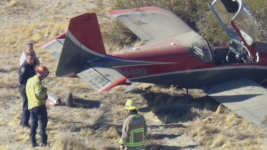
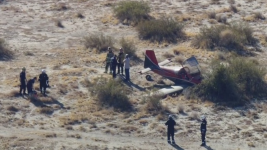
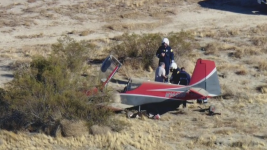
I just saw a news report about an aircraft down in the high desert and the video clearly showed an RV. The news reported that it was a 14A and the pilot was standing near the site refusing medical care. News said he flew out of a "Palmdale airport".

-Marc
 
Last edited:
I just saw a news report about an aircraft down in the high desert and the video clearly showed an RV. The news reported that it was a 14A and the pilot was standing near the site refusing medical care. News said he flew out of a "Palmdale airport".

-Marc

Fake news. :-)
He does not fly out of Palmdale. Northern CA based
 
“Apparent Minor Damage”?
The gear can be seen separated from the aircraft sitting behind the tail.
Bummer.
Glad the pilot is ok.
 
“Apparent Minor Damage”?
The gear can be seen separated from the aircraft sitting behind the tail.

Well, by the official definition, "minor damage" is anything less than "substantial damage", which is: (emphasis mine)

Substantial damage means damage or failure which adversely affects the structural strength, performance, or flight characteristics of the aircraft, and which would normally require major repair or replacement of the affected component. Engine failure or damage limited to an engine if only one engine fails or is damaged, bent fairings or cowling, dented skin, small punctured holes in the skin or fabric, ground damage to rotor or propeller blades, and damage to landing gear, wheels, tires, flaps, engine accessories, brakes, or wingtips are not considered “substantial damage” for the purpose of this part.
 
Well, by the official definition, "minor damage" is anything less than "substantial damage", which is: (emphasis mine)
Thank you. Someone who understands the rules, a rare gem among many clueless lost souls. Probably not the case here but many events such as this wind up being listed as incidents which are purged from FAA records after a period of time. Very important for future insurance.
 
I'd say that not having any landing gear might affect the flight characteristics. Not being able to take off or land, for example. But hey...think of the decrease in drag. :)

Glad the pilot is okay. Planes can be fixed, rebuilt or replaced.
 
Landing gear ripped from its mount would, by definition, be major structural damage.
No matter. They’ll sort it out.
 
Hi all. I'm the pilot. Thanks for being respectful. This has been a really hard time and I delayed looking at the forums for fear of what I might see. I'm based at KDWA near Sacramento and I was returning home from KUDD near Palm Springs. I was cruising at 8,500' somewhere between KPMD (Palmdale) and the drone base which I think is 99CL (El Mirage). The plane was performing perfectly when it started bucking violently for maybe 5 seconds (although I don't trust my sense of time at this point--it may have been 1 second) and then the prop froze. There were no warnings or alerts. I went through the usual procedures to try to restart, but even with an oversized B&C starter nothing I did moved the prop. This is being investigated by the NTSB and I have an insurance company to deal with, so I'm not going to say anything about my decisions after this point, except to say that the engine out procedures we all practice didn't prepare me for having a frozen prop. The sight picture looking forward, and the effect of control inputs, didn't resemble what I'd practiced.

Once I got low enough to see details on the ground I could see that all the paved roads were lined with power poles. The terrain was desert with closely spaced mesquite mounds. I aimed for a dirt road, but as I got close I saw it was just made by tracks and had a hump in the middle with bushes growing out of it; I have (had) a nose wheel, so that was a no. I shifted to an open "lane" so to speak through the mounds and went in. It actually worked better than I expected. The soft dirt was forgiving and it slowed me down more than the hard-packed dirt would have, and I was able to keep the nose wheel up longer than I thought I would. I kept trying to steer until a large mound took the right main gear off. After that I was just along for the ride.

I have to give Van's the props it richly deserves. The gear was robust enough to stay on the plane in the soft dirt and absorb most of the energy of the landing. I'll never own a plane other than a Van's.

Now for the hard part--there's nothing left of the frame except the empennage. Despite appearances, the fuselage is buckled at the wingroots--she's gone. I'll rebuild if I can get the wreckage from the insurance company. If I do, I'll get to correct my one regret: the new N144SD won't have a nose wheel. Syrus
 
A/W certificate a little over 4 yrs ago, ~ hrs. on the engine? Glad you walked away!
 
Syrus,
Thank you very, very much for the detailed accounting of your off-field landing here. Your decision to share with us as a first person observer has me reassessing some of my memory items, and for that I thank you, Sir!
If there is ANYTHING I can help you with, please don't hesitate to reach out.
Kindest,
Doug
 
Last edited:
Syrus,
Thank you very, very much for the detailed accounting of your off-field landing here. Your decision to share with us has me reassessing some of my memory items, and for that I thank you, Sir!
If there is ANYTHING I can help you with, please don't hesitate to reach out.
Kindest,
Doug
Thanks Doug. There's no other plane I want to fly. I'll be calling if I can get the parts back.
 
The plane was performing perfectly when it started bucking violently for maybe 5 seconds (although I don't trust my sense of time at this point--it may have been 1 second) and then the prop froze.
Thank you for your report - sounds like you did a great job!!

Do you have any thoughts on what may have been the cause of the engine seizing like that? Can you share any more info about the engine? Was it a standard mag setup? Electronic ignition? EFI? etc
 
Thank you for your report - sounds like you did a great job!!

Do you have any thoughts on what may have been the cause of the engine seizing like that? Can you share any more info about the engine? Was it a standard mag setup? Electronic ignition? EFI? etc
It was an IO-390-X made by Barrett Precision Engines. An awesome company out of Tulsa, Oklahoma. Lycoming cylinders on a Superior case. SDS electronic ignition with dual coils and Airflow Performance fuel servo. It was also setup with electric fuel pumps with return fuel lines. Complete mystery as to what happened. I had just changed the oil so it had a full sump. (8 qts just like a standard Lycoming) While I was waiting for help to arrived I did a quick inspection. Tanks were intact and oil was clean. EGTs, CHTs, oil pressure, and oil temp were all wired to give me a panel warning and an audible alert--nothing. One minute all is well, then a brief period of engine shudder followed by full seizure. Tried using the starter twice hoping to budge the prop to no effect. Now you know as much as I do.
 
It was an IO-390-X made by Barrett Precision Engines. An awesome company out of Tulsa, Oklahoma. Lycoming cylinders on a Superior case. SDS electronic ignition with dual coils and Airflow Performance fuel servo. It was also setup with electric fuel pumps with return fuel lines. Complete mystery as to what happened. I had just changed the oil so it had a full sump. (8 qts just like a standard Lycoming) While I was waiting for help to arrived I did a quick inspection. Tanks were intact and oil was clean. EGTs, CHTs, oil pressure, and oil temp were all wired to give me a panel warning and an audible alert--nothing. One minute all is well, then a brief period of engine shudder followed by full seizure. Tried using the starter twice hoping to budge the prop to no effect. Now you know as much as I do.
Thank you. Following with keen interest if you ever find out would love to know. Talking to Rhonda at the moment about getting a 390 built for my -14. Finding a case has been very difficult.
 
the engine out procedures we all practice didn't prepare me for having a frozen prop. The sight picture looking forward, and the effect of control inputs, didn't resemble what I'd practiced.
Syrus -- congrats on a job well done with that emergency. Sounds to me like you did everything right.

I was wondering if you could expound a bit on the part of your post that I quoted. Can you describe how the sight picture and control input differed from what you had practiced? I try to make training as close to reality as possible, and although I have an RV-6 (which, incidentally, I purchased from a guy named Cyrus!) rather than a -14, I'm curious about this.

With the propeller frozen, I'd expect an improvement in performance. Is that what you experienced?

--Ron
 
The ground comes up quickly with the engine out, you’re over hostile terrain, the plane belongs to the insurance company and the goal is now to survive- you were an awesome pilot Bob!
 
Syrus -- congrats on a job well done with that emergency. Sounds to me like you did everything right.

I was wondering if you could expound a bit on the part of your post that I quoted. Can you describe how the sight picture and control input differed from what you had practiced? I try to make training as close to reality as possible, and although I have an RV-6 (which, incidentally, I purchased from a guy named Cyrus!) rather than a -14, I'm curious about this.

With the propeller frozen, I'd expect an improvement in performance. Is that what you experienced?

--Ron
Ron--with a frozen prop your glide performance is far worse. So much so that that I became reluctant to attempt turns I would have otherwise done without hesitation for fear of losing more altitude than expected, or trust that I could accurately estimate my glide distance once I got close to the ground. By odd sight picture, I mean the ground was approaching faster than I expected it to at that speed. Once this is all behind me I can say more, but right now I don't know how the insurance company is going behave so I'm sticking to just facts. At the right time, I'll have a lot to say about how I'll handle any future engine-out emergency. To sum up, if you have a CS prop and your engine isn't turning, you can't feather your prop and it becomes an air brake.

Here's one objective fact I'll pass along that was never discussed in my previous training or a specific part of my engine-out practice: above 2,000' AGL, you can't see enough detail on the ground to pick out a possible landing site. You think you can, and we train as if we can, but it only gets real around 200'. (As a side note, 2 weeks prior I had my vision checked in an ophthalmologist's office and I have perfect distance vision.)

I lost my engine at about 8,500'. That's over a 1.5 miles away from the ground right below you. At 3,000', which is more than .5 miles, I saw a number of paved roads that were all reachable. At 2,000', I saw that they were narrow and guarded by power lines. At about 1,500', I saw dirt roads that looked like easy landing sites. At 200', I saw that the road I had picked out had a hump in middle with dense bushes.

Above about 3,000(ish)' AGL, there are only a few obviously right actions. (e.g., trimming for best glide and heading to a runway.) Beyond that, it's not right vs. wrong actions, it's good vs. bad analysis of your options. I had a laminated card with emergency procedures with me. In future, I'll have a different kind of card that specifies what actions are helpful within listed altitude bands. I provide more detail once this is all sorted out.

 
Good Job Syrus!

...and thank you for the data point on non-feathered prop -vs- airframe best glide performance; I think this is one of those OWT/thought exercises that we get wrong and need constant reminding of reality...

Out of curiosity, did the GPS/Avionics provide any guidance for suitable landing areas?
 
Last edited:
Since the prop/engine quit and locked up all of a sudden, I wonder if a bearing blew out and wrenched/jammed everything to an immediate stop. Looking forward to hearing more. I am building a 14A.
 
I'd like to thank Syrus again for providing us with a first person account of his off field landing. I can only guess how hard to have all this so publicly discussed is, but I for one am taking every word he says and reflecting on my own memory items, and thought process, should the unfortunate happen in my future.
Thank you Syrus!!!!
I know I speak for many when I say we're here for you in any capacity needed. I hope the NTSB investigation can shed insight into the accident.
v/r,dr
 
Last edited:
Thank you. Someone who understands the rules, a rare gem among many clueless lost souls. Probably not the case here but many events such as this wind up being listed as incidents which are purged from FAA records after a period of time. Very important for future insurance.
This is what most if not all insurance companies ask:

Screenshot 2024-12-09 163358.jpg
 
Thanks Cyrus for your reports and findings. You definitely made a great job handling the emergency !!
Hope you get an explanation as for why the sudden engine seizure.

Outside of noting the diffences in flight with a stopped prop, did you notice any difference in response (slugissness) from the elevator ?
I remember training students for engine-out simulations and at times, with a close to final test student and with guarantee of reaching the runway, I would kill the engine on purpose on short final. (Cessna's with FP props).
That was to demonstrate how the elevator was less responsive and the flare became more "nose heavy".

Even at idle, the prop wash generates enough airflow back there to make a difference.

Do you recall having the same effect at flare with the 14 ??
 
Things being equal (pitch), a wind milling prop typically creates much more drag than a fixed one.
This is correct.

It may not seem to have been the case during this emergency landing because for the majority of us, we have only done engine out emergency practice with the engine idling.
In this condition, the engine is still producing quite a bit of thrust (which is why practicing turn backs to a runway can be deceiving…. But that is a whole different discussion).
I have done simulated engine failure landings with the engine shut down but prop windmilling. The difference is eye opening, compared to engine at idle.
 
Things being equal (pitch), a wind milling prop typically creates much more drag than a fixed one.

Congrats on a well handled emergency
I love a good hangar debate--literally one of my favorite things in life--but not applicable here. I'm referring to a spinning feathered prop vs. stuck prop at fine pitch. Until this happened, I'd never even thought about a prop being physically unable to spin and what effect that would have.

But sitting here thinking about it, I'm not seeing why even a fine-pitched windmilling prop would create more drag. With the prop frozen, 100% of the energy created by the force of the airstream slamming into the prop is being converted into drag. With the propeller moving in response to the force of the airstream, some of the force against the propeller blade is now being dissipated into turning the engine. It seems to me that the spinning propeller is dividing the energy it is absorbing from the airstream into drag and rotational force, whereas the still propeller in converting all of its absorbed energy into drag. Hmmm. I want to think about it more, but right now I'm on the side that a spinning prop creates less drag even if the blade angles are the same.
 
I love a good hangar debate--literally one of my favorite things in life--but not applicable here. I'm referring to a spinning feathered prop vs. stuck prop at fine pitch. Until this happened, I'd never even thought about a prop being physically unable to spin and what effect that would have.

But sitting here thinking about it, I'm not seeing why even a fine-pitched windmilling prop would create more drag. With the prop frozen, 100% of the energy created by the force of the airstream slamming into the prop is being converted into drag. With the propeller moving in response to the force of the airstream, some of the force against the propeller blade is now being dissipated into turning the engine. It seems to me that the spinning propeller is dividing the energy it is absorbing from the airstream into drag and rotational force, whereas the still propeller in converting all of its absorbed energy into drag. Hmmm. I want to think about it more, but right now I'm on the side that a spinning prop creates less drag even if the blade angles are the same.
An engine no longer producing power, but still having resistance to rotation from normal compression in the cylinders requires a significant amount of energy from the propeller to rotate it at the typical rpm that would occur. The biproduction of producing that rotational energy comes is drag.
The stopped propeller has drag as well but with no rotation the blades are stalled and the resulting drag is slightly less.
We are not talking about huge differences between the two, but there is a difference.
This phenomenon has been tested on airplanes with fixed pitch propellers where a pilot shut down the engine and was able to slow the airplane to near stall and get the engine to stop rotating.
It generally requires gliding slower than best glide speed to prevent the propeller from starting to turn again, but the resulting glide is better than a glide at the same speed with the propeller rotating.

Not my intent to have a debate and it’s not at all relevant regarding the options you had laid out for you. It sounds like you did a heck of a job. I was just agreeing with another post that we don’t think you had a worse glide situation than you would have had,just because your engine locked up.
 
Last edited:
I often think about this when driving, could I land on this road if I needed to, and in most cases, one should be able to, crossing power lines are the biggest hazard. I once landed at Roosterville, MO advertised as the narrowest runway in MO at 20 feet (after that I started taking a look at runway width something I never paid much attention to before)! I've heard of folks landing on model airplane runways by accident.
Things definitely look different from 1000' compared to 50'.

Road specs:
The typical width of a two-lane road is 24 feet, with each lane being 12 feet wide. However, there are some exceptions:

  • Urban areas: The minimum lane width is 11 feet, but 12 feet is preferred.

  • Interchanges: The lane width is 12 feet for a two-lane conventional state highway that connects to a freeway.

  • Conventional state highways: The minimum lane width is 11 feet for highways with posted speeds of 40 miles per hour or less and truck volume less than 250 per lane.
 
Did you, or anyone, ever set the mechanical fine pitch stop to limit fine pitch to just below redline, static runup?
I believe there is an adjustment that the manufacturer sets to keep the prop below the max rmp, which was 2,700 in my case, but I had electronic ignition that also limited engine RPM which I had set at 2,650 to be conservative.
 
I love a good hangar debate--literally one of my favorite things in life--but not applicable here. I'm referring to a spinning feathered prop vs. stuck prop at fine pitch. Until this happened, I'd never even thought about a prop being physically unable to spin and what effect that would have.....
Not a debate. This phenomena is well known, understood, and demonstrated countless times. A rough approximation for drag on a spinning propeller is a disc of equal diameter. Scott McDaniel's energy balance approach is one way to help conceive it.

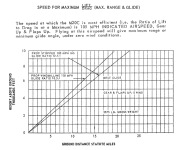
If you'd like some secondary evidence, many certified aircraft will publish glide data for both a spinning and stopped prop. My Mooney had a published glide ration of 12.7:1 for a stopped prop and 10.3:1 for a wind-milling one. This is a rather significant delta.

Just one small example from the 60's. Stay safe.
Screenshot 2024-12-10 080012.png
 
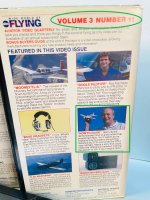
Back in the days of VHS, ABC's "Wide World of Flying" did a very good video using a C-182. Measured glide was done with engine idling, with prop in fine & course pitch, with engine cut-off and prop windmilling in fine & coarse pitch, and with prop stopped. Results were pretty incredible. With the prop stopped, glide was improved dramatically. Still trying to find that old tape.
 
Back in the days of VHS, ABC's "Wide World of Flying" did a very good video using a C-182. Measured glide was done with engine idling, with prop in fine & course pitch, with engine cut-off and prop windmilling in fine & coarse pitch, and with prop stopped. Results were pretty incredible. With the prop stopped, glide was improved dramatically. Still trying to find that old tape.

If you find that old box of tapes, if might be Volume 3 Number 11.

Wide World.jpg
 
Back
Top