


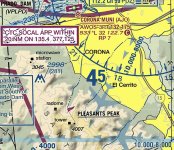
I had an engine failure at night a couple of weeks ago. I was five miles out from a grass field airport with trees, power lines and other considerations such as a berm at one end of the runway. I was familiar with the area and the airport. There was no warning, and the failure was so violent that I did not even bother attempting a restart.
First thing I would say is that everything is different than what you might have rehearsed and practiced. It is unlikely that you will be on a standard approach path or at a standard pattern altitude like we often practice. You will have maintained as much altitude as you can when you arrive over your landing area. Flight characteristics can be different with a stationary propeller. You must gage glide characteristics keeping in mind that winds may influence your glide distance when you change directions.
In my case, I arrived at the airport at 1000' AGL and had to turn away from the airport while judging distance and altitude. I remember looking over my shoulder as the airport was out of view. I chose the landing direction that had space to overrun the far end of the grass runway, but that had bad results on the approach end if I mismanaged distance, trees, power lines, ditches etc. The opposite direction had a tree line 1000 feet from the approach end but had an unmanageable berm at the far end in case of an over run. When I was assured to make the field, I had excess energy in the form of speed and altitude. I pulled flaps and initiated a hard slip. I bounced on my initial touchdown as I did not fully arrest my descent from the hard slip and still had a little excess speed. I could have floated the speed out but I wanted the option of braking if need, I have a tailwheel. From my touchdown to final stop was about 1500 feet, I had 600 feet of additional runway, and another 1000 feet of field before the next tree line. I rolled to within 20 feet of my runway exit and did use my brakes, ;-). No injuries, no bent metal, so I consider it a massive success.
From the time of the engine failure to touchdown was 5 minutes. In that time, I located the airport, reversed direction, flipped to the local approach frequency which I had on stand-by, (I keep the local approach frequency or 121.5 on standby), gave a mayday call, was given and entered a squawk code, gave souls on board and fuel, had ATC request that I write down a phone number to call after landing which I refused and called out my cell number, assessed position and ability to make airport, considered risk of land RWY 9 or 27, and maneuvered to chosen runway. In the meantime, I enjoyed the quiet and vibration free glide, I can remember thinking how beautiful the lights were and how serene and peaceful it was with the engine quiet. In hindsight, I find that surprising.
In the time it took me to unbuckle, shutdown everything, and climb out, take a deep breath, I saw someone with an off-road light driving around the airport. It turned out to be a sheriff's deputy. With-in 5 minutes, there were several more deputies. The first deputy did not see me right away and I thought that was odd as I had left my navigation lights and strobes on as I was still on the runway. It made me think about what if I had been upside down in a field, or forest somewhere.
With this experience, what would I tell someone to practice? From an altitude that you normally fly at, pull power and glide to an airport with a non-standard approach arriving at above or below the standard pattern altitude, practice turning away from the airport to consume excess altitude and energy. Have the muscle and mental memory to pitch down and transition to best glide speed at the moment of an engine failure. I was in a climbing turn at around 105 MPH when I had my catastrophic engine failure. Designate and fly with, on every flight, a minimum maneuvering speed (MMS) that you never fly below. Stall/Spin is the number 1 killer of GA pilots. I use 80 MPH MMS for convenience, which is about 1.4 times stall speed, actual number is 77. I credit Dan Gryder of the YouTube channel, Probable Cause, with my knowledge of and use of MMS. On this emergency flight, looking at my ADSB data, I had 1 data point at 76 with all the others between 89 and 93. It shows that I had speed variation that I did not know about in the moment of my emergency but that I had excess energy to maintain a safe speed that would not stall at a reasonable turning rate. In flight, the only time I remember looking at my speed was establishing best glide and when I was in the final phase of flight and trying to ensure that I did not have an insane speed, either high or low. I did not find a stationary propeller to have a such a significant impact that I it was a challenge to assess glide characteristics, it seemed perfectly normal. Since it was night, it may be hard to assess, but I do not think it made any difference with a fixed pitch propeller. ADSB says I was losing 710 to 720 Feet per minute at 90 miles per hour which is 425 feet altitude per mile. In terms of experience, I have about 450 hours of flight time.
Other things I would tell someone? In an emergency, do not accept actions or requests from ATC that will distract you from flying, particularly if you are already task saturated. I was at 1500 feet AGL, without power, maneuvering, evaluating landing direction, and a host of other tasks when ATC asked me to copy a number. My Mayday call was so that someone would know to look for me, not so I could write down a number. I also figured if I ended up in a crumbled ball, they could geo-locate my cell phone with my number. I debated accepting the squawk code, but it was a moment in time when everything was stable, gliding strait, airport in sight, runway lights on, and it had the benefit of positively identifying my radar position for search and rescue which I suspected that I was going to be needing. The last ADSB reading was at the runway threshold at 250 AGL. The ADSB data completely missed my over flight of the airport and flying away from the airport. So, if you are ever looking at ADSB data on an accident flight, it may not be telling the whole story.
Finally, if you are going to fly at night, ask yourself if it is worth the risk. I looked at it as a 1/2000 risk which is reasonable until you find yourself gliding and unable to tell if that dark area is a farmer's field, a lake, a mountain, or a forest. It gave me a new perspective. The whole event was very non-emotional until I started telling someone about it days later, I felt my emotions as it could have ended up very differently.
I am glad that I have my feet planted firmly on the ground, no damage, no injuries, and alive to tell the story.
First thing I would say is that everything is different than what you might have rehearsed and practiced. It is unlikely that you will be on a standard approach path or at a standard pattern altitude like we often practice. You will have maintained as much altitude as you can when you arrive over your landing area. Flight characteristics can be different with a stationary propeller. You must gage glide characteristics keeping in mind that winds may influence your glide distance when you change directions.
In my case, I arrived at the airport at 1000' AGL and had to turn away from the airport while judging distance and altitude. I remember looking over my shoulder as the airport was out of view. I chose the landing direction that had space to overrun the far end of the grass runway, but that had bad results on the approach end if I mismanaged distance, trees, power lines, ditches etc. The opposite direction had a tree line 1000 feet from the approach end but had an unmanageable berm at the far end in case of an over run. When I was assured to make the field, I had excess energy in the form of speed and altitude. I pulled flaps and initiated a hard slip. I bounced on my initial touchdown as I did not fully arrest my descent from the hard slip and still had a little excess speed. I could have floated the speed out but I wanted the option of braking if need, I have a tailwheel. From my touchdown to final stop was about 1500 feet, I had 600 feet of additional runway, and another 1000 feet of field before the next tree line. I rolled to within 20 feet of my runway exit and did use my brakes, ;-). No injuries, no bent metal, so I consider it a massive success.
From the time of the engine failure to touchdown was 5 minutes. In that time, I located the airport, reversed direction, flipped to the local approach frequency which I had on stand-by, (I keep the local approach frequency or 121.5 on standby), gave a mayday call, was given and entered a squawk code, gave souls on board and fuel, had ATC request that I write down a phone number to call after landing which I refused and called out my cell number, assessed position and ability to make airport, considered risk of land RWY 9 or 27, and maneuvered to chosen runway. In the meantime, I enjoyed the quiet and vibration free glide, I can remember thinking how beautiful the lights were and how serene and peaceful it was with the engine quiet. In hindsight, I find that surprising.
In the time it took me to unbuckle, shutdown everything, and climb out, take a deep breath, I saw someone with an off-road light driving around the airport. It turned out to be a sheriff's deputy. With-in 5 minutes, there were several more deputies. The first deputy did not see me right away and I thought that was odd as I had left my navigation lights and strobes on as I was still on the runway. It made me think about what if I had been upside down in a field, or forest somewhere.
With this experience, what would I tell someone to practice? From an altitude that you normally fly at, pull power and glide to an airport with a non-standard approach arriving at above or below the standard pattern altitude, practice turning away from the airport to consume excess altitude and energy. Have the muscle and mental memory to pitch down and transition to best glide speed at the moment of an engine failure. I was in a climbing turn at around 105 MPH when I had my catastrophic engine failure. Designate and fly with, on every flight, a minimum maneuvering speed (MMS) that you never fly below. Stall/Spin is the number 1 killer of GA pilots. I use 80 MPH MMS for convenience, which is about 1.4 times stall speed, actual number is 77. I credit Dan Gryder of the YouTube channel, Probable Cause, with my knowledge of and use of MMS. On this emergency flight, looking at my ADSB data, I had 1 data point at 76 with all the others between 89 and 93. It shows that I had speed variation that I did not know about in the moment of my emergency but that I had excess energy to maintain a safe speed that would not stall at a reasonable turning rate. In flight, the only time I remember looking at my speed was establishing best glide and when I was in the final phase of flight and trying to ensure that I did not have an insane speed, either high or low. I did not find a stationary propeller to have a such a significant impact that I it was a challenge to assess glide characteristics, it seemed perfectly normal. Since it was night, it may be hard to assess, but I do not think it made any difference with a fixed pitch propeller. ADSB says I was losing 710 to 720 Feet per minute at 90 miles per hour which is 425 feet altitude per mile. In terms of experience, I have about 450 hours of flight time.
Other things I would tell someone? In an emergency, do not accept actions or requests from ATC that will distract you from flying, particularly if you are already task saturated. I was at 1500 feet AGL, without power, maneuvering, evaluating landing direction, and a host of other tasks when ATC asked me to copy a number. My Mayday call was so that someone would know to look for me, not so I could write down a number. I also figured if I ended up in a crumbled ball, they could geo-locate my cell phone with my number. I debated accepting the squawk code, but it was a moment in time when everything was stable, gliding strait, airport in sight, runway lights on, and it had the benefit of positively identifying my radar position for search and rescue which I suspected that I was going to be needing. The last ADSB reading was at the runway threshold at 250 AGL. The ADSB data completely missed my over flight of the airport and flying away from the airport. So, if you are ever looking at ADSB data on an accident flight, it may not be telling the whole story.
Finally, if you are going to fly at night, ask yourself if it is worth the risk. I looked at it as a 1/2000 risk which is reasonable until you find yourself gliding and unable to tell if that dark area is a farmer's field, a lake, a mountain, or a forest. It gave me a new perspective. The whole event was very non-emotional until I started telling someone about it days later, I felt my emotions as it could have ended up very differently.
I am glad that I have my feet planted firmly on the ground, no damage, no injuries, and alive to tell the story.


 Let’s not hear another one though, okay?


