Van's Air Force

The definitive Van's Aircraft support community! Buying, building or flying an RV? Join our exclusive family of mentors and enthusiasts!

New PMag install, weird Tach/RPM issue ...

bkervaski

Hellloooooooo!
Staff member
Testing
Brand new PMag install, G3X Touch, the RPM indicates fine over 1400 RPM, but below that it drops to zero and stays there until you're above 1400 RPM again.

Has anyone seen this?

Brad said one of the phases of the generator may be bad, but the test to confirm that didn't show what he expected the result to be if that was the case.

Just picking ya'lls brains a bit for ideas before I pull it out and send it back.

Thanks for any help :D
 
When running only on that Pmag does the engine keep running when the tach drops out?
 
Yes! And even when I remove ship's power with the test button. Weird.

If you are sure your connections are all good, looks like it needs to go back to Brad. Is this a new install or has it been flying for a while?
 
If you are sure your connections are all good, looks like it needs to go back to Brad. Is this a new install or has it been flying for a while?
I'm going to re-terminate the tach wire, it's a small shielded wire with the shield removed about 1/4 out. I'll take that shield way up and see if it makes a difference. But yea, looks that way.
 
I'm going to re-terminate the tach wire, it's a small shielded wire with the shield removed about 1/4 out. I'll take that shield way up and see if it makes a difference. But yea, looks that way.

I have not used a shielded wire with the Pmags tach signal on several installs and never had any issue.
 
No luck. I'm borrowing another PMAG to test and see if it's the unit. Not sure what else it could possibly be at this point.
 
I’ve had erratic RPM indications that would follow the unit from side to side when I swapped sides using a different RPM wire for the respective side on the engine (two pmags). Brad couldn’t figure out why it was doing this but I asked them to rebuild the whole pmag. After that the problem stopped and RPM works now for 50+ hours. It did have a slight end play in the shaft. It also had a problem of not grounding out correctly to “turn off” the mag. The pmags don’t actually turn off when you ground them like a conventional mag, they just stop the spark.
 
I was just going to start a new thread about my issue but given the subject, this seems close enough so I'll add to it.

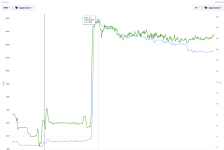
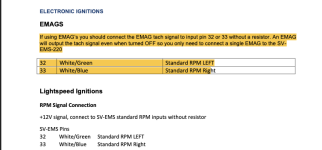
I bought my RV-10 about 2.5 years ago with dual Lightspeed ignitions. Between some issues with what eventually turned out to be the mini-sensor and strong recommendations from other RV owners, I decided to work with an A&P to swap the Lightspeeds out for Pmags. We wired the tach outputs from one Pmag to what seemed like the one of the tach inputs to the AFS 5600 (which the Lightspeeds were connected to) per the instructions in the AFS install manual (screenshot below). The engine seems to run fine and the tach indications are normal at low RPM but on takeoff and high RPM, the tach reading is bouncing all over the place and showing as high as 2800 (see chart below - RPM is in green) - the normal takeoff RPM is around 2650! The propeller has not been touched as part of this work and the sound is not changing so it looks like the prop is fine and it seems to be an issue with the reading. The RPM reading settles down somewhat once the RPMs are reduced below about 2400 RPM but still bounces around more than it used to. The A&P thought it might be an issue with the crimp and took care of that today but the problem persists.

Any suggestions on what we should be looking at as we troubleshoot this issue?

Thanks,

Vas

1730183025277.png

1730182637842.png
 
I was just going to start a new thread about my issue but given the subject, this seems close enough so I'll add to it.

I bought my RV-10 about 2.5 years ago with dual Lightspeed ignitions. Between some issues with what eventually turned out to be the mini-sensor and strong recommendations from other RV owners, I decided to work with an A&P to swap the Lightspeeds out for Pmags. We wired the tach outputs from one Pmag to what seemed like the one of the tach inputs to the AFS 5600 (which the Lightspeeds were connected to) per the instructions in the AFS install manual (screenshot below). The engine seems to run fine and the tach indications are normal at low RPM but on takeoff and high RPM, the tach reading is bouncing all over the place and showing as high as 2800 (see chart below - RPM is in green) - the normal takeoff RPM is around 2650! The propeller has not been touched as part of this work and the sound is not changing so it looks like the prop is fine and it seems to be an issue with the reading. The RPM reading settles down somewhat once the RPMs are reduced below about 2400 RPM but still bounces around more than it used to. The A&P thought it might be an issue with the crimp and took care of that today but the problem persists.

Any suggestions on what we should be looking at as we troubleshoot this issue?

Thanks,

Vas

View attachment 73212

View attachment 73211
Id probably verify everything really closely if I was you. Base timing etc. Get a tach and check the RPMs.
Is your prop low pitch set properly?

Quite possible that your PMags installation is quite different to your LSEs. I would not trust your ears to tell the difference between 2780 and 2650. Notice any CHT changes?
Is that you pulling the rpms back just after hitting WOT or the governor kicking in?

I know this doesn’t help your erratic reading question sorry.
 
Erratic instrumentation could be an indication of a bad/poor ground wire. Worth checking.

On that note, the PMag ground wire should be terminated on the engine case and not on the firewall forest of tabs.
 
I have a similar issue with my Pmags; long time installation, 2200+ hrs with right Pmag feeding tach info to a GRT EIS 4000, grounded at the engine. Was working fine until a year or so ago when it started to glitch below 850 RPM. If above 850, all is fine; when I pull throttle below 850 it goes to 0, then up to crazy high numbers, then back to 0 again. I still need to swap sides on Pmags to see if that has any effect...
 
Id probably verify everything really closely if I was you. Base timing etc. Get a tach and check the RPMs.
Is your prop low pitch set properly?

Quite possible that your PMags installation is quite different to your LSEs. I would not trust your ears to tell the difference between 2780 and 2650. Notice any CHT changes?
Is that you pulling the rpms back just after hitting WOT or the governor kicking in?

I know this doesn’t help your erratic reading question sorry.

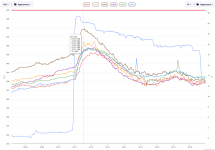
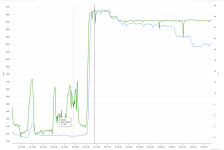
The below chart is from when the plane had the LSE ignitions. As you can see, it tops out at about 2650. Looking at the zoomed timeline, I do see some "glitches" in the RPM reading even with the LSE but in general, it was a lot more stable.

Question - if nothing other than the ignitions were changed, is there any reason that the prop settings (low pitch, max rpm, etc. settings) would change? My understanding is that the tach wire from the Pmag is purely an output to the EFIS.

Perhaps, I can switch the tach input (to the EFIS) to the other Pmag and see if it looks any different. I am going to call them to see if they have any ideas too.

On the chart from my previous post, yes, I pulled the prop back soon after takeoff because of the high RPM reading.

On CHTs, the Pmags originally came with the base timing set to about 22 degrees before TDC. We changed it to 25 since that's what the LSEs were set to and that's also what the engine plate said. I started to see some CHT issues on takeoff and in low speed flight (I am prepping for my CFI checkride) but I assumed it may have been due to the timing curve being different (as mentioned by the Emag folks) so I retarded it back to 22 degrees a couple of days ago and the CHTs have generally been ok since then. And, the CHTs seem to generally be unrelated to the prop setting. I did a lot of my maneuvers at 2400-2500 RPM.

So, that is a different question - with the LSE, the CHT on #6 was typically the high one. As long as I climbed at about 135 KIAS on hot days, I was able to manage it. With the Pmags, I am finding that #3 (and next, #4) seems to be the hottest cylinder. We did put in 1 inch holes in the baffles to provide blast air cooling for the Pmags. Based on some reading, I thought it might be due to the blast air "stealing" cooling from the cylinders so I closed off 75% of the holes (the Emag guys said it would be fine) and I still saw CHT3 was high on takeoff (390-400 degrees) until I retarded the timing. Even now, it is higher than the others (see the second chart below).

Thanks,

Vas
1730218795438.png
1730219888890.png
 
Last edited:
In hot cimates it's impossible to not get the PMags above their rated temp and turn that little sticker the wrong color, it happens mostly after you shutdown and heat soak them. I always pop my oil door to vent, no idea if that helps but it helps me feel better about it :LOL:
 
seeing as you've verified the advance etc then It certainly is a head scratcher. I could definitely see a case where you might not have your low pitch stops set and the RPM surges more than before at initial application of FT because the new ignitions were further advanced - but it sounds like you've covered that.
Maybe it is an issue with the ignition. Swapping the output should yield some data to rule things in or out. That sounds like a good idea.

In hot cimates it's impossible to not get the PMags above their rated temp and turn that little sticker the wrong color, it happens mostly after you shutdown and heat soak them. I
always pop my oil door to vent, no idea if that helps but it helps me feel better about it :LOL:

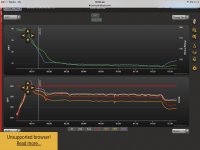
Had one LSE and one Slick which I replaced with a PMAG on my 7. Put an RTD on top of the PMAG to measure it. It can easily heat soak up to 200F I don't know how long it takes to cool on the ground, but here's some charts of a quick turn on a hot day and you can see its still at 200 until well after takeoff.

IMG_0256.jpegIMG_0255.jpeg
 
Finally got the tach issue resolved! We had removed a small circuit board when we removed the two Lightspeed ignitions and then directly connected the output from one of the Emags to what appeared to be the correct tach input for the AFS EFIS thinking that was the pin that took a 12V tach signal (because the Lightspeed manual said it generates a 10V tach signal) - and we needed only one because the Emag generates a tach signal even if it’s turned off (p-lead is grounded). On the other hand, the Lightspeed ignition does not generate a tach signal if it’s turned off so it needed to have both tach outputs connected to the EFIS. After checking with the previous owner and then finding/reading the correct documents for my "legacy" AFS 5600 (with the built-in engine monitoring), I figured out that the small circuit board was from AFS (71420L RPM Interface Board) - it combines two tach signals and generates one input signal for the EFIS AND steps the voltage down to 5V. So, the output from the circuit board went into the pin for the 5V tach input for the AFS (and not the 12V as I had assumed).

What we should have done (and did) was to put the circuit board back in and just replace the two Lightspeed tach outputs into this circuit board with the Emag tach outputs because everything else stayed the same (5V tach output to the EFIS). As we discovered today, the 12V tach input on the AFS (pin 33) did not even have a pin connection so it was unused. The clean install would have been to connect one of the Emag tach outputs to the 12V tach input on the EFIS.

Vas
 
Resolved my issue, harness had a resistor, removed it and everything worked as expected.
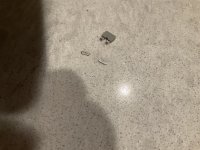
Not to highjack your thread but if you are using the jumpers on your e-mags be careful with them. I found mine broken off after changing my oil filter yesterday. I think my shirt sleeve hooked on it or something but they are quite flimsy. Found it on the floor.
IMG_0547.jpeg
 
Back
Top