Van's Air Force
You are using an out of date browser. It may not display this or other websites correctly.
You should upgrade or use an alternative browser.
You should upgrade or use an alternative browser.
New Lycoming IO-360 with #4 cylinder hotter than the rest
- Thread starter PH102
- Start date


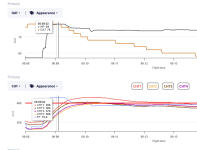
Your #4 is the leanest cylinder since it peaks first while leaning.
Before the other cylinders peak, it is quite LOP which makes it run noticeably cooler.
I can’t tell from the chart: What is your exact FF spread between the first (#4) and last (#3) to peak? Ideally it should be .5 gph or less. Tune via your injector restrictors and live happy LOP.
Also, when leaning while gathering data: lean slowly. It looks like you start leaning at 29:00 and finish at 29:45. Reducing by .2 gph and waiting a minute or two before reducing again will yield more consistent data.
Before the other cylinders peak, it is quite LOP which makes it run noticeably cooler.
I can’t tell from the chart: What is your exact FF spread between the first (#4) and last (#3) to peak? Ideally it should be .5 gph or less. Tune via your injector restrictors and live happy LOP.
Also, when leaning while gathering data: lean slowly. It looks like you start leaning at 29:00 and finish at 29:45. Reducing by .2 gph and waiting a minute or two before reducing again will yield more consistent data.
+1Your #4 is the leanest cylinder since it peaks first while leaning.
Before the other cylinders peak, it is quite LOP which makes it run noticeably cooler.
I can’t tell from the chart: What is your exact FF spread between the first (#4) and last (#3) to peak? Ideally it should be .5 gph or less. Tune via your injector restrictors and live happy LOP.
Also, when leaning while gathering data: lean slowly. It looks like you start leaning at 29:00 and finish at 29:45. Reducing by .2 gph and waiting a minute or two before reducing again will yield more consistent data.
#4 clearly running leaner than the others. I would go up one size on the #4 restrictor. Can get them at AFP.
Last edited:
Southern Pete
Well Known Member
Insufficient data to really offer an opinion, potentially #4 running leaner than the others, partially blocked injector?


It likely points to an issue with the #4 injector. May be undersized, or it may just be partially blocked. My guess with a new engine and new fuel hoses is that it's partially blocked. Easiest thing to do is pull the injector nozzle and inspect it. Even the tiniest bit of schmutz will affect its performance. If it's clean, then an increase in orifice size is likely in order. You'll have to perform the lean tests for the manufacturer to determine what size might be appropriate.
For reference, my second flight had high CHT and EGT on one cylinder at high break-in power settings. Pulled the one injector and there was an almost imperceptible piece of debris in it. Looked almost like a hair. Probably flushed its way through during break-in. Soaked it in some Hoppes, blew it clean with compressed air--with a very tight grip on it--and all was well again.
For reference, my second flight had high CHT and EGT on one cylinder at high break-in power settings. Pulled the one injector and there was an almost imperceptible piece of debris in it. Looked almost like a hair. Probably flushed its way through during break-in. Soaked it in some Hoppes, blew it clean with compressed air--with a very tight grip on it--and all was well again.
A few questions:
Title says “new” IO-360. So:
-is this how it’s always been? Is it old enough to have had this trend? Or, is this a new trend?
If a new trend then +1 with JonJay and Dubya.
If this is how it’s always been then getting an accurate Gami spread is the easiest place to start.
Download AFP’s instructions and spreadsheet.
Title says “new” IO-360. So:
-is this how it’s always been? Is it old enough to have had this trend? Or, is this a new trend?
If a new trend then +1 with JonJay and Dubya.
If this is how it’s always been then getting an accurate Gami spread is the easiest place to start.
Download AFP’s instructions and spreadsheet.
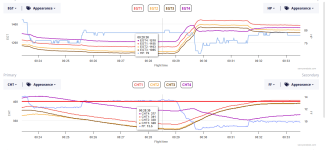
This occurs on every flight since the first flight last month. #4 heats up fast and over 400 F soon into climbout with OAT between 35 - 45 F. The engine now has 11 hours tach time. I added some RTV around #4 with no change. I'm changing break-in oil today and will also pull that #4 nozzle restrictor to take a look and see if I can get a picture of something.

I had a bad injector (#1) on my new-out-of-the-box IO-360-A1B6; Lycoming replaced it (the whole injector) under warranty. Signature was very similar to yours -- High CHT, High EGT, peaked "early" compared with cohorts. It wasn't the insert - there was something restricting the flow after the bleed hole/air mix plenum.
I'm voting for a small blockage on that injector restrictor.

Before getting too excited about taking action on that one nozzle, take it out blow off inspect and swap with another cylinder. Take care for torque on both for reassembly.
1. If it was plugged it is fixed.
2. If it is not the nozzle the cylinder will move,
3. if it is still #4 then it was not the nozzle and look for another issue.
During the flight do an in-flight mag check for a few seconds to ensure it is not spark related as well.
My stock IO360 GAMI test showed all the nozzles peaked within .1 GPH, so if yours is off, definitely get to the root cause.
What does this mean (please)? "I added some RTV around #4 with no change."
Happy hunting.
1. If it was plugged it is fixed.
2. If it is not the nozzle the cylinder will move,
3. if it is still #4 then it was not the nozzle and look for another issue.
During the flight do an in-flight mag check for a few seconds to ensure it is not spark related as well.
My stock IO360 GAMI test showed all the nozzles peaked within .1 GPH, so if yours is off, definitely get to the root cause.
What does this mean (please)? "I added some RTV around #4 with no change."
Happy hunting.

I interpreted that to mean that he added additional RTV around any potential baffle air leaks at #4 cylinder to ensure proper cooling. Roger may chime in if it meant something different.What does this mean (please)? "I added some RTV around #4 with no change."
Based on his most recent post, I think he may have found the culprit with the injector.