Van's Air Force

The definitive Van's Aircraft support community! Buying, building or flying an RV? Join our exclusive family of mentors and enthusiasts!

NAV Antenna recommendation solicitation

Pounder

Well Known Member
Patron
Hello VAF..

Looking for recommendations for NAV antenna setup for two VOR/ILS receivers. I'm installing an IFD540 and a VAL INS429 in RV8
- I’m thinking an antenna in a wingtip would be cleanest.
Q might this choice be a compromise or in anyway less “functional” than traditional external antenna?
- I believe I can split signal from one antenna to both receivers.
Q Might this result in signal compromise, or any sort of degradation as opposed to installing an antenna for each receiver?

Q I believe a duplexer (?) is the required device for inputting LOC and GS info to respective receivers. Is there a preferable make/model?

- the VAL has MB included.
Q is a MB antenna necessary, or can that signal also be derived from NAV antenna?

I love and appreciate the plethora of knowledge and experience in this group.
If you’ve read this far, thanks!!

Bryan
 
Hello VAF..

Looking for recommendations for NAV antenna setup for two VOR/ILS receivers. I'm installing an IFD540 and a VAL INS429 in RV8
- I’m thinking an antenna in a wingtip would be cleanest.
Q might this choice be a compromise or in anyway less “functional” than traditional external antenna?
- I believe I can split signal from one antenna to both receivers.
Q Might this result in signal compromise, or any sort of degradation as opposed to installing an antenna for each receiver?

Q I believe a duplexer (?) is the required device for inputting LOC and GS info to respective receivers. Is there a preferable make/model?

- the VAL has MB included.
Q is a MB antenna necessary, or can that signal also be derived from NAV antenna?

I love and appreciate the plethora of knowledge and experience in this group.
If you’ve read this far, thanks!!

Bryan
1. Yes, a wingtip (‘Archer’) antenna is ‘cleaner’. Gain 0.2 knots 😁 over an external antenna. No danger of poking out your or your dog’s eye.
2. A good external antenna will pull in a distant signal better than the Archer, especially when the path to the vor is thru the fuselage (vor station 90 deg to the nose). But I’m talking over 80 nm away. Is that really a requirement?
3. Splitting the signal in two cuts the strength by two. But it also cuts any external noise (‘static’) in half. So it’s only a real concern if you’re limited by the internal noise generated by the receiver. If you’re concerned, put an Archer in each wingtip, run one to nav 1, the other to nav2 (Do not connect them together). This is pretty much a wash cost-wise, as the second antenna costs about the same as the splitter (which you don’t need with two antennas).
4. I do not know if your radios require external diplexers (split vor/loc out from GS). Some radios do this internally. Is there a separate antenna input for GS on your radios?
5.What’s a MB? Seriously, they are going the way of the do-do. But they’re at 75 MHz, bad mis-match for the 110 MHz nav antenna. OTOH the transmitter is very close to you in practice. Almost any wire laying in the bottom of the engine cowling will work okay as an MB antenna.

Get some advice on how to best install the Archer(s).
 
1. Yes, a wingtip (‘Archer’) antenna is ‘cleaner’. Gain 0.2 knots 😁 over an external antenna. No danger of poking out your or your dog’s eye.
2. A good external antenna will pull in a distant signal better than the Archer, especially when the path to the vor is thru the fuselage (vor station 90 deg to the nose). But I’m talking over 80 nm away. Is that really a requirement?
3. Splitting the signal in two cuts the strength by two. But it also cuts any external noise (‘static’) in half. So it’s only a real concern if you’re limited by the internal noise generated by the receiver. If you’re concerned, put an Archer in each wingtip, run one to nav 1, the other to nav2 (Do not connect them together). This is pretty much a wash cost-wise, as the second antenna costs about the same as the splitter (which you don’t need with two antennas).
4. I do not know if your radios require external diplexers (split vor/loc out from GS). Some radios do this internally. Is there a separate antenna input for GS on your radios?
5.What’s a MB? Seriously, they are going the way of the do-do. But they’re at 75 MHz, bad mis-match for the 110 MHz nav antenna. OTOH the transmitter is very close to you in practice. Almost any wire laying in the bottom of the engine cowling will work okay as an MB antenna.

Get some advice on how to best install the Archer(s).
Outstanding. Thanks Bob.

I’m on it, probably, with an antenna in each wing tip.
 
Outstanding. Thanks Bob.

I’m on it, probably, with an antenna in each wing tip.
I just looked it up. Both your nav radios have a separate GS antenna input (no internal diplexer) so you'll need a pair of diplexers to split off the GS signals prior to the back of the nav's.
 
Hello VAF..

Looking for recommendations for NAV antenna setup for two VOR/ILS receivers. I'm installing an IFD540 and a VAL INS429 in RV8
- I’m thinking an antenna in a wingtip would be cleanest.
Q might this choice be a compromise or in anyway less “functional” than traditional external antenna?
- I believe I can split signal from one antenna to both receivers.
Q Might this result in signal compromise, or any sort of degradation as opposed to installing an antenna for each receiver?

Q I believe a duplexer (?) is the required device for inputting LOC and GS info to respective receivers. Is there a preferable make/model?

- the VAL has MB included.
Q is a MB antenna necessary, or can that signal also be derived from NAV antenna?

I love and appreciate the plethora of knowledge and experience in this group.
If you’ve read this far, thanks!!

Bryan

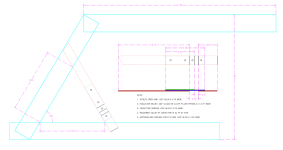
Make your own "Archer" antenna -- dimensions attached.

Screenshot 2026-06-26 at 8.19.39 PM.png

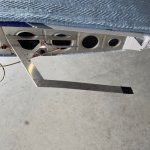
Add a 7" x 0.375" x 0.025" "stub" under the top plastic screw to optimize GS reception (329 - 335MHz)

IMG_0486.jpeg

A good splitter is a Minicircuits ZFSC-3-1+, full bandwidth (read: frequencies) passed to all 3 ports -- no pesky "notch" or hi/lo pass like with the Comant splitter/diplexer. Good isolation across all ports.
 
Hello VAF..

Looking for recommendations for NAV antenna setup for two VOR/ILS receivers. I'm installing an IFD540 and a VAL INS429 in RV8
- I’m thinking an antenna in a wingtip would be cleanest.
Q might this choice be a compromise or in anyway less “functional” than traditional external antenna?
- I believe I can split signal from one antenna to both receivers.
Q Might this result in signal compromise, or any sort of degradation as opposed to installing an antenna for each receiver?

Q I believe a duplexer (?) is the required device for inputting LOC and GS info to respective receivers. Is there a preferable make/model?

- the VAL has MB included.
Q is a MB antenna necessary, or can that signal also be derived from NAV antenna?

I love and appreciate the plethora of knowledge and experience in this group.
If you’ve read this far, thanks!!

Bryan
I installed an Archer in the wingtip of ny 4. I had an original version of the Narco NAV-122, which is everything (VOR/LOC/GS/MB) in one very long 3 1/8” box.
The Archer drove everything and it worked fine. As someone here mentioned, the MB transmitters are directional and designed to work when you are directly over the top so I’m thinking almost anything would work. In my case, the Archer was sufficient.

As for a splitter, my NAV-122 came with a Narco splitter, specifically designed to fit on the back of the Nav and matched mechanically with all of the ant connectors simultaneously. From there, I ran a single coax to the Archer.
 
I installed an Archer in the wingtip of ny 4. I had an original version of the Narco NAV-122, which is everything (VOR/LOC/GS/MB) in one very long 3 1/8” box.
The Archer drove everything and it worked fine. As someone here mentioned, the MB transmitters are directional and designed to work when you are directly over the top so I’m thinking almost anything would work. In my case, the Archer was sufficient.

As for a splitter, my NAV-122 came with a Narco splitter, specifically designed to fit on the back of the Nav and matched mechanically with all of the ant connectors simultaneously. From there, I ran a single coax to the Archer.

For reference --
MB -=> 75MHz -- 3W
VOR/LOC -=> 108 - 118MHz, 50W (VOR-L, T) to >250W (VOR-H)
GS -=> 329 - 335MHz -- <5W

In order to use a single antenna with its output split among many receivers you should use a splitter that has full band pass thru capabilities (see earlier post ref. Mini-circuits ZFSC-3-1+) -- 1 - 500MHz is sufficient.

The classic Archer antenna is optimized (and can be tuned further) for VOR/LOC frequencies - a low SWR (<2:1) and impedance matched to the coax feed (~50Ω). The GS frequencies show about 5:1 SWR and MB is 7:1 or so with impedances all over the map (the matching capacitor is too large/too small for those frequencies)*

Without modification, the GS frequencies are received pretty well, but the splitter loss (>5dB) can become problematic if you're trying to receive the GS beyond the service area (10 miles).

Similarly, MB works pretty well; Sort of like driving over a speed bump at night -- The antenna won't see it (VSWR, Impedance), but the receiver is still going to feel it.
 
For reference --
MB -=> 75MHz -- 3W
VOR/LOC -=> 108 - 118MHz, 50W (VOR-L, T) to >250W (VOR-H)
GS -=> 329 - 335MHz -- <5W

In order to use a single antenna with its output split among many receivers you should use a splitter that has full band pass thru capabilities (see earlier post ref. Mini-circuits ZFSC-3-1+) -- 1 - 500MHz is sufficient.

The classic Archer antenna is optimized (and can be tuned further) for VOR/LOC frequencies - a low SWR (<2:1) and impedance matched to the coax feed (~50Ω). The GS frequencies show about 5:1 SWR and MB is 7:1 or so with impedances all over the map (the matching capacitor is too large/too small for those frequencies)*

Without modification, the GS frequencies are received pretty well, but the splitter loss (>5dB) can become problematic if you're trying to receive the GS beyond the service area (10 miles).

Similarly, MB works pretty well; Sort of like driving over a speed bump at night -- The antenna won't see it (VSWR, Impedance), but the receiver is still going to feel it.
BJD, then it seem for best performance i should install one antenna per receiver.
 
I installed a home made wingtip antenna for the MGL NAV 16 radio. (ILS/LOC, VOR) Had some local Ham radio guys with the equipment to tune it, and it works great. Never had an external antenna for direct comparison though.

If you make your own, look at some of the prior post by Carl.....he had some good ideas for mounting it directly to the outdoor rib, and making it larger so you can fully utilize all the wingtip space for improved performance vs. the size of the one in the areo electric connection book plans.
 
I put an archer antenna in the right wingtip to feed a GTN650xi. It picks up a VOR from about 50 miles away. As others have experienced, the signal gets wonky if it's blocked by the fuselage, but I'd do the same thing again.

In my opinion, the only reason you need that receiver at all is for the redundancy of an ILS in case the GPS network tanks while you're IFR.

I didn't mess with marker beacons. They're going away faster than VOR's and I didn't feel that was worth the hassle.
 
I installed an all new Garmin panel recently. My 5 minutes of research online revealed that marker beacons are nearly extinct. My installer raised an eyebrow when I asked about marker beacons. Almost every ILS/LOC approach has fixes that are part of the approach when pulled from the GPS database. I could hardly find an ILS/LOC approach chart that shows a marker beacon. I wouldn’t bother with an antenna and coax even if your receiver has the capability.
 
To the OP -- apologies for the thread drift...

I will still keep and use VOR/LOC in my aircraft -- until the GPS receivers we use enable multi-domain GNSS (i.e. GPS + GLONASS + BDS + Galileo), and our Military, other nation-states, rogue idiots with DIY/Homebrew GPS spoofing/jamming equipment stop jamming/spoofing. (e.g. The 746th TS out of Holloman AFB).
 
A little bit more thread drift, I just posted a brand new Rami AV-532L Nav antenna for sale, if anyone is interested in an external Nav antenna.
 
I installed an all new Garmin panel recently. My 5 minutes of research online revealed that marker beacons are nearly extinct. My installer raised an eyebrow when I asked about marker beacons. Almost every ILS/LOC approach has fixes that are part of the approach when pulled from the GPS database. I could hardly find an ILS/LOC approach chart that shows a marker beacon. I wouldn’t bother with an antenna and coax even if your receiver has the capability.
IMHO you highlighted a problem. Almost all airports with an ILS offer an LPV approach to the same (cat 1) minimums. So ILS capability is a back up to loss of GPS. But if the ILS approach requires a gps for certain fixes, it really isn’t a back up to loss of GPS. Fortunately I have a nearby ILS where a single SL30 nav can provide all needed nav info, as the fixes can be determined from a VOR cross-radial.
 
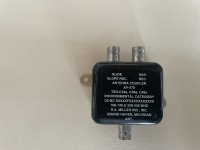
I had a NAV splitter in the first RV I built 26 years ago. It was removed when I upgraded my IP and removed the VAL INS429. I think I still have it. If I do, I’ll take a pic and post it here, and if you want it it’s yours - cheap (beer, but not cheap beer).
 
I had a NAV splitter in the first RV I built 26 years ago. It was removed when I upgraded my IP and removed the VAL INS429. I think I still have it. If I do, I’ll take a pic and post it here, and if you want it it’s yours - cheap (beer, but not cheap beer).
Thanks Scott. I’ll be sourcing one antenna to two receivers, both have respective NAV and GS antenna inputs.

So, I’m not yet sure what the nomenclature of that (diplexer) splitter is.

Please let me know.

BTW, how was the VAL INS 429 for you, operationally?

I’ve heard mixed reviews.
 
Thanks Scott. I’ll be sourcing one antenna to two receivers, both have respective NAV and GS antenna inputs.

So, I’m not yet sure what the nomenclature of that (diplexer) splitter is.

Please let me know.

BTW, how was the VAL INS 429 for you, operationally?

I’ve heard mixed reviews.
The VAL worked, but I wouldn’t call it user friendly. The course deviation dots were just odd, I thought. Never got used to it.
 
So, I’m not yet sure what the nomenclature of that (diplexer) splitter
A simple splitter provides an impedance matched 50%-50% split of all incoming signals.
A ‘diplexer’ is slightly more complicated , it is frequency dependent. In the ideal case it can split nearly all of the 300MHz signal (GS) into one output, and nearly all the loc/Vor signal at 110 MHz into the other. You could use a simple splitter instead of a diplexer if you can tolerate a 50% loss.
 
Thanks Scott. I’ll be sourcing one antenna to two receivers, both have respective NAV and GS antenna inputs.

So, I’m not yet sure what the nomenclature of that (diplexer) splitter is.

Please let me know.

BTW, how was the VAL INS 429 for you, operationally?

I’ve heard mixed reviews.
Couple pics of the splitter……
 

Attachments

  • 94F3F3AB-754F-4328-9C37-B43D5710AA20.jpeg
    94F3F3AB-754F-4328-9C37-B43D5710AA20.jpeg
    680.2 KB · Views: 20
  • DCB870AD-6585-48F1-B19B-443B8DF99934.jpeg
    DCB870AD-6585-48F1-B19B-443B8DF99934.jpeg
    640.4 KB · Views: 20
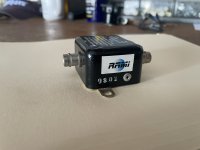
I havent used it yet (still building) but i picked up a RAMI splitter from advance flight systems the AV-570 for $165 to feed my 430.
 
The VAL worked, but I wouldn’t call it user friendly. The course deviation dots were just odd, I thought. Never got used to it.
Thats what I thought when I first fired it up... woooaaaa how does this work... turns out you are on loc on glide when no needles are showing.... I would say emergency use only LOL and thats what makes it an emergency when you have to fly an ILS with no needles. You are chasing dots... no dots on course, dot on right turn right til its gone. If dot is up than decrease descent rate til dot is gone.... flyable but wierd.
 
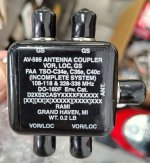
I got one of these for 50 bucks to use on my VAL429 it seemed to work okay but is it splitting the signal four times?
 

Attachments

  • IMG_20260701_232628.jpg
    IMG_20260701_232628.jpg
    157.1 KB · Views: 11
I got one of these for 50 bucks to use on my VAL429 it seemed to work okay but is it splitting the signal four times?
It’s filtering, not splitting.

The frequencies are filtered out without losing energy and are passed to different ports -vs- a splitter which cuts the energy but passes all the frequencies to all the ports…

Right @BobTurner?
 
It’s filtering, not splitting.

The frequencies are filtered out without losing energy and are passed to different ports -vs- a splitter which cuts the energy but passes all the frequencies to all the ports…

Right @BobTurner?
Half right. A diplexer (frequency sensitive) splits the input into two signals, one around 110 MHz and the other around 330 MHz (GS), with close to zero loss at each frequency. Then two normal, impedance matched splitters, split each of these (110 and 330 MHz) signals into two, with each getting 50% of the power.
 
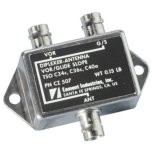
So I bought the Rami first a couple years ago and used it with the VAL429, than bought the Comant 507 from a member here about a year ago for 25 bucks. Are you saying the Rami that has 2 gs and 2 loc outputs is splitting the input and outputting a 50% weaker signal than the Comant 507 that only has 1 gs and loc output?

Thanks
 

Attachments

  • Screenshot_20260701_235113_Chrome.jpg
    Screenshot_20260701_235113_Chrome.jpg
    84.3 KB · Views: 10
  • IMG_20260701_232628.jpg
    IMG_20260701_232628.jpg
    157.1 KB · Views: 10
So I bought the Rami first a couple years ago and used it with the VAL429, than bought the Comant 507 from a member here about a year ago for 25 bucks. Are you saying the Rami that has 2 gs and 2 loc outputs is splitting the input and outputting a 50% weaker signal than the Comant 507 that only has 1 gs and loc output?

Thanks
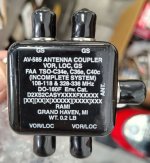
Yes - there is a +3 dB loss in the AV585.
 
I will open it up like you do with alternators, and see if I can figure out where the 3db is going and amplify it and fix it.
 
I will open it up like you do with alternators, and see if I can figure out where the 3db is going and amplify it and fix it.
I’m naive, I assume you’re serious. If you have 10 watts coming in, you get a total of 10 watts going out. With a simple splitter, that’s 5 watts into two outputs. If the original 10 Watts in was 5 W at 110 MHz and 5 W at 330 MHz, then a diplexer gives you 5 watts into each output. But all 5 W are at 110 MHz into one output, and all 5 W are 330 MHz into the other. Energy is conserved (absent an amplifier).
Now, adding a powered amplifier. Modern receivers have virtually unlimited gain. The issue is ‘noise’, heard as background static. Noise has two sources: external (‘static’ picked up by the antenna) and internal (noise generated by the receiver’s electronics.) Now most modern receivers have a pretty low noise ‘front end’ (if you think about this it’s clear that the first stage of amplification is where low additional noise is important). Point is, once the signal is weaker than the noise, it’s very tough to hear. So if you have a cheap, high noise receiver, adding a good, low noise amplifier in the splitter or at the antenna can help. But usually, the majority of the noise is picked up by the antenna. Amplifying this also amplifies that noise, resulting in no improvement in the signal to noise ratio. (Remember that if a passive splitter cuts the signal in half, it also cuts the external noise in half, too.)
 
last post I was joking about opening it up... bj always tears open brokin alternators LOL. Was serious though about the difference between tha 4 outputt rami and 2 outputt comant, if the comant will give out a better glideslope signal i will junk the rami
 
Back
Top