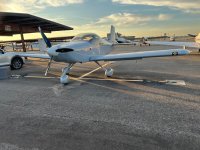
A little bit of thread drift here, but since it came up here I thought I would answer. I am the designer of the RV-10 and RV-14 airfoil. The airfoil was designed so that if you do a really good job building the wings smooth, you actually get some laminar flow on the wing. At the time, I didn't know that Vans was going to put the spanwise J -stiffeners in there, but even with those, a well-built and well-painted RV-10 does get laminar flow basically back to the wing spar. This is where the reflex comes in. As you make small changes to angle of attack, the resulting changes in pressure distribution on the front portion of the airfoil can have a big effect on laminar flow, especially if it is just marginally hanging in there. The reflex changes the angle of attack so that it is more favorable to keeping laminar flow on the bottom, where it is easier to maintain anyway, and perhaps reduces the chances of keeping the laminar flow on the upper surface, where it might be lost anyway. So, in general, you SHOULD see slightly higher speeds with the 3-degree reflex.
BUT....
If you have some bugs on your wings, you have lost the laminar flow anyway and it is not going to matter. If you paint your wings with an accent stripe along the front 1/4 of the wing, the paint edge is going to trip the laminar boundary layer anyway and the reflex is not going to matter. If you build a good smooth wing, paint it all one color (at least the front 1/3) and keep the bugs washed off, you should go a little faster with the reflex.











 , all minor improvements have been to the airframe (larger brakes, brake return springs, parking brake, aerobatic harness)