Van's Air Force

The definitive Van's Aircraft support community! Buying, building or flying an RV? Join our exclusive family of mentors and enthusiasts!

IO-390 or IO-390EXP119

Michael Burbidge

Well Known Member
Patron
My RV-14A build will be a basic VFR equipped airplane. I'm trying to be frugal where I can. I figure the cost difference to go with the IO-390EXP119 is about $4000.

I've about concluded to go with the IO-390 A3B6 as part of my goal to be frugal where I can.

What think ye? Is anyone else making this same choice?

Thanks,
Michael-
 
The main advantages as I understand it for the EXP 119 version are 5 more rated HP, lower weight, and pre-installed Airflow Performance fuel injection system.

The biggest / most significant disadvantage of the EXP 119 (other than price) is that there is no accessory drive (intended on older version for vacuum pump) that can be used for a backup alternator.

Disadvantage of the standard version is the need to modify the snorkel and cable routing (mixture/throttle) if you add Airflow Performance fuel injection (a pain but manageable).

So if you don't mind 5 less HP and don't mind the standard fuel injection (or don't mind modifying the snorkel if you go with Airflow) the standard version is a good option.
 
Last edited:
Worth it ?

There's a very good engineer/builder who wanted to explore the direct difference, so he spent a lot of time/$$$ to convert. I applaud him for the effort. He thoroughly documented the process. Perhaps someone has a link. This way it was an apples-to-apples comparison. Same prop, same airframe, etc. except he modified the engine and cowling.
 
A lot of people say EXP-119 and Thunderbolt all in the same breath, but they’re two separate things.

With the EXP-119 you primarily get the cold-air induction, the larger 200 mm airflow performance throttle body, and the option to delete the vacuum pump accessory pad….which I think is a bad idea. It takes away the ability to add a backup alternator.

With the Thunderbolt your engine is lovingly built by a one or two man team that takes special care during assembly. The engine is ported, polished, and balanced…it’s basically blueprinted. You can also choose the compression ratio (8.9 or 10:1) You also have your choice of ignition systems. I’m not one hundred percent sure, but I think you can also opt for the larger 200 mm airflow performance fuel injection that comes on the EXP-119. You also have your choice of engine colors.

If you’re planning on the SDS or EFII injection and ignition systems, other than the cold air induction, there’s really no reason to get the EXP-119.

If you decide to go with the “standard” 390….with or without the Thunderbolt treatment, I think you can still order your kit with the EXP-119 cowling and snorkel just as if it were an actual EXP-119. Don’t take my word for it though and confirm this with Vans. I actually don’t know what the differences are in the cowling?? I could be mistaken, but I think all of the kits come with the 4 into 2 exhaust pipes now. If the standard/non EXP-119 cowling is still designed for the 4 into 1 exhaust pipe, then you should be able to opt for the EXP-119 cowling and 4 into 2 exhaust pipe. But once again, you’d need to confirm these things with Vans.

I did a “home-brew” EXP-119. I got the Thunderbolt option, but I’m installing the Superior cold-air induction rather than going with the Lycoming cold air. I also had Clint build my exhaust pipe, which is a trombone design rather than the cross over. This pipe was required with the Superior cold air unit.

When ordering, I ordered everything (the cowling and snorkel) as if I were going with the EXP-119 even though “technically” it’s not.

Saying all of that, and making a long story longer, I’m sure you’ll be perfectly happy with the standard A3B6 and your airplane will still perform well.

Hopefully this will give you a little bit food for thought and help guide you through the maze.
 
Last edited:
Another point of view

My kit was #140329, ordered in 2016, flying in 2018. The -119 was not an option; only standard or Thunderbolt. I went with the standard because I couldn’t justify the added cost of t-bolt on a 2,700 RPM engine. No regrets! Love my airplane, love the performance.
 
Kitplanes

I've also read the article in Kitplanes about the IO-390EXP119 upgrade. I believe it is DanH that describes the drag reduction and the math behind it. Good info.

https://www.kitplanes.com/flight-review-vans-rv-14a-with-lycoming-io-390-exp119-engine/

Even given all the positives, I was curious if there were others that were still opting for the vanilla IO-390 because of the cost of the upgrade. It sounds like there are others.

Michael-
 
There's a very good engineer/builder who wanted to explore the direct difference, so he spent a lot of time/$$$ to convert. I applaud him for the effort. He thoroughly documented the process. Perhaps someone has a link. This way it was an apples-to-apples comparison. Same prop, same airframe, etc. except he modified the engine and cowling.

The published 119EXP performance increases were obtained the same way… the original prototype was used while developing all of the modifications so the differences in performance between the standard and the EXP119 versions are well quantified.
 
As DanH has said the bulk of performance gains come from a change in cooling drag flowing through the cowling. I have an A3B6 in a -14 that with the 5 inch oil cooler that IMHO is overcooled. The fixed cowl scoop on the original cowl provides almost 3 times the exit area of the new cowling.

Designing the proper amount of cooling for an aircraft with the speed range of the RV is quite the challenge. It needs to work both in the summer and in the pattern but not give up too much when cruising along at 180 knots. A movable cowl flap is the solution but adds complexity. I ran the control cable when building so this can be added. The -14 doesn't need the fixed scoop for gear or engine clearance so my plan is remove it and replace with a moveable flap. The bottom of the cowling will run flush into the fuse without the bump. I won't do this until I have my -14a flying as I need something to fly and really this project is just chasing pennies left on the ground. I will be sure to post results when I get them. BTW I am installing the standard A3B6 on my 14a as well. I also got the quote for adding the cold air induction to convert A3B6 to EXP119.....$12k from lycoming! No Thanks!
 
Last edited:
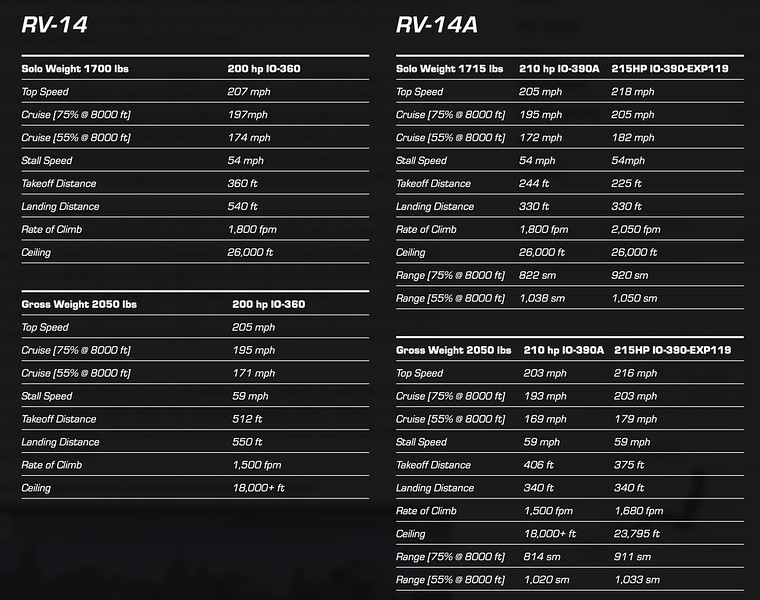
The drag reduction efforts paid off. From Van's:

i-7932Bmf-L.jpg

Interestingly, it appears the 200 hp IO-360 might be the best bang for the buck.

I ordered the EXP119 a little over a year ago. I thought it was the most viable option as it appeared Van's had done a lot of optimization for this engine and it appeared to be the logical choice at the time. Not sure I feel that way now and it is the most costly option.
 
Performance data

It appears the data for the original 390 engine and cowling might be a tad conservative. Using mid-points for power setting (65%) and weight between max and the lower weight in the chart (1,880 lbs. which is more typical for normal cross country flying) I came up with 166 knots for the early 390's and 175 knots for the new 390 and cowling. (Subject to rounding) Using my performance data for my early 390 this seems low. It would be interesting to see what others are getting closer to 65% settings.

Also, would be interesting to hear if others are seeing a difference with and without reflex. (3%) I fly almost the same route every week (Tampa to Jacksonville) and have tried both settings for 15 to 20 minutes each leg and sometimes reflex is slightly better sometimes no reflex slightly better. I've given up making the comparison. I know several RV-10 flyers who have tried the same test and they don't see a difference. The pitch of the airframe changes slightly but not the TAS or GPS ground speed.
 
In my opinion the performance numbers for EXP119 engine are conservative too. I'm a first time builder therefore my RV14 is far from perfect. Installed oversized tires, several external antennas and to make things worst, against mothership recommendations opted for 74" BA Hartzell Prop. Despite it all I can easily exceed the 218 mph top speed.
 
In my opinion the performance numbers for EXP119 engine are conservative too. I'm a first time builder therefore my RV14 is far from perfect. Installed oversized tires, several external antennas and to make things worst, against mothership recommendations opted for 74" BA Hartzell Prop. Despite it all I can easily exceed the 218 mph top speed.

Remember the 218 mph top speed is for a tri-gear RV-14A with the IO-390-EXP119. If you've got an RV-14 taildragger, it is expected that it will be faster than that.
 
I am at the point in the build where I am about to order my engine and wanted to revive this thread.
I am trying to decide between the A3B6 and the EXP119 w/acc. I am going to go with SDS (fuel lines, fuel selector, done) so I will be removing the both mags and injection system from the engine anyhow. In the end, the standard A3B6 RV14A is a little rocket ship, so I'm just not convinced that 5hp is worth the $4300 USD upgrade. Not trying to cheap out, but since using Canadian dollar I want to make smart choices.

Thanks
 
I am trying to decide between the A3B6 and the EXP119 w/acc. In the end, the standard A3B6 RV14A is a little rocket ship, so I'm just not convinced that 5hp is worth the $4300 USD upgrade.
IMO, the extra cost isn't worth the real world performance difference (and if you were the kind of person who thinks that it is, you wouldn't be asking the question). The resale value for the EXP119 might be more than $4300 higher than the A3B6 for the buyer who is willing to pay top dollar for the absolute best performance. But the build quality, panel, and paint job will likely be more significant factors for the resale value down the road. So...if you're building an average airplane, the A3B6 will be fine and you can buy a lot of avgas with the savings. If you're building a no compromises show plane that you want to sell for top dollar someday, put in the EXP119.
 
Last edited:
IMO, the extra cost isn't worth the real world performance difference (and if you were the kind of person who thinks that it is, you wouldn't be asking the question). The resale value for the EXP119 might be more than $4300 higher than the A3B6 for the buyer who is willing to pay top dollar for the absolute best performance. But the build quality, panel, and paint job will likely be more significant factors for the resale value down the road.
Thanks
I guess that is my thought as well. I’m thinking the increased performance and efficiency of the SDS will easily make up the 5hp and help down the road if want to sell. Again, to pay the upgrade to pull off all the injection and ignition stuff doesn’t make sense.
 
I am at the point in the build where I am about to order my engine and wanted to revive this thread.
I am trying to decide between the A3B6 and the EXP119 w/acc. I am going to go with SDS (fuel lines, fuel selector, done) so I will be removing the both mags and injection system from the engine anyhow. In the end, the standard A3B6 RV14A is a little rocket ship, so I'm just not convinced that 5hp is worth the $4300 USD upgrade. Not trying to cheap out, but since using Canadian dollar I want to make smart choices.

Thanks
This:


Screenshot 2026-01-06 203147.png

Adding cowl louvers (drag), going from a 4" to 5" SCAT tubing for the oil cooler takes cooling away from your cylinders MIGHT be ok. or not.

E is one of best hands engineer I've met, and I've met a lot of good ones.
 
This:


E is one of best hands engineer I've met, and I've met a lot of good ones.
And after all that work and expense upgrading to the EXP119 installation, his summary says "Zero performance change measured. In fact, my power, fuel flow and RPM settings yield exactly the same results as before, per the performance table I built before the engine modification."

While I think Van's claims of a 10 kt speed increase are 'optimistic', the extra power and reduced drag of the EXP119 installation should at least result in a measurable increase of a few knots 🤷‍♂️
 
And after all that work and expense upgrading to the EXP119 installation, his summary says "Zero performance change measured. In fact, my power, fuel flow and RPM settings yield exactly the same results as before, per the performance table I built before the engine modification."

While I think Van's claims of a 10 kt speed increase are 'optimistic', the extra power and reduced drag of the EXP119 installation should at least result in a measurable increase of a few knots 🤷‍♂️
It's possible.
The best, most precise way to compare performance of 2 gliders is to have them fly side by side. If we could have two 14s with the different firewall front packages, but otherwise identical fly side by side we could say for sure what % of performance gains the EXP119 mod brings.

I am at the point in the build where I am about to order my engine and wanted to revive this thread.
I am trying to decide between the A3B6 and the EXP119 w/acc. I am going to go with SDS (fuel lines, fuel selector, done) so I will be removing the both mags and injection system from the engine anyhow. In the end, the standard A3B6 RV14A is a little rocket ship, so I'm just not convinced that 5hp is worth the $4300 USD upgrade. Not trying to cheap out, but since using Canadian dollar I want to make smart choices.

Thanks
The trade-off you are about to make is a matter of personal preference. I would trade leather seats and interior for the extra climb rate.

I guess that is my thought as well. I’m thinking the increased performance and efficiency of the SDS will easily make up the 5hp and help down the road if want to sell. Again, to pay the upgrade to pull off all the injection and ignition stuff doesn’t make sense.
I'm installing the SDS as well and frankly, I don't expect any performance gains. Easier hot starts, LOP operation, or more safety margin with mogas - but not necessarily more speed or a better clim rate.
 
This:


View attachment 106649

Adding cowl louvers (drag), going from a 4" to 5" SCAT tubing for the oil cooler takes cooling away from your cylinders MIGHT be ok. or not.

E is one of best hands engineer I've met, and I've met a lot of good ones.

I am having trouble wrapping my head around the comparison of the two engines. I asking because I don't know. If MP, RPM, and fuel burn is the same on the two engines are you making the same HP? To get the extra 5 HP don't you have to burn more fuel? At anything less than 100% power can you not just burn the extra gas in the non-exp engine to get the same HP? I also understood that 1/2 of the Exp version increase in speed was due to drag reduction.
 
Another thought crossed my mind with my engine dilemma. I just finished visiting a buddy who is installing the SDS system to confirm what parts are not required and realized that the only difference after everything is removed is a different size hole for the throttle body. At this point I think I have decided to just go with the A3B6 version, however, I do like the look of the dual exhaust and cowl of the EXP-119. I’m wondering if anyone has contemplated or knows if it is possible to install the new tuned exhaust on the A3B6 version? Is this even possible? If possible, then I would just order the EXP-119 FWF kit and cowl. Thanks.
 
Another thought crossed my mind with my engine dilemma. I just finished visiting a buddy who is installing the SDS system to confirm what parts are not required and realized that the only difference after everything is removed is a different size hole for the throttle body. At this point I think I have decided to just go with the A3B6 version, however, I do like the look of the dual exhaust and cowl of the EXP-119. I’m wondering if anyone has contemplated or knows if it is possible to install the new tuned exhaust on the A3B6 version? Is this even possible? If possible, then I would just order the EXP-119 FWF kit and cowl. Thanks.

That's a very good question. I know the Van's EXP exhaust is tucked up pretty tightly to the sump. The sump on the Exp is a different size. I wouldn't assume that the exhaust would fit on a Non-EXP unless you get Van's guidance or someone who has done it.

What I did was put a dual Vetterman exhaust on my non-Exp along with the cooling flap. I modified the cowling to accept the dual pipes. The Exp was not available when I ordered my engine and the Vetterman exhaust.
 
That's a very good question. I know the Van's EXP exhaust is tucked up pretty tightly to the sump. The sump on the Exp is a different size. I wouldn't assume that the exhaust would fit on a Non-EXP unless you get Van's guidance or someone who has done it.

What I did was put a dual Vetterman exhaust on my non-Exp along with the cooling flap. I modified the cowling to accept the dual pipes. The Exp was not available when I ordered my engine and the Vetterman exhaust.
No cooling flap with my Non-Exp and dual exhaust. The cooling flap represents drag. If you need it fine. My CHT's and OT's have been perfect according to Savvy. 700 hrs. and 6 years and counting. (Half the time in Florida)

Screenshot 2026-01-08 195629.png
 
jetmart and dmattmul
Thank you for the info. After some further investigation it seems that the EXP- 119 exhaust won’t work with major modifications.
I am liking your dual exhaust idea. Any chance you could DM me the details on the Vetterman exhaust and cowl mods that are required.
Thank you.
 
If doing it again, I think I'd go non EXP. The airplane doesn't need the extra power, and the heat production of the EXP setup is a challenge.
 
If doing it again, I think I'd go non EXP. The airplane doesn't need the extra power, and the heat production of the EXP setup is a challenge.

There is definitely a difference in the heat generated, mainly oil temp, between the two engines. Why is that? Is it all due to cowl design differences?
 
Here is a better picture of my exhaust. Very little mods made. Note the angle of the exhaust down which I think helped with floorboard prop pulses (very smooth) but that is just speculation. Also helped with clearance issues. Exhaust supplied by Vetterman and originally intended for the Superior 400 which I was advised would fit the Lycoming 390 (210 hp ver.) I ended up buying. (Pic of a recent oil change, 700 hrs. and no issues, great airframe and engine)

Screenshot 2026-01-14 182606.png
 
Last edited:
Performance data

It appears the data for the original 390 engine and cowling might be a tad conservative. Using mid-points for power setting (65%) and weight between max and the lower weight in the chart (1,880 lbs. which is more typical for normal cross country flying) I came up with 166 knots for the early 390's and 175 knots for the new 390 and cowling. (Subject to rounding) Using my performance data for my early 390 this seems low. It would be interesting to see what others are getting closer to 65% settings.

Also, would be interesting to hear if others are seeing a difference with and without reflex. (3%) I fly almost the same route every week (Tampa to Jacksonville) and have tried both settings for 15 to 20 minutes each leg and sometimes reflex is slightly better sometimes no reflex slightly better. I've given up making the comparison. I know several RV-10 flyers who have tried the same test and they don't see a difference. The pitch of the airframe changes slightly but not the TAS or GPS ground speed.

A little bit of thread drift here, but since it came up here I thought I would answer. I am the designer of the RV-10 and RV-14 airfoil. The airfoil was designed so that if you do a really good job building the wings smooth, you actually get some laminar flow on the wing. At the time, I didn't know that Vans was going to put the spanwise J -stiffeners in there, but even with those, a well-built and well-painted RV-10 does get laminar flow basically back to the wing spar. This is where the reflex comes in. As you make small changes to angle of attack, the resulting changes in pressure distribution on the front portion of the airfoil can have a big effect on laminar flow, especially if it is just marginally hanging in there. The reflex changes the angle of attack so that it is more favorable to keeping laminar flow on the bottom, where it is easier to maintain anyway, and perhaps reduces the chances of keeping the laminar flow on the upper surface, where it might be lost anyway. So, in general, you SHOULD see slightly higher speeds with the 3-degree reflex.

BUT....

If you have some bugs on your wings, you have lost the laminar flow anyway and it is not going to matter. If you paint your wings with an accent stripe along the front 1/4 of the wing, the paint edge is going to trip the laminar boundary layer anyway and the reflex is not going to matter. If you build a good smooth wing, paint it all one color (at least the front 1/3) and keep the bugs washed off, you should go a little faster with the reflex.

 
A little bit of thread drift here, but since it came up here I thought I would answer. I am the designer of the RV-10 and RV-14 airfoil. The airfoil was designed so that if you do a really good job building the wings smooth, you actually get some laminar flow on the wing. At the time, I didn't know that Vans was going to put the spanwise J -stiffeners in there, but even with those, a well-built and well-painted RV-10 does get laminar flow basically back to the wing spar. This is where the reflex comes in. As you make small changes to angle of attack, the resulting changes in pressure distribution on the front portion of the airfoil can have a big effect on laminar flow, especially if it is just marginally hanging in there. The reflex changes the angle of attack so that it is more favorable to keeping laminar flow on the bottom, where it is easier to maintain anyway, and perhaps reduces the chances of keeping the laminar flow on the upper surface, where it might be lost anyway. So, in general, you SHOULD see slightly higher speeds with the 3-degree reflex.

BUT....

If you have some bugs on your wings, you have lost the laminar flow anyway and it is not going to matter. If you paint your wings with an accent stripe along the front 1/4 of the wing, the paint edge is going to trip the laminar boundary layer anyway and the reflex is not going to matter. If you build a good smooth wing, paint it all one color (at least the front 1/3) and keep the bugs washed off, you should go a little faster with the reflex.

What amount of speed increase, say in cruise, would one expect if the wing is in laminar flow?
 
A little bit of thread drift here, but since it came up here I thought I would answer. I am the designer of the RV-10 and RV-14 airfoil. The airfoil was designed so that if you do a really good job building the wings smooth, you actually get some laminar flow on the wing. So, in general, you SHOULD see slightly higher speeds with the 3-degree reflex.

BUT....

If you have some bugs on your wings, you have lost the laminar flow anyway and it is not going to matter. If you paint your wings with an accent stripe along the front 1/4 of the wing, the paint edge is going to trip the laminar boundary layer anyway and the reflex is not going to matter. If you build a good smooth wing, paint it all one color (at least the front 1/3) and keep the bugs washed off, you should go a little faster with the reflex.

My wing was QB, my paint has zero paint hard transitions (Thanks Evoke) almost no bugs (can't clean in flight) I fly reflex almost 100% of the time when I don't need flaps. When would flying with flaps in trail be beneficial? To date I have not seen any data that shows reflex or in trail is faster. (And after hundreds of hours in flight of trying can't generate positive data) Maybe nobody (including Vans) can build a perfectly smooth wing with zero paint edge and zero bugs? Seems theory and reality might not meet each other in this application but interested in learning.
 
What amount of speed increase, say in cruise, would one expect if the wing is in laminar flow?
Oh dear, I'm afraid I've forgotten the specific numbers. Getting a modest amount of laminar flow could be worth 3--4 kts I suppose.
 
  • Like
Reactions: cjs
I'll put in a good word for the A3B6. My kit is #158, first flight 2017 and now approaching 1000hrs. All standard Van's kit parts, AvStar FI. No issues, no breakdowns, never failed to start instantly. Most flying is light aerobatics. Other than an injector replacement (still don't know if it was necessary :-), all minor improvements have been to the airframe (larger brakes, brake return springs, parking brake, aerobatic harness)
Only major mod is a Whirlwind 300 prop which was great for improving climb slightly and moving the CG aft about 1in making full flap landings much easier.
A great engine and airframe.
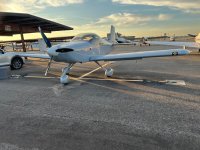
ys-1.jpg
 
I'll put in a good word for the A3B6. My kit is #158, first flight 2017 and now approaching 1000hrs. All standard Van's kit parts, AvStar FI. No issues, no breakdowns, never failed to start instantly. Most flying is light aerobatics. Other than an injector replacement (still don't know if it was necessary :-), all minor improvements have been to the airframe (larger brakes, brake return springs, parking brake, aerobatic harness)
Only major mod is a Whirlwind 300 prop which was great for improving climb slightly and moving the CG aft about 1in making full flap landings much easier.
A great engine and airframe.
View attachment 107301
Good looking plane. I like the white, very classic
 
A little bit of thread drift here, but since it came up here I thought I would answer. I am the designer of the RV-10 and RV-14 airfoil. The airfoil was designed so that if you do a really good job building the wings smooth, you actually get some laminar flow on the wing. At the time, I didn't know that Vans was going to put the spanwise J -stiffeners in there, but even with those, a well-built and well-painted RV-10 does get laminar flow basically back to the wing spar. This is where the reflex comes in. As you make small changes to angle of attack, the resulting changes in pressure distribution on the front portion of the airfoil can have a big effect on laminar flow, especially if it is just marginally hanging in there. The reflex changes the angle of attack so that it is more favorable to keeping laminar flow on the bottom, where it is easier to maintain anyway, and perhaps reduces the chances of keeping the laminar flow on the upper surface, where it might be lost anyway. So, in general, you SHOULD see slightly higher speeds with the 3-degree reflex.

BUT....

If you have some bugs on your wings, you have lost the laminar flow anyway and it is not going to matter. If you paint your wings with an accent stripe along the front 1/4 of the wing, the paint edge is going to trip the laminar boundary layer anyway and the reflex is not going to matter. If you build a good smooth wing, paint it all one color (at least the front 1/3) and keep the bugs washed off, you should go a little faster with the reflex.
This is gold. Free performance upgrade by keeping the front part of the wing clean.
 
Slightly off topic, but does anyone know if the lengths of the 3 engine cables need to change based on whether you choose the EXP119 vs A3B6?
 
Back
Top