
Wondering what people see for fuel flow at takeoff power. I have an IO-360 A1B6 with a Hartzell CS prop. The engine seems to run smooth at any condition I’ve run it at but it’s consuming 22 gph on climb out. I’ve seen suggestions 18-19 gph is expected. My fuel flow flow totalizer matches fuel burned pretty closely so I think it’s accurate. Is this normal or does my maximum mixture need adjusting? To be fair, I’m operating at -1000 ft density altitude or more on the ground this winter but it’s still flowing that much 1000 ft of the ground.

Van's Air Force
You are using an out of date browser. It may not display this or other websites correctly.
You should upgrade or use an alternative browser.
You should upgrade or use an alternative browser.
IO-360 fuel flow
- Thread starter glombard
- Start date


Norman CYYJ
Well Known Member
At that density altitude don't worry about it especially if the cylinder head temps are good. After the initial climb it would not hurt it to start leaning it out a bit. If it is in the 7 to 9 gallons per hour during cruise leaned out be happy.Wondering what people see for fuel flow at takeoff power. I have an IO-360 A1B6 with a Hartzell CS prop. The engine seems to run smooth at any condition I’ve run it at but it’s consuming 22 gph on climb out. I’ve seen suggestions 18-19 gph is expected. My fuel flow flow totalizer matches fuel burned pretty closely so I think it’s accurate. Is this normal or does my maximum mixture need adjusting? To be fair, I’m operating at -1000 ft density altitude or more on the ground this winter but it’s still flowing that much 1000 ft of the ground.


Considering that Lycoming BSFC for rated power (accoding to @DanH) is 0.48-0.52 lb/(hp*h), for which the high end of that range translates to 17.3gal/h for 200hp.
=> 22gal/h is really high.
=> 22gal/h is really high.

On a Fuel Injected engine, max fuel flow can be adjusted using the star wheel, but you actually just set the star wheel to allow a 50 rpm rise at idle with a fully warmed up engine, for those with seemingly night or low fuel flow, what is your idle speed and how much rise do you get at ICO?
What are your climb egts showing? Have you tried to lean it out in the climb - perhaps in the 1300f range - how does it sound, run, fuel low there? What are your chts...try and see the overall big picture...where is all that fuel going? I don't see why the engine isn't complaining about being over rich....

Is your boost pump on?
Sorry, but that is for idle only. Has noithing to do with max flow.On a Fuel Injected engine, max fuel flow can be adjusted using the star wheel,

Folks - OP has an IO-360-A1B6 (Angle Valve, 8.7:1 CR pistons), NOT an IO-360-B1E/M1B (Parallel Valve, 8:5:1 CR Piston)
Per the chart, ~15.5 GPH (93PPH) is expected at Sea Level, Full throttle, 200HP. Note that the ignition timing is advanced 5° (25 instead of 20).
In actual practice, I see between 15.7 and 16 depending upon conditions from my 800ft MSL airport.
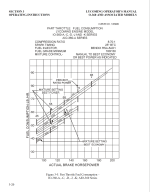
Per the chart, ~15.5 GPH (93PPH) is expected at Sea Level, Full throttle, 200HP. Note that the ignition timing is advanced 5° (25 instead of 20).
In actual practice, I see between 15.7 and 16 depending upon conditions from my 800ft MSL airport.
A call to Don and the guys at AFP be the right ones to ask, but I’m pretty sure there’s still a relationship with Max fuel flow based on the length of that rod. Misadjusted idle fuel flow is going to have the barrel valve at a different location at full throttle.Sorry, but that is for idle only. Has noithing to do with max flow.
Throttle blade movement is controlled completely by the throttle arm. The turnbuckle only change the movement of the internal idle flow valve relative to the throttle arm. It has nothing to do with max flow. It only sets flow rate/pressure at idle RPMs, where airflow is not great enough for the internal mechanisms to see and adapt to. No valves for setting max flow; That is all done internally.A call to Don and the guys at AFP be the right ones to ask, but I’m pretty sure there’s still a relationship with Max fuel flow based on the length of that rod. Misadjusted idle fuel flow is going to have the barrel valve at a different location at full throttle.
Last edited:
My idle speed is about 830 rpm after its warmed up a little. I've never notice the rise at idle cut off but I've never leaned it out slowly either. I've just chopped it and it shuts down pretty instantly.On a Fuel Injected engine, max fuel flow can be adjusted using the star wheel, but you actually just set the star wheel to allow a 50 rpm rise at idle with a fully warmed up engine, for those with seemingly night or low fuel flow, what is your idle speed and how much rise do you get at ICO?
This chart says leaned to best power or best economy. I can lean toFolks - OP has an IO-360-A1B6 (Angle Valve, 8.7:1 CR pistons), NOT an IO-360-B1E/M1B (Parallel Valve, 8:5:1 CR Piston)
Per the chart, ~15.5 GPH (93PPH) is expected at Sea Level, Full throttle, 200HP. Note that the ignition timing is advanced 5° (25 instead of 20).
In actual practice, I see between 15.7 and 16 depending upon conditions from my 800ft MSL airport.
View attachment 112054
It sounds fine and runs smooth. EGTs are lower than 1300F I believe, closer to 1100. My CHTs are in the neighborhood of 300 but keep in mind its winter temps outsitde here 30F or below typically.What are your climb egts showing? Have you tried to lean it out in the climb - perhaps in the 1300f range - how does it sound, run, fuel low there? What are your chts...try and see the overall big picture...where is all that fuel going? I don't see why the engine isn't complaining about being over rich....
I usually check the flow right after turning off the boost pump, this is with it off.Is your boost pump on?
That would be a confirmation that you are too rich. You can lean it with the red knob. You will save a bunch of fuel and power should increase by 5% or so.F I believe, closer to 1100.
Larry, you are correct .. I was wrong.. I looked at the manuals, watched a video, then called Don. After the disk valve rotates past the idle mixture slot, it’s wide open no matter where the star wheel was set.. if the OP has an issue of too much fuel flow, he should consider a call to Don and see about having his main jet changed or at least flow bench his unit..Throttle blade movement is controlled completely by the throttle arm. The turnbuckle only change the movement of the internal idle flow valve relative to the throttle arm. It has nothing to do with max flow. It only sets flow rate/pressure at idle RPMs, where airflow is not great enough for the internal mechanisms to see and adapt to. No valves for setting max flow; That is all done internally.

For reference, I’m seeing about 22 GPH at full throttle in climb on a 200+ HP IO-360 ( High Compression Pistons ). Using the Lycoming rule of thumb (~0.50 lb/hp/hr with avgas at ~6 lb/gal), a 200 HP engine needs roughly 16.5–17 GPH minimum to produce rated power. Anything above that is essentially extra fuel for cooling and detonation margin.
At 22 GPH, the engine is running roughly 30% richer than the minimum power mixture, which ensures running well rich of peak at full power. My preference is for the servo to be slightly rich intentionally to keep CHTs under control during climb and increase detonation margin.
For me that’s a reasonable tradeoff, climb is only a few minutes, and I’m perfectly happy burning a little extra fuel during that phase if it helps keep CHTs lower and the engine happier under high power.
- YMMV -
Regards,
David Rowbotham
RV-8A - N712CR
At 22 GPH, the engine is running roughly 30% richer than the minimum power mixture, which ensures running well rich of peak at full power. My preference is for the servo to be slightly rich intentionally to keep CHTs under control during climb and increase detonation margin.
For me that’s a reasonable tradeoff, climb is only a few minutes, and I’m perfectly happy burning a little extra fuel during that phase if it helps keep CHTs lower and the engine happier under high power.
- YMMV -
Regards,
David Rowbotham
RV-8A - N712CR
Actually that recommendation is well rich of what is needed to reach rated power. In fact, it is already just beginning its fall from best power at that flow. The further you go, the more it falls. That recommendation equates to about 250-300* rop. Best power is around 100 rop. Detonation is most likely at or just rich of peak. They go richer in their recommendations to increase detonation margin. Going another 30% beyond it just reduces power further with no real incremental benefit in detonation margin. Can’t say if it helps with cooling, as it is rare to see those fuel rates. I doubt you are making rated power at 22 gph, especially if you are climbing lower than 2700.For reference, I’m seeing about 22 GPH at full throttle in climb on a 200+ HP IO-360 ( High Compression Pistons ). Using the Lycoming rule of thumb (~0.50 lb/hp/hr with avgas at ~6 lb/gal), a 200 HP engine needs roughly 16.5–17 GPH minimum to produce rated power. Anything above that is essentially extra fuel for cooling and detonation margin.
At 22 GPH, the engine is running roughly 30% richer than the minimum power mixture, which ensures running well rich of peak at full power. My preference is for the servo to be slightly rich intentionally to keep CHTs under control during climb and increase detonation margin.
For me that’s a reasonable tradeoff, climb is only a few minutes, and I’m perfectly happy burning a little extra fuel during that phase if it helps keep CHTs lower and the engine happier under high power.
- YMMV -
Regards,
David Rowbotham
RV-8A - N712CR
Not trying to change your strategy, just making sure you sehad all the facts.
Last edited:
Exactly which fuel injection system do you have? Bendix, Airflow or what?
I need to double check that. I’ll pay more attention to egts in the climb on the next flight.That would be a confirmation that you are too rich. You can lean it with the red knob. You will save a bunch of fuel and power should increase by 5% or so.
Precision Airmotive.Exactly which fuel injection system do you have? Bendix, Airflow or what?
I have the same motor (A1B6) and I'm right in the 15-16 gph range at takeoff power and full rich. I would check your FF calibration.... do you have a red cube or something different?Wondering what people see for fuel flow at takeoff power. I have an IO-360 A1B6 with a Hartzell CS prop. The engine seems to run smooth at any condition I’ve run it at but it’s consuming 22 gph on climb out. I’ve seen suggestions 18-19 gph is expected. My fuel flow flow totalizer matches fuel burned pretty closely so I think it’s accurate. Is this normal or does my maximum mixture need adjusting? To be fair, I’m operating at -1000 ft density altitude or more on the ground this winter but it’s still flowing that much 1000 ft of the ground.

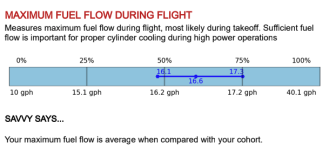
I'd also recommend uploading your engine logging data to Savvy - and make sure that your engine configuration is accurate so that they can compare your numbers to other "cohorts" with about the same engine. If you buy one of their services, they send you a regular comparison of your numbers with your cohorts.

Using the Lycoming rule of thumb (~0.50 lb/hp/hr with avgas at ~6 lb/gal), a 200 HP engine needs roughly 16.5–17 GPH minimum to produce rated power. Anything above that is essentially extra fuel for cooling and detonation margin.
....but mostly just spews money and lead.
Fuel evaporation doesn't reduce temperature very much in the big scheme of things. Playing with some calculations, assuming...
22 gph when 18 is plenty, so 4 excess, 6 lbs per gallon = 24 lbs of excess per hour, or 0.4 per minute
latent heat of vaporization for 100LL at 125 BTU/lb
Specific heat of air as 0.24 BTU/lb-F
Air density of 0.07 lbs ft^3 at 3000 feet
2700 RPM, 360 ci, 0.875 VE = 246 CFM
...I get an additional intake air temperature drop of 12 F at 22 gph, as compared to 18 gph.
I'm impressed that you even attempted this calculation in "freedom units", and amazingly completed it!....but mostly just spews money and lead.
Fuel evaporation doesn't reduce temperature very much in the big scheme of things. Playing with some calculations, assuming...
22 gph when 18 is plenty, so 4 excess, 6 lbs per gallon = 24 lbs of excess per hour, or 0.4 per minute
latent heat of vaporization for 100LL at 125 BTU/lb
Specific heat of air as 0.24 BTU/lb-F
Air density of 0.07 lbs ft^3 at 3000 feet
2700 RPM, 360 ci, 0.875 VE = 246 CFM
...I get an additional intake air temperature drop of 12 F at 22 gph, as compared to 18 gph.

I don't remember what the fuel flow sender is, I think it pre-dates the redcube. It seems to be within a gallon or so on total fuel burn for a 2 hr flight (so about +/-5%) but of course if it were off at high flows that only last a few minutes it would be hard to know.I have the same motor (A1B6) and I'm right in the 15-16 gph range at takeoff power and full rich. I would check your FF calibration.... do you have a red cube or something different?
Agree. If you have to pull the mixture 1/2 way out in a full power climb to get to 200 ROP, you definately have an issue somewhere in you system that will require some troubleshooting. not normal.I checked my EGTs on climb out yesterday. They are around 1200F. Seems like thats confirmation I running a bit rich. I had to pull the mixture back almost 1/2 way to get to 1300F.
And how do you know 1300 is 200 ROP?Agree. If you have to pull the mixture 1/2 way out in a full power climb to get to 200 ROP, you definately have an issue somewhere in you system that will require some troubleshooting. not normal.
Greg, go fly a standard mixture check and report back. Here's the procedure, per Don Rivera.
Fly the plane at 3500 Ft. Set 24 square for power. Slowly lean the mixture to find the peak EGT on one cylinder. Record the peak EGT. Put the mixture back full rich. Wait one minute, then record the full rich EGT on the same cylinder. Take the difference. There should be 185 to 230 degrees F difference in the two readings.
"...it was my understanding that there would be no math..." -- Chevy Chase, as Gerald R. Ford.....but mostly just spews money and lead.
Fuel evaporation doesn't reduce temperature very much in the big scheme of things. Playing with some calculations, assuming...
22 gph when 18 is plenty, so 4 excess, 6 lbs per gallon = 24 lbs of excess per hour, or 0.4 per minute
latent heat of vaporization for 100LL at 125 BTU/lb
Specific heat of air as 0.24 BTU/lb-F
Air density of 0.07 lbs ft^3 at 3000 feet
2700 RPM, 360 ci, 0.875 VE = 246 CFM
...I get an additional intake air temperature drop of 12 F at 22 gph, as compared to 18 gph.
Haha, one of my fav lines. I used that throughout most of my military flying career."...it was my understanding that there would be no math..." -- Chevy Chase, as Gerald R. Ford.
And how do you know 1300 is 200 ROP?
Greg, go fly a standard mixture check and report back. Here's the procedure, per Don Rivera.
Fly the plane at 3500 Ft. Set 24 square for power. Slowly lean the mixture to find the peak EGT on one cylinder. Record the peak EGT. Put the mixture back full rich. Wait one minute, then record the full rich EGT on the same cylinder. Take the difference. There should be 185 to 230 degrees F difference in the two readings.
I will do that, thanks. I wasn’t aware of this test. Today (before seeing this) I leaned to an egt of 1300F during climb out and that resulted in a fuel flow just over 17gph, which seems more in line with what others suggest, but I will take your suggestion next time I fly.And how do you know 1300 is 200 ROP?
Greg, go fly a standard mixture check and report back. Here's the procedure, per Don Rivera.
Fly the plane at 3500 Ft. Set 24 square for power. Slowly lean the mixture to find the peak EGT on one cylinder. Record the peak EGT. Put the mixture back full rich. Wait one minute, then record the full rich EGT on the same cylinder. Take the difference. There should be 185 to 230 degrees F difference in the two readings.
Just completed the suggested flight test. I’m seeing 350F EGT rise from full rich to peak EGT so I guess I’m running too rich a full rich setting. Do need to make changes to the fuel servo to fix that? When I started this inquiry, I was thinking it was just setting a travel limit on the mixture arm but I’d be cutting the travel almost in half I think.I will do that, thanks. I wasn’t aware of this test. Today (before seeing this) I leaned to an egt of 1300F during climb out and that resulted in a fuel flow just over 17gph, which seems more in line with what others suggest, but I will take your suggestion next time I fly.

A data point:Just completed the suggested flight test. I’m seeing 350F EGT rise from full rich to peak EGT so I guess I’m running too rich a full rich setting. Do need to make changes to the fuel servo to fix that? When I started this inquiry, I was thinking it was just setting a travel limit on the mixture arm but I’d be cutting the travel almost in half I think.
I did a very similar test the other day. 24 squared 3500 ft. EGT rise 222F from full rich to peak. Parallel Valve IO-360 - PMAGs. Seeing about 16GPH on takeoff max power.
No external method to adjust full rich fuel. Requires replacing the jet in the servo. You can learn what peak is and then just lean to 2-250 rop at full power. For TO, you will eventually learn the knob position to get it set.Just completed the suggested flight test. I’m seeing 350F EGT rise from full rich to peak EGT so I guess I’m running too rich a full rich setting. Do need to make changes to the fuel servo to fix that? When I started this inquiry, I was thinking it was just setting a travel limit on the mixture arm but I’d be cutting the travel almost in half I think.
Just completed the suggested flight test. I’m seeing 350F EGT rise from full rich to peak EGT so I guess I’m running too rich a full rich setting.
We kinda knew that

Do need to make changes to the fuel servo to fix that?
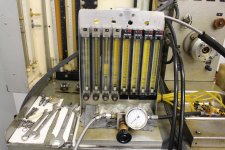
Yes, remove it and send it to Don Rivera at Airflow Performance. He will put it on an airflow bench connected to this fuel flow bench, and re-jet as necessary. Recommend you send the fuel divider also.
Ooh, I’d have to stop flying to do that!We kinda knew that
Yes, remove it and send it to Don Rivera at Airflow Performance. He will put it on an airflow bench connected to this fuel flow bench, and re-jet as necessary. Recommend you send the fuel divider also.
View attachment 113472
 thank you for helping me get to the bottom of this. I will likely take that advice.