Van's Air Force

The definitive Van's Aircraft support community! Buying, building or flying an RV? Join our exclusive family of mentors and enthusiasts!

Increasing CO in cockpit — need help beyond the usual suspects

SwimmingDragon518

Well Known Member
Patron
Hey all,

Over the past 3-4 months I’ve seen increasing co levels in the cockpit of my 7a via my Aithre, flight by flight to the 20s in nose high mixture rich profiles, and now even higher. I noticed my exhaust hanger on the left hand exhaust had come loose. I re-rigged that and sealed up the opening at the bottom of the aft portion of my tail cone as suggested in many threads and thought this would all be behind me. FF to today taxiing out for an IFR training flight and I was already showing 10ppm on the Aithre. Damn I thought, but continued with my flight. CO the whole way through, oscillating between 0-35ppm depending on phase of flight. Continued and went back to home base of KSEE RNAV 17 circle to land 27R. Turning downwind to base look down and I’m at 55ppm! The levels do not change with cabin heat and my AP and I inspected the exhaust system for leaks and couldn’t find any sources of a leak. One thing is for sure, it is getting worse. I bought a cheap’ish handheld from Amazon to compare with and it reads a little less than half the Aithre, but still shows CO. I am at a loss. Can someone suggest some other things to try? Tighten up aileron boots? Change wing root seals? Any help extremely appreciated.
 
Remove the Scat tubing from cabin heat diverter on exhaust side of firewall and cover the diverter or plug the diverter, put scat tube back on. Then fly and test again. If this solves the problem, then be sure to replace the heater exchanger wrapped on the exhaust pipe before cool weather and remove the plug.
 
CO is not good. If it was my problem I would tape something else up every time I flew. A 4” roll of vinyl tape will seal things up. There is only so many holes in the fuselage for air to get in. The first big suspect is the cabin heat. Do you have a tip up or slider? Having someone else tape up your canopy from the outside While you are inside could be a simple ‘it ain’t that’ check.
 
@SwimmingDragon518 -- The CO is coming into the cabin from the area at the bottom of the aft most bulkhead and fuselage skin, below the bottom rudder hinge and in front of the rudder bottom. Sealed up the area with HVAC tape on a friends -14A

The "Ah-Ha" moment came during the Condition Inspection; we could see soot (not grime) on the bottom side of the VS-410PP hinge bracket -- Was clear that exhaust was being drawn into the fuselage at this location -- Not flaps tubes, not wing roots, not firewall, not exhaust heater, etc.


IMG_0536.jpeg

As you'll recall from Bernoulli's Principle and Newton's Third law, the cabin will be at a lower pressure than the ambient outside air in cruise -- this will draw air (and whatever else is nearby) into the cabin.

In some aircraft there is more CO/exhaust gas entrained into the slipstream, e.g. 4-into-1 exhausts, 2 exhausts that protrude straight into slip stream (no turn downs.)
 
Last edited:
Agree with post above. I have a friend with newly built RV and that's exactly where his was coming in. I never had an issue with CO but I sealed
that area up anyway with some RTV.
 
He said that he's already sealed up the tailcone. Plus, he said it's now showing up while he's taxiing, it doesn't seem like there would be any pressure differential to suck stuff inside back there at taxi speeds.

I have a 7, and in addition to the hole in the aft bulkhead, there is that relatively big opening around the tailwheel spring. None of that stuff is sealed up on mine and yet I've never had a peep out of either my onboard or headset integrated CO detectors.

I think that Brian is right in that the reason some folks have to go the extra mile and some can have stuff wide open back there might have to do with how your exhaust stacks enter the slipstream. But, like I said, it doesn't seem to me that would show up at taxi speeds. Maybe Brian and others can elaborate; If it's coming in through the aft bulkhead does it do it on the ground?

You said that when this started you found an exhaust stack had come loose and you had re-rigged it. Is it possible that it's now secured at a different position than it was before this problem showed up? I really kind of doubt that's your problem, but it's something easy to eyeball.

Since it's a new problem, and it's happening both on the ground and in flight, seems to me that the most likely candidate would be a leak via the heater system, wing roots, etc. I thing the suggestion to start taping stuff off until you find it is a good one.
 
Last edited:
Agree with post above. I have a friend with newly built RV and that's exactly where his was coming in. I never had an issue with CO but I sealed
that area up anyway with some RTV.
Be aware that water could pile up there and not drain if completely sealed.
 
One more possibility to consider -- the holes cut into the emp. fairing for the elevator horns *could* be an ingress point - especially at high angles of attack; visualize the slip stream coming along the fuse from underneath then moving upward and along the underside of the H-stab.

Since you can't seal this area, suggest putting in an air dam or diverter or similar shape to push the airflow away from the hole....
 
@SwimmingDragon518 -- The CO is coming into the cabin from the area at the bottom of the aft most bulkhead and fuselage skin, below the bottom rudder hinge and in front of the rudder bottom. Sealed up the area with HVAC tape on a friends -14A

The "Ah-Ha" moment came during the Condition Inspection; we could see soot (not grime) on the bottom side of the VS-410PP hinge bracket -- Was clear that exhaust was being drawn into the fuselage at this location -- Not flaps tubes, not wing roots, not firewall, not exhaust heater, etc.


View attachment 93231

As you'll recall from Bernoulli's Principle and Newton's Third law, the cabin will be at a lower pressure than the ambient outside air in cruise -- this will to draw air (and whatever else is nearby) into the cabin.

In some aircraft there is more CO/exhaust gas entrained into the slipstream, e.g. 4-into-1 exhausts, 2 exhausts that protrude straight into slip stream (no turn downs.)
I sealed this up (as best I could) and had the highest CO reading I've had thus far on the following flight.
 
Tried this no change. One thing is for sure it’s coming from firewall forward. Had my handheld moved it around clearly coming in from my feet. I could spend some time sealing the firewall but there weren’t any issues before. Had another mechanic inspect my exhaust he said he didn’t see anything suspect. Any other ideas? I think I’m losing it lol
 
I'd recommend sealing the firewall even if you don't have CO coming in. You really don't want the air from the engine compartment coming into the cockpit, whether it has CO or not.
+1
I would seal the perimeter of the firewall to side skin joint with 3M Firestop 2000 and go over all penetrations to make sure they are all well sealed. If yours is built like mine the cabin heat box is low on the firewall. Make sure that the box itself is sealed to the firewall. Possibly when the exhaust pipe was loose vibration could have loosened the ball joint so gas is escaping from there inside the cowl instead of under the fuse.
 
If you're really out of ideas, you could recreate in-flight conditions while you're on the ground. You need to depressurize the cabin sufficiently to find the leak.

Get poly (6 mil, not the cheap drop cloth stuff), masking tape (2" or 3" wide is best) and a strong fan (we use 1hp woodworking portable dust extractors when doing similar tests at work, but a shop vac could do the trick). A smoke pen can also be handy, but in my experience the smoke is only useful for taking pictures of 'air'; the back of your hand is the best tool for finding the leaking air.


The idea will be to tarp over the canopy and cockpit with the poly, seal it to the fuselage, poke the hose from your shop vac through the plastic and use it to put suction on the cabin. If you get a lot of nuisance air leaking in from the vents, wing roots or tail, you will have to keep taping off the biggest gaps until your fan generates decent suction. Then get flexible and start feeling around for the leaks at the firewall.

If you attempt this, a few tips:
- cut a relief hole in your poly 6" square, then tape over it successively to slowly build pressure. A shop vac is more than strong enough to create sufficient pressure to cause damage if you have a good a seal!
- use as much of the canopy to support the poly as possible, but cover the entire thing because taping off to the fuselage will be a lot easier than trying to seal a half propped canopy.
- try to locate the relief hole in the poly away from where you're testing to minimize nuisance air currents
- you'll need a helper to seal you in and run the fan for you.
 
If you're really out of ideas, you could recreate in-flight conditions while you're on the ground. You need to depressurize the cabin sufficiently to find the leak.

Get poly (6 mil, not the cheap drop cloth stuff), masking tape (2" or 3" wide is best) and a strong fan (we use 1hp woodworking portable dust extractors when doing similar tests at work, but a shop vac could do the trick). A smoke pen can also be handy, but in my experience the smoke is only useful for taking pictures of 'air'; the back of your hand is the best tool for finding the leaking air.


The idea will be to tarp over the canopy and cockpit with the poly, seal it to the fuselage, poke the hose from your shop vac through the plastic and use it to put suction on the cabin. If you get a lot of nuisance air leaking in from the vents, wing roots or tail, you will have to keep taping off the biggest gaps until your fan generates decent suction. Then get flexible and start feeling around for the leaks at the firewall.

If you attempt this, a few tips:
- cut a relief hole in your poly 6" square, then tape over it successively to slowly build pressure. A shop vac is more than strong enough to create sufficient pressure to cause damage if you have a good a seal!
- use as much of the canopy to support the poly as possible, but cover the entire thing because taping off to the fuselage will be a lot easier than trying to seal a half propped canopy.
- try to locate the relief hole in the poly away from where you're testing to minimize nuisance air currents
- you'll need a helper to seal you in and run the fan for you.
Holy smokes hope I don’t need to go this far but thanks
 
Did your mechanic pull the heat muff to check for cracks on the otherwise hidden pipe? those heat valve leak a bit, so a possible source.
 
Did your mechanic pull the heat muff to check for cracks on the otherwise hidden pipe? those heat valve leak a bit, so a possible source.
I tried doing this but the heat muff is more or less caked onto the exhaust at this point. I did plug its output more or less isolating the system and there was no change so we concluded no cracks in there. Seems like the heat divider is next up for me.
 
The exhaust system itself is very leaky until it heats up -- this was an interesting discovery in the RV-14;

Screenshot 2025-07-26 at 1.42.03 PM.png
 
I tried doing this but the heat muff is more or less caked onto the exhaust at this point. I did plug its output more or less isolating the system and there was no change so we concluded no cracks in there. Seems like the heat divider is next up for me.
That is most definitely NOT an excuse for not removing it to check for cracks. Yes, you may have to replace the muff, but at least once every few years, you should have your mechanic (or you...it's experimental, you can do the work yourself), get it off and check.
 
Put HVAC tape along the top and sides of the cowling-fuselage seam and see what happens.
Did this over the weekend no change. Portable CO monitor clearly indicating leak coming from FWF. I sealed up all the open holes but I'm guessing this is just a bandaid and there is excessive CO under the cowling, most likely due to an exhaust leak.
 
As part of my annual, I removed the heat muff on my daily driver and found the exhaust pipe cracked. Fortunately the muff on that side of the engine went to the carb heat.

You really ought to remove the heat muff and inspect the exhaust pipe. You already KNOW that CO is a byproduct of the combustion process. This exhaust is probably not staying inside the pipe all the way to the exhaust pipe tip.

At some point you will remove the entire exhaust system for inspection. If you still can’t find it, plug it up, and check it under pressure.
 
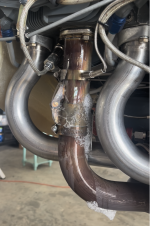
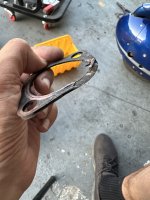
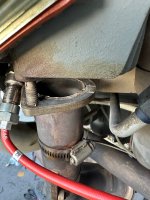
Hey everyone I just wanted to close this thread off. Vetterman recommended putting a vacuum on the tailpipe and spraying some soapy water. Soapy water didn’t do much under vacuum but an audible hiss directed me to the exhaust gasket on cylinder 2. Gasket blown on #2 and upon inspection #1. Swapped to blow proof, CO confirmed gone today!

Unfortunately, while feeling around for loose fittings in the fuselage before exhaust gasket discovery, I noticed a loose fitting on my brake line at the firewall -> gear leg pass through that ended up being a broken flare, hence the delay. Changed to flex from TS and finished buttoning everything up today.

Thanks all.
 

Attachments

  • IMG_4547.jpeg
    IMG_4547.jpeg
    1.4 MB · Views: 41
  • IMG_4546.jpeg
    IMG_4546.jpeg
    2.1 MB · Views: 41
Back
Top